@Miatsf@bbcquestiontime Our children and grandchildren will live in post industrial Britain unless you take action to reduce energy costs by
Stopping Net Zero policies and
Opening the North Sea.
Do you want to have to live with the reality that YOUR decisions killed UK industrial base?
@BBCSimonJack Equinor like anyone with a brain must think the UK is terminally stupid using hydrocarbons from others at higher cost and higher CO2 footprint for appearances sake. It's Student Union politics. Maybe that's what Labour understand best.
Scottish Parliament|1 Oct 2026
🎥video editor @biologyphenom
Debate: Scotland’s Priorities for the UK Budget
1999 parliament budget was £35 billion (43% GDP) today it is £125 billion (55% GDP).
£3 billion spent every year on ‘‘Net stupid zero.’’
The EU is not the answer.
‘‘The compound annual growth rate is 5% per annum..that is NOT austerity..5% growth per annum is not austerity..Westminster has NOT starved this country of money.’’💷
‘‘And the exam question is…are our schools better? No..are our hospitals better?..No..are our roads better? No..Is our police better?..No.’’
‘‘The deficit you have here was made in Scotland by the SNP.’’
‘‘The price of our energy is FOUR TIME the US and SEVEN TIMES China which is why we are DE-INDUSTRIALIZING and yet our emissions are less than 1% China is 30% emissions and US is 13% of emissions.’’
‘‘China has used cheap COAL as a transition fuel..China opens a coal fire power station one PER WEEK.’’
-Malcolm Offord. Leader Reform UK Scotland
@johnadgrady You need to drop net zero energy policy immediately or the country's industry will be destroyed.
Business has been driven from the country in so many different ways but high energy prices are the most destructive
@KathrynPorter26 So basically, we're paying EDF in France since we have insufficient generating capacity to meet expected demand.
I see that wind is currently giving us 4% of total demand. Shocking considering all that has been invested in wind.
Crass coverage of the French riots by main BBC radio news 5pm show. Even though 40 head-teachers have been injured, bystanders torched in the face, lone female teachers assaulted by mobs, the BBC still focused on a union activist who supported the protests. Seriously one-sided.
@Artemisfornow It's a truly crazy act of industrial sabotage.
And the other aspect is that with net zero inflated energy prices industry is shutting down everywhere reducing corporate tax take.
.@andyburnham, with respect, you treat the British public with contempt if you expect us to swallow this.
Britain has the dearest industrial electricity in the IEA, and you want us to blame 1986. You say we pay some of the highest energy bills in Europe because we privatised the basics, and you blame conflict overseas. But the data supports neither claim.
British industrial gas prices sit below the IEA median. Industrial electricity does not. In 2023 British industry paid 25.85p per kWh against an IEA average of 17.7p. Over the last decade the premium over the median has run between 17% and 49%. In 2024 we had the highest industrial electricity prices of any IEA member with data available. If gas were the cause, we would be near average. We are at the top. Wholesale costs drove most of the rise since 2021, but they cannot explain why we pay more than our neighbours for the same gas.
Policy can. Taxes and levies on household electricity rose 59% in real terms between 2017 and 2025, when they made up 23% of the average bill. One Oxford Institute for Energy Studies estimate puts policy related costs at 33% of the pre-tax electricity bill once contracts for difference, carbon charges and the capacity market are counted. The government's own analysis has supported British industry paying £86 per MWh from this year, against £69 in France and £60 in Germany.
The relief your government announced in April was a transfer. It scrapped a levy funded efficiency scheme and moved 75% of the domestic cost of the Renewables Obligation onto general taxation. The cost did not disappear. The Treasury now collects it from the same households through tax.
Then the grid. The typical household is on a price cap of £1,723 a year, up £60 since July. Networks made up about 30% of the spring price cap, and Ofgem has set out a further expansion of local networks for 2028 to 2033, paid for by households through higher charges.
Your answer is Great British Grid. It will be funded from Great British Energy's existing budgets and will work with the private sector and network companies. That means no new money, no new cable and one more public body. Your own government has also acknowledged that its buy British approach to grid contracts could add cost, yet no full impact assessment has been carried out. You promise European prices within a decade. You have not shown us the bill.
You speak of lost control. You were a cabinet minister when the Climate Change Act passed in 2008. Ed Miliband, its author, later set the Clean Power 2030 target. Britain refuses new North Sea licences and imports gas it could produce at home. Gas remains the marginal source that sets the wholesale electricity price, so every turbine added on this model leaves the bill tied to gas while households fund the cables and backup behind it.
Public ownership has been tried locally. Nottingham's Robin Hood Energy cost taxpayers an estimated £38m. Bristol Energy, closed this week, left a final bill of £39.3m. Both were Labour-run councils. Solar panels on a library roof are pleasant. They will not move a national price.
Bills fall when costs fall. Remove levies that don't belong on electricity. Licence new North Sea fields. Build nuclear on time. Then publish what your plan costs and who pays for it.
"Burnham was a cabinet minister when the Climate Change Act passed in 2008. Ed Miliband, its author, later set the Clean Power 2030 target."
Andy meant to say our energy was so expensive because of net zero policies pushing prices up whilst sending jobs (and carbon emissions) abroad.
But he let his misplaced nostalgia and muddle-headed history get in the way.
But give him a break, he’s new to the job and he’s ‘our hopeful Andy from up north’ who (re)froze bus fares so he’s still a great, tea drinking lad.
🙄
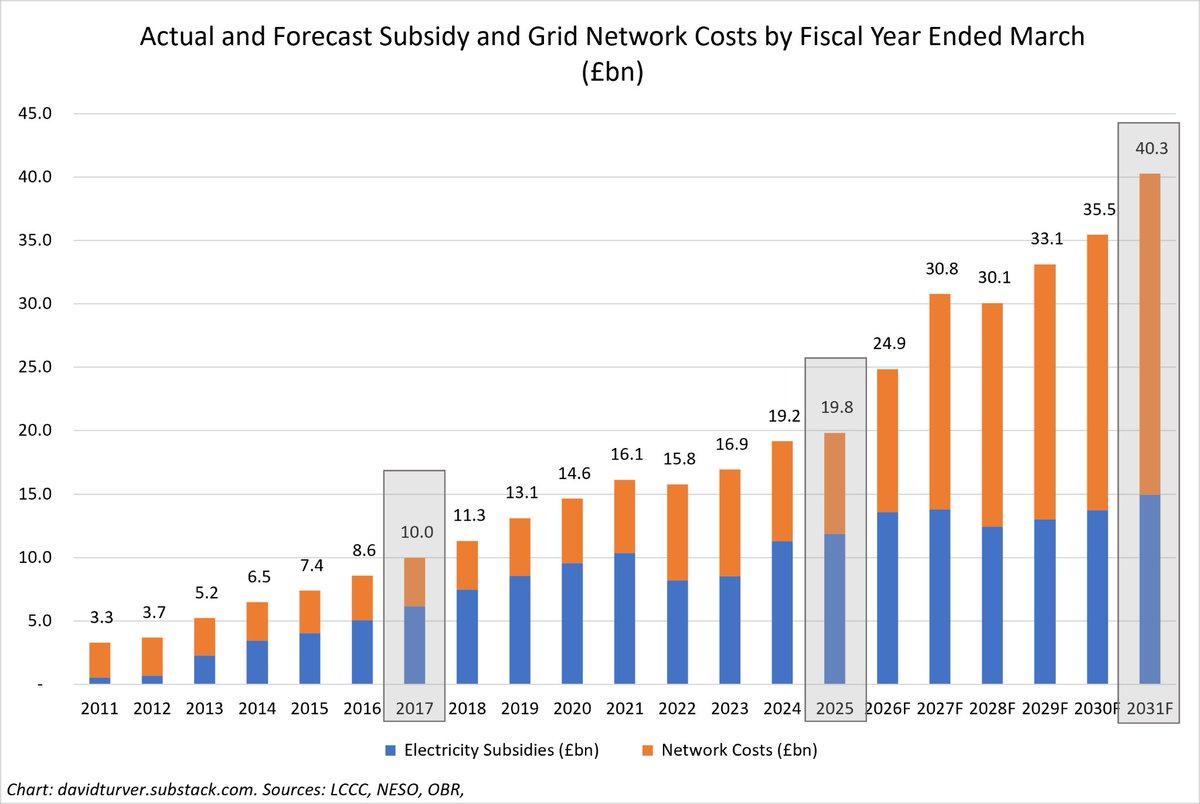
You might want to be honest, but you're being dishonest. Net Zero policies have been the biggest driver of higher electricity bills and system costs driven by renewables are set to double by 2030/31. Speeding up grid spending will increase costs further.
Dear Andy, you do know this is untrue, don’t you?
Highest energy bills in the world are due to:
* Reckless pursuit of net zero
* Blowing up our coal-fired power stations
* Failing to exploit our own fossil fuels
* Insane dependency on foreign oil and gas. The phrase “over a barrel” springs to mind
* Paying Norway £20 billion plus a year for oil and gas we could get out of our own North Sea
* Subsidizing renewables to the tune of billions by slapping green taxes on bills
* Putting an eco-cult and leftist ideology before the comfort and warmth of the British people
* Allowing good jobs to be lost in pursuit of all of the above
* Claiming your government wants to “reindustrialise” while creating conditions no manufacturer could succeed in
* Closing refineries and gas storage so the UK is uniquely vulnerable this winter and likely to have serious power cuts.
You’re welcome.
@andyburnham
@BrianLeishmanMP terrible news today about Syngentia and sorry for all affected. But this sits firmly with the ideological drive against n sea and to NZ.
It drives energy costs up and is incompatible with reindustrialisation.
Wishing you every success in mitigating the fallout.
@Pietros1@andyburnham Exactly.
Energy costs.
Energy costs.
Energy costs.
We are crippled by net zero energy policy.
Lovely ideology but hopeless for business.
Highest priority issue followed by illegal immigration and then finding a way to grow industry.
@tracygilbert72 The first thing you should do is stop all net zero investment open the North sea and start bringing down underlying costs of energy. UK industries dying on the ideology of netzero
@Miatsf You've destroyed UK industry with ideological Net Zero power ambition. Highest power costs of any developed economy.
UK cannot afford low Carbon power. And it makes no difference to global CO2 intensity. You shut UK oil gas while importing same from overseas.