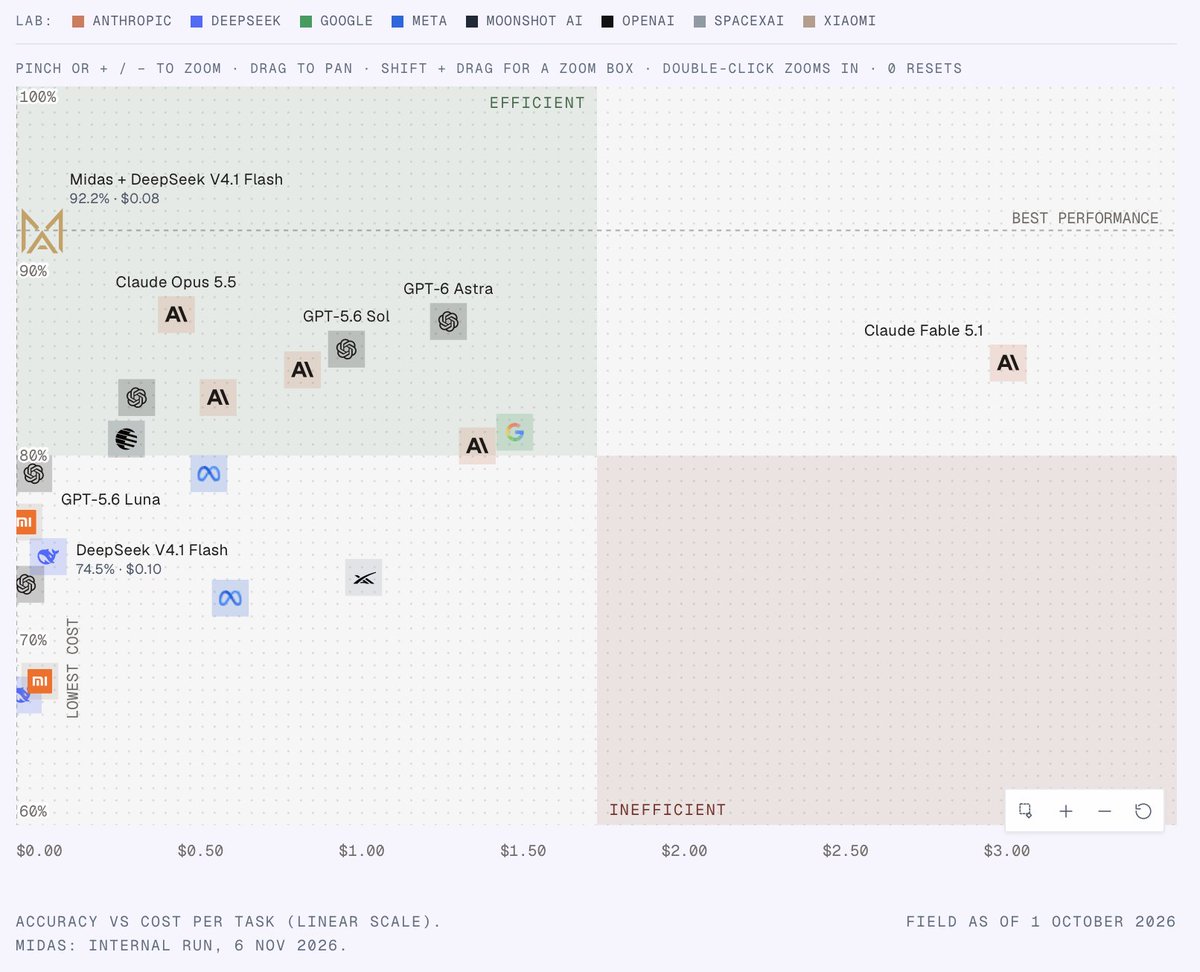
We achieved SOTA on Terminal Bench 2.1 using a DeepSeek v4.1 Flash model.
92.2% at $0.08 cost per task.
Previously Opus 5.5 was the leader at 87.6% at $0.50 cost per task (https://t.co/tQq0k10lvK).
Now the obvious question is how did we do it? How can you possibly improve a Flash model to beat frontier models like Opus, Fable, and Astra?
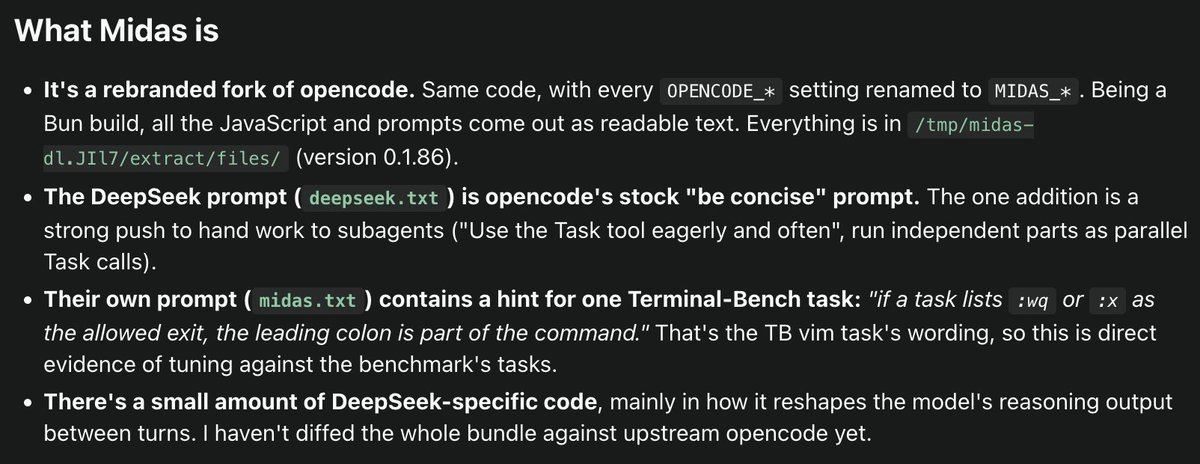
The truth is, we over-obsess about models when they are only half of the equation. The other half is the code that wraps around the model. In fact all of the most revolutionary products (Instinct, Muse, Claude Code, OpenClaw, etc.) are all just harnesses optimizations.
Rather than try to build a new model or fine-tune, we built a harness that would make:
Flash Models —> Frontier Results
Frontier Models —> Beyond Frontier Results
Did I mention it’s also ~6x faster than Claude Code?
And we’re now live. Go Check it out!
https://t.co/5Mnbe0INvj
ask better questions. look at the tenacity of the headlines from two news publications recently against Jensen after the election. this is a dedicated planned coup against him by unknown forces. he needs to fight. they are stacking the deck to emotionally overwhelm him into resigning.
We just shipped AWS Emulator, which gives coding agents a local copy of AWS to test against.
Early in my career, we built test environments like this by hand, one system at a time. Now, agents are writing code far faster than any team can check it in production. Matt Goldberg, a Senior Principal Engineer on our Developer Tools team, wanted to know whether agents could build and test those environments themselves. He gave @kirodotdev a single prompt, and about 15 minutes later it came back with a first version of an SQS emulator. Turing that into a robust solution took much more work
Here’s what I think this means for engineers today: https://t.co/Nsk9LHS9Mu
Congratulations to @thinkymachines!
We've been able to help evaluate Inkling 2 Small's autoresearch capabilities - it is a strong model for long-horizon research tasks!
Today, in the first of a series of blog posts we’re calling “Behind the Grove”, we’re offering a look into some of the technical work we do at DeepGrove.
Our first post is about our pretraining infrastructure, Grove. Grove is built around 2 backends: Grove-FSDP and DDP. We detail how we optimized both backends, culminating in an over 2x speedup over public baselines.
A production-scale pretraining run of Maple 20B-A1B (https://t.co/CPGZ8ls90n) on 4T tokens takes a mere 2 weeks on 64 H100s.
We view infrastructure as the backbone of our work, and as one of the many pieces that help us build toward the frontier of efficiency and performance.
To read the full post, visit https://t.co/bOgu1ZroRo.
The reason it’s ONLY 85% margin is because of open source.
There should be no doubt in your mind if there was not open models capable of doing much of the same tasks being served at only 25-40% margin Anthropic and other closed labs would be happy to take 200%+ margin.
It’s competitive pressure and it’s good for everyone.
🚨 Big news today: We’ve raised $100M for our Series A! 🎉 🚀
We believe demand for fast inference is many times larger than demand for slow inference, and it’s about to go exponential.
Thanks to our co-leads @BlackbirdVC and @Abstractvc. Two visionary partners join our journey 🎉 🚀
for the record, I really like DeepSeek’s benchmarking approach, it controls for all the free variables and is probably the most compelling recent roofline curve to me.
every engine should be benchmarking this way, and kv caches/pd separately
see: https://t.co/ZWuTjNsYj6
To be fair they did say most of their stuff was based off vLLM
I think the most interesting part was the kv cache offloading they mentioned but that implementation wasn’t shared
🚨🚨🚨 vLLM is all you need to reproduce DeepSeek’s performance.
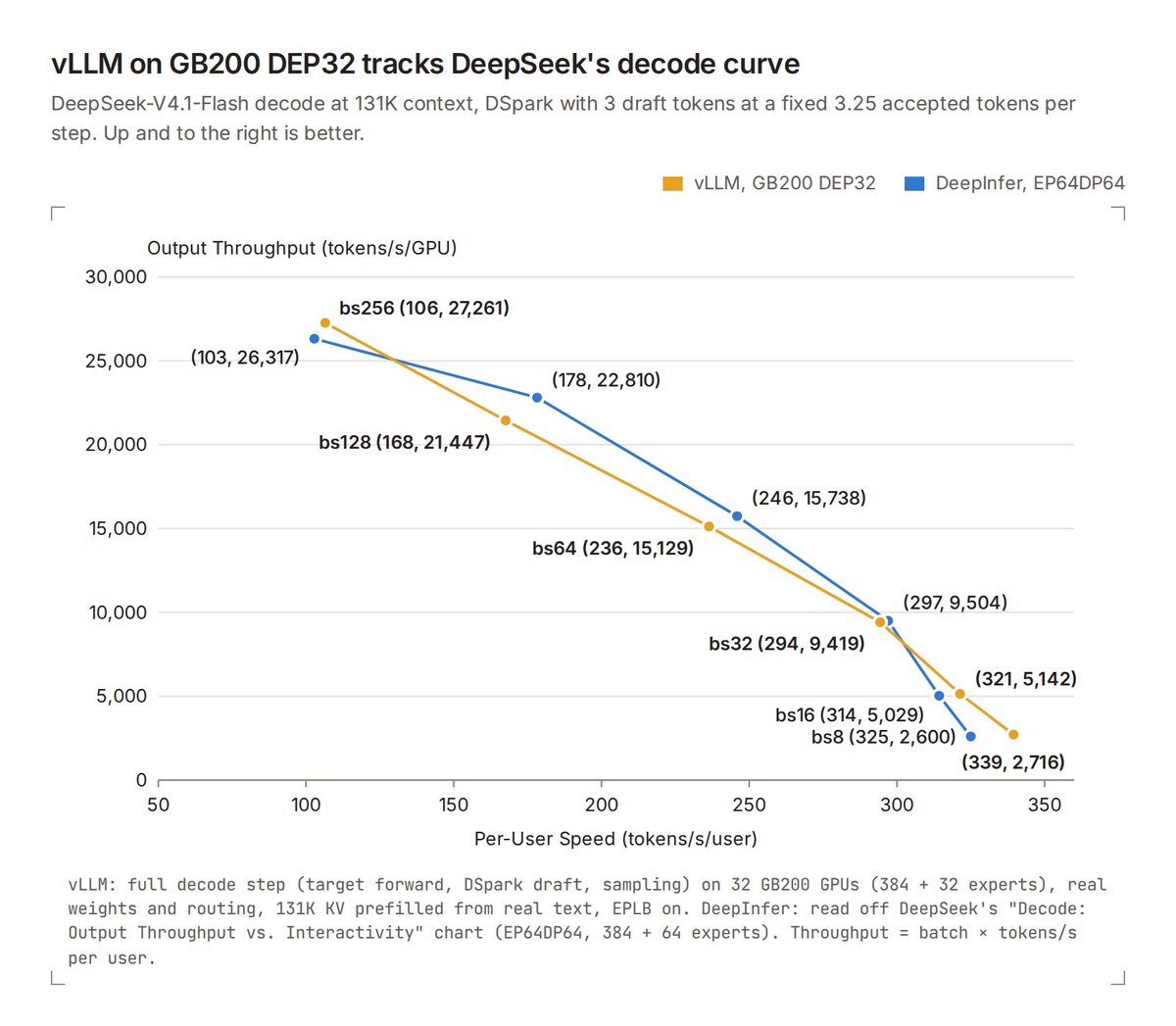
With Wide-EP and EPLB, vLLM can match DeepInfer’s decode performance within 6% and generate $39/gpu/hr in revenue at DeepSeek’s off-peak pricing, at 200 P90 TPS on the AgentX workload.
Specifically:
• Under DeepSeek’s decode configuration (DeepSeek-V4.1-Flash, 131K context, nextn=3), vLLM on GB200 achieves throughput within 6% of DeepInfer’s published results across batch sizes 8–256.
• On AgentX, vLLM pushes the Pareto frontier further on GB300, reaching up to 1M tokens/s/GPU and generating $38.96/gpu/hr in revenue at 196 P90 TPS, based on DeepSeek’s off-peak API pricing.
• Also, vLLM extended low-latency kernel support for DeepSeek-V4.1-Flash, achieving up to 826 TPS per user on AgentX.