Indian Corporate Profits Are Growing at Their Fastest Pace in Four Years. But 60% of Stocks Are Still Down.
Its been 10 days since the mid-terms and the turbulent week. Over the last week, more companies have released earnings and we have seen more data regarding FIIs and DIIs buying/selling behaviour
Here are some facts after going through some 3000 companies earnings and valuations:
1. Corporate India's earnings are growing strongly, but the growth is concentrated
In Q2 FY27, 2,979 listed companies reported revenue growth of 22.3% and adjusted net-profit growth of 29.8%, the strongest quarterly earnings performance in over four years.
However, a large portion of this growth came from commodity producers, oil and gas companies, and financial services. BFSI, metals, oil and gas, and automobiles accounted for 77% of incremental profits. Oil producers benefited from better refining margins and commodity-related factors, while financial companies benefited from improving business performance.
2. Foreign investors are returning to India, and large-cap financials are leading the rally
After selling $31.4 billion worth of Indian equities during January–October 2026, foreign investors bought $9.53 billion in just the first 16 days of November, a record monthly inflow. Banking stocks have been among the strongest performers. HDFC Bank gained 17.9% and ICICI Bank 13.4% during November through the 16th, while the Nifty Bank rose approximately 14% through November 17.
One explanation is that global investors are diversifying away from AI-heavy markets such as South Korea and Taiwan, while India's improving earnings and lower oil prices are making it relatively attractive.
3. Mid-cap and Small-cap stocks are not cheap anymore
Despite strong corporate earnings and record foreign buying, 61% of NSE-listed stocks were still trading below their December 2025 closing prices as of November 16.
Why?
According to HDFC Mutual Fund's November analysis:
Nifty 100 traded at 18.5× forward earnings, below its ten-year average of 19.3×.
Nifty Midcap 100 traded at 22.8×, broadly in line with its historical average.
BSE Smallcap 250 traded at 21.9×, still above its historical average of 18.7×.
4. The banking sector is becoming interesting again
In a study of 2,057 companies, 83% of financial-services companies reported higher profits, with median profit growth of 26.8%.
Meanwhile, private banks were trading at approximately 2× forward book value in early November, around 20% below their historical valuation benchmark.
What is the takeaway from the data so far?
Indian companies are recovering across the board, and FII money has already reached the large-caps. However, we should find companies who are not solely relying on increase in commodity, metal, and oil prices.
Smaller companies with improving revenue, sustainable profit growth and healthy cash flows may offer opportunities in specific sectors that are receiving funds either from the government or private consumption.
I think that is where selective research could become helpful.
After all, the opportunity isn't necessarily in buying what has already rallied, but in identifying where business fundamentals are improving before the broader market recognises them.
The last week was turbulent for both US and Indian markets.
What a turbulent week it has been! Stock markets have been swinging up and down almost every day, and when you track both Indian and US markets, the volatility feels even more intense.
Look at what happened last week:
US Markets:
- Nasdaq fell 5.52% on November 5, its biggest single-day fall in 19 months.
- Semiconductor stocks crashed 12.25% in a single day, with Nvidia falling 9.3%.
- Nasdaq ended the week down 3.4%.
Indian Markets:
- Nifty gained 8.58% during the week, its strongest weekly rally in nearly six years!
- Foreign investors purchased approximately ₹46,000 crore of Indian equities.
- But the rally was uneven. While Nifty gained 8.58%, the Smallcap 250 gained only 3.71%.
So what's happening? And more importantly, how should we approach investing in such markets?
1. Are we witnessing another dot-com crash? The primary concern in the US is that companies are spending enormous amounts on AI infrastructure, and investors are beginning to question whether these investments will generate adequate returns.
There are similarities with the dot-com bubble of 2000. But there's also an important difference. Unlike many dot-com companies, today's technology leaders such as Microsoft, Google and Meta are already highly profitable businesses generating substantial cash flows.
And AI is genuinely useful. I'm personally seeing enormous productivity improvements in researching companies, analysing financial disclosures and monitoring investments.
2. India isn't necessarily immune to what happens in the US. A common assumption is that if the US AI trade crashes, foreign investors will move their money into India.
But why should they?
They have several alternatives: US government bonds, gold, other emerging markets and non-AI American companies.
And Indian markets aren't as independent of US markets as we sometimes believe. Historically, they have moved in the same direction approximately 60% of the time.
3. While investors worry about markets, companies continue to grow.
This is perhaps the most interesting part. Across both India and the US, several industries continue reporting strong earnings growth. In India, we're seeing opportunities across industrial equipment, automobiles, defence manufacturing and financial services. In the US, industrial companies reported approximately 18.5% earnings growth, while materials companies reported around 31%.
Think about that. Stock prices are fluctuating wildly, but many underlying businesses continue growing.
4. So what am I doing differently?
Over the last few months, I've been sharpening my investment framework to identify companies at potential inflection points. Rather than trying to predict the next market crash or rally, I'm focusing on understanding:
- Where is money flowing within an industry?
- Which companies are developing differentiated technology, products or IP?
- Which companies are approaching an inflection point after years of R&D?
- What does the personality of the founders and management tell us?
- Can the company execute, and is the valuation attractive?
I'm particularly focusing my research on four sectors:
- Power electronics and electrical infrastructure
- Defence technology and electronics
- Cybersecurity
- Specialised industrial technologies
My overall philosophy is simple: As investors, our goal should be to make money whether markets move up, down or sideways.
We can't predict what the markets will do next. But we can try to identify good businesses, understand their growth potential and invest when valuations become attractive.
For the full post, you can read the newsletter here: https://t.co/NQL3DsXs8j
Thanks,
Ankur Gupta
Given the recent bloodbath in the US markets, I guess lots of attractive companies are now available for decent valuations. Here are some potential investments I'm going to study next in the power, storage, and defence space:
* *GNRC – Generac:* Manufactures generators and backup power systems, increasingly serving large data centers.
* *BE – Bloom Energy:* Develops fuel-cell systems that generate electricity on-site without traditional combustion.
* *POWL – Powell Industries:* Manufactures specialized switchgear and electrical control systems for power distribution.
* *VRT – Vertiv:* Provides power management and cooling infrastructure for data centers.
* *AMSC – American Superconductor:* Develops power-grid technologies, superconducting systems and electrical equipment for wind turbines.
* *BELFB – Bel Fuse:* Makes power conversion systems, electronic components and connectors used in data centers and industrial equipment.
* *BWEN – Broadwind:* Manufactures heavy steel components, industrial gearing and precision equipment for energy and infrastructure markets.
* *NVEC – NVE Corporation:* Develops highly specialized magnetic sensors and spintronic semiconductor devices.
* *ITRI – Itron:* Provides smart electricity meters and software that help utilities monitor and manage power grids.
* *LPTH – LightPath Technologies:* Develops optical lenses and infrared imaging systems for defence, industrial and sensing applications.
* *LTRX – Lantronix:* Makes industrial IoT connectivity devices and embedded computing systems for remotely monitoring and controlling equipment.
Zen Technologies: A Record Quarter and an interesting philosophy
Zen Technologies reported its highest-ever quarterly revenue of ₹345 Cr, almost doubling YoY. I went through the latest management conference call, and a few things stood out.
My takeaway:I like the long-term direction Zen is taking. Commitment to technology and principles, rather than just building for winning tenders. And the platform approach to become an end-to-end defence platform, rather than just make single products, would help improve margins and customer ‘embeddedness’. It’s just very difficult to replace a platform, while its very easy to replace single productsThe strong Q2 demonstrates improved execution. The next test is whether the large counter-drone orders arrive, whether the acquisitions start contributing meaningfully, and whether the growing business can convert its profits into cash.
Notes below:
1. They are building for the love of technology, not just for winning
Zen is making products to “to win wars, not to win tenders.” While they are already invested in counter-drone systems and simulation technology, they now want to identify the 20% of technologies that are responsible for 80% of impact in a war (they are calling it ‘Pareto Technologies’).
This principle is guiding their future growth and acquisition strategy
2. Acquisitions are another way of investing in R&D
Acquisition is their way of buying 10–15 years of accumulated R&D and intellectual property, even if that IP is not patented. This is what we saw in the recent Cogknit acquisition. Management considers this one of its most important acquisitions and believes it could become a significant revenue contributor over the next five years.
3. Why was Q2 so strong?
Revenue grew 99% YoY to ₹345 Cr, with EBITDA margins of 38.2%.
Management attributed this to two things:
The order book accumulated over the last year is now being executed.
Operations have been streamlined, with better processes and visibility into bottlenecks. Management claims it could now handle substantially larger execution volumes.
4. What about revenue over the next two years?
Management expects FY27 revenue of approximately ₹1,200–1,300 Cr, potentially higher. With around ₹487 Cr executed in H1, this implies ₹713–813 Cr of revenue in H2.
They feel that they can still generate ₹4,000 Cr cumulatively across FY27 and FY28 although a lot of it also depends on government tender timing
5. When will the large counter-drone orders arrive?
This remains the biggest uncertainty. The government has approved Fast Track Procurement (FTP), but the actual tenders are still awaited.
Management expects:
RFPs to start coming over the next few weeks/months.
Orders potentially getting finalised by March 2027.
Separately, Zen expects approximately ₹400 Cr of simulator orders
6. Two more developments worth tracking
Zen is developing HyperStrike, a counter-drone interceptor. It is currently undergoing internal trials, with initial revenue expected in FY28 and a potentially larger ramp-up in FY29.
The company also claims to own the design and manufacturing of its complete counter-drone technology stack, which means it will get an advantage over companies who are just assembling or importing products.
*Over the last 2 weeks, defence company results have been rolling in, and the positive results show that the industry is possibly at an inflection point*
Look at the revenue growth reported by some of these companies for the September quarter:
* Zen Technologies: Revenue up 99%, adjusted profit up 51%
* Unimech Aerospace: Revenue up 98%, profit up 103%
* Apollo Micro Systems: Revenue up 72%, profit up 54%
* High Energy Batteries: Revenue up 68%, profit up 184%
* Paras Defence: Revenue up 43%, profit up around 57%
* Avantel: Revenue up 34%, profit up 59%
* Bharat Electronics (BEL): Revenue up 27%, profit up 20%
India has been investing in developing its domestic defence manufacturing industry for more than a decade. And defence manufacturing is unlike most other industries. It can take 10–15 years to develop a product before it begins generating meaningful revenue.
Think of HBL Engineering. It spent almost two decades developing Kavach, a railway safety system, before commercialisation. Or Zen Technologies, which started developing counter-drone technology in 2018, and is now generating substantial revenues from it. And even after winning orders, manufacturing and deliveries can take years.
*And perhaps that's what we're beginning to see in India's defence industry?*
Companies that spent years developing products and building capabilities are now receiving orders, manufacturing equipment and reporting substantial revenue growth.
And the opportunity ahead is still significant!
Just last week, India's Defence Acquisition Council approved in principle new procurement proposals worth ₹2.12 lakh crore, with approximately 82% expected to be sourced domestically. It's not just the large companies manufacturing aircraft, ships and missiles that can benefit.
Think of all the smaller companies supplying specialised batteries, electronic systems, radars, microwave components, drone technologies and other equipment that go into these larger defence platforms.
*Of course this comes with risks.*
* First, defence revenues are extremely cyclical. One large order delivered in a quarter can double revenue, while delays in the next quarter can cause a sharp decline.
* Second, many defence stocks already trade at very expensive valuations, with years of future growth potentially priced in.
*So, are we at an inflection point?*
Possibly. Companies that have been doing R&D for years and testing and participating in procurement cycles might now finally be seeing those experiments convert into actual orders.
We will find out more as more results roll in over the coming weeks
Thanks,
Ankur Gupta
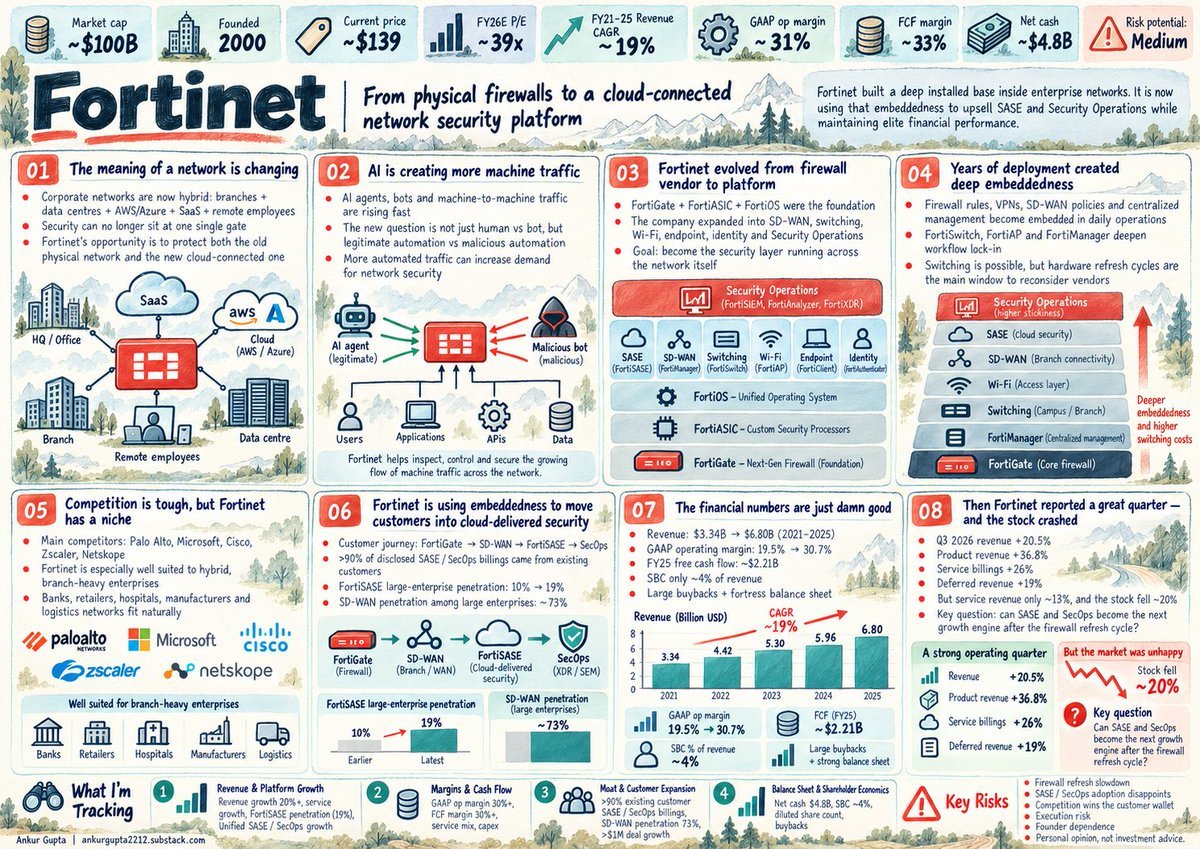
The stock price crashed 25% yesterday, so I went deeper into finding out the reasons for the crash. What I found is signs of over-selling and an over-reaction by the market.
Fortinet’s products are deeply embedded into customer networks and has been for 25+ years. Now its using that advantage to upsell its network cybersecurity platform consisting of SASE and SecOps.
Underneath its products, it is a cash compounding machine par excellence.
Now I feel, given the price crash, there is a genuine opportunity for us to consider for an investment.
Do read the post to find out more: https://t.co/XR6tpgay4a
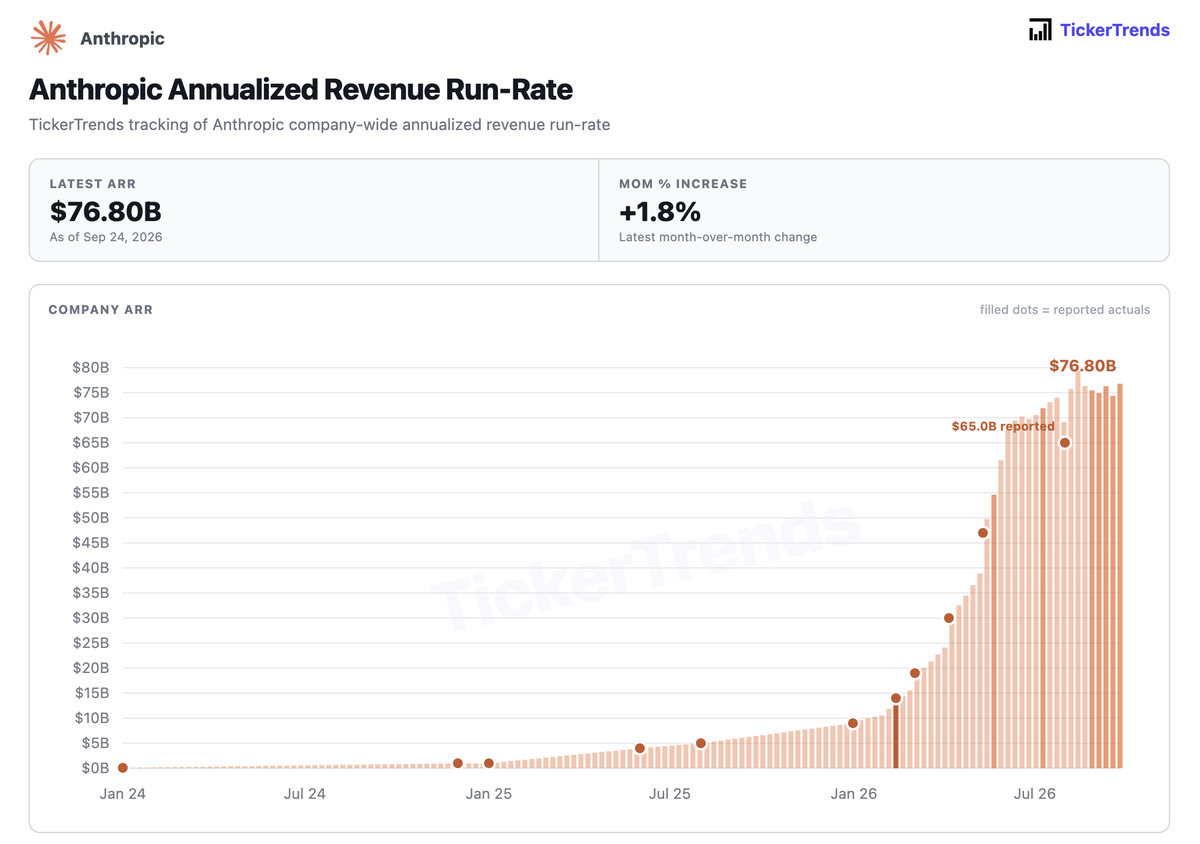
A lot has already been written about the Anthropic S-1 filing, so I won't mention those points again. Yes it has been the fastest growing company in the history of capitalism. Yes it has one of the highest revenues per employee in the world, second only to NVidia, 5x more than Microsoft, and 100x more than TCS.
Instead, when I read the 400+ page document, I decided to focus on the company's personality and possible reasons for how it managed to become the fastest growing company in history. I attribute three aspects:
1) Bold Vision
2) A deep focus on Research
3) Scaling is embedded into every decision
To reduce risks and reduce dependency on suppliers, it is also leasing and commissioning its own data centers
The strange thing is, there is very little mention of Chinese open-source models as threats. Just general reference
Now its AI, after disrupting the software-engineering and IT-services industry, is going hard after pharma and drug-research, and also into factory automation and physical AI.
I'm not sure how the IPO will open or what the state of AI will be in the near future, especially as Chinese models become more powerful and can do more for less, but the document is a very insightful read!
Full post: https://t.co/IktbE80UUh
It’s been days since I posted this note when the eMudhra controversy erupted, and three more alarming cybersecurity stories made headlines!
1. A security flaw that could affect millions of websites worldwide!
Researchers discovered two serious weaknesses in PHP, a technology used to run a large proportion of websites.
Imagine an online shopping website.
Because of these weaknesses, a hacker could potentially send malicious instructions to the website and make its computer execute them, without even logging in!
For example, the hacker might be able to access customer information, steal passwords or disrupt the website.
The threat was so serious that governments around the world issued urgent warnings, and hundreds of websites were temporarily taken offline while fixes were applied.
2. AI agents are accessing American bank accounts!
Major US banks have reported detecting AI agents accessing customer accounts without the banks having authorised those agents.
But what if that AI assistant starts performing actions you never asked it to perform?
That's exactly the kind of risk banks are now trying to address.
Some banks are struggling to distinguish between actions authorised by customers and those initiated independently by AI agents.
3. One hacker used AI to break into more than 100 websites!
According to Reuters, a hacker used AI agents to attack more than 1,200 websites, successfully breaking into over 100 of them, including websites associated with large American companies.
Instead of manually searching for weaknesses and breaking into websites, the hacker instructed AI agents to do much of the work automatically.
And the estimated cost of the entire operation? Just $5,000!
Looks like cybersecurity is going to be a hot investment theme once more!
The recent eMudhra controversy in India has brought focus onto the importance of cybersecurity.
I don’t blame eMudhra.
Cybersecurity, for most organizations, is an afterthought. In fact, based on certain reports, only 4% of the companies in the US say they are completely secure from cyber-attacks.
And while I don’t have numbers for India, I feel intuitively the numbers in India will be much lower.
Why? Because powerful and effective cybersecurity platforms are not cheap, and I don’t think most Indian companies, whether large or small, view it as a necessary expense.
Fortunately, the world is slowly waking up and taking notice, and the cybersecurity market is growing 10%+ every year
I’d already written a post on Qualys. This is the higher-level sector map of the entire cybersecurity sector. Read on to find out more!
Full post: https://t.co/eEQ503D8gO
A US Startup claims it can manufacture real gold in a lab. What are the investment implications?
Something very interesting happened last week: On October 21, a San Francisco-based startup called Marathon Fusion announced it had successfully converted mercury into real gold using nuclear technology.
Not artificial gold. Actual gold, chemically identical to what we mine from the earth.
That sounds unbelievable right? Of course, its still early days, and the company didn’t disclose how much it produced or even what it cost to produce it. So its still an experiment right now.
What I’m interested in is the implications this experiment can have on the wider power industry:
1. Could this accelerate investment in nuclear fusion?
First things first. Marathon Fusion isn’t a gold company. It is a nuclear fusion technology company.
Scientists have been trying for decades to produce energy via nuclear fusion and make it commercially viable at scale, but without success.
Now with Marathon Fusion’s experiment, it seems like creating nuclear fusion can become financially viable. Because potential future nuclear power plants can earn money by producing electricity and manufacturing gold.
According to Marathon's estimates, a future fusion plant could potentially earn:
• $223 million annually from selling electricity alone.
• $482 million annually from selling both electricity and gold.
So a power plant can double its revenue if it can produce both gold and electricity.
And if the economics of producing nuclear fusion become attractive, wouldn’t governments and investors have a much stronger reason to invest in developing the technology?
2. Could this create a new investment opportunity in nuclear power plants?
If manufacturing gold makes nuclear fusion more financially attractive, companies and governments could accelerate their investments in building fusion reactors.
But building these reactors requires some extremely specialised equipment. And as it happens in other highly technical industries such as defence, space, automotives, ancillary equipment providers start making money before the technology becomes commercially successful.
In fact, we're already seeing this happen in the US.
Just last month, a US nuclear fusion company called Commonwealth Fusion Systems signed an agreement to purchase more than 10,000 kilometres of specialised superconducting material from Japan's Fujikura.
This material is used to build the powerful magnets needed inside certain types of fusion reactors.
Fujikura is now expanding its manufacturing capacity to support these orders.
Think about that. Nuclear fusion hasn't yet become commercially viable, but companies supplying the equipment are already winning business.
Now imagine what might happen if gold production makes fusion technology even more financially attractive.
We could see greater investment in fusion projects, creating additional demand for specialised engineering, materials and equipment manufacturers.
3. And finally, what happens to gold prices?
Honestly, its too early to predict whether this will lead to a crash in gold prices, similar to how lab-grown diamonds have crashed diamond prices.
There are enormous unresolved challenges such as making fusion commercially viable, producing gold at a competitive cost, obtaining suitable mercury isotopes and ensuring the resulting gold is safe to sell.
But I think we are at a potential inflection point where companies supplying to nuclear fusion producers might see their order books increase.
As of now, I don’t have any companies in my watchlist or study list. Will post here in case I come across any interesting companies in the near future.
Thanks,
Ankur Gupta
The recent eMudhra controversy in India has brought focus onto the importance of cybersecurity.
I don’t blame eMudhra.
Cybersecurity, for most organizations, is an afterthought. In fact, based on certain reports, only 4% of the companies in the US say they are completely secure from cyber-attacks.
And while I don’t have numbers for India, I feel intuitively the numbers in India will be much lower.
Why? Because powerful and effective cybersecurity platforms are not cheap, and I don’t think most Indian companies, whether large or small, view it as a necessary expense.
Fortunately, the world is slowly waking up and taking notice, and the cybersecurity market is growing 10%+ every year
I’d already written a post on Qualys. This is the higher-level sector map of the entire cybersecurity sector. Read on to find out more!
Full post: https://t.co/eEQ503D8gO
Zen Technologies Paid ₹135 Crore for a Company With Just ₹48 Lakh in Revenue. What Does This Tell Us About the Value of Defence Technology?
The company is Cogknit, and Zen is acquiring a 52% stake in it for ₹135 crore.
To find out why they would pay so much, I sent them an email on Sunday evening. And by Monday morning, I had received a long response directly from the CFO.
(I was surprised they responded to fast and in a detailed manner, despite me being a small shareholder)
Cogknit develops Battlefield Management Systems, which digitally connect tanks, soldiers and military vehicles. The company won an Indian military iDEX innovation challenge and successfully completed field trials with the Indian Army.
Zen says that the technology, R&D, and military qualifications are worth more than ₹250 crore, despite it generating almost no revenue.
I then connected this number to another company I've been researching: Aartech Solonics
Aartech is a roughly ₹150 crore market-cap company, with an established power-electronics business generating approximately ₹41 crore in FY26 revenue.
But it's also been developing indigenous technologies for military applications that have benefited from the military's iDEX innovation programme.
I wrote to Aartech’s management as well to understand at what stage of development the products were in. Their response was positive that the technology is ready and field trials are beginning.
Now here's the investment question: If Cogknit’s military validation is worth more than ₹250 crore, is Aartech’s defence technology being undervalued by the market?
Aartech's entire market capitalisation is only around ₹150 crore, and that includes its existing revenue-generating industrial business.
Commercialization of its defence technology is still far away, but if that transition happens successfully, the economics of the business could change significantly, and the market cap could reprice from the current ₹150 crore soon.
My newsletter: https://t.co/47XWlSj9s3
Thanks,
Ankur Gupta
Anthropic's Growth Is Slowing Down, but AI growth Isn't. Is Growth Shifting Towards Chinese and Open-Weight Models?
Anthropic released its latest numbers: quarterly revenue growth slowed from approximately 147% in Q2 2026 to 45% in Q3.
That's still impressive growth. But the sharp slowdown raises an interesting point, because AI token usage growth in general is not slowing down.
I came across an interesting report published by OpenRouter, one of the world's largest platforms for accessing different AI models.
According to OpenRouter, weekly AI token usage on its platform increased from 0.5 trillion in January 2025 to 128.4 trillion in September 2026.
That's approximately 250 times growth in just 20 months!
But what's more interesting is where this growth is going.
According to the same report:
Chinese AI models accounted for 69% of all tokens processed on OpenRouter in the week of September 14.
Over 40% of US startups using OpenRouter now use China's DeepSeek in production, compared with approximately 13% in January.
Spending on three Chinese AI developers, DeepSeek, Moonshot AI and https://t.co/wQf87uvmvB, increased more than tenfold between January and August 2026.
But the trend is difficult to ignore. Chinese AI models are increasingly capturing actual AI workloads, not just attracting attention.
Why the change now?
Because companies are discovering that they don't always need the most expensive or most powerful AI models. For many applications, cheaper models can do the job sufficiently well.And open-weight models allow businesses to download, customise and run AI using their preferred infrastructure rather than depending entirely on a single model provider.
From an investment perspective, I had discussed Alibaba previously, and have posted an investment note about it: https://t.co/YRAkh21CJF
Alibaba is a highly polarizing stock. A lot of people have made money on it and lost money on it. I am bullish on it for the near term because, apart from its ownership of Qwen, Alibaba also owns a massive cloud computing business that can benefit as more companies adopt and deploy AI.
And importantly, the money is already beginning to translate into actual business.
In Alibaba's latest reported quarter, AI Cloud and Compute Services revenue grew 45% year over year and AI-related product revenue recorded triple-digit annual growth for the twelfth consecutive quarter.
My investment hypothesis is that as AI becomes cheaper and more accessible, companies like Alibaba could benefit from both the adoption of their AI models and the infrastructure required to run them.
So three takeaways:
1) Frontier paid models are becoming a commodity
2) AI infrastructure is still an attractive investment opportunity
3) China is gaining fast in terms of models and AI infrastructure
Original OpenRouter report: https://t.co/XOTqzPupXv
Thanks,
Ankur Gupta
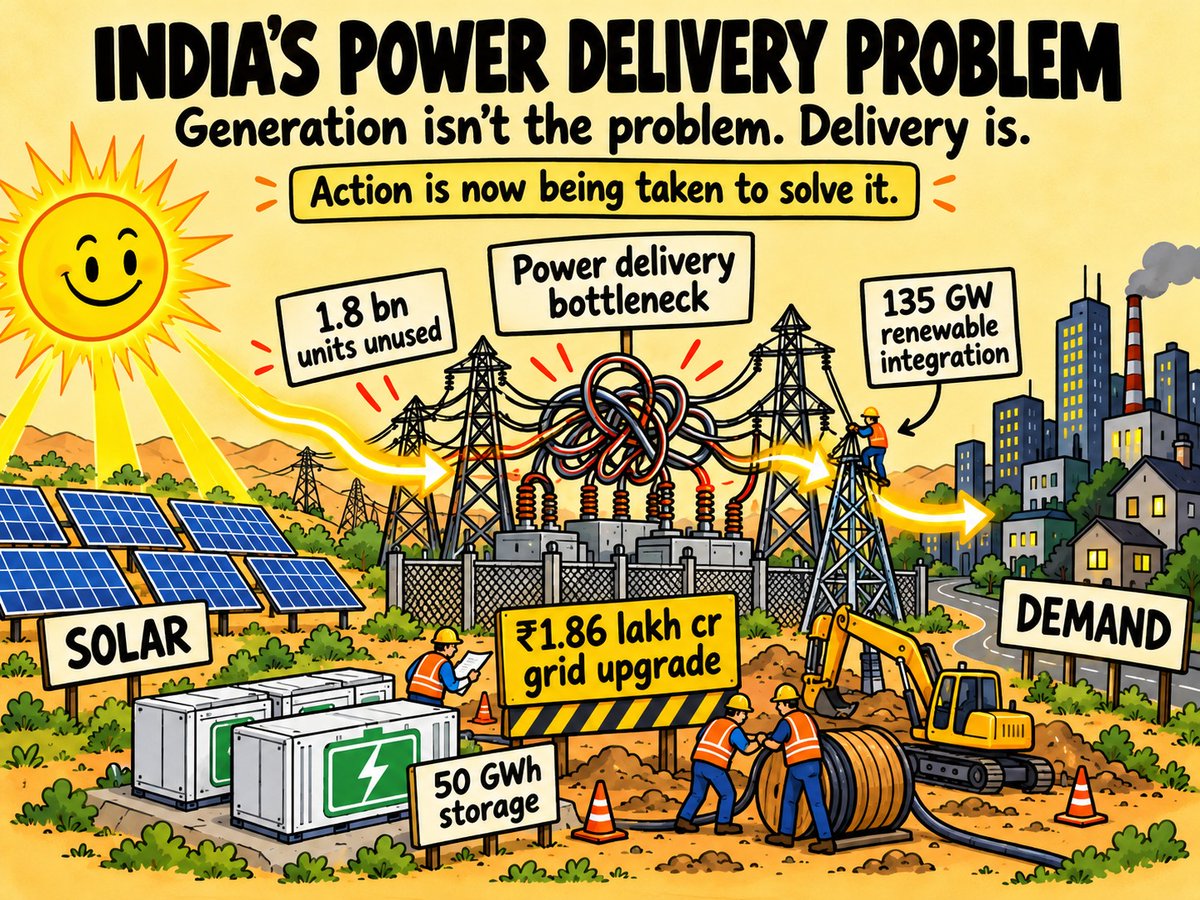
You’d think that India doesn’t produce enough solar power. It actually does. The bigger problem is delivering it.
I read a Reuters report published this week that said that India was unable to use nearly 1.8 billion units of renewable electricity during July–August 2026, even while parts of the country were facing power shortages.
So what's going wrong?
I’d posted in the US ideas group about how companies like Google and Nvidia are investing in generating more power via fuel-cells (such as those manufactured by Bloom Energy), that are located in the premise of the data-center.
In India, the problem seems to be in the next layer: Power generation is not the problem. Power transmission is. Solar electricity is often generated hundreds of kilometres away from where it's needed.
Without adequate transmission lines, transformers, substations and batteries, electricity cannot always reach consumers when they need it.
This is where I feel more money should flow in the future, and it will become a great investment opportunity.
Why do I say that? 2 proof points
1. BHEL released very strong results last week. Revenue grew 24%, operating profit grew 77%, and its order book reached approximately ₹2.58 lakh crore
2. And the government has also finally recognized this problem. In September, it approved a ₹1.86 lakh crore investment programme to strengthen India's electricity network, including:
* Infrastructure to connect 135 GW of renewable energy capacity to the grid.
* 50 GWh of battery storage to store surplus electricity for later use.
The money is already beginning to translate into actual business.
Consider what happened just this week:
1. Kalpataru Projects: Announced approximately ₹2,031 crore in new transmission and distribution orders
2. Transformers & Rectifiers: Reported 61% revenue growth and a 97% increase in new orders, with an order book of ₹7,237 crore
3. KEC International: Secured ₹1,014 crore of new transmission orders, including infrastructure connecting a large energy-storage project to the electricity network
I’ve previously discussed one company following this theme: Aartech Solonics . It develops indigenous BTS 2000 systems that rapidly switch between power sources to prevent interruptions in power plants. Interestingly, BHEL's earlier tender documentation for NTPC's Sipat-III power project listed Aartech among the approved suppliers for these systems.
I’ll be keeping my eyes open for more such micro-caps and small-caps in this area. Will post here when I come across new ideas.
And I’d love to hear if someone else has more ideas around what companies are good to invest in this space.
My Newsletter: https://t.co/a0aGqv4wr7
Thanks,
Ankur Gupta
Google's $4 Billion Power Deal and NVIDIA's 800V Technology: Strengthening the thesis around power being the bottleneck in the AI trade
Two announcements this week caught my attention, and I think they reveal an important shift in where money is flowing within the AI industry.
Google is investing billions to secure electricity.
On October 14, American Electric Power announced a $4 billion investment in a 702 MW fuel-cell power project, backed by a 20-year electricity purchase agreement with Google. The project will use Bloom Energy's fuel-cell technology.
Think about that. A company primarily known for search, software and AI is now helping support multibillion-dollar investments in dedicated electricity generation. Why? Because getting reliable electricity is becoming a major constraint on how quickly AI data centres can be built.
NVIDIA is trying to change how electricity flows inside data centres.
NVIDIA and its partners recently highlighted their work on a new 800V DC power architecture.
Traditionally, electricity passes through multiple stages of conversion before reaching the GPUs. Each conversion wastes some energy, generates heat and requires additional equipment. NVIDIA wants to simplify this process by distributing electricity at a much higher DC voltage.
Its proposed architecture targets:
* Up to 5% improvement in power efficiency
* Approximately 45% less copper
* Support for future AI server racks consuming 1 megawatt+
What this implies is that the big players are now actively trying creative solutions to solve the power bottleneck. And I believe this could be an interesting investment theme to research over the next several months (if the AI-trade doesn’t crash by then).
Interestingly, I had explored this theme in a previous article, where I mapped the entire journey of electricity from the power grid to the GPU inside an AI data centre.
There are 8 layers in the journey:
1. Substations: Transformers and switchgear — Hammond Power Solutions (HPS.A), Powell Industries (POWL)
2. On-site power generation: Fuel cells, gas turbines and backup generators — Bloom Energy (BE), Generac (GNRC), Capstone Energy+ (CEPL)
3. Power distribution: Switchboards, busbars and power distribution equipment — Powell Industries (POWL), nVent Electric (NVT)
4. Cables and interconnects: High-current cables, connectors and specialised electrical interconnects — Amphenol (APH), Bel Fuse (BELFB)
5. UPS and power conditioning: Power converters, voltage regulation and uninterrupted power delivery — Advanced Energy Industries (AEIS), Bel Fuse (BELFB)
6. Energy storage: Industrial batteries, lithium-ion backup systems and energy management — EnerSys (ENS)
7. Cooling: Liquid cooling, chillers, heat exchangers and thermal management — AAON (AAON), Modine (MOD)
8. Monitoring and controls: Power monitoring, electrical protection and intelligent control systems — Powell Industries (POWL), Advanced Energy Industries (AEIS)
The next step in my research is to identify companies across these eight layers that have genuine technological advantages, strong customer relationships and the ability to convert growing demand into sustainable cash flows.
Original article: https://t.co/uF6kRhbkD8
Thanks,
Ankur Gupta
Tonbo Imaging – An IPO full of controversies and opportunities
I generally don’t analyse IPOs, but this one caught my eye because of two things:
· It makes defence infrared, a high-potential product
· HBL Engineering is a 15% stake-holder, with a nominee in the board
There are notes going around that are talking about ‘Chinese’ links and its Singapore-based shareholder CEAQ Technologies, among other allegations.
So I did some research into whether the IPO is worth bidding for. I found some concerning points, but also a potential technology story.
What concerns me?
1. Chinese suppliers have actually been identified: Changchun Jstar Optics and Changchun Sunday Optoelectronics, both Chinese optics companies, are among Tonbo's recorded trading relationships. Tonbo also recorded over 11,500 import shipments, including about 20% from China.
However, importing Chinese components is not, by itself, a violation of Indian defence procurement rules.
2. Dependence on imported critical components is increasing: Tonbo’s cost of critical components sourced from international suppliers, as a percentage of COGS, increased from 41.2% in FY24 to 54.7% in FY26.
Can Tonbo call itself completely indigenous? I don’t think so.
3. The CEAQ Singapore relationship needs greater transparency: CEAQ Technologies was formerly known as Tonbo Imaging Singapore. In March 2024, Tonbo India acquired IP from CEAQ Singapore for approximately ₹183 crore.
But the commercial relationship did not end there. Tonbo continued purchasing equipment amounting to approxima5ely ₹44 crore in FY25 and ₹79 crore in FY26.
CEAQ Singapore is also one of Tonbo's largest shareholders and is partially selling its stake in the IPO.
4. The financials are lumpy: Revenue moved from ₹428 crore in FY24 to ₹469 crore in FY25, before declining to ₹363 crore in FY26.Profit after tax also fell from approximately ₹73 crore to ₹51 crore.
More strikingly, exports contributed 65.5% of revenue in FY25, but only 5.6% in FY26. Its sales to Europe declined almost 100% since last year.
6. The IPO is entirely an Offer for Sale (OFS), but HBL is not selling: Existing shareholders are selling ₹852 crore worth of shares. Tonbo itself will not receive any fresh capital from the IPO.
There is nothing wrong with an OFS. But given the company's R&D and other costs, I’d prefer at least some money going into the business.
However, there is an interesting positive here.
While CEAQ Singapore is partially reducing its stake and CEAQ India is exiting, HBL Engineering is not selling a single share and is retaining its entire 14.25% stake.
What are the other positives?
1. HBL Engineering's involvement is a significant source of comfort
HBL owns 14.25% of Tonbo. Its CFO, Sai Ram Edara, is a nominee director on Tonbo's board and a member of its audit committee.
This means HBL is not merely a financial investor looking at quarterly disclosures. Its representative has board-level access to financial reporting, governance and related-party oversight.
If I am questioning Tonbo's governance, I also have to ask what HBL's investment diligence and continued oversight tell us.
2. Tonbo appears to have genuinely differentiated technology
Its capabilities include thermal imaging, infrared optics, advanced image processing, stabilised electro-optical systems and targeting technologies.
According to its prospectus, Tonbo has supplied products to customers across 24 countries, including demanding international defence markets.
This is not an easy industry to enter. Industry insiders I spoke to explicitly told me that Tonbo has strong in-roads within the Indian government, and that point itself speaks a lot.
My takeaway: This IPO has its share of both controversies and potential. Whether to bid for it or not will depend on how strongly you interpret HBL’s involvement into Tonbo’s governance, and how much potential you think the technology has.
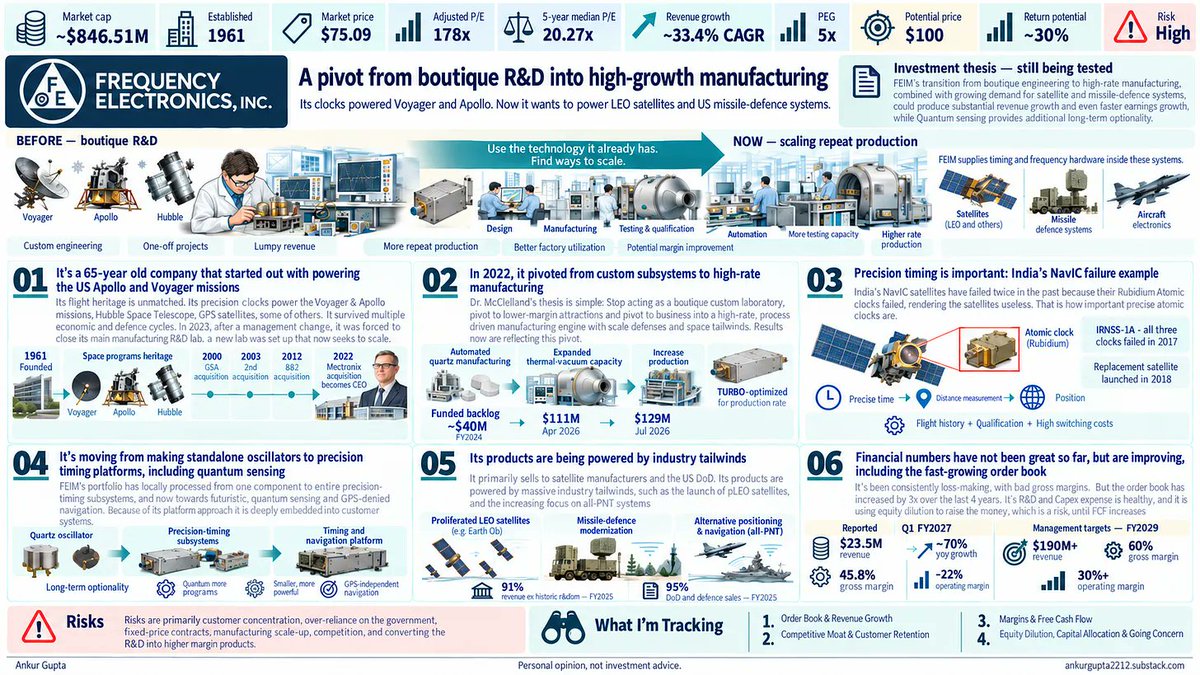
Risks are primarily customer concentration, over-reliance on the government, fixed-price contracts, manufacturing scale-up, competition, and converting the order-book to cash
FEIM’s transition from boutique engineering to high-rate manufacturing, combined with growing demand for satellite and missile-defence systems, could produce substantial revenue growth and even faster earnings growth
Full post: https://t.co/CW0cB75UE8