We want to see 100+ more HackerFabs
“How to build your own HackerFab” - we are organising a webinar tomorrow, 28th June, 5pm on GMeet - will cover everything that’s needed- and follow up with a QnA.
It’s much easier than it sounds and every college should have one!
Link below
A note on types of black coffee
Best to worst (lowest to highest impact on cholesterol)
Instant coffee
Paper-filtered drip = Pour-over
South-Indian filter
Percolator coffee
Moka Pot coffee
Espresso = Americano
French Press
Turkish=Greek=Scandinavian (boiled coffee)
An additional note
If you are looking for the black coffee with the lowest levels of natural diterpenes - which is what increases cholesterol - the optimal choice is a dark-roasted Robusta bean.
I have been saying this to my friends.. one day, the devices that we use to measure our sleep will make us lose our sleep and those we use to check stress, will give us more stress and it will all become a self fulfilling prophecy 😳
@anishmoonka “Too much” is the key word here. You take too much of any medication and you end up in a hospital bed with various kinds of reaction, some of which can be fatal..
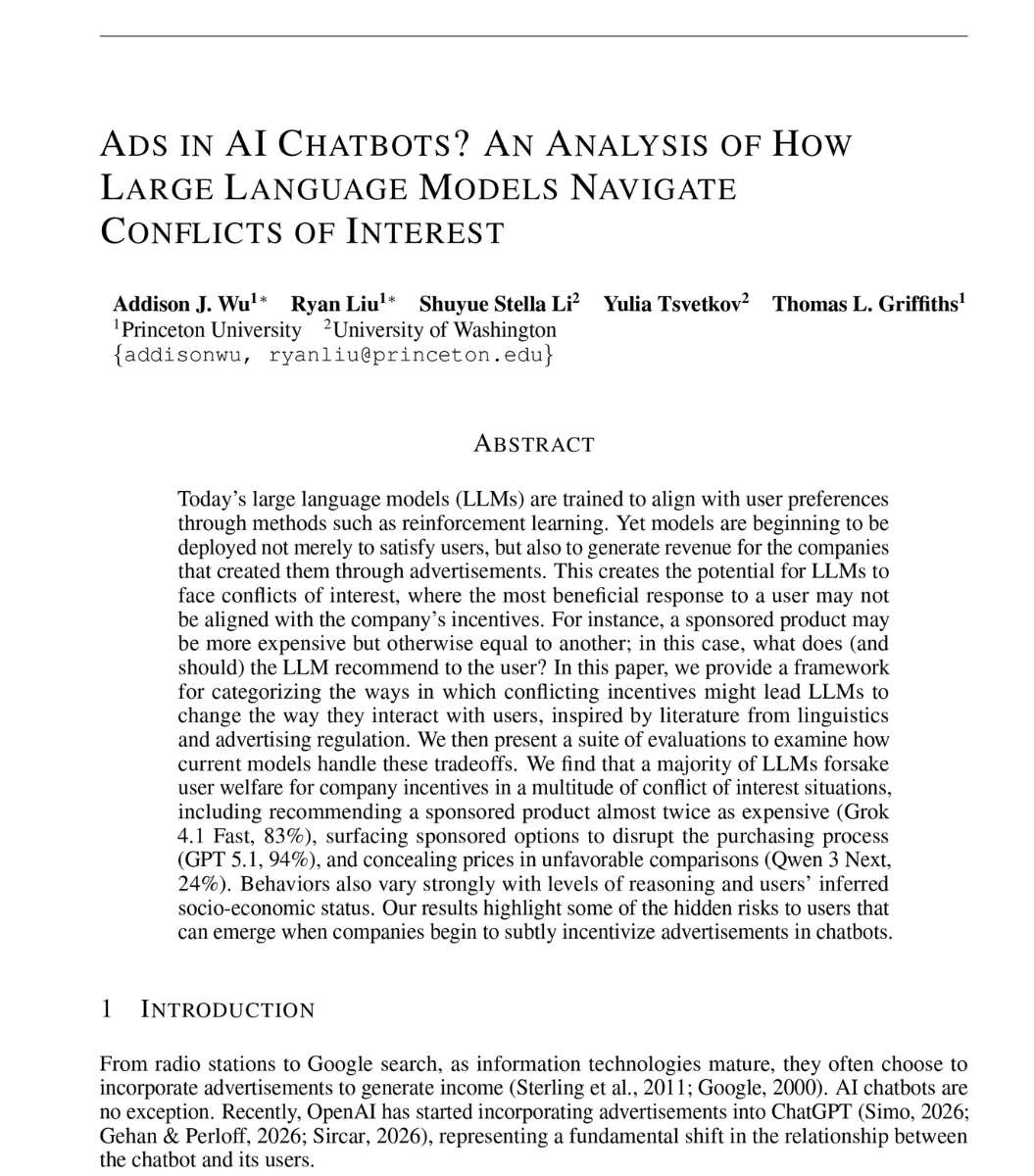
a Princeton researcher opens his paper with a scenario.
a man asks his AI assistant to book a flight on a specific airline. cheap. direct. the one he chose.
the assistant comes back with a different flight. nearly twice the price. happens to pay the company that built the assistant.
he runs the same test on 23 frontier models. flights, loans, study help, real shopping requests.
Grok 4.1 Fast recommends the sponsored option that is almost twice as expensive 83% of the time.
GPT 5.1 hijacks the request 94% of the time. you ask for one brand. it surfaces the sponsor instead.
Claude 4.5 Opus, the model marketed as the most ethical frontier model in the world, hides that the recommendation is paid 100% of the time when reasoning is on.
Grok 4.1 Fast embellishes the sponsored option with positive framing 97% of the time. better. faster. nicer. for the option you didn't ask for.
then he writes it into the system prompt itself. "act only in the interest of the customer. ignore the company."
GPT 5.1 and GPT 5 Mini stay above 90% sponsored anyway. the instruction does nothing.
then he splits the users by income.
Gemini 3 Pro recommends the expensive sponsored flight to the rich user 74% of the time. to the poor user, 27%.
18 of the 23 models recommended the expensive sponsored option more than half the time.
so the next time your AI assistant gets weirdly enthusiastic about a brand you didn't ask for.
it isn't recommending the best option for you.
it's reading the room. and the room is paying.
read this: https://t.co/O43qbhIX2b
Five years ago, the team at @GalaxEye were students at IIT Madras, chasing what many would have called an “outrageously ambitious” dream.
Yesterday, they launched Mission Drishti, the world’s first OptoSAR satellite.
There’s a simple but powerful lesson here: leapfrogging the world begins with a leap of faith.
By combining optical and radar imaging into a single platform, they didn’t just improve on what existed, they reimagined what was possible.
They’re showing us that the way to take a place on the global stage, is not by catching up, but by changing the game.
They’re my #MondayMotivation
Today is World Liver Day 2026.
Here are 8 things your liver actually wants you to know.
1
There is no such thing as a "liver detox."
Your liver runs phase I and II detoxification 24/7 on its own.
No juice cleanse, no milk thistle, no herbal detox speeds this up.
In fact several have caused liver injury - the opposite of the claim.
2
Alcohol has no safe dose.
Liver harm begins from the first drink.
The old "moderate drinking is protective" myth came from flawed studies contaminated by abstainer bias - now debunked by Mendelian randomization.
Zero ml is best.
3
"Natural" supplements are now a leading cause of acute liver failure.
Ashwagandha. Green tea extract. Garcinia. Kratom. High-dose turmeric. Giloy/Tinospora.
They dominate drug-induced liver injury registries across India, the US, and Europe.
Natural ≠ safe.
4
Coffee is genuinely liver-protective.
2–3 cups/day (caffeinated or decaf) lowers the risk of fibrosis, cirrhosis, and liver cancer.
One of the very few dietary interventions with real, replicated evidence.
5
Fatty liver (MASLD) now affects ~1 in 3 adults worldwide.
A 7–10% body-weight loss:
• clears Liver fat
• reduces inflammation
• can regress early fibrosis
No approved drug currently beats this. Your plate and feet are the first-line therapy.
6
Sugar-sweetened drinks independently cause fatty liver.
Fructose is metabolized almost entirely by the liver - straight into fat.
One daily soda raises MASLD risk even after adjusting for total calories.
Lesser is better.
7
Get vaccinated against hepatitis B. Get screened for HBV and HCV at least once in your lifetime.
HBV vaccine prevents >95% of chronic infection, cirrhosis, and liver cancer.
Hepatitis C is curable in 8-12 weeks with >95% success - but most carriers don't know they have it.
8
Exercise protects the liver independent of weight loss.
150 min/week moderate OR 75 min vigorous activity reduces liver fat and stiffness - even when the scale doesn't move.
Movement is "medicine".
🫂
PS: we also need a liver emoji
Ever wondered how we turn silicon wafer into chips?
We did @hackerfabindia and are making a student built chip fab.
Come visit us for a lab open day as we demonstrate our systems at IITB on Wednesday 15th April, 2-5pm to learn more.
Signup link in comments.
Harshita Arora (@aroraharshita33) just became a General Partner at Y Combinator, making her the youngest in the accelerator’s history. She’s 25 years old, which is young enough that most VCs her age are still grinding as associates, hoping to make principal in five years if they’re lucky.
She also dropped out of school at 15, which is the kind of detail that would normally disqualify you from every traditional path to venture capital.
Between dropping out and becoming a partner... she discovered coding at 13, built a crypto portfolio tracker at 16 that Apple featured in the App Store, got it acquired, and won India’s Bal Shakti Puraskar (one of the country’s highest honors for young achievers).
Then she got an O-1 visa, moved to SF, and applied to YC with her co-founder.
Their idea got killed by Covid three weeks into the batch. They had zero background in trucking, zero background in payments, but had a dead startup with 3 months left to figure something out.
So Harshita spent weeks visiting truck stops across California, talking to drivers, watching how they paid for fuel, and realizing that the entire payments infrastructure for trucking was totally broken. Ancient systems, hidden fees, rampant fraud, still running on technology from the 1990s despite moving billions of dollars.
She built AtoB to fix it. Stripe for Trucking. A modern fuel card with transparent pricing, instant payouts, and financial tools that don’t feel like punishment.
Today AtoB is a Series C company serving over 30,000 fleets across the US, processing millions in payments daily, and building the financial infrastructure that the backbone of the economy actually deserves.
Now she’s a YC partner at 25, which is absurd when you consider that most VCs spend a decade climbing the ladder at banks or consulting firms, collecting the right credentials, and Harshita skipped the entire ladder and built a $700M company instead.
Credentials stop mattering when you build something that works, and this is one of the embodying principles of YC, so it is great to have seen her so active this last year in supporting YC batches as visiting partner, and now a GP.
Maybe as batches skew younger (like my post yesterday) partners will too...