How do introverts navigate a career in academic surgery? @SophiaKMcKinley and colleagues found the sociocultural conventions of academic surgery are challenging but that introspection and mentorship foster growth, career satisfaction, and accomplishment.
https://t.co/g5E0dkW6bd
New research out in @AnnalsOpen provides an assessment of hospital performance in emergency general surgery ft. @drewwgoldberg, @ljk50, Chris Wirtalla, James Sharpe, Jacob Rosenthal, Elinore Kaufman & @surgeryspice (@PennSurgery) @PennLDI https://t.co/5mjPx0Rgpc
🆕 from the @UofTUpsurge Research Group in @AnnalsOpen 📘
This perspective outlines our partnership with the @CAGS_ACCG to bring high school students into the academic surgical space through mentorship, simulation, and community🚀
📝 👇
https://t.co/rvAvHsKNkQ
@UofTMedicine
How do patients perceive the choice to undergo high-risk abdominal surgery for cancer? @kekopeckMD's group found patients frequently equated surgery with survival, shaping how viable alternatives seemed. Recognizing this can shape shared decision making.
https://t.co/HusTsdE5sU
How do surgeons face fear in the OR? @JohannaNRiesel and colleagues found fear arose from operating alone in chaos, judgement, and uncertainty. Help from trusted colleagues was the ultimate mitigation strategy, underscoring the importance of collaboration. https://t.co/MSuK30iklZ
Utilization of a perioperative mental health intervention (PMHI) was perceived positively by older adult surgical patients. It provided valuable psychological support, especially for those undergoing oncologic or complex cardiac operations. https://t.co/T1c1F8GpAe
In this prospective study of over 1500 pediatric surgery patients, @mehulvraval and colleagues examined opioid prescribing practices after surgery. One third of patients had an opioid exposure with significant variation between hospitals and specialties. https://t.co/pc6TupRrHi
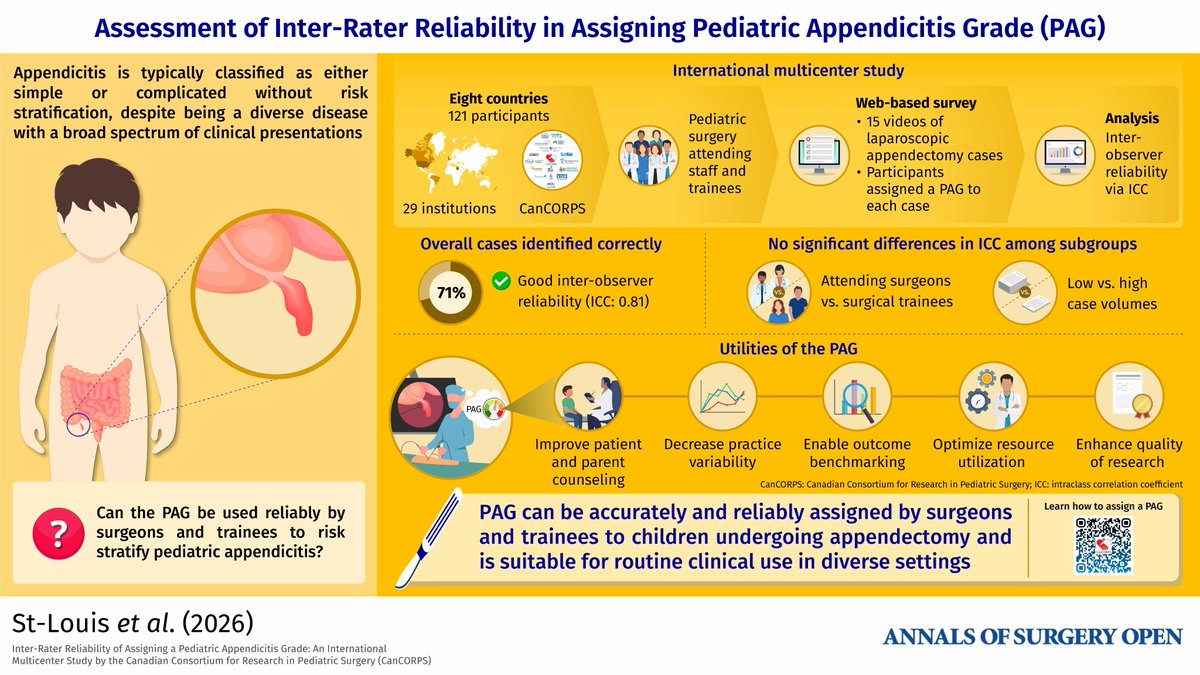
The #CanCORPS Pediatric Appendicitis Grade (PAG) can significantly change surgical practice in pediatric appendicitis by risk stratifying the disease and setting outcome benchmarks for each grade. A major advance in the care of this most common pediatric surgical disease.
Can surgeons reliably grade pediatric appendicitis? A multi-center international study from @DrSherifEmil and CanCORPS found a pediatric appendicitis grade was accurately assigned. Its routine use may improve patient counseling and outcomes reporting. https://t.co/JrwfZR7T7o
How does Medicare Advantage influence surgical outcomes? ⚕️🏥@Cody_Mullens and @AndrewMIbrahim found rural surgical patients with Medicare Advantage had similar rates of complications and mortality compared to fee-for-service Medicare patients.
https://t.co/dtVHEjYXBv
Very excited to publish my most recent historical work on Dr. William Halsted’s radical mastectomy patients in @AnnalsOpen ! It is a good reminder of the importance of patient-centered surgical care.
https://t.co/Ii0ws57D93
Risky alcohol use can increase post-operative complications, yet pre-operative alcohol screening is inconsistent. @MarkBicket's group found AUDIT-C is a feasible screening tool that could help identify at-risk patients if integrated system-wide.
https://t.co/IbQfcDegMH
How long will it take? ⏱️🏥 A machine learning model that utilized patient, operation, surgeon, and health system factors outperformed an embedded EHR model in predicting operative case length and could improve peri-operative planning and efficiency.
https://t.co/xGTqArydEt
Annals of Surgery Open is excited to welcome new associate editors Dr. Heather Lillemoe (surgical education) and Dr. Anai Kothari (AI and data science)!
How does health literacy impact cancer patients' surgical journeys? 🏥📚@bayley_jones and @DChu80 at @UABSurgery found low health literacy contributed to difficulty understanding diagnoses and treatment plans and impaired compliance and follow up. https://t.co/MeghlUFDUZ
Is operative approach water under the bridge for ureteral injuries in rectal surgery? 🤖🌊🩸Liu and colleagues found no difference in rate of ureteral injury between robotic and lap approaches, but a robotic approach had lower rates of GI complications. https://t.co/JiHhhb4DnK
Can centralization of care for esophagectomy improve safety and reduce costs? 🏥💰 Savitch and colleagues found low-volume centers spent $4,000 more per episode and had higher rates of complications and 90 day mortality compared to high-volume centers.
https://t.co/Vvg0lo3xTY
The Pulse of Progress: the development of the Ankle-Brachial Index (ABI) and the lasting impact of Dr. James S.T. Yao on the field of vascular surgery are highlighted in this Surgical Retrospection by Visa and colleagues. 🦶💪🩺🩸https://t.co/QntCKXwFTh
What is next for Annals of Surgery Open? Our new Editor-in-Chief, Dr. Funk, shares his vision, priorities, and what he looks for in top-tier submissions. Watch the 4-minute interview here!👇 https://t.co/6Jfx36h7tJ