The "Statement Against the #Boycott of Israeli Academics" now has a dedicated website. It includes relevant media related to the Statement and the problem of boycotting Israeli academics. Feel free to share it. https://t.co/p3JF4M2Fow @SmithHelmut @Daniel_Newcast
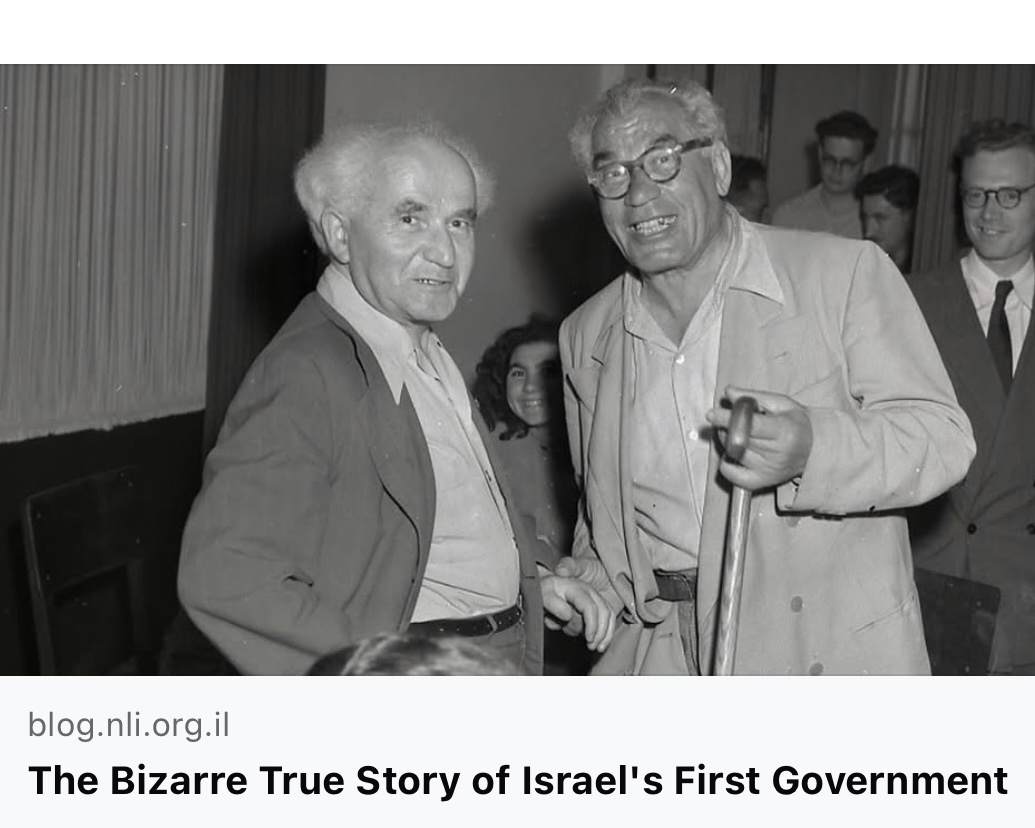
So far, the Eisenkot bloc has 65 seats, Arab parties included, to Netanyahu's 55. As crucial decisions loom, the @NLIsrael has reposted a timely piece on Israel's first government and coalition-building.
https://t.co/q9580tJ9z2
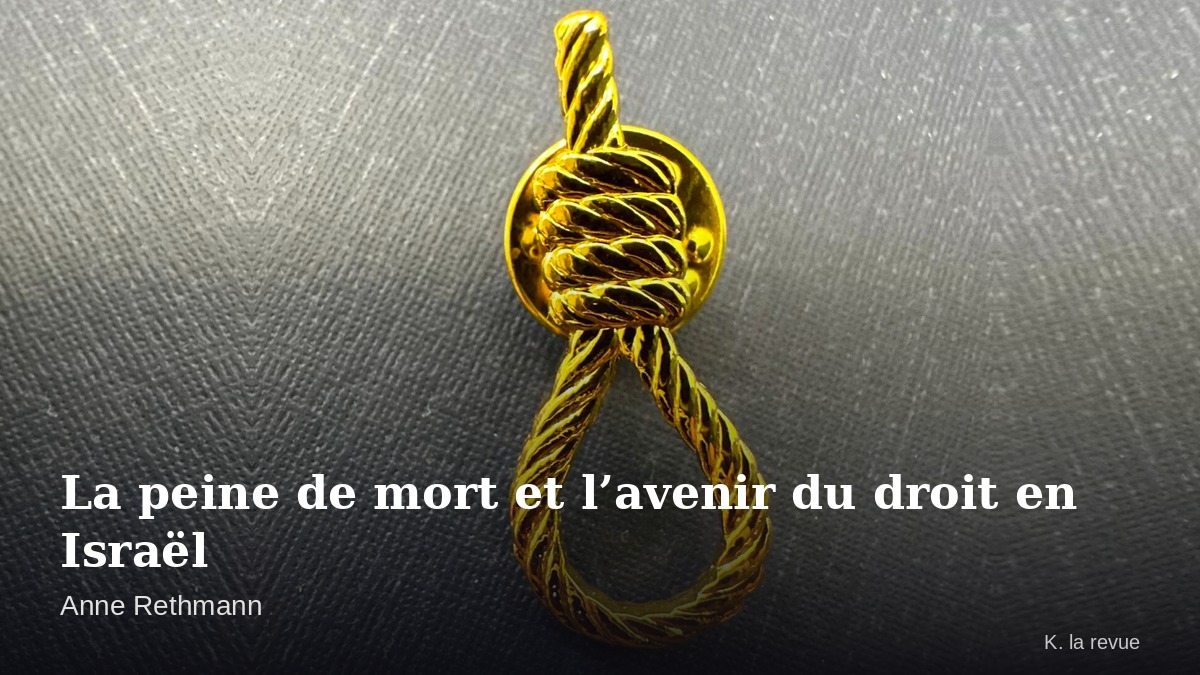
« La peine de mort est un test décisif, non seulement de la politique pénale, mais de la nature de l’État qu’Israël entend être. »
Lire le texte d' @AnneRethmann : https://t.co/GNxhId7PuJ
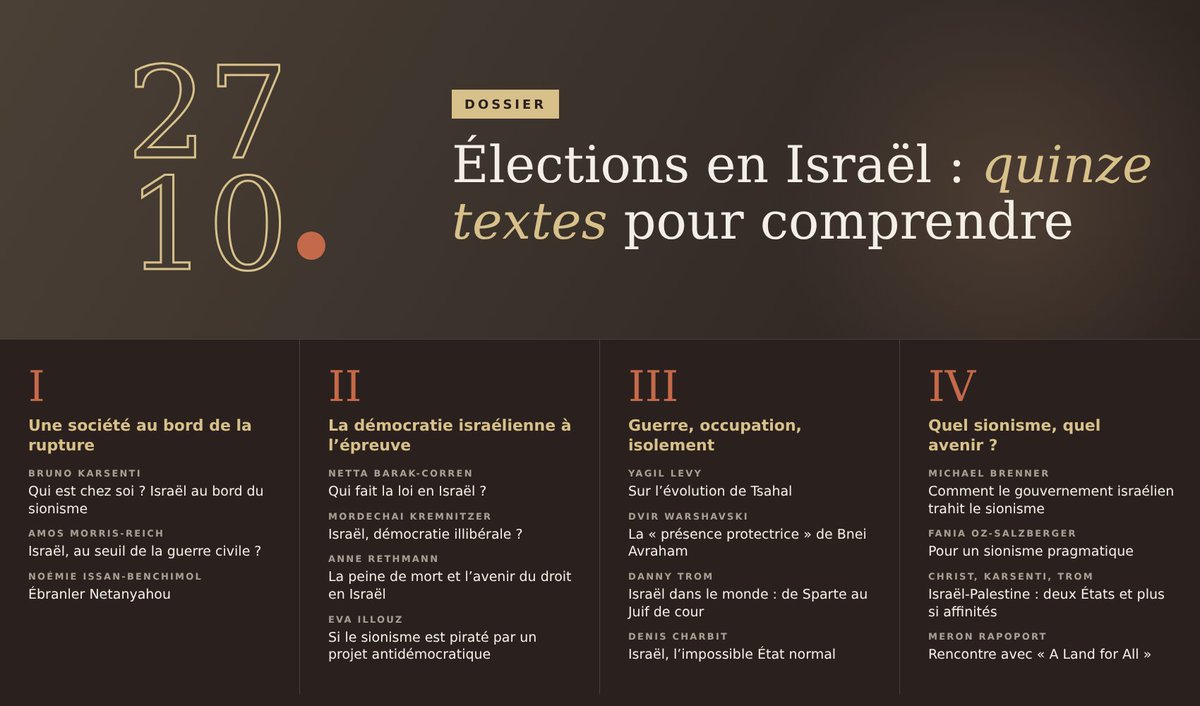
Élections en Israël
Les Israéliens votent pour la première fois depuis les massacres du 7 octobre et les guerres qui ont suivi. Pour saisir ce que cette élection peut changer, mais aussi ce qu’elle ne suffira pas à résoudre, K. a sélectionné quinze textes https://t.co/YlMDrmpAVA
Ahead of Israel's elections, @k_revue put together a dossier on Israel's present and future, available in French and English. Thank you for including my article on the death penalty.
https://t.co/es6PZDK85S
Dear followers, when you see hostile comments deriding young Israelis for singing about peace in a music festival, please follow my example and block these accounts. We need every ounce of hope and positive vibes as our election date draws closer. ❤️🩹
A video of young Israelis singing "Song for Peace" at InDNegev, ain indie music festival in the Negev Desert, near Gaza has gone viral, stirring nostalgia for a time when Israeli-Palestinian peace seemed possible | Video by @tomerappelbaum
🔗https://t.co/hRa50iIcIH
Yosef Aziadna, from the Bedouin community in the Negev, recalls #October7 for Edut 710:
"I didn't wait for it, and I didn't expect to be called a hero. I'm Israeli, and they're Israelis... We're all human. I did what is expected of a human being." (1/2)
https://t.co/BovgWbn3co
@Michael_Gilead I see your point, but I’m not sure equal value is invalidated here. Being justified in defending myself against a threat does not make that life less valuable; it changes what I may legitimately do. I agree, though, that judging whether someone actually poses a threat is crucial.
My article "Was kommt nach dem Leiden in Israel und Gaza?" is out in @faznet. Taking Carolin Emcke's "asymmetrical empathy" as a point of departure, I ask: Does the claim that every life counts equally have to rest on our capacity to feel with others?
https://t.co/S4935FzEQp
@Michael_Gilead I agree that empathy can serve an epistemic function. But I would distinguish between what helps us recognize the other and what makes their claim to equal rights valid. The latter has to hold even where empathy fails.
Almost one week at the @DubnowInstitut behind me and glad to be spending two months here as a visiting fellow. I particularly value its interdisciplinary approach and its understanding of Jewish history as a seismograph of broader historical developments.
In the shadow of the recent military confrontation between the United States and Iran, these are some of the people sentenced to death in Iran. They are very young, and this gives a sense of who took part in the January protests. Via @ICHRI
Mit Ernst Noltes Deutung, der Holocaust sei primär eine Reaktion auf sowjetische Verbrechen, begann der Historikerstreit. Für Habermas war diese Sicht revisionistisch. Im Gespräch erläutert der Historiker Dan Diner die Frontlinien des Streits. https://t.co/VADkHW9PzV
My dissertation, The Nonidentical of Human Rights: The Individual and the Concept of Dignity after 1945, has been shortlisted for the Deutscher Studienpreis of the Körber Foundation. I am very grateful to the jury for this recognition.
Further information: https://t.co/fahqRXjWOE
Looking forward to presenting in Berlin next week. My paper explores how early postwar Jewish engagements with human rights complicate the opposition between universalism and particularism in debates about human rights, memory, and the Holocaust. https://t.co/uPWdmyemg0
My article "The Death Penalty and the Future of Law in Israel" has been published in @KJewsEurope and is also available in French and Italian. Many thanks to the editors and translators.
https://t.co/tHKOlD4q7u
La Knesset adopte la peine de mort pour les terroristes. Anne Rethmann,chercheuse en histoire des droits humains, analyse ce basculement de l'État de droit :dans la lignée de la réforme Netanyahu, le droit ne sert plus de cadre, mais d'instrument politique https://t.co/GNxhId7PuJ
This is a really lovely insight into the indeed very famous #TelAviv Central Bus Station. No hip party scene, but people from the neighborhood and volunteers who did an amazing job cleaning up the space. Video by @unpackedmedia