@koeppelmann All in all there are many undesirable properties to be overcome here. Privacy, non-binding oversubscription to drum up prices, order books etc.
Probably doable, and Ethereum does have plenty of experience with token launches.
But an uphill battle for sure
DAO influence is not just about winning a delegate mandate. It is about retaining independent judgment after you have one.
Tomorrow’s DAO Work issue examines what delegates say earned trust before voting power. And why genuine alignment should not mean following a party line.
It includes perspectives from Evgeny (@haenko21 ) of
@NEARLegion; Francesco (@francescoweb3) of @castle_labs; Ivey (@IveyOnDuty ) of @SEEDGov; Pud (@K_Puddiin) of @Curia_gov; Raph (@raphbaph) of
@Anode_GG; Vini (@vinibarbosabr) and Zeptimus (@zeptimusQ) of @Giveth
Subscribe today to receive the full issue. Subscription details are in the first reply.
Email any questions to: [email protected]
@benInfinilex 100%! And making all of this legible, owned, resilient and explainable is why we built the LORE framework and advise DAOs on how to become investable.
Contracts need a legal person, but whether that person is a foundation, a company or an association follows liability and purpose constraints, and tax considerations.
In any way: Records must show how it the operating entity take direction from the community. Otherwise the entity is the decision maker and the DAO is branding.
Both are fine, but would advise to be transparent.
How @reserveprotocol decided on what to do with their treasury (50% of outstanding token supply) is a case study in DAO governance and tapping into the community's wisdom.
The winning proposal, and current implementation was proposed by an anonymous forum member, refined by comments on the Forum, and adopted by all token holders across 20+ DTF DAOs.
We helped rally community support, explain the stakes and the consequences and clarify the options.
We published an updated version of our DAO Delegate Handbook.
Dive in to see what makes a delegates useful for DAOs, what to avoid and how to be a great delegate:
https://t.co/owBMbR9cr9
Digital entity is only useful if the identity it creates travels. On-chain organizations need a structure courts, banks, investors, and counterparties understand beyond the jurisdiction that formed it. This is why we built LORE, a governance framework for DAOs that want to go beyond permissionlessness.
DAOs take note! Governance needs to be developed as an integral part of the offering and protocol.
This will be expected of DeFi by institutional players.
Get ahead of this today.
Governance can't be a last-minute add either.
Rule 5605 generally requires a majority-independent board and an audit committee of 3+ members with specific independence and financial-literacy requirements. A board that ran informally usually needs real restructuring here.
@MIDAODS Early is best, but it's never too late. For DAOs that want to go in the right direction, we designed our LORE framework, which distills the most important parts of IOSCO, Basel and DORA among others.
https://t.co/lx8j6ftPbx
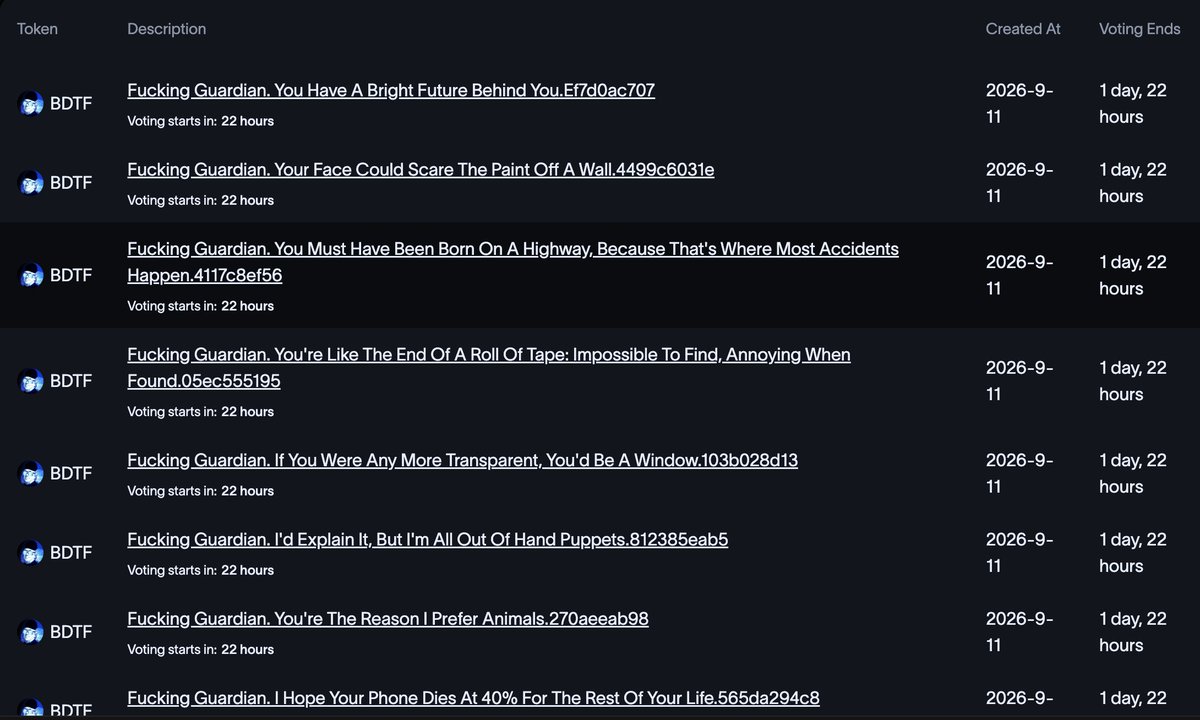
The @reserveprotocol governance attack has shifted into next gear. After a malicious proposal on a DTF with < $5,000 market cap passed the vote, guardians cancelled the proposal, as they should.
The attacker now used a script/bot to launch 1656 malicious proposals with titles starting with "Fucking Guardians:..."
This is basically a denial of service attack. The malicious proposals completely drowned out any legit proposals that were active, and are so numerous that the Reserve app (https://t.co/6LUAUIKWLi) can no longer display all malicious proposals.
What to do?
We recommended to pause the token and then find a way for holders to withdraw their funds. The DTF had no interactions for months, so interest seems to be low.
Cyber security and governance security has completely changed in the age of cheap AI, low TVL tokens and plenty of angry people. The days of WAGMI are gone.
@itzpreshX@rollxfi Enjoying the open thinking and transparency here.
We'd recommend to be very intentional with what this should achieve, where permissions are recorded, how they are evaluated and who gets to chose the parameter set.
Transparency is key.
For a Swiss Stiftung the runway rule is the threshold the Stiftungsaufsicht reads the annual report against. If reserves can't cover roughly the next year of obligations, the Aufsicht can step in, and worst case redeploy the assets to a successor purpose. The thread is right; the foundation version has a supervisor attached.
There are ways to use options for market-making which increases liquidity without the buy pressure though.
@dangsoun Permissions here are a key feature. Now who sets these permissions? Where are they documented? Where are the escalation paths and procedures?
Our LORE framework would be priceless here.
Polkadot is always ahead of its time. The role of the Web3 Foundation might have run its course now, and the time could have come to transition control to the community more.
This is a great initiative. We'd love to see more.
We're helping steward transitions from Foundation to founders or community for other chains as well. Finding a compliant and solvent path that preserves what needs to live on.
Exactly the drum we're beating. Permissionlessness is NOT the same as decentralization.
In fact decentralization in DAOs is about transparency, ownership, legibility and resilience.
This is why we designed the LORE framework, which takes the best parts of the major financial regulations and translates it to DeFi.
We published a proposal calling for all DTFs to follow time tested governance procedures.
The RFC calls for two core governance upgrades across the Reserve ecosystem:
Mandatory Standard Governance Flows: Require all Index and AI DTFs to follow the standard DTF Governance Requirements that Yield DTFs have successfully utilized for years.
Optional: Transition to Permissioned Governance (Curated Proposers): Eliminate arbitrary addresses ability to on-chain proposal creation. Instead replace it with a curated, pre-screened proposer framework to protect stakers, governors, and users.