Now I know why God wouldn’t let me read my Cepher Bible. They even named it after kabbala. You can’t divorce modern Hebrew from the occult. You can use the star of rempham to make all the letters. Created for making spells, it’s witchcraft. And now we know why everyone is going insane.
Yes—Phoenician is very close to Paleo-Hebrew (the language and script of ancient Hebrew) and related to Aramaic, as all three belong to the Northwest Semitic language family.
• Paleo-Hebrew (Very Close): Both Phoenician and ancient Hebrew belong to the Canaanite subgroup. They share core vocabulary, grammar, and significant mutual intelligibility, especially with northern Israelite Hebrew. Their early scripts are also closely tied and nearly identical in early inscriptions, with Paleo-Hebrew branching off from the Phoenician alphabet. Opinions on Reddit are mixed on whether they are better viewed as closely related dialects or distinct languages.
• Aramaic (Related, More Distant): Aramaic sits in a separate branch of Northwest Semitic rather than Canaanite. It shares many cognates and historical contact with Phoenician and Hebrew, and the Aramaic alphabet evolved from the Phoenician script, but it has distinct sound and grammar shifts that make it less immediately close than Hebrew.
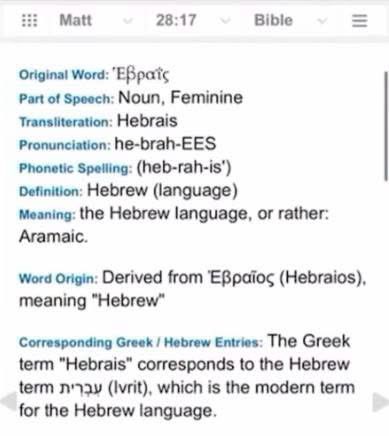
Strong's 1446 Greek to Hebrais proves that the Hebrew that was spoken in the time of messiah was actually Aramaic...
Hebrais (Ἑβραΐς, Strong's G1446) is a Greek noun meaning the Hebrew language or the Hebrew-Aramaic dialect spoken in first-century Judea/Palestine.
Biblical Usage
In the New Testament, hebrais appears three times—all in the Book of Acts:
• Acts 21:40: Paul addresses the crowd in Jerusalem in the Hebrew/Aramaic tongue.
• Acts 22:2: The crowd grows quiet as Paul speaks to them in that language.
• Acts 26:14: A voice speaks to Saul (Paul) in the Hebrew/Aramaic language on the road to Damascus.
Linguistic Nuance
• Hebrew vs. Aramaic: While hebrais literally translates as "Hebrew," scholars note that in first-century Palestine it often referred to the everyday Aramaic dialect spoken by Jewish people, alongside classical/literary Hebrew.
• Related Terms: A Hebraist is a scholar or specialist in Hebrew and Hebraic studies, and a Hebraism is an idiom or phrasing rooted in Hebrew thought or grammar.
@brucewalkie@AKAWatchmen@CovenantReform2 Maybe if you’re an idiot, who’s never actually read the Bible. Go love your neighbour instead of being a religious zealot. You’re useless to the kingdom. Tare
@brucewalkie@AKAWatchmen@CovenantReform2 Nope, actually you can’t prove me wrong or the Greek. All you have is Jewish propaganda because that’s what you are. We see you Zionist cucks for what you are
@brucewalkie@AKAWatchmen@CovenantReform2 You’re an accuser. If you’re judging people by holy days and food, you belong to the synagogue of Satan. And the Muslims. You’re not set apart from anything.
@brucewalkie@AKAWatchmen@CovenantReform2 You’re supposed to be set apart in your heart. Not in your religion. We have a new religion. James 1:27. Jesus didn’t come to bring us more religion. If you think you were created to be a religious nut bar, then you don’t know God.
@Ki_janah@BlessedOne14616@mmamasaidd The character of God is 1 John 3:12. It’s not holy days in food. If you’re reducing or comparing God to holy days and food, you’re going to hell.
Don’t think you’ll be promoting Jewish propaganda on Twitter without somebody like me correcting you.
Greek is actually ancient Hebrew. This book is very censored.
JESUS was a Greek speaking Hebrew, from the Greek speaking province of Galilee! Being a tradesman (carpenter), Greek would have been a requirement! Being that Greek was the international language of trade in the 1st century BC/AD. For the most part the Aramaic language was confined to Judea, and even then the common people spoke Greek. JESUS more than likely knew Aramaic as a secondary language. We know that JESUS was able to speak fluently with both Pilot, and the Pharasees.
The LXX Greek Septuagint is a Greek translation of the OT scriptures. It was translated from the original Paleo Hebrew scriptures, not using the Aramaic! The miracle was that there were 70 (LXX) Jewish scholars working on the translation together, but separately! That is, they each had their seperate space; apart from the others! When they brung their works together each scholar translated the text exactly the same! Word for word, and book for book! This all happened in Alexandria Egypt!
The synagogues also had their beginning in Alexandria, about the same time as the Septuagint. The synagogues, and the Septuagint spread together from there. The Greek scriptures were known as the scriptures of the synagogues. It is said that the last Paleo Hebrew Scroll parished when the Temple was destroyed in 70AD! The Aramaic scrolls called the targums survived, but were nothing more than paraphrases! Such as our "living Bible"!
In your KJV, everytime the OT is quoted in the NT the Septuagint is used. That is why there is a wording change in the NT from the KJV OT. The OT was translated from the Masoretic texts. This clearly shows that JESUS, and His Apostles read; and quoted from the LXX Greek Septuagint! Giving the Greek scriptures His authorization!
I must note that the Masoretic texts came into existence beginning approximately 800 years after the 1st advent! The reason they came into existence was to counteract the growth of Christianity! The Christians were proving JESUS by the LXX Greek Septuagint!
A lowly servant of JESUS CHRIST
https://t.co/Fp0InRXee2

📘 2. Modern Hebrew.
HEBREW 2.0
Created in: The late 1800s – early 1900s
By: Eliezer Ben-Yehuda (a secular Jew, not a rabbi or prophet)
Purpose: To revive Hebrew as a national language for the modern state of Israel (Zionism)
❌ Characteristics:
• Reconstructed from biblical texts mixed with European grammar and modern influences.
• Lacks the sacred pictographic nature — it uses the “Square script” (Aramaic-based block letters).
• Filled with Yiddish, Germanic, Slavic, and even Arabic influences.
• Introduced vowel points (nikkud) which never existed in the original texts — added by Masoretes centuries later.
• Often distorts meanings found in original Hebrew scriptures.
@DrShayPhD Jesus or no Jesus those are your salvation choices. You’ll never be perfect enough to stand before God. You will fail every day. Only Jesus and His blood imputed you with righteousness.
📘 2. Modern Hebrew.
HEBREW 2.0
Created in: The late 1800s – early 1900s
By: Eliezer Ben-Yehuda (a secular Jew, not a rabbi or prophet)
Purpose: To revive Hebrew as a national language for the modern state of Israel (Zionism)
❌ Characteristics:
• Reconstructed from biblical texts mixed with European grammar and modern influences.
• Lacks the sacred pictographic nature — it uses the “Square script” (Aramaic-based block letters).
• Filled with Yiddish, Germanic, Slavic, and even Arabic influences.
• Introduced vowel points (nikkud) which never existed in the original texts — added by Masoretes centuries later.
• Often distorts meanings found in original Hebrew scriptures.
@LeeCashusx7@DrShayPhD Jesus said like the birds and the foxes. Argue with him about it like the lilies that do not toil. Like the wind. Children of God do not watch days and months and years and we don’t care what we eat. Because we know that doesn’t make us righteous.
@LeeCashusx7@DrShayPhD It comes by nature. Romans 2:14. I knew him for 35 years before I ever read a Bible. His law was written in my heart as soon as I believed. Do you know how to love your neighbor?