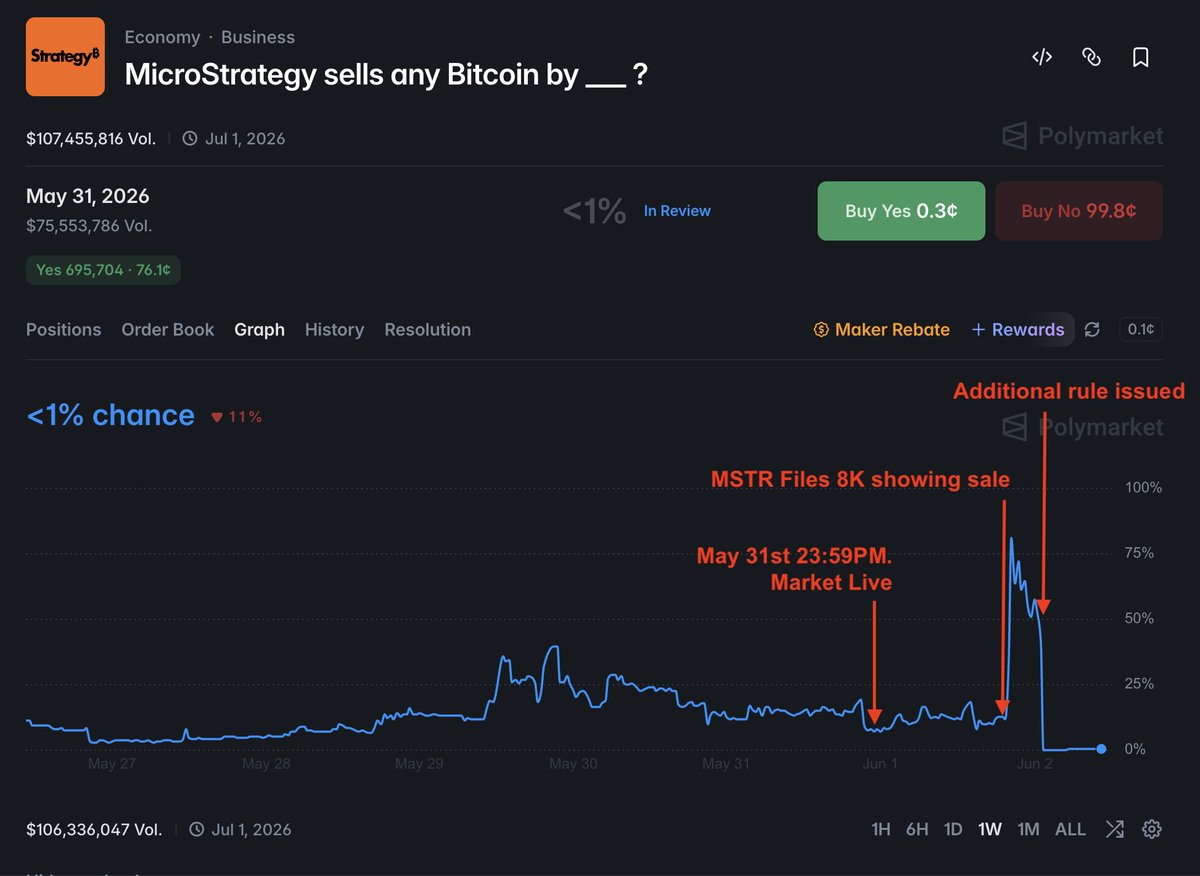
Polymarket is really starting to bite off more than they can chew with some of these event contracts that they’re unable to resolve fairly.
My feed is now flooded with examples of dubious resolutions.
Let me not mince words here:
UMA is an oracle that has not improved since its release 6 years ago.
Polymarket’s approach to rule alterations adds insult to injury, making legitimate forecasting impossible. It’s textbook “moving the goal posts,” and in inconsistent directions at that.
Everyone is speculating as to whether Polymarket adopts a new resolution system, but based on their attitude towards current resolutions, any new system they introduce will likely have the same shortcomings.
‘@Trueo_ is gonna bring life back to briplo with the next release.
We about to harness the unlocks from AI and capitalize on the boredom of CT.
The things we’ve been doing onchain for the past 7 years are getting played out.
CT needs a new outlet. We about to give em that.
After failing to bring in new users and retain them through the streaming meta and the creator meta, @Pumpfun is now targeting people in developing countries who are willing to do degrading things to earn money.
@a1lon9 knew this would happen, yet decided to go in that direction anyway.
Imagine the level of cynicism and greed you need to have to do that after banking a billion dollars.
So, when do we collectively hold these morally bankrupt dogs responsible for the decay of our industry and cancel them?
Polymarket just produced a market for whether the Zcash bug had been exploited in the wild.
We created the same market yesterday.
I’ll let yall decide which rules are better.
FYI, I was able to generate our rules with a single prompt. And soon anyone will be to able as well.
The Polymarket for MSTR selling BTC in May had a hidden rule.
That rule actually shifted the market deadline from May 31st to May 25th.
It wasn’t stated explicitly in the contract, but many rule hackers or “sharps” were aware of this lacking context.
I call this flaw “context-lacking markets.”
Meaning that the market rules do not capture the context of the event it is covering.
They say that evidence after the market deadline shouldn’t count.
But the way the market was designed, it excluded any and all activity between May 25th to May 31st.
Why?
Because MSTR only reports its BTC buys or sells from the previous week on Mondays when it files its 8-K.
This has been the pattern for a while now.
In fact, I don’t recall when Saylor made an explicit announcement of buys or sells inconsistent with that weekly filing in recent memory.
So as of their 8-K filing on Monday morning May 25th, this market was effectively already a NO for all intents and purposes because the next filing fell outside the “evidence deadline.”
A rule that was not explicitly stated, but that some traders secretly knew about.
Sure Saylor could have made a random announcement that he sold BTC mid week, but that would be such a deviation from the norms that the odds of such a thing were lower than the odds of the market itself.
So basically taking the NO side was free money for 7 whole days.
For 7 days YES buyers were getting exploited by rule hackers.
Why is this egregious?
Because think of a Polymarket for whether “Nvdia earnings will see a quarterly decline in any quarter of 2026.”
Now imagine setting the deadline for this market to be before Nvidia’s earnings call for the last quarter of 2026, but not specifying that “evidence submitted after the deadline” will not be considered.
Then as we enter that final quarter, everyone who knows this hidden rule can make free money for months on end.
Polymarket knew that it was too late for the market to resolve to YES, UMA voters knew, and all the badge holding rule hackers knew.
Yet it wasn’t publicly shared for the whole period that the market had all but resolved on paper.
The market rules lacked context.
A critical part of the market’s timeline was privately voided until after the evidence had surfaced and a clarification had been issued.
This is what I mean by a context-lacking market.
On top of that their market format is fundamentally flawed.
The market rules and sources are put in the same description instead of being separate fields, so sources are often given little thought.
In this case, they cited “onchain transactions” as a resolution source in the rules despite the fact that it is impossible to determine whether a BTC transfer is evidence of a sale.
Another example of lacking context.
funny enough, the closest thing to onchain proof of a sale did occur when MSTR transferred 400 BTC to Coinbase prime on May 29th, but obviously that wasn’t considered as definitive proof.
Which begs the question, why was it a listed source in the rules in the first place?
Because the market was lacking context on several fronts.
To be clear, this is different from ambiguous rules.
for the market in question, aside from the meaningless onchain proof source, the rules were quite clear.
And by its literal interpretation, the market criteria was satisfied.
But the intention of the market wasn’t a literal interpretation of the rules, or even the spirit of the market.
The intention was missing completely.
A hidden secret shared by a select few.
This is why the market was trading in a void for a whole week.
If you knew, you were making free money.
If you didn’t, you were getting rinsed.
Im doing so pure gamble speculation move here on $BABY.
Babylon has 51k BTC staked around $3B, while BABY mcap is only $ 60M.
That gap is stupid enough to become a narrative.
Native $BTC staking/collateral, Aave angle big backers.
But the real bet is simpler:
perps look loaded, funding is ugly and this could be the next $MYX $RAVE type crime pamp.
Pure casino. Could be wrong. 👀
GAS COST UPGRADE WATCH ⛽
EIP-8037 Glamsterdam EIP-8037 scheduled for Glamsterdam hardfork: gas cost of creating new accounts and writing to new storage slots increases 5-8x.
The L1 war is basically over.
ethereum:native @ethereum won serious finance: security, settlement, stablecoins, RWAs, institutions.
And the old ETH is slow, expensive and fully exposed meme is dying too.
Ethereum is scaling the base layer itself now:
higher gas limits, cheaper execution, better UX, native account abstraction, FOCIL, keyed nonces, Kohaku, shielded balances and a real privacy roadmap.
$SOL @solana won the casino: speed, memes, trading, degeneracy.
That’s crypto now.
Serious money on Ethereum.
Degen money on Solana.
Everything else is stuck in the middle.
And the middle is where L1s go to die.
You wanna bet on a market that doesn’t exist.
On @Trueo_ you create it in seconds.
Once it graduates, you share it around. The trading fees? They’re yours to keep.
Bet on your beliefs, and your own markets.
Polymarket proved prediction markets have demand.
But the next winner is settlement infra.
$TRUE @Trueo_ is already live on @base : onchain rules, TYD yield bearing USDC collateral, Uniswap v4 YES/NO liquidity and token aligned oracle governance.
@VitalikButerin has already been pointing at this direction.
$3.4M mcap feels early.
https://t.co/MjHfxyeNxp
$ETH
This @Polymarket market needs to resolve YES.
If the event happened settlement has to follow reality not technical loopholes.
Refunding YES holders still wouldn’t fix the reputation damage. The entire product is trust in resolution.
I bought some YES as a gamble but if this goes NO it’s a brutal signal for PMs.
That’s why I think $TRUE is one of the most undervalued plays in the sector.
@Trueo_ is already live built around onchain settlement, yield bearing collateral, token aligned oracle/governance and DeFi native liquidity.
Trueo user created markets are launching this month.
Polymarket proved demand.
$TRUE is building the better rails.
$4M mcap.
https://t.co/MjHfxyeNxp
$ETH $SOL