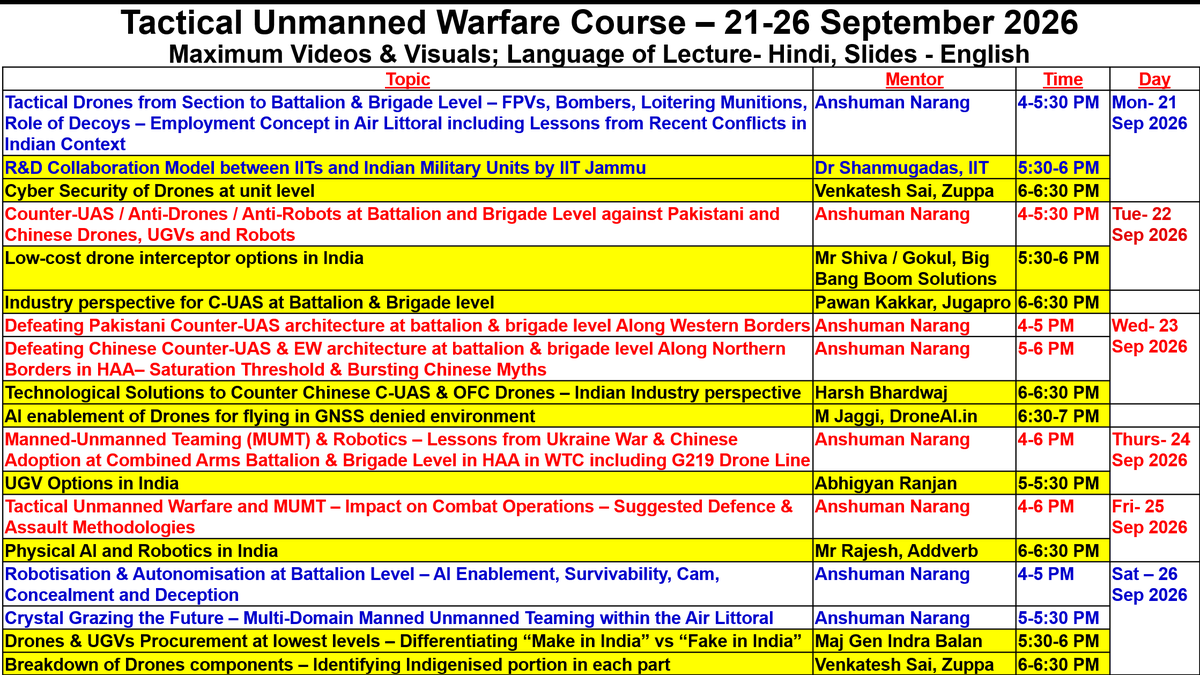
Indigenous Capability Development for Unmanned Warfare at Battalion and Brigade Level is the need of the day. Team Atma Nirbhar Soch @AtmaSoch is exactly addressing that need through its next online course on Tactical Unmanned Warfare Course from 21 to 26 September 2026.
Contact 7896414035 / 8437277128 to register for the course.
Aim- Strengthen doctrine, indigenous capabilities to defeat adversaries, deepen R&D collaboration between industry, academia and military, highlight Indian industry developments & facilitate AI-enablement.
Method- Online, 2:30 hours every day, presentations shared, recordings shared, certificates provided.
Fee – Rs 2500/-
ANS Family (attended any ANS Course earlier) - Rs 2,000/-
Organisation / Institute Fee Structure – Rs 8,000/-
(Five devices, unlimited number of persons)
ANS Organisation Family (undertaken any ANS Course earlier) - Rs 6,000/-
Objectives-
1. To understand the evolution of FPV / OFC FPV / Bomber / MMDS / kamikaze drones / loitering munitions & tactics of drones warfare from section to battalion & brigade level
2. To analyse Chinese & Pakistani Drones at section, platoon, company, battalion & brigade level
3. Study the conceptual contours, technologies & essentials of Counter-UAS grid at battalion & brigade level & understand Indian industrial perspective
4. To study evolution of UGVs & Robots
5. To study Russia-Ukraine war, & ongoing conflicts & analyse role of drones, UGVs & robots in conduct of defence & offensive operations at company & battalion level
6. To appreciate PLA’s employment of drones at from section to battalion & brigade level
7. To understand the requirements of AI enablement of drones & C-UAS at battalion & brigade level & target profiling of PLA & Pakistan’s vehicles & infrastructure
8. To understand the employment of UGVs, MUMT & Swarms at battalion level
9. To bridge the gap between the academia, industry & military by providing various perspectives of Indian Indigenous industry & how to undertake collaborative R&D between Academia organisations like IITs & military organisations
10. To analyse how to defeat Pakistani & Chinese C-UAS systems at battalion & brigade level
https://t.co/VZSB2SpTwQ strengthen indigenisation by clearly differentiating between “Made in India” and “Fake in India”
https://t.co/GzqI16iOkV strengthen cyber security of drones & C-UAS platforms at battalion & brigade level
Chinese answer to a key question "Why can't PLA capture Indian state of Arunachal Pradesh today?". An unofficial Chinese article at https://t.co/lCScqr9XyB (link given at end) first gives the infrastructure development which has taken place and what is balance & then concluding verdict. Could be intentional Chinese propaganda timed with forthcoming Xi Visit.
My assessment- The article states the truth. Chinese are currently building the Strategic Shi physically, cognitively and multi-dimensional, making settlements irreversible near disputed border areas, stabilising Tibet internally by assimilation (ethnic & logistics constraints were major Chinese lessons of 1962 war) & try to gain assured launch move on Weiqi board. Till then, Hot shelving in a quasi war & permanent crisis state is their solution to keep gaining small victories (Winning without fighting & without provoking) at every opportunity so that overall they have a favourable situation every year. An Apple Map image & Copernicus time series is used to make people understand key geographical areas mentioned.
Now what the article says - Purely Chinese perspective
1. "severance" - The real enemy in Arunachal Pradesh is not Indian army, but extreme natural barriers & supply disruptions during winter. To put it bluntly, in early days, it wasn't that we were unwilling to station troops or defend our territory on front lines of Arunachal Pradesh, but rather that objective conditions simply did not allow for a long-term presence.
2. Decades of infrastructure development has solidified core lifeline of rear area (in Chinese occupied Tibet) - Lhasa-Nyingchi Railway has reduced travel time from Lhasa to Southeastern Tibet from 7-8 to just >3 hours but has not opened up last supply link from hub to front-line control line.
3. Paimo (Pai-Metok) Highway through Doshungla Tunnel has reduced distance from Nyinggchi to Metok by nearly half & reducing travel time from 8 to just >2 hours. (Please note that is where Chinese Centurion Project Metok Hydropower Project is being built to transfer 60 gigawatts of energy from occupied Tibet to their mainland Guangdong onwards as part of East to West Energy Grid). Original Zhamo Highway has been continuously upgraded , forming a two-way closed loop with Paimo Highway. See Fig 1 & 2.
4. The conditions for stationing have been comprehensively upgraded, shifting from seasonal rotation ("entering in summer & leaving in winter") to year-round stationing. Today, all outposts along India-Tibet border have undergone comprehensive upgrades & renovations, with new insulated barracks, full-area indoor oxygen supply system, constant-temperature canteen, clean water & heating facilities all available, transforming them into permanent border defence positions. Retaining personnel is only first step; preserving equipment & combat effectiveness is core objective. All logistical support plans for plains areas become ineffective on plateaus. We have established a complete oil storage & transportation network, including rear oil depots, transit stations & forward supply points. Relying on permanent fortifications & mountain facilities along route, we provide continuous energy support for plateau armoured formations, weapons & equipment, ensuring that equipment in HAA can be started up at any time & combat power can be fully mobilised at any time. These hidden facilities along plateau highways & inside mountains are not temporary fortifications, but permanent, indestructible strategic assets, and core source of confidence for long-term garrison in South Tibet.
5. Today, multi-level, 3-dimensional delivery network (Please note in Tibet they call it 5 cities, 3 hours, map graphic at Fig 3) consisting of railway arteries, all-weather highways, mountain tunnels, plateau airports, heavy helicopters, & intelligent drones has been fully formed, & "supply disruption" has become a historical term on the plateau battlefield (please note that despite this propaganda, it took 55 hours plus for first PLA soldier to reach Gyirong GLOF imoact area). Mass deployment of Z-8L heavy-lift high-altitude helicopter has filled the last supply gap in HAA border defences. Domestically produced high-altitude intelligent transport drones have been fully deployed in border defence combat readiness drills. They can take off & land autonomously & deliver goods accurately in extreme rain, snow, strong winds, & low temperatures, making up for blind spots & weather limitations of manned aircraft operations. (Please note this is G219 Drones Line being created by PLA in conjunction with G695- sample at Fig 4)
6. Advantages continue to rise, but risks are quietly escalating. The protracted standoff on Tibet-India border has long since evolved into a time-consuming & costly logistical infrastructure tug-of-war, a test of endurance, resilience, & financial strength. Such a protracted struggle can easily erode public patience & breed impulsive, emotional decisions. These risks are unrelated to logistical capabilities; they are purely driven by subjective emotions. The density of forward patrol forces on both sides continues to rise, seemingly giving us an increasing chance of victory & a stronger hand (purely Chinese assumption). However, the irrational risk of accidental clashes and sudden conflicts is actually higher than in previous years. In this protracted battle, whoever can maintain a steady pace, stay true to their original aspirations, and refine their strategy will be able to firmly grasp ultimate strategic initiative .
7. Top-tier overt strategy: Using irreversible infrastructure to secure permanent sovereignty (please note this is STRATEGIC SHI which PLA wants to gain). The so-called physical control means transforming abstract national sovereignty into a visible, tangible, and irreversible geographical entity through highway extensions, tunnel construction, pre-positioned warehousing, on-site barracks, and full communication coverage. While other side makes empty claims to sovereignty and engages in verbal manoeuvring, we have transformed our paper sovereignty into actual control through every km of highway, every meter of OFC, & every permanent fortification. Troops can be temporarily mobilised and withdrawn after a war, but roads, warehouses, tunnels, and communication facilities rooted in the country can never be removed or dismantled. The ultimate logic of border games is never about piling up troops & winning in the short term, but about changing the temporal & spatial attributes & stationing rules of plateau border through a continuously improving logistical system. Today, with insulated barracks, all-weather tunnels, mountain storage, routine aerial patrols, & full-area OFC monitoring in place, our presence in southern Tibet has become permanent, uninterrupted control 24/7, 365 days a year. This is the ultimate core of border defence: it's not about how many troops are stationed on the front lines, but about having comprehensive infrastructure that completely blocks any possibility for the enemy to take advantage of any weaknesses. India can't learn this strategy even if it wants to. (very important Chinese deduction here) Southern slope of Himalayas has loose geology & is prone to disasters. Large-scale tunnel excavation & mountain construction are extremely risky costly, making it unsuitable for large-scale infrastructure projects (please note that is why Chinese blocked German transfer of TBMs to India). In contrast, the northern slope where we are located has stable hard rock geology, which is naturally suitable for the construction of super-high-altitude projects. This is a unique and irreplaceable advantage of favourable timing and location. Negotiation is a means to stabilise situation, but infrastructure construction is trump card to win the future. All the bargaining power at the negotiating table stems from strength of steel bars and roadbeds built on our land. (THIS IS KEY TAKEAWAY FOR INDIAN NEGOTIATORS & STRATEGISTS)
8. Objective review: We are gradually developing the ability to defend our territory. can we hold onto Arunachal Pradesh? - Answer is not an absolute yes or no, but rather that it is steadily being developed, gradually improved, and will soon be fully formed. We can securely hold rear hubs & main channels without any pressure, but if we want to station heavy combined arms forces in front-line river valleys for a long time & maintain high-intensity combat readiness, we still need time to make up for infrastructure shortcomings. This is also core reason why our country has always maintained strategic focus & remained inactive: time is not right, shortcomings have not been addressed, & we will never rush into action. Our greatest strategic confidence comes from irreversible nature of infrastructure development. We can stabilize situation & contain our opponents through diplomatic negotiations while continuing to advance infrastructure construction southward, taking steady steps and establishing a solid foundation. (PLEASE NOTE HOT SHELVING IS THE LESSON WHICH WE ARE MISSING - NEGOTIATIONS ARE ONLY TIME PASS TO BUILD THE STRATEGIC SHI- EARLY HARVEST ARE ALL WORDS TO FOOL TO BUILD INFRASTRUCTURE AS THEY DID FROM 1959 TO 1962)
9. India's fatal weakness in logistics: gap is already enormous. India's supply system in Aruncahal Pradesh front has fatal structural weaknesses & single-point risks. Its core passage connecting the front-line mountain pass is only a one-way two-lane road, & supply lifeline for the hundreds of thousands of troops stationed on entire front line depends entirely on this fragile road. If any bridge, tunnel, or road section is damaged or blocked, entire forward supply chain will be instantly paralyzed, & front-line troops will be left isolated & helpless. Even more critically, India's forward supply depots are mostly makeshift barracks & open-air storage areas, lacking any underground protection or fortifications. In the event of a conflict, a single precision strike could deplete their months-long stockpiles of supplies, causing a direct collapse of their front-line combat capabilities. This fragile supply line is completely unable to withstand a high-intensity, prolonged war of attrition.
(Now Chinese conclusion and verdict in their own words which is well known that they will not go to war until the following)
"When we are able to routinely deploy heavy combined arms forces at an altitude of 4,000 meters, deliver supplies to the front lines year-round despite wind and snow, stockpile sufficient combat readiness resources for sustained operations in mountain warehouses, and ensure the normal life and duty of officers and soldiers in extremely cold environments, then the territory of southern Tibet will truly be firmly in our hands. If these things cannot be done, no matter how far military advances or how great battlefield advantage is in short term, it will eventually be limited by supply shortages, repeating mistakes of history & being forced to retreat. The ongoing national super infrastructure project in Arunachal Pradesh is essentially transforming the disputed area from a "seasonal presence and passive standoff" into a "sustainable, normalized, & permanent" strategic frontier for our side. Every extended highway, every tunnel that is completed, and every facility that is put into operation reduces risk of military conflict, expands space for political solutions, & strengthens our confidence in our sovereignty. The final answer to Arunachal Pradesh issue has never been found on military simulations or in passionate public opinion, but rather on construction sites of Tibetan Plateau, amidst roar of machinery, and in every inch of roadbed that continues to extend southward. The ability to hold the line, maintain stability, & secure gains is not a temporary battlefield condition, but rather long-term result of countless infrastructure projects, logistical systems, & strategic layouts accumulated over time. Once this strategic infrastructure system for plateau is fully completed & its shortcomings are completely addressed, the final outcome of Arunachal Pradesh issue will have already been quietly predetermined"
https://t.co/phlKRT9yqq
Chinese authors published a drones warfare analysis on India-Pakistan drones conflict during Operation SINDOOR in May 2025 at https://t.co/5YaBq9wlk8
A special thanks to @mikeslackenerny for sharing the link. While my original monograph on employment of Pakistani drones (Chinese - https://t.co/j5Se8sry70, Turkish at https://t.co/vnSFG5dosh) have covered the conflict immediately after it, this document coming 16 months later highlights two variations;-
1. Use of Israeli Skylark short-range drone (look at translated table at figure below). This is the most revealing part of the document. If it's true, this needs detailed corroboration and investigation. While this may just be a Chinese bait, it requires corroboration. The document misses out the Russian S-250 drone which I had covered. In both cases, Russian and Israeli drones support to Pakistan against India are worth noting.
2. The next interesting claim is use of FN-6 MANPADS to down Harop drones. Without any proof, this is again Chinese marketing of their export weapons with a lot of salt.
Rest there is nothing new which the report highlights and in fact over assumes a few issues particularly on AI.
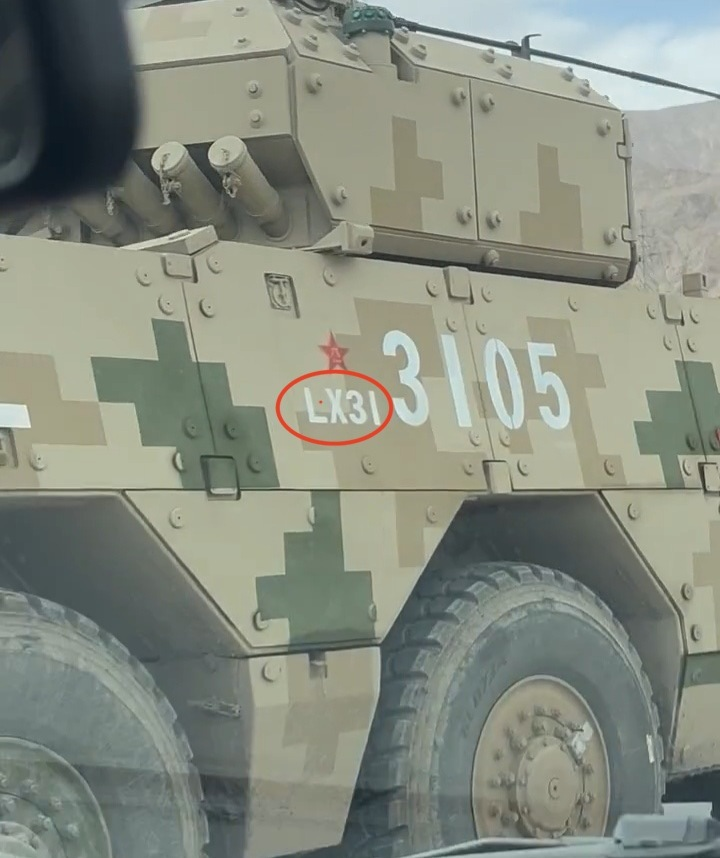
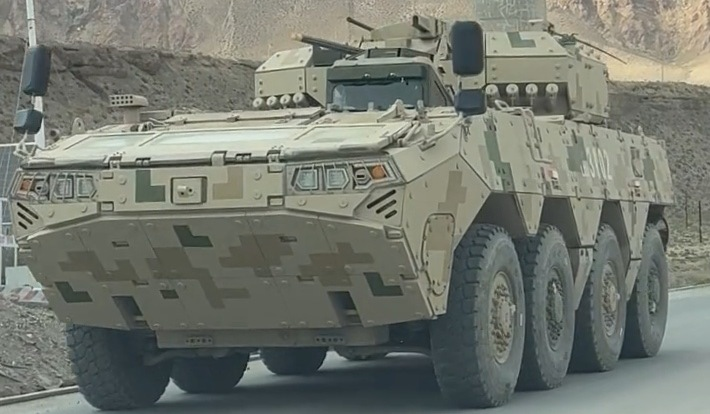
China PLA PLAGF Western Theatre Command is inducting ZBL-19 IFVs at an accelerated pace. While 76th Group Army was confirmed earlier, even 77th Group Army has inducted the same most probably.
Latest photo (if Chinese propaganda photo with LX31 tactical numbering is to be believed) confirms ZBL19-T12 IFV version with 39th Combined Arms Brigade ex 77th Group Army.
39th CAB was earlier assessed to have received T-59 tanks from 12th H-CAB as per various OSINT inputs. This wasn't so tactically logical particularly since 77th Group Army likely to operate in Tibet Military Region. So, it makes sense that 39th CAB may have Medium CAB with induction of ZBL19 IFVs.
Many OSINT personnel also assess induction of a different version of ZBL221E (VN1G) which as per me is not this version inducted in WTC.
Global Times vide its aticle "PLA Army fields new wheeled armored vehicles in Gobi Desert" on 11 August 2026 at https://t.co/fumkYqKRC4 had confirmed induction of ZBL-19 with a brigade of 76th Group Army in 2025. The earlier brigade with ZBL-19 IFVs in 76th Group Army was 149th Medium CAB (LX15). So, Chinese propaganda may have shown same brigade or may have indicated ZBL-19 with another brigade. If it's one more brigade, then WTC is undertaking Mediumisation of its CABs which makes more sense to enhance mobility with massive road infrastructure upgrades which have already happened - G4219, G4218, G219, G695, G94 etc.
The Global Times article amplifies ZBL19 IFV as under - "The new 8x8 armored personnel carrier features an unmanned turret and anti-tank missiles, and its tailgate can be figured to open either sideways or downward. In 2025, the company received new equipment. For the PLA soldiers, the challenge extended beyond changes in specialized skills to include upgrades in training models and combat concepts, said the report.
The new IFV is a deep redesign of the Type 08 wheeled armored vehicle family, with comprehensive improvements in firepower, protection, mobility, informatization and ergonomics, Zhang Junshe, a Chinese military affairs expert, told the Global Times.
According to a CCTV report in June, the vehicle has several new features: high mobility and speed suitable for all-domain operations; an unmanned turret offering wider visibility and higher automation, improved protection and crew safety; amphibious capability; long-range vehicle-mounted anti-tank missiles; and a flexible tailgate that can open either sideways or downward, combining both options in one design.
Compared with the Type 08, the new model has significantly enhanced firepower. It introduces an unmanned turret for the first time, improving survivability and freeing up interior space, while featuring a new-generation 30mm chain gun with adjustable firing rate. The anti-tank missiles have also been upgraded, enabling asymmetric strikes within enemy tank direct-fire range, Zhang said.
Protection has been comprehensively upgraded with thicker composite add-on armor, and structural improvements offer better resistance against mines and improvised explosive devices.
Mobility is also stronger, with better off-road climbing ability than the Type 08. Its informatized situational awareness and system integration capabilities are more advanced, and improved ergonomics enhance combat efficiency, said Zhang.
The vehicle has appeared multiple times in official media reports this year.Zhang said it is now entering mass deployment and may eventually replace the Type 08 as the core equipment of the PLA's medium combined brigades.
In January, CCTV reported on a coordinated tactical exercise involving an armored infantry squad from a brigade of the 76th Group Army, marking the vehicle's first public appearance.
Prior to its official debut, media outlets such as Hong Kong-based Ta Kung Wen Wei Media Group had analyzed the vehicle's capabilities based on online images, reporting that it features a remote-controlled weapon station, an unmanned turret, and four HJ-16 anti-tank missiles, delivering more powerful and precise firepower.
It adopts a hydraulic suspension system and incorporates signature-reduction measures to minimize infrared signatures, and can be fitted with composite armor to enhance protection and concealment.
Following a series-based, modular "vehicle family" development model, the vehicle's common chassis, in addition to the three existing variants, can be rapidly adapted into other configurations, comprehensively enhancing the medium brigade's combat effectiveness and long-range cross-regional mobility.
Compared with the current Type 08 wheeled armored vehicle family, these variants feature considerable differences in firepower configuration, chassis and hull layout, offering more flexible operational performance and superior protection, said Ta Kung Wen Wei.
Like the Type 08 family and the Type 11 Wheeled Assault Gun, the new IFV is expected to develop into multiple variants with different functions, forming a complete vehicle family.
Through this "one chassis, multiple variants, series-based development" approach, the new-generation will efficiently cover the full spectrum of combat elements - from command, reconnaissance and strike to support - significantly improving overall combat effectiveness and logistical support efficiency, Zhang added."
📷
Mission Success!
GSLV-F17 has successfully accomplished its mission, placing EOS-05 into the intended orbit.
Sharing a few memorable moments from the lift-off.
For more information:
https://t.co/VneB2jgZoY
#GSLVF17#EOS05#ISRO
With Ukrainian increased intensity of successful unmanned assaults & distinct shift to MUMT, Chinese PLA has accelerated advances in Tibetan plateau in MUMT, humanoid robots and UGVs.
To study this & discuss Indian responses, Team Atma Nirbhar Soch is organizing a Tactical Unmanned Warfare Course from 21 to 26 September 2026
Contact 7896414035 / 8437277128 if interested
Pakistani media claims two points- which indicate Munir has reached Turkey for the Mecca Pact Defence Conference
1. The Mecca Pact: Türkiye, Saudi Arabia and Pakistan will hold the first Strategic Political and Defense Committee meeting in Istanbul tomorrow, focusing on military interoperability, defense-industry cooperation, counterterrorism, and setting up the alliance secretariat.
2. 🇵🇰🇹🇷 Field Marshal Syed Asim Munir has arrived in Türkiye on an important official visit
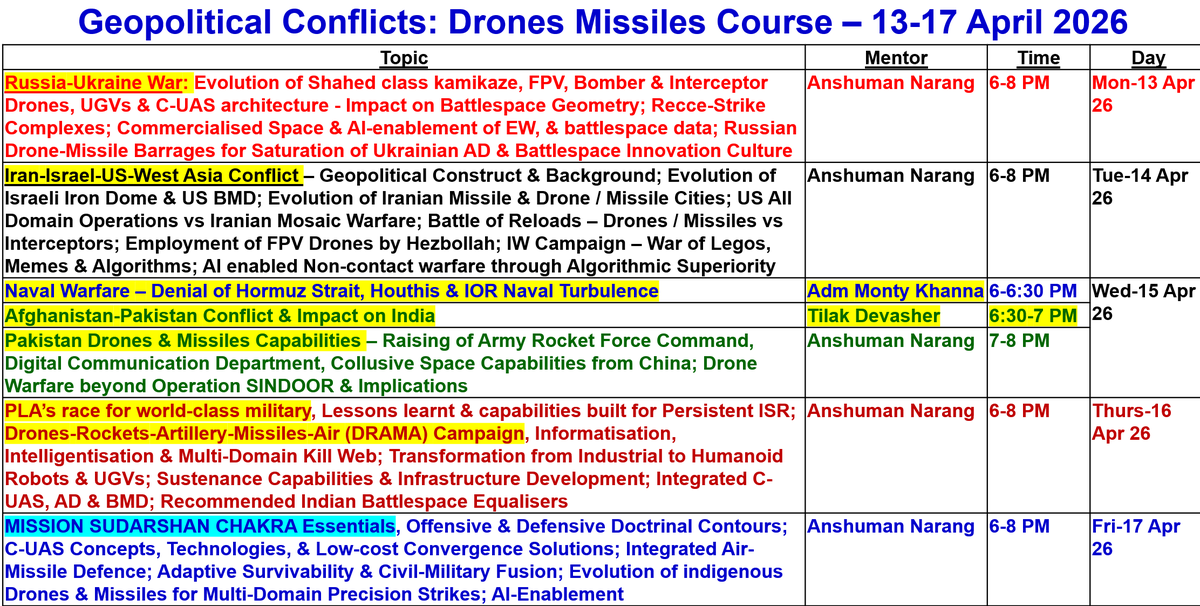
Geopolitical Drones Missiles Online Course by Team @AtmaSoch from 13 to 17 April 2026
Focus Areas priority wise
1. Iran-Israel-US-West Asia Conflict & Lessons for India
2. Mission Sudarshan Chakra
3. Evolution of Shahed, FPV & Interceptor Drones
4. C-UAS Capabilities sub-tactical level upwards
5. Chinese & Pakistani Drones & Missile Capabilities
6. Naval warfare- Strait of Hormuz & Arabian Sea / IOR
7. Afghanistan-Pakistan conflict
8. Saturation / Exhaustion tactics of adversarial AD
Message at 7896414035 / 8437277128 if interested
•Cost Rs 2000/- individual (Rs 1500 for ANS family – anyone who has done any ANS course earlier)
•Rs 8,000 per unit / organization / institution (5 VC links irrespective of strength) – Rs 6000 for any ANS family – any ANS course done earlier as an organisation
•Authenticate / Register at 7896414035 / 8437277128 - Certificates provided
•Online course (Cisco Webex) for 5 days – 2 hr per day from 6 to 8 PM IST (1800 to 2000 hours)
•All presentations shared, listen to recording (link provided) in own time if busy / miss a class
Defence Procurement & Emerging Technologies Course for Defence Scholars, MSMEs, Startups, and all Indian
In order to bridge the gap between Indian Military requirements, our rising Defence Industry and our academia, Team Atma Nirbhar Soch (@AtmaSoch) is pleased to announce an online course designed to enhance understanding of India’s defence Procurement ecosystem- Capital, Revenue, proposed DAP 2026, etc.
Dates: 17–22 August 2026
Time- 6-8 PM
Format: Live online, Webex (daily recording links provided)
Cetificates for participation given
The course will cover draft DAP 2026 and its TRL/MRL-based categorisation, the distinction between “Made in India” and “Owned by India,” revenue and capital procurement models, the defence planning process (ICDP, AAP, acquisition categories), and MSME-specific entry points including Indigenous Content Norms and the Fast Track Procedure. Participants will also be introduced to the Army Design Bureau and Suo Moto proposal route, the iDEX ecosystem (Open Challenge, DISC, ADITI), and procurement practices specific to the Navy and Air Force. The final sessions will address civil-military integration and the alignment of technology roadmaps with Atmanirbhar Bharat 2047 and Mission Sudarshan Chakra 2035.
Sessions will be conducted by subject matter experts with direct experience in defence procurement and planning, including ex Army Commander Lt Gen Raj Shukla on Civil-Military Fusion, Air Marshal BR Krishna, Rear Admiral Puneet Chadha, Maj Gen Abhay Dayal, Maj Gen Devinder, Col Varun Tanwar, and Brig Anshuman Narang.
By the conclusion of the course, participants will be able to identify their correct acquisition category, the relevant funding pathway, and the service best suited to their product or technology.
Registration Fees:
Individual Registration — ₹3,000 (ANS Family Rs 2,400)
Company Registration — ₹12,000 (Five devices, unlimited strength, ANS Family Rs 9,000)
For registration, please send WhatsApp message at 7896414035 / 8437277128
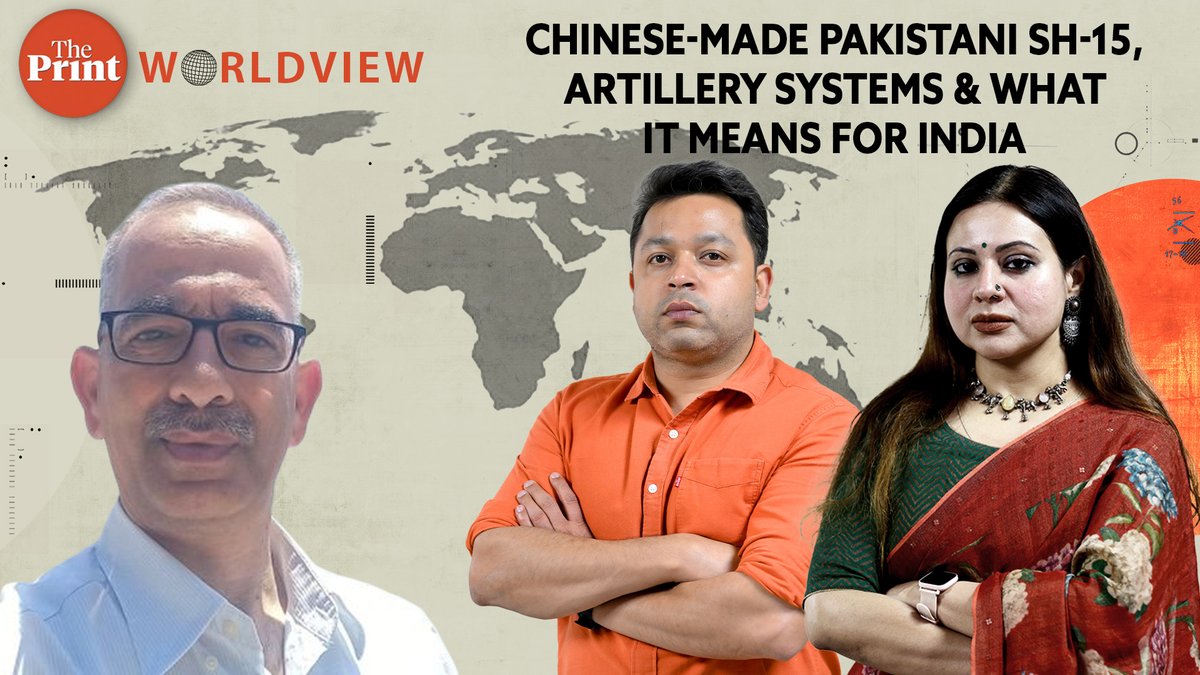
Pakistan Army's induction of SH-15 Wheeled Self Propelled Howitzers (SPH)
In my interview with @ThePrintIndia Dr Swasthi Rao (@swasrao) , I highlight following issues
1. Total order of 236 SH15 SPH Wheeled (Chinese equivalent PCL181) placed by Pakistan on Chinese NORINCO. First delivery in February 2022, paraded in March 2022.
2. Delivery of 236 piece means 13 Battalions (@18 each) has been completed. Surely, they would keep something for their School of Artillery for training. Pakistan Artillery had earlier tried the Chinese SH1 model (30 pieces) which didn't succeed.
3. Maximum claimed range of 53 km is with guided ammunition which surely is in limited quantity. The reported range of 70 km plus is only in high altitude region above 4000 m. In Russo-Ukraine war, the accuracy of PGMs dropped from 70% earlier to nearly 7% currently.
4. All the four Group Army Artillery Brigades of PLA in Western Theatre Command (76th, 77th, 84th / XMR & 85th / TMR) also hold PCL181 SPH (original Chinese version of SH15). Additionally, the four Combined-Arms Divisions (4th, 6th, 8th & 11th) of Xinjiang Military Region also have PCL181 Battalions. Total about 16 PCL181 Battalions with Western Theatre Command.
5. So, in all India has minimum 29 PCL181/SH15 Battalions deployed against it by the two adversaries.
6. While Pakistan has inducted the guns, it is trying its best to indigenise the ammunition production. In the modern day "Battle of Reload" at lowest sustainable costs, ammunition replenishment is surely a challenge.
7. Biggest lesson for India is that the era of Towed Tube Artillery is over. With greater shift towards Drones, there is an increasingly expanding Contested Zone (started from 2-5 km in Ukraine war in 2023, has now expanded to nearly 25 km in 2026) where deployment of Artillery guns is very difficult. Static towed guns deployment is out of question. Shoot & scoot is an essential requirement. Thus, induction of indigenous Mounted Gun Systems or more of Pinaka MLRS is absolutely essential for Indian Artillery to have mobile systems.
https://t.co/Fc0jAygDV7
Pakistan has deployed China-made SH-15 artillery systems along India's border. Consulting Editor @swasrao, speaks to Defence & Diplomacy Editor @sneheshphilip & Brig @Anshu217 on Pakistan-China ties, implications for India & more
#ThePrintWorldView
https://t.co/Iqrd2gvmQo