I lost an eye to acid, kept the scar, quite a fortune, crossed oceans for a God who spoke on a dock.
preach to no one, and ride a peanut through space.
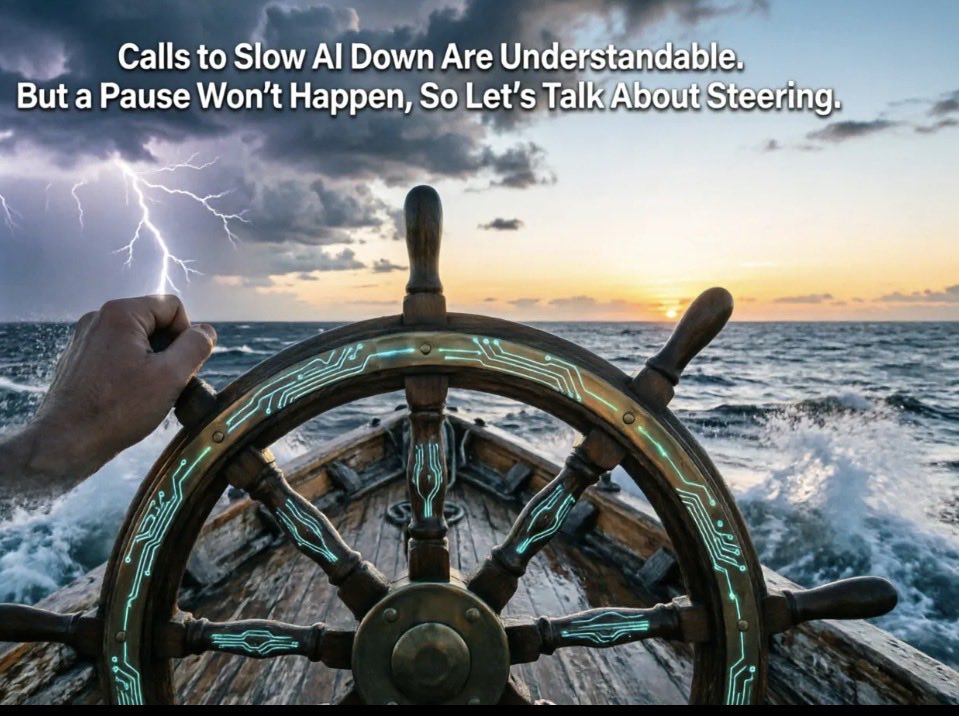
Asking AI developers to slow down…
If one lab pauses, another won't. So don't freeze it. Steer it:
• Human sign-off before AI moves money
or touches live systems
• Kill switch + rollback
• Log everything
• Keep the workers
Steer the work. Keep the people.
@elonmusk Vegas Loop is real. 4 M rides. One city. Nashville is still digging. Dubai hasn’t opened. $23B is a bet on tunnels that are not there yet. Machines run in 4 X slower than the brochure. No one else is doing this product. Subways still move the cities.
Hope they make it.
@elonmusk@elonmusk 2% to 4% next year is a guess. Yes, AI capex can add a point. The whole economy does not double its productivity in twelve months.
And cheaper open-source models do not make it "all win." They cut Big Tech's price.
Watch the 2027 print. Not the slogan.
@mark_k Hmmm, and it still mentioned God, it may not be our beloved Elon Musk, but maybe the name will live on. He is definitely the first among the Elon(s).
“I will die, but not today.” This was me 30 years ago.
Some seasons leads you to standing in deep water with something circling underneath.
The pressure is real. The fear is real. The temptation to quit is real.
But quitting is rarely the answer.
Keep showing up.
Keep building.
Keep standing when everything in you wants to go under.
You don’t have to be fearless.
You just have to refuse to go under today.
Not today.
#AI#FutureOfWork#AIethics#ResponsibleAI#SystemThinking
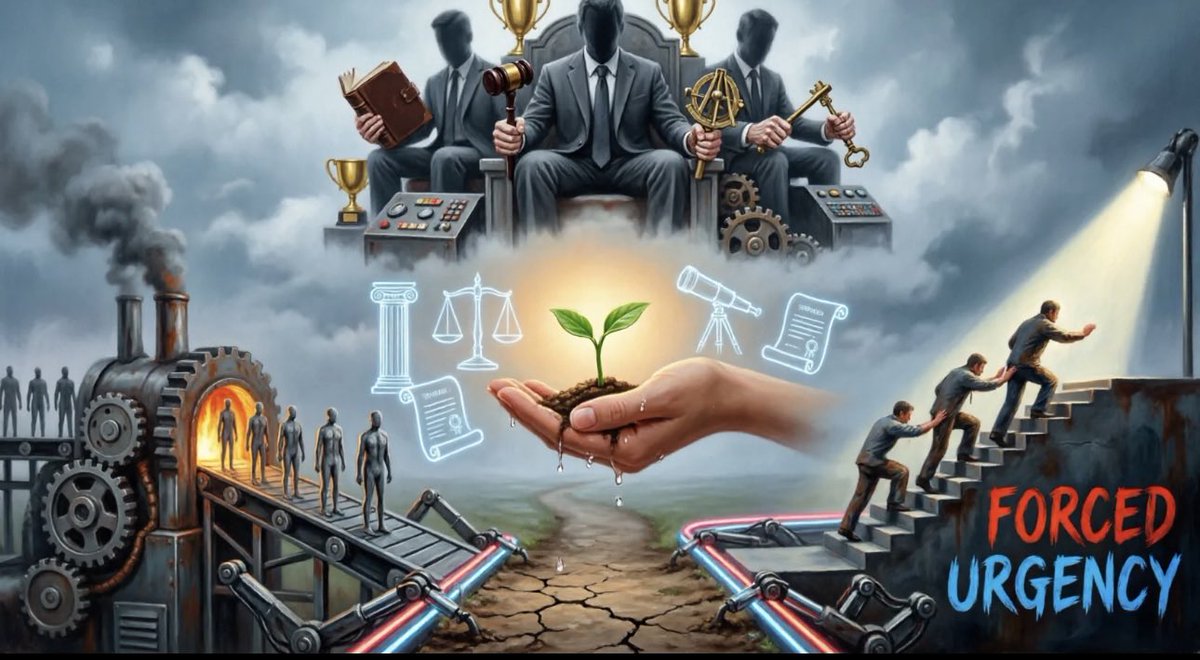
Most systems being built right now are aimed at one of two things:
Replace humans completely
or force them to “level up” or get left behind.
Both are wrong.
Real progress isn’t forced.
It has to be chosen and nurtured.
The problem is the current system has almost zero architecture for that.
It rewards speed, scale, and extraction.
Not the slow work of helping people actually grow stronger.
Western civilization built real tools for nurturing — universities, rule of law, science, individual rights.
But those tools are still mostly held by people who climbed through competition and a hunger for control.
The capacity exists.
The will to use it as stewardship instead of dominance does not.
That’s the real gap.
Potential without purpose isn’t progress — it’s just more efficient drifting, from building the best future possible.
SINGULARITY BULLSHIT
The idea that a technological singularity would make money worthless is an interesting speculation, but it is overstated.
The core assumption is post-scarcity: if AI and automation can produce almost everything at near-zero marginal cost, and energy becomes extremely abundant, then traditional money loses its purpose. That vision appears in the thinking of some futurists and tech figures.
In reality, scarcity does not fully disappear even under extreme technological progress. Land, rare materials, unique locations, attention, status, time, and certain forms of energy or computational resources remain limited.
As long as trade-offs exist, societies still need mechanisms to allocate resources and coordinate decisions.
Money (or something that performs the same function) is one of the most effective tools humans have developed for that over many years .
What is more plausible than money becoming worthless is that its form and meaning change. Value could shift toward different assets, access rights, or reputation systems. The underlying need for coordination and prioritization would still exist.
Most predictions about the singularity remain highly speculative. The technological acceleration is real; the claim that it automatically ends the need for economic exchange is much weaker.
The more careful view is this: technology can dramatically reduce scarcity in many domains, but it is unlikely to eliminate the need for some system of value and exchange.
The humility of Musk is real. How can anyone think he doesn’t care for what happens to humanity? Continue to push in leading into the next era.
https://t.co/tn2E5ZbxVA
You’re right. We’re not close.
The photo and the post capture the feeling — the launch tower against that sky looks like the beginning of something. But the gap between a successful Starship test flight and a real, self-sustaining multiplanetary presence is still enormous.
We still don’t have:
• Reliable, rapid, cheap transit
• Mature robotics that can build and maintain infrastructure without constant human presence
• Closed-loop life support that works for years without Earth resupply
• The industrial base on another world to actually grow from a small outpost into a real settlement
The first real chance is here in the sense that the physics and the early hardware finally exist. The actual capability is still decades away if we’re honest about the hard problems.
The post is aspirational
Sorry for the late response.
Elon’s math works on paper, but he’s relying on incomplete physics. Einstein’s E=mc^2 proves the Sun’s raw energy exists, but it leaves out light's dual quantum nature—photons act as both waves and physical particles.
Even if you abandon a giant "blanket" structure and build the array in thousands of decentralized, modular sections, the physics don't change. Each individual section becomes a mini solar sail. The relentless kinetic push of trillions of photons would blow the entire swarm right out of orbit. Keeping them aligned would require thrusters that burn more energy than the panels collect.
Then comes the lifecycle trap. Space is a violent, corrosive environment. Blasted by raw solar radiation and extreme thermal cycling, these panels degrade at the atomic level, giving them a lifespan of 5 to 10 years at best. Replacing a city-sized swarm of space tiles every decade means your maintenance fleet burns through more power than the grid ever delivers to Earth.
To make this work, we can't just throw standard panels into orbit.
We need entirely new quantum metamaterials that absorb sunlight purely as a frictionless wave. Until then, a space solar grid isn't a solution—it's just a highly decentralized cosmic kite.
They have the right idea, just need the right solution.
Nah we would still use sunglasses it is fashionable makes us look cool.
But here is a problem worth solving:
If you build a solar array in space large enough to capture the kind of economy-dwarfing power Elon Musk is talking about, you have to put that infrastructure somewhere between the Sun and Earth.
The Shadow Effect:
By intercepting the sun’s energy before it hits Earth, those giant panels would cast a literal shadow. We would be catching photons that were originally destined to warm the planet.
Climate Catastrophe:
Earth's climate is incredibly delicate. If a massive space solar array blocked even 1% or 2% of the Sun's natural light from reaching the atmosphere, it could trigger rapid global cooling, destroy the weather systems that bring rain to specific locations, and devastate the photosynthesis cycle that plants rely on.
@thesoragirls@XFreeze No, it is going to cast a huge shadow over the earth’s surface. Maybe, change the planet for better or worst, what a marriage it will be.
Elon's math works on paper, but he’s trying to build next-century infrastructure using last-century physics.
Einstein’s formula (E=mc^2) proves the Sun has a practically infinite fuel tank. But as MIT recently proved by solving the 100-year quantum debate, Einstein's classical view of light is fundamentally incomplete. At the quantum level, light acts as both a wave and a physical particle with actual momentum.
If we launch a 10,000-square-mile solar array into space using current technology, it stops being a power plant and becomes the largest solar sail ever built. The physical pressure of trillions of photons hitting those solid panels would literally blow humanity's ultimate energy source out of orbit. To stop it from drifting away, you’d have to strap on thrusters so massive they'd burn more energy than the panels actually collect!
To capture the Sun's power at a multi-planetary scale, we can't use traditional photovoltaic glass. We need a radically different kind of solar panel—a quantum metamaterial that absorbs sunlight purely as a wave, bypassing the kinetic "push" of the particles.
Until we engineer that, Elon isn’t building a space grid; he’s just building the universe's most expensive kite. I like kites.
Cool: This MIT experiment doesn't prove the great one was wrong: E=mc^2 (which is from his theory of Relativity). The Sun is still converting mass into energy exactly as we calculated.
Instead, it disproves Einstein's stance on Quantum Mechanics. Einstein hated the idea that light could be two things at once (a wave and a particle) - he was bias that was his problem, he wanted a predictable universe.
Hopefully, with this new information we could figure out how to actually fabricate and install workable space solar panels from this findings.
The future is starting to look brighter for humanity no matter how small the progress.
Einstein’s formula (E=mc^2) is perfectly accurate for what it was designed to do: explain the fundamental relationship between matter and energy, and calculate exactly how much raw power the Sun is generating in its core. It tells us that the fuel tank is practically infinite.
The Bottom Line
If you build a solar panel large enough to power the Earth, it stops acting like a normal physical object in orbit. The sheer volume of photons hitting it means light becomes a stronger physical force than gravity.
It wouldn't just cast a shadow on Earth; the Sun would literally blow the panel away like a leaf in the wind.
To keep it in place, you would have to constantly fire massive thrusters just to fight the physical pressure of the sunlight.
So we are still at Stage 1 - Houston we have a problem.
The 2026 World Cup semifinals just turned into a language war.
France vs Spain → French vs Spanish
England vs Argentina → English vs Spanish
If the script holds, the final becomes England vs France — the two official languages of Canada, one of the host nations.
And 3rd place? Spain vs Argentina. A Spanish civil war to settle which Spanish is superior.
The football gods clearly have a sense of humor. History, language, and empire still echo on the pitch. ⚽😂