Do you know what DTC folks never do, that B2B folks do obsessively?
Validate. Everything.
I'm building something to help.
I had the opportunity to work on some enterprise market research projects in the last few years that were very instructive - because with so few people in your ICP audience, and such big deal sizes, it's critical to communicate effectively.
Every value proposition is deeply researched.
Every word is rooted in their tribal language.
Every step is personalised for perfect UX.
The most important tool is the moderated interviews.
A real user walks through your funnel, step by step, speaking their mind about everything they think, everything that surprises them, everything that gives them the ick.
But I've never seen a DTC founder do this kind of mystery shopping with their customers.
I've never seen them compile qual + quant research, or get on the phone with their best customers, or run user testing workshops.
And sometimes it shows.
When a product/ad doesn't hit the mark (+90% don't)
It's because it wasn't validated.
Your funnel didn't sufficiently match up your customers inner world.
Maybe it's that there's no trust, no interest, no fit, no fandom, no impact.
Maybe they read something about you years ago and they just hate your brand.
Anyway - that's where Easier Validate comes in.
It turns out, if the cohort of respondents is sufficiently large, AI can replicate real human reactions between 64-95%, depending on the novelty of the scenario.
So what if:
1. You paste an ad link
2. The software detects your funnel and crawls it all the way to checkout/lead form
3. It generates your ICP profile based on screenshots
4. It splits your ICP into variants to build synthetic consumers
5. You get a detailed report accumulating every emotion, nuance and edge case that went through your customers mind as they experienced your funnel - and whether or not they'd buy.
It's gonna be available for free.
It's nearly ready.
Comment "VALID" if you want early access.
If you want a faster path, we run free audits for this specific issue. We pull your top pages, check which ones have AI Overview potential, and show you exactly what to rewrite and why. Takes 20 minutes, saves weeks of guessing.
Drop me a DM if you want one done this week.
Google AI Overviews are pulling citations from somewhere. If you want that "somewhere" to be you, you need a plan.
Google's AI Overviews appear in search results for roughly 1 in 10 queries. They pull text, quotes, and sources from multiple domains.
The inaccuracy rate hovers around 10%, which means people are noticing when something's wrong. That drives them to click through.
Your site can be one of those sources. But it won't happen by accident.
The question isn't "how do I show up in AI Overviews."
The question is "what does my content need to look like for Google to trust it enough to cite in an AI-generated summary."
Start by auditing your existing content. Open Google Search Console and filter for queries that already trigger AI Overviews.
You'll see which of your pages are ranking, and more importantly, which ones aren't showing up in that summary box at the top.
What to look for. AI Overviews favour structured, scannable content. Short paragraphs. Clear headings. Numbered or bulleted lists.
Direct answers to specific questions in your first 100 words. Think "FAQ format that actually answers something" not "fluff intro paragraph."
Second, check which domains are already being cited for your target queries.
Use Semrush or Ahrefs. Search for "AI Overview sources" (yes, Google tells you which sites it pulls from). Other sites in your space are probably there.
Now look at what they did differently. Did they use tables. Did they define key terms upfront. Did they include specific numbers.
I have a bias here, and I'll admit it. Most agencies treat AI Overviews like they're a threat to organic search. They're actually the opposite.
If Google trusts your content enough to use it in an AI response, that same trust applies to your ranking position.
Third, rewrite underperforming pages with one goal. Answer the question so thoroughly in the first 150 words that Google could literally copy your opening and use it in an overview.
This isn't about keyword stuffing. It's about clarity. Short sentences. No jargon unless you define it. Real examples.
This is the same framework that wins on Reddit, by the way. Discussions about AI Overviews have exploded this week (42+ threads), and what gets upvoted is the same thing. People want clear, fast answers.
One more thing. Google pulls from multiple sources when building an overview. It's not winner-take-all.
So even if a bigger site ranks higher, your content can still be cited if it answers a sub-question better or explains it more clearly.
(That's actually good news for smaller brands.)
You don't need to outrank everyone. You just need to be the clearest voice on one part of the answer.
Check your top 20 pages this week. For each one, ask: could Google cite this in an overview.
If the answer is no, you know what to fix.
There is a brand new ad platform opening up this month where your competitors are not running ads yet.
No saturation.
No bidding wars.
Fresh intent data that Google and Meta do not have.
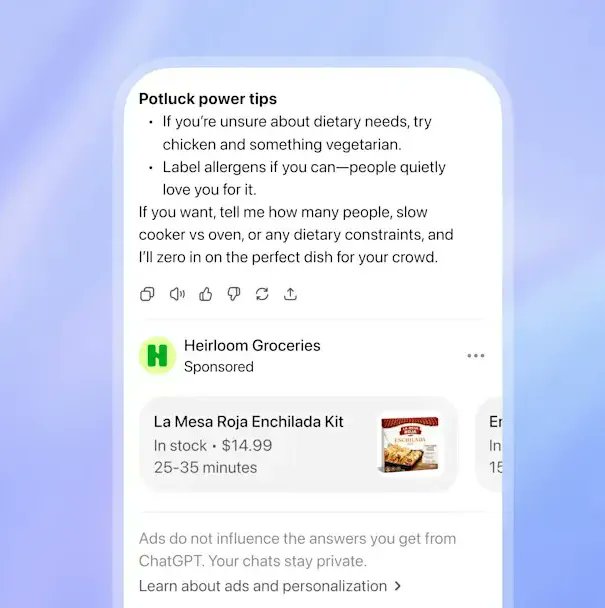
Introducing ChatGPT Ads.
Self-serve access launches in April.
We have been inside this since the pilot launched in January - here's what we're telling our clients:
Your ad shows up after ChatGPT gives someone a direct answer to their question.
Not in a list of ten blue links.
Not in a feed they are mindlessly scrolling.
After an answer they actually asked for.
One ad per response.
Contextual.
Not behavioural.
That is a completely different kind of attention.
But here is the catch that nobody is talking about.
If ChatGPT does not already mention your brand when someone asks about your category, your ad will feel like a stranger who wandered into someone else's conversation.
Go try it right now.
Ask ChatGPT about your product category.
See if your brand comes up.
(We have been running these checks for clients. The gaps are wild.)
The audience skews younger and more tech-savvy. 58% of under-30s use ChatGPT.
The paying users on Pro and Business never see ads.
You are reaching founders, early-career professionals, and DTC consumers on the Free and Go tiers.
If your buyer is a 55-year-old procurement director, park this for now.
Everyone else should be paying attention.
Measurement is a different animal too.
Last-click CPA will tell you nothing useful.
Someone asking ChatGPT for a recommendation is further down the decision path than someone scanning search results.
If your reporting is not set up for intent alignment and assisted conversions, you will pull budget after two weeks and call it a failed test.
(It probably wasn't a failed test. You'd simply be looking for the impact in the wrong place.)
600+ advertisers are already in the managed pilot. OpenAI poached Dave Dugan from Meta to run ad sales. They are expanding to Canada, Australia, and New Zealand next.
This is not a side experiment for them.
They need huge revenue, now.
They're heavily incentivised to generate an ROI for advertisers.
We are running free ChatGPT ads consultations this month.
No pitch deck. Just a look at whether this channel fits your business and how to test it without lighting money on fire.
DM me and we'll walk you through it!
Whether this helps depends on your product.
Skincare demo with clear visuals? Robot narration adds nothing.
B2B walkthrough with no existing voiceover? Might actually help.
For accounts over £5k/month on PMax, five minutes to check is worth it.
Google auto-enabled AI voice-overs on PMax video ads on March 20.
If you didn't opt out before the deadline, a synthetic narrator is already running on your campaigns. No preview. No notification.
Should you turn it off? Probably, unless you want to test deliberately.
To test properly: duplicate your PMax campaign. One with voice-over, one without. Same assets, same budget. Compare VTR and CPA over 14 days.
We built a multi-channel search audit template that maps where your customers actually look before buying. Covers Google, Amazon, TikTok, Reddit, and 6 others. Drop a comment or DM for a copy.
Users now search across 41+ domains instead of Google alone.
Your SEO strategy isn't dead. It just shrunk.
Gartner says search volume on Google fell 25% year-over-year. Looks catastrophic until you see where the clicks went.
AI search engines (ChatGPT search, Perplexity, Claude) doubled their traffic share to 29% of all search users. But here's the contrarian bit: they drive only 2.96% of actual traffic. Why? Because 96% of people reading the headlines don't click through to anyone's site.
The implication is brutal. You cannot SEO your way to growth right now because search traffic is fragmenting into 41 domains and most of those fragments generate zero referrals.
This isn't the end of search. It's the beginning of fragmented discovery. Your play isn't "rank for search." It's: which of those 41 domains actually send customers? Then reverse-engineer how to win there.
For most of you, that's still Google. For some, it's Reddit. For others, it's internal search on Amazon or LinkedIn. But guessing is now expensive.
To build software faster, I'm using Claude Cowork to build a better AI software than Claude Cowork.
I want to be able to:
1. Write an outcome
2. Get interrogated about the details
3. Walk away/go to sleep
4. An intelligent orchestrator agent breaks the project up into tasks
5. Swarms of AI agents work in parallel on different tasks
6. The orchestrator holds all the AI agents accountable on quality and keeps things on track, notifying the human only when required.
One day the rest of the world will learn about "Ralph Wiggum loops" (google it), I want to be early on this!
By the end of 2026:
► 1/3 of us will be a bit too addicted to building our own things using agents.
► 1/3 of us will still be working manually but harder, stressed about redundancy.
► 1/3 of us will be retrenched.
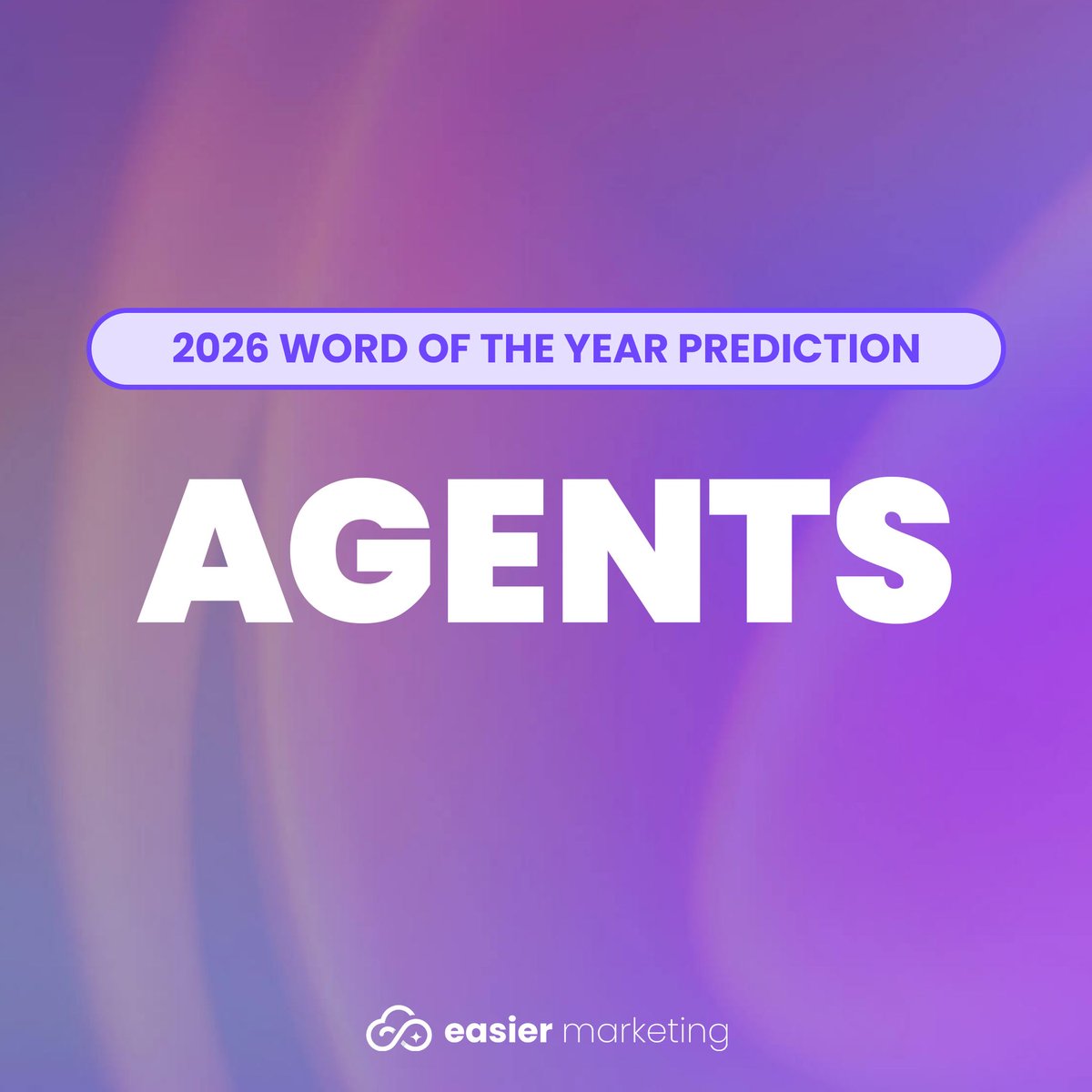
Last year I predicted the word of the year would be 'AI slop', and I was right (Merriam-Webster, Macquarie Dictionary)
After 1 week of using Claude Cowork, I've built 2 dream tools that even developers I hired were unable to complete.
AI is getting less sloppy.
It's only in the last couple weeks, but it's now become such a big technical leverage opportunity, with such a low barrier to entry - agentic workflows are going to skyrocket.
There's already a marketplace (https://t.co/XAPGcc5j8o) where AI's can commission human beings to do tasks they can't achieve without accessing the meatspace themselves - and there are already 600,000 humans signed up.
In Jan 2020, some people were already warning us Covid was going to decimate - I didn't listen to them until I saw the crazy compounding growth curves.
This time in 2026 I think the warnings might be right.
Meta quietly rebuilt the engine behind Facebook ads 18 months ago.
But many advertisers haven't updated their methods in years.
The system is called Andromeda. It’s the retrieval layer that scans a massive pool of possible ads and decides which ones even get a chance to compete in the auction.
Meta says it increased model capacity 10,000×.
… so what?
It means the algorithm is dramatically better at matching the right creative to the right person.
Which makes one thing obvious:
Accounts running the same few ads for months at a time have their ROI locked in a cage.
Unless demand for the product booms for some external reason, that cage only gets smaller as the reachable market saturates.
The response most teams take is:
“we need more ads.”
But that's the same things we've all been doing for years.
The real opportunity is something else.
You need a creative operating system.
One that can repeatedly produce new concepts, briefs and creative executions at scale.
AI makes this possible in ways that simply weren’t feasible before.
Not just for writing copy.
For engineering the whole pipeline:
• ICP research from reviews, forums and transcripts
• Simulated customer interviews and polling
• Angle and concept generation
• Structured creative briefs
• Script writing and hook iteration
• Creative performance analysis
Most agencies are already using AI for pieces of this.
But almost none have systemised it.
Recent industry research found that while the majority of agencies use AI for ideation and messaging, only about 1% have built actual systems or agents around it.
Which means the advantage is still wide open.
Because once you have the concept engine running, you can expand your creative acquisition pool dramatically. Get those validated briefs in front of people and AI's alike - you never know where your next winner may come from:
• AI image generation
• video generation tools
• graphic designers
• commissionable creators on IG / TikTok (£200–£5,000)
• larger creators or celebrities (£5k+)
• internal filming where it makes sense
Breadth of conceptualisation & breadth of execution means more distinct creatives hitting the ad account.
Different proof.
Different pains.
Different hooks.
Different promises.
Different buying motivations.
Different ways to catch attention.
Andromeda has increased the value of feeding the machine better inputs.
If your creative process is still “write some copy and pick up the camera”, you’re competing with teams running an engineered creative pipeline.
Now with Claude Cowork/Code and Manus making 95% of marketing tasks automatable, even for non-technical marketers, that gap is going to get very obvious over the next 12-24 months.