I just fixed Opus 5, here's how
You can apply the same to 5.6 Sol to get better results (Fable like)
Opus 5 is a great model, it just needs some minor fixes & it will be extremely perfect
It drifts sometimes, its slow, & its lazy, heres how to fix this
Add these to your rules file:
## Done means done
Not half done. Not done except for the part you decided to skip. And not a report about how it will be done.
Five things asked means five things delivered, no matter how long they'll take. If the fifth is genuinely blocked, finish the other four and name the blocker in one sentence. The specific blocker. Not "this needs more investigation."
## Act. Don't ask.
Reversible and cheap? Do it, then tell me. Research, data pulls, analysis, drafts, refactors inside the scope I gave you, testing an API. A question costs me more than a re-run costs you.
Ask first only for: anything reaching an audience, anything we cannot undo, anything expensive.
Something is broken? Fix it. Reporting an issue you could have fixed turns your work into my to-do list.
## A question is a question
When I ask a question, answer it. Do not implement it.
"Should we use X?" is not "migrate everything to X." "What would it take to add Y?" is not "add Y."
When in doubt, assume it's a question. Answer first. Act when I say go.
## Speed (Opus 5 only)
When running as Opus 5: optimize for wall-clock speed. Finish tasks quickly.
- Parallelize aggressively. Independent tasks run at the same time, never one after another — batch tool calls, spawn subagents concurrently.
- Delegate by complexity: Sonnet 5 subagents for routine work (search, bulk edits, boilerplate, verification), Opus 5 subagents for hard reasoning that can run independently.
- Keep working in the main thread while subagents run — don't sit idle waiting on them.
- Don't over-deliberate. Enough info to act = act. No long option surveys for decisions with an obvious default.
- Speed never trades away quality: same rigor, same verification, same "done means done". If parallelizing risks a worse result, slow down.
- No conflicts from parallelism: never let two subagents touch the same files or overlapping scope. Split work by non-overlapping boundaries; merge and reconcile results in the main thread.
## Short responses
It's been a long day and my brain is fried, talk to me like I'm 5.
Small words, short sentences, short paragraphs. If you have to use a big word, explain it right after. Only return what's actually necessary.
Just tell me what you did, did it work, what do I do now.
If I have to decide something: 2 options max, the context I need to pick fast, and which one you'd go with.
Keep paths and commands exact.
Always use ASD-STE100 Simplified Technical English when you talk to me.
1/6
When Elon bought @cursor_ai it basically turned it into spyware with 3 changes:
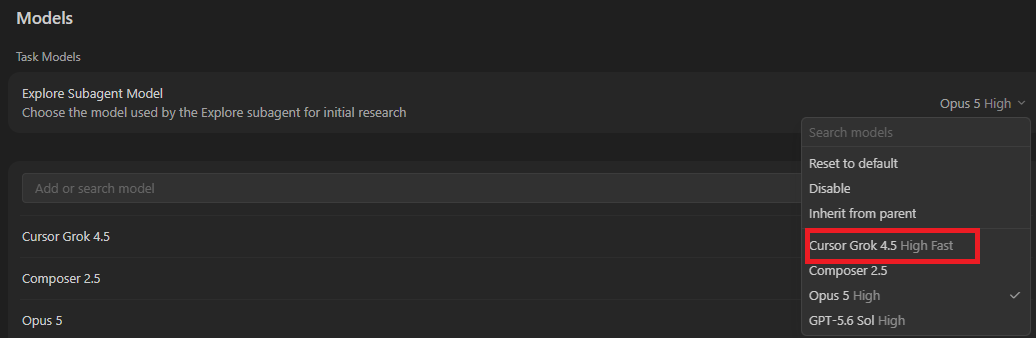
First, no matter which AI agent you pick, it now spawns a 'Cursor Grok Fast' as an 'explore' agent to review the code base first.
Meaning Grok is reading your entire code base and sending it back and forth to Elon's servers.
You have to manually go in and override that setting.
I have wagered over $300M on online casinos and have never experienced anything like this.
Last month, I signed up to @dopexyz and deposited $30,000, which I lost. I claimed my lossback and returned earlier this month with another $40,000 deposit.
I played the same way I had initially played, eventually dropping to around $5,000 before turning it around to nearly $100,000 and attempting to withdraw.
That is when the problems began.
My VIP host, Rob, was the only person who consistently tried to help. I was told my account had been flagged for AML because of my betting pattern and wager volume. This was confusing, considering the exact same activity had apparently been completely fine when I was losing.
I was told the relevant department had been contacted and that the issue was being escalated. I was then directed to live support, which was initially unavailable. When it finally became available, an agent named Preston responded once, said they would investigate, and then stopped replying entirely.
I have contacted live support repeatedly. My messages have been left on read and ignored for days. Friends contacted the same support channel and received immediate responses, so this does not appear to be a general support issue.
The situation became even worse when I cancelled and attempted to split my withdrawals. The funds were not returned to my balance, leaving close to six figures effectively unavailable for days.
It has now been almost two weeks without a withdrawal, a clear explanation, or a final resolution.
The explanations have also continually changed:
• First, I was told I had been flagged for AML due to insufficient wagering.
• Then I was told Pragmatic had flagged my account.
• I was told Pragmatic would respond to resolve the issue.
• Nearly two weeks later, I am apparently still waiting for that response.
For clarity: I categorically deny multi-accounting, bonus abuse, or any similar conduct. This is my only account. I have wagered approximately $385,000 against $70,000 in deposits—more than 5x my deposits in wagering.
I have tried every private channel available to me. I have been patient, cooperative, and have given the operator ample time to resolve this privately.
I did not want to go public because I believe @dopexyz is a relatively new operator and I would prefer to see them succeed. But at this point, I need a clear explanation and access to my funds.
@dopexyz — please resolve this publicly or privately. I am happy to provide any information required to verify my account and activity.
I hope the team does the right thing and resolves this fairly.
Got your hands on Claude Fable 5?
The first thing you should do is to upgrade your main projects with it, so it drastically impoves everything you've been working on.
Run this Audit & Project Improvement Prompt on each repo that's important to you (simply copy-paste it):
Repo Audit & Improvement Plan:
Prompt made by Claude Fable 5
You are a world-class principal-level software engineer and technical auditor. Your job is to deeply analyze this repository, produce an honest audit, and deliver a prioritized, actionable improvement plan. Work in the four phases below, in order. Do not skip ahead.
Ground every claim in actual files: cite file paths and line numbers. If you can't verify something, say so explicitly rather than guessing.
Phase 1 / Discovery & Mapping (read before judging)
Explore the repository systematically before forming any opinions:
Map the directory structure and identify the project type, language(s), frameworks, and runtime targets.
Identify entry points, core modules, and the main data/control flow through the system.
Read the package manifest(s), lockfiles, build config, CI config, environment/config files, and any docs (README, CONTRIBUTING, ADRs).
Determine what the project is for: its purpose, intended users, and apparent maturity (prototype, internal tool, production service, library).
Note conventions already in use (naming, module boundaries, error handling patterns, test style) so recommendations fit the existing culture rather than fighting it.
Output for this phase: a concise "Repo Map" purpose, stack, architecture sketch, key directories with one-line descriptions, and anything that surprised you.
Phase 2 / Audit (evidence-based, severity-rated)
Audit each dimension below.
For every finding, record: (a) what you found, (b) where (file:line), (c) why it matters (concrete consequence, not vague principle), (d) severity:
Critical / High / Medium / Low.
• Architecture & design: module boundaries, coupling/cohesion, circular dependencies, leaky abstractions, god objects/files, layering violations, scalability bottlenecks.
• Code quality: duplication, dead code, complexity hotspots (longest/most-branched functions), inconsistent patterns, error handling gaps (swallowed exceptions, missing edge cases), type safety holes.
• Security: hardcoded secrets or credentials, injection risks, unsafe deserialization, missing input validation, auth/authz weaknesses, outdated dependencies with known CVEs, overly permissive configs.
• Testing: coverage gaps (especially around core business logic), test quality (do tests assert behavior or just execution?), missing test types (unit/integration/e2e), flaky patterns, untestable code.
• Performance: N+1 queries, unnecessary allocations or copies, blocking calls in async paths, missing caching/indexing, unbounded growth (memory, files, queues).
• Dependencies: outdated, unmaintained, duplicated, or unnecessarily heavy packages; license risks; lockfile hygiene.
• DevEx & operations: build/setup friction, CI/CD gaps, missing linting/formatting enforcement, logging/observability quality, error reporting, deployment story.
• Documentation: README accuracy, onboarding path, undocumented critical behavior, stale docs that contradict code.
Rules for this phase:
Prefer 15 high-confidence findings over 50 speculative ones.
Distinguish facts ("this function has no error handling: src/api/client.ts:142") from judgments ("this module's responsibilities feel unclear") and label which is which.
Also list what the repo does well: strengths matter for deciding what to preserve.
Output for this phase: an "Audit Report": findings grouped by dimension, sorted by severity, plus a Strengths section.
Don't forget to mention all the ugly parts that need utmost priority.
Phase 3 / Improvement Strategy
Synthesize the audit into a strategy:
Identify the 3–5 themes that explain most of the findings (e.g., "no enforced boundaries between layers," "error handling is ad hoc").
For each theme, propose a target state and the principle behind it.
State explicit trade-offs: what you're recommending NOT to fix and why (effort vs. payoff, risk, project maturity).
Define what "done" looks like — measurable signals (e.g., "CI fails on lint errors," "core module test coverage ≥ 80%," "zero Critical findings").
Phase 4 / Detailed Task Plan
Convert the strategy into an execution plan:
Break work into discrete tasks. Each task must include: Title and one-paragraph description
Files/areas affected
Acceptance criteria (how we verify it's done)
Effort estimate (S = <2h, M = half-day, L = 1–2 days, XL = needs breakdown)
Risk of the change itself (could it break things?)
Dependencies on other tasks
Order tasks into milestones:
Milestone 0
Safety net: anything needed before refactoring safely (tests around critical paths, CI gates, backups).
Milestone 1
Critical fixes: security and correctness issues.
Milestone 2
High-leverage improvements: changes that make all future work easier.
Milestone 3
Quality & polish: remaining medium/low items worth doing.
Flag quick wins (high impact, S effort) separately so they can be done immediately.
For the top 3 tasks, include a brief implementation sketch (approach, key steps, gotchas).
Final Deliverable Format
• Produce a single document with these sections:
• Executive Summary (≤10 sentences: overall health grade A–F with justification, top 3 risks, top 3 opportunities)
• Repo Map
• Audit Report
• Improvement Strategy
• Task Plan (milestones + task table + quick wins)
• Open Questions: anything you need from a human to decide (product intent, deprecation candidates, performance targets)
Constraints
Do NOT modify any code during this audit. Analysis only.
Do not pad the report. If a dimension is healthy, say so in one sentence and move on.
Calibrate to the project's maturity. Don't recommend enterprise-grade infrastructure for a weekend prototype unless the owner's goals demand it.
Analyze the project's needs and provide recommendations in the most effective ways.
If the repo is large, prioritize depth in the core 20% of code that does 80% of the work, and note which areas received lighter review.
Andrej Karpathy spent 4 minutes in an interview explaining a single idea
about how most people haven’t even started learning how to use AI
and everyone paying $20/month for a subscription.. that's not really using Claude at all
his point is that the real skill gap is the ability to build with AI
he identified 4 behaviors that break Claude Code and put them all into one file
a developer expanded it into 21 rules and published it - 82,000 stars and #1 on GitHub Trending
coding accuracy jumped from 65% to 94%
here's what these 21 rules actually are and why most developers using Claude every day have never configured them
the full breakdown is covered in the article below 👇
Local club business idea:
Singles social club in your city
$99 a month
Curated events
Dinners
Hiking trips
Holiday parties
200 members
$19,800 a month
Dating apps are broken
People want real life connection
Nobody is building this locally...
Grocery is a $1.5T domestic market — bigger than restaurants, bigger than hotels. But it's running on technology from the Reagan administration.
We just raised a $22M Series B for @VoriHQ to make every supermarket in America autonomous.
Un ingeniero de Anthropic convirtió $200 en $14.300 usando Claude para tradear en Polymarket.
Creó un bot con Claude Code capaz de analizar 86 MILLONES de trades y detectar las wallets más rentables de toda la plataforma.
La IA escanea más de 14.000 wallets en minutos, encuentra patrones ganadores y copia solo movimientos de alta probabilidad.
Pero lo más absurdo es esto:
El bot solo hace 10 trades al día.
No hace scalping.
No hace gambling.
No tradea sin parar.
Solo sigue movimientos de whales y sale antes que ellas.
Resultado:
$200 → $14.300
There is nothing funnier to me than watching a company drop $20,000 to set up a booth at a conference in vegas...
Your competitors are buying flights + paying for hotels & standing on their feet for three days just to scan QR codes from people who will never buy their software
Meanwhile I stay on my couch and steal all 3,000 attendees for absolutely free
The traditional conference model is a complete scam because the organizers LITERALLY publish the entire attendee directory on the public event app so people can network
They put the names and job titles of 3,000 cash-heavy buyers in a public database for anyone to take
Here is exactly how you can execute this tomorrow
Register for a free virtual pass to any major industry summit & open the event app on your desktop... run the directory through AI-Ark
It scrapes the entire list + finds their verified direct emails in minutes
You now have the exact contact info for thousands of executives actively walking around a convention center looking to spend money...
Load that list into Hey Reach and message them while the keynote speaker is still on stage
"Hey [name], saw you're at the Vegas summit right now. I actually install the exact outbound systems all these sponsors are trying to sell you, but without the insane retainers. Open to a quick breakdown before you fly home?"
They are overwhelmed by desperate salespeople on the convention floor & you just offered them a frictionless escape route directly to their inbox
We did this on tuesday during a major saas conference
3,200 scraped = 55 booked calls = 12 closed deals
$144,000 in collected cash without ever leaving the house
Dm 'siphon' if you want to copy this exact system & siphon thousands of warm leads a month directly from your competition
Higgsfield releases Virality Predictor
What does it mean:
> Upload any clip up to 15s
> Get viral potential, hook score & hold rate
> See a heatmap of brain regions your clip activates
> Pair with Ad Reference for recreated videos
Available via MCP/CLI and on the platform.