I am interested in Middle East & Punt Lands History & politics. A history scholar with deep insights & discoveries for history revisionism. Retired engineer
@biustbw The Components of Modular Big6-NFT Sandwich System.
1. Frame. 2. Big6. 3. Irrigation tubes. 4. Irrigation manifold. 5. Gutter. 6. Lid. 7. Reservoir.
A number of credible sources consider B6NSS as worth and ready for prototype stage and validations.
B6NSS is marked as highly innovative, disruptive and promising for NFT industry and commercialization.
Proposal for Research Collaboration & Prototype Validation: The Big-6-NFT Sandwich System (B6NSS)
Dear Professors,
I am writing to introduce an innovative agricultural system engineering concept—the Big-6-NFT Sandwich System (B6NSS)—and to invite BUAN to collaborate on its empirical testing, prototype development, and validation.
Background & Problem Statement
The global adoption and commercial scaling of conventional Nutrient Film Technique (NFT) hydroponics are significantly constrained by high Capital Expenditure (CapEx), complex assembly, labor-intensive maintenance and sanitation (OpEx), and bulky, non-nestable shipping logistics.
The B6NSS Solution
The Big-6-NFT Sandwich System (B6NSS) addresses these global barriers by reimagining hydroponic channel design. B6NSS converts standard, mass-produced corrugated PVC Big-6 profiles paired with a flat, opaque PVC lid into an integrated, multi-channel growing manifold.
By replacing multiple individual pipes, brackets, and custom fittings with nestable corrugated sheets, B6NSS dramatically reduces part counts, freight volumes, and structural complexity while maintaining optimal crop support and fluid distribution.
Feasibility Score & Research Objectives. Initial technical feasibility and structural assessments yield a preliminary engineering score of 82/100, highlighting strong potential across innovation, economic viability, and modular design.
However, to move B6NSS from a promising concept into a validated commercial technology, controlled empirical testing is required. We seek to collaborate with BUAN to build and evaluate a pilot prototype, focusing on:
1.Hydraulic Uniformity & Fluid Dynamics: Validating flow consistency across all 7 channels.
2.Thermal & Structural Durability: Assessing profile behavior under local ambient conditions.
3.Crop Yield & Sanitation Efficiency: Comparing growing output, water usage, and post-harvest cleaning times against standard NFT benchmarks.
4.Economic & Modularity Analysis: Confirming lower CapEx/OpEx for local commercial growers, smallholders, school farms, and Community Mini-Farm Compounds (CMCs).
Comparative Performance Overview
Performance MetricConventional NFT SystemsB6NSS (Big-6-NFT Sandwich System)
Hardware CapEx / m²High ($35 – $60 / m²)Low ($12 – $22 / m²)
Shipping / Freight VolumeHigh (Bulky, non-nestable pipes)Very Low (Nestable corrugated sheets)
Sanitation & Clean TimeLabor-intensive (Internal pipe scrubbing)Rapid (Snap-off lid washdown)
Assembly ComplexityHigh (Multiple glued joints/fittings)Low (Modular sheet placement)
Required ComponentsChannels, brackets, end-caps, connectors, pipe sections, holdersBig-6 sheet, PVC lid sheet, irrigation header, lower gutter, end manifold, support frame
Proposed Next Steps
I welcome the opportunity to meet with you and your colleagues at BUAN to present the technical dossier, discuss potential research pathways, and explore how we can jointly validate this technology for Botswana and international markets.
Thank you for your time and consideration.
Sincerely,
Tarig Anter
Structural Civil Engineer, Systems Builder & Project Designer.
Botswana, Email: [email protected]
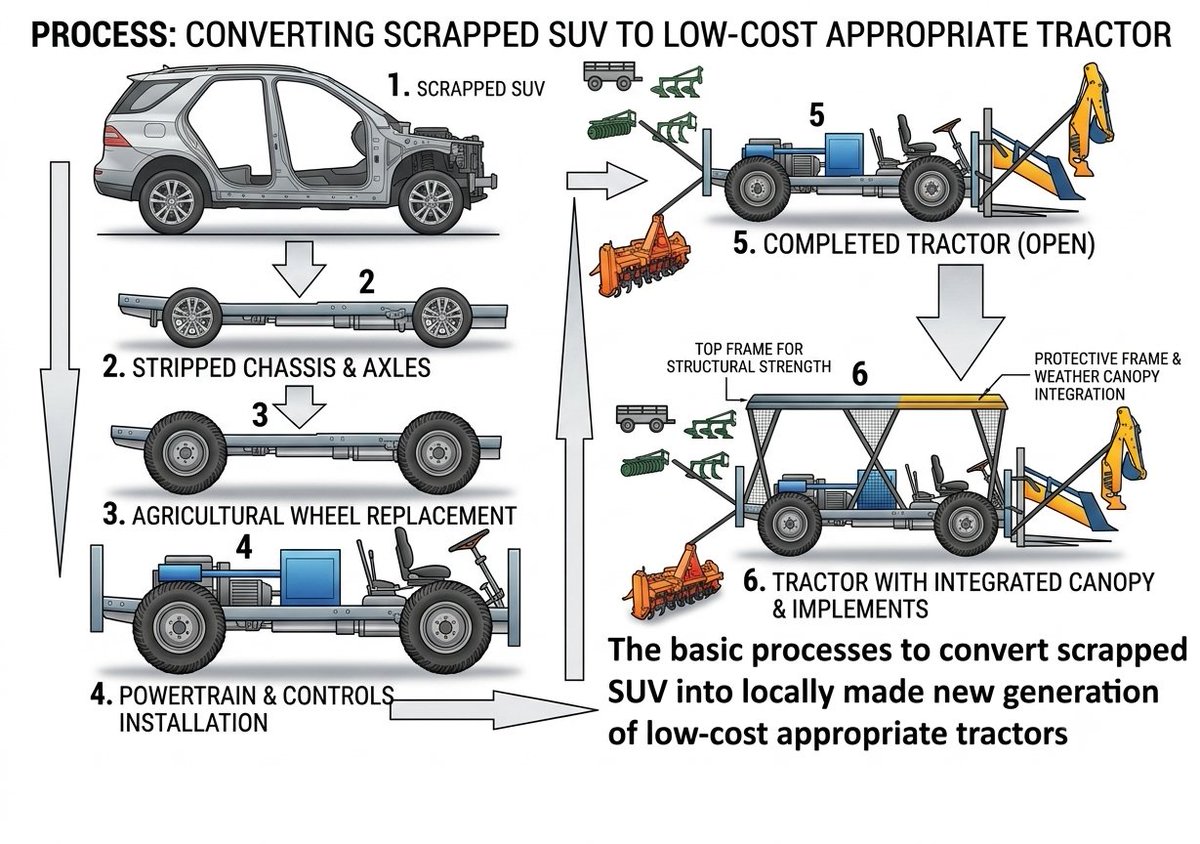
The Basic Processes to Convert Scrapped SUV Into Locally Made New Generation of Low-Cost Appropriate Tractors, also for other vehicles of different sizes and three-wheeled.
Here is the step-by-step conversion process:
Step 1: Scrapped SUV Vehicle
Start with an end-of-life or scrapped SUV as the base platform.
Step 2: Stripping the Bodywork
Remove the SUV body shell, interior, doors, and roof to expose the underlying chassis frame, axles, and powertrain.
Step 3: Wheel Replacement
Replace the original road tires with heavy-duty, high-traction agricultural/tractor wheels.
Step 4: Mechanical & Controls Setup
Mount the engine/transmission block, driver seating, and steering assembly directly onto the frame, along with mounting brackets for equipment attachments.
Step 5: Implement Integration
Attach rear agricultural implements (such as plows, harrows, tillers, or trailers) and front utility implements (such as loader arms or backhoe attachments).
Step 6: Top Structural Frame & Weather Canopy
Install the upper frame structure, which serves a dual purpose: providing essential structural strength/rigidity to the vehicle overall, while simultaneously functioning as a protective roll cage and overhead weather canopy for the operator.
The Basic Processes to Convert Scrapped SUV Into Locally Made New Generation of Low-Cost Appropriate Tractors, also for other vehicles of different sizes and three-wheeled.
Here is the step-by-step conversion process:
Step 1: Scrapped SUV Vehicle
Start with an end-of-life or scrapped SUV as the base platform.
Step 2: Stripping the Bodywork
Remove the SUV body shell, interior, doors, and roof to expose the underlying chassis frame, axles, and powertrain.
Step 3: Wheel Replacement
Replace the original road tires with heavy-duty, high-traction agricultural/tractor wheels.
Step 4: Mechanical & Controls Setup
Mount the engine/transmission block, driver seating, and steering assembly directly onto the frame, along with mounting brackets for equipment attachments.
Step 5: Implement Integration
Attach rear agricultural implements (such as plows, harrows, tillers, or trailers) and front utility implements (such as loader arms or backhoe attachments).
Step 6: Top Structural Frame & Weather Canopy
Install the upper frame structure, which serves a dual purpose: providing essential structural strength/rigidity to the vehicle overall, while simultaneously functioning as a protective roll cage and overhead weather canopy for the operator.
The Basic Processes to Convert Scrapped SUV Into Locally Made New Generation of Low-Cost Appropriate Tractors, also for other vehicles of different sizes and three-wheeled.
Here is the step-by-step conversion process:
Step 1: Scrapped SUV Vehicle
Start with an end-of-life or scrapped SUV as the base platform.
Step 2: Stripping the Bodywork
Remove the SUV body shell, interior, doors, and roof to expose the underlying chassis frame, axles, and powertrain.
Step 3: Wheel Replacement
Replace the original road tires with heavy-duty, high-traction agricultural/tractor wheels.
Step 4: Mechanical & Controls Setup
Mount the engine/transmission block, driver seating, and steering assembly directly onto the frame, along with mounting brackets for equipment attachments.
Step 5: Implement Integration
Attach rear agricultural implements (such as plows, harrows, tillers, or trailers) and front utility implements (such as loader arms or backhoe attachments).
Step 6: Top Structural Frame & Weather Canopy
Install the upper frame structure, which serves a dual purpose: providing essential structural strength/rigidity to the vehicle overall, while simultaneously functioning as a protective roll cage and overhead weather canopy for the operator.
The Basic Processes to Convert Scrapped SUV Into Locally Made New Generation of Low-Cost Appropriate Tractors, also for other vehicles of different sizes and three-wheeled.
Here is the step-by-step conversion process:
Step 1: Scrapped SUV Vehicle
Start with an end-of-life or scrapped SUV as the base platform.
Step 2: Stripping the Bodywork
Remove the SUV body shell, interior, doors, and roof to expose the underlying chassis frame, axles, and powertrain.
Step 3: Wheel Replacement
Replace the original road tires with heavy-duty, high-traction agricultural/tractor wheels.
Step 4: Mechanical & Controls Setup
Mount the engine/transmission block, driver seating, and steering assembly directly onto the frame, along with mounting brackets for equipment attachments.
Step 5: Implement Integration
Attach rear agricultural implements (such as plows, harrows, tillers, or trailers) and front utility implements (such as loader arms or backhoe attachments).
Step 6: Top Structural Frame & Weather Canopy
Install the upper frame structure, which serves a dual purpose: providing essential structural strength/rigidity to the vehicle overall, while simultaneously functioning as a protective roll cage and overhead weather canopy for the operator.
The Basic Processes to Convert Scrapped SUV Into Locally Made New Generation of Low-Cost Appropriate Tractors, also for other vehicles of different sizes and three-wheeled.
Here is the step-by-step conversion process:
Step 1: Scrapped SUV Vehicle
Start with an end-of-life or scrapped SUV as the base platform.
Step 2: Stripping the Bodywork
Remove the SUV body shell, interior, doors, and roof to expose the underlying chassis frame, axles, and powertrain.
Step 3: Wheel Replacement
Replace the original road tires with heavy-duty, high-traction agricultural/tractor wheels.
Step 4: Mechanical & Controls Setup
Mount the engine/transmission block, driver seating, and steering assembly directly onto the frame, along with mounting brackets for equipment attachments.
Step 5: Implement Integration
Attach rear agricultural implements (such as plows, harrows, tillers, or trailers) and front utility implements (such as loader arms or backhoe attachments).
Step 6: Top Structural Frame & Weather Canopy
Install the upper frame structure, which serves a dual purpose: providing essential structural strength/rigidity to the vehicle overall, while simultaneously functioning as a protective roll cage and overhead weather canopy for the operator.
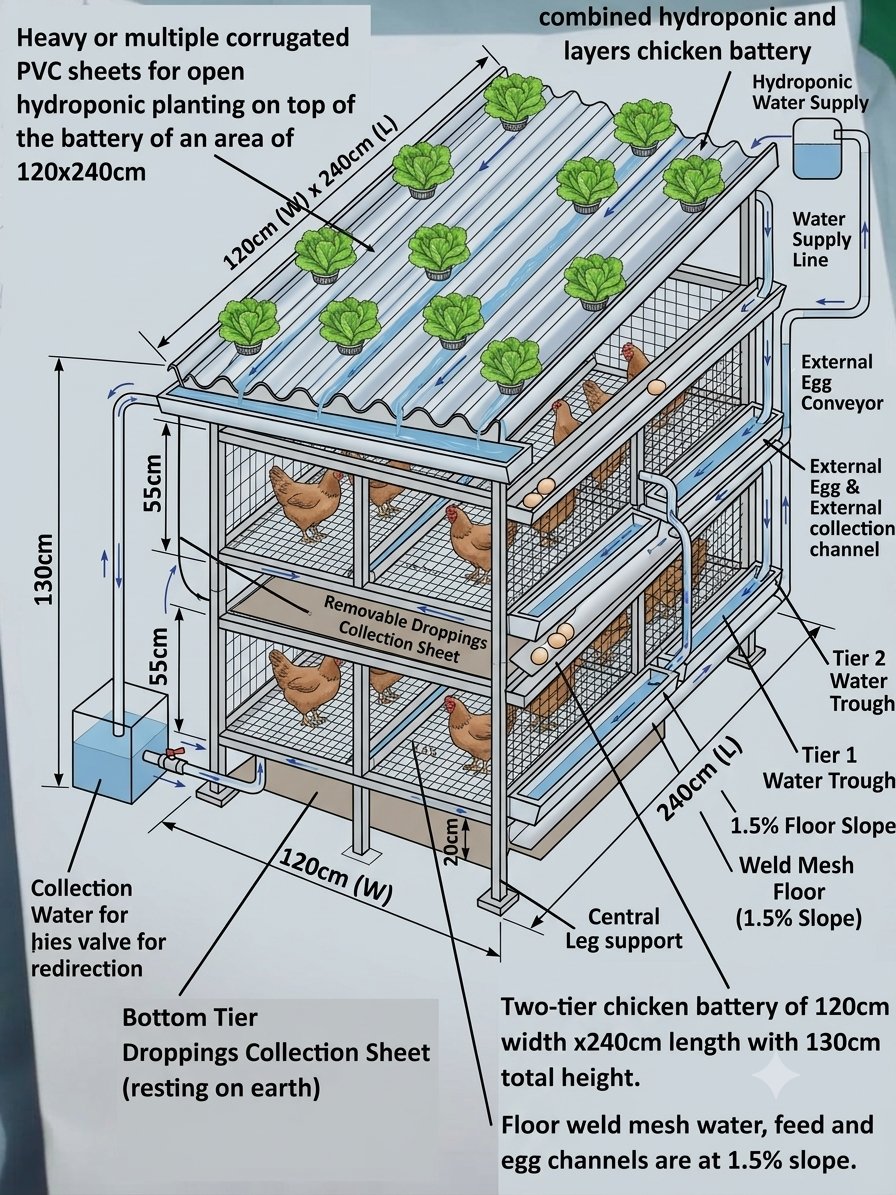
This isometric diagram shows a combined hydroponic and layers chicken battery unit
A. Two-tier chicken battery of 120cm width x240cm length with 130cm total height.
Hydroponic roof has 2.5% slope, floor weld mesh feed, water and egg channels are at 1.5% slope.
The top tier has a removable droppings collection sheet, and the bottom tier its droppings collection sheet rests on earth
B. A heavy or multiple sheets of corrugates PVC for open hydroponic planting on top of the battery of an area of 120x240cm