@Brad_Setser@CBankingEditor I think the more interesting question, which I don't know the answer to, is how much more of this export-dependency the Chinese economy can take? Logan Wright makes a good point that no economy this size can expect exports to carry it for long if the financial system is broken.
@CBankingEditor@Brad_Setser Hey, CBaN, in the age of AI, there is no point belittling someone for not being able to read Chinese in order to understand what policymakers or economists are saying. Come on, make a stronger argument.
@Brad_Setser@CBankingEditor Plenty of advisors/academics offering remedies for China's imbalanced economy, none has impact. This is ever more clear from He Lifeng's essays, which bring a supply solution to a demand problem. The course is set. https://t.co/BKOOgAN1Xs
@vshih2 Logan Wright's new book has a section where he reminds how Xi sidelined the PSC and State Council soon after taking power by setting up the various leading groups. The language of this readout suggests he may just have formed his own group again ...
@vshih2 The great irony as pointed out by those clever people at Dragonomics is that these amounts are rounding errors compared to how much money Beijing throws into supporting the corporate sector with subsidies.
A long essay on the way Japan, Korea and Taiwan – all democracies – are still struggling to rebalance their economies after decades of growth under an investment-heavy model. If it is tough for them, just imagine how hard it is for China. That will come next. https://t.co/lHtBxUcsXa
@Brad_Setser Well said Brad, great timing as China's July activity data comes out. I argued in today's newsletter that each month's data release without a policy shift to rebalance the economy is another month down an inexorable path to economic stagnation. You say it needs more, bravo. 💪
@michaelxpettis The sad irony of TSF growing so strongly while bank lending declines is that TSF used to be where private financing played – people putting their idle cash to use in the grey market. Then Beijing cracked down, and now TSF is meaningless, it's just the same banks buying govt bonds
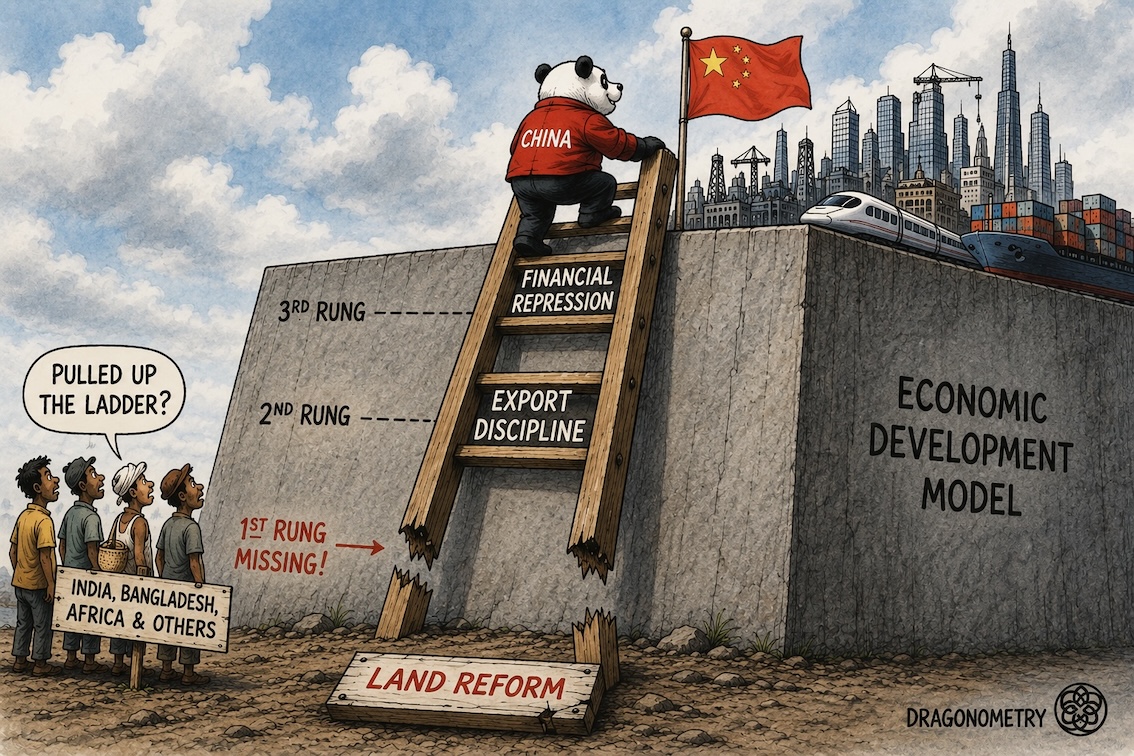
Today’s deep dive engages with posts by Adam Tooze and David Fishman, as we feel this is a wider debate worth encouraging. What is “the ladder”, and how is China’s development model different from the other three Dragons? Hint: it’s all about land reform.
https://t.co/AvE23Bc7tQ
Daily Dragon: More posturing from US trade negotiators ahead of Xi’s trip; a US delegation to China says they saw evidence of anxiety; the US-China board of investment is going nowhere, fast; and a market has grown for tipoffs on anti-corruption probes.
https://t.co/i5ykdCRrDf
@michaelxpettis Agreed. I would argue (with hindsight) that those provincial leaders clearly had no idea what they were giving away in '94 :)
More seriously, I covered this in a recent essay as a major obstacle to rebalancing: who pays for it? https://t.co/aOrIu3NRzY
@michaelxpettis Thanks for the shout-out. One thing I didn't say in the piece: This tightening says a lot about the sheer desperation in Beijing to plug budgetary holes. Same for the latest crackdown on offshore wealth. And yet a property tax is still apparently considered impossible.