Constitutionalist. Stands w/🇮🇱. I #instablock gaslighters & glittering jewels of ignorance. Anticipating the return of the only hope for mankind; Jesus Christ
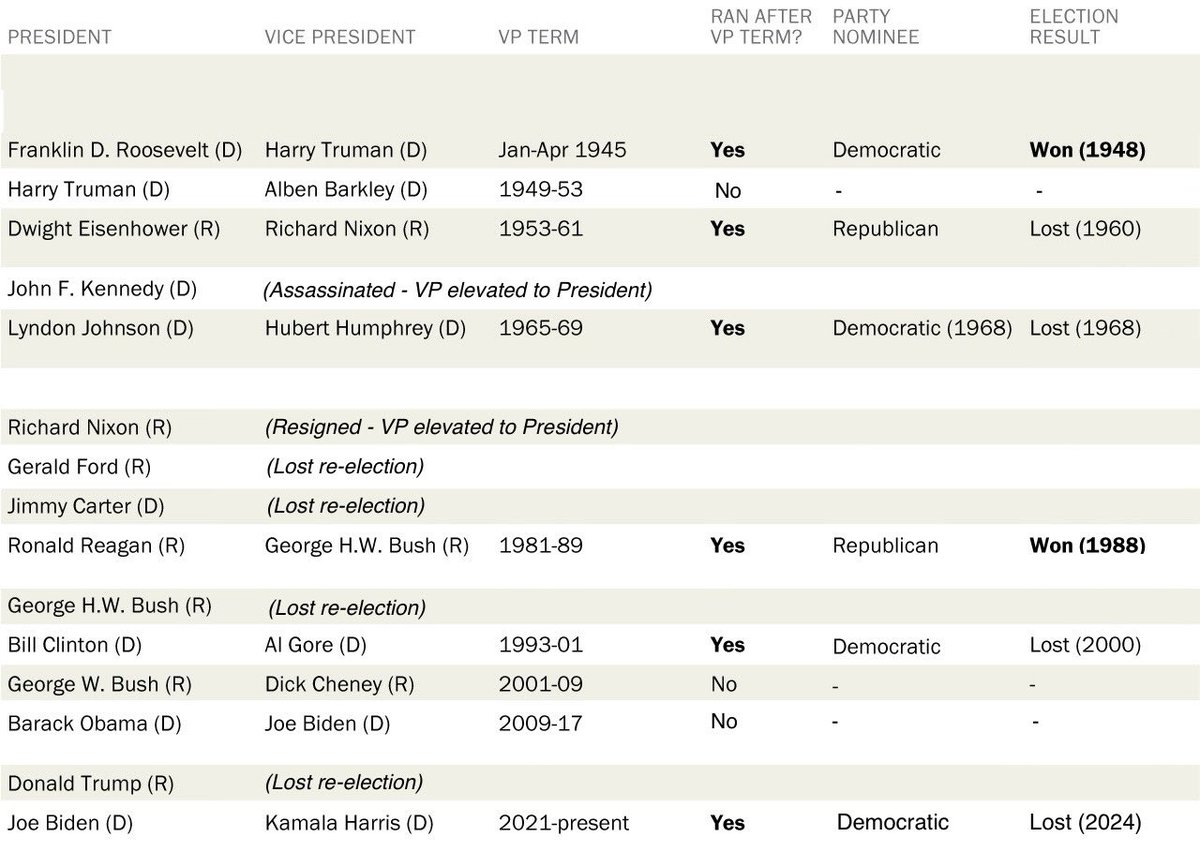
In the modern era (post FDR), VPs are almost always the nominee. There have been only three who were not nominated while in office, either because they were too old (i.e. Barkley), or chose not to run at all for personal reasons (Cheney and Biden).
Of the other six, only 2 managed to get elected while a president of their own party was still in office. That was only accomplished because they followed highly popular presidents.
Because Trump is no FDR or Reagan, I predict Vance will have no chance to become president in 2029.
Of note: in the modern era, no losing VP presidential nominee except Nixon has come back later to win the presidency.
@soothkeep The key phrase here is "all the world". There has been no trial that has come on the entire world since the flood. People who refuse to acknowledge this fact need to up the quality of their study of scripture.
In Revelation 3:10, Jesus promises the church that He will keep thee from the hour of trial, which shall come upon all the world, to try them that dwell upon the earth. The phrase “keep from” is the Greek tereo ek, meaning to keep out of. This is very different from dia tereo, which is the idea of being protected through a trial while remaining inside it.
The distinction matters.
If the coming trial is said to come upon “the whole world,” then there is only one way to truly be kept from the hour of that trial: to be removed from the earth before it begins.
Jesus did not promise merely to preserve believers during the Tribulation. He promised to keep them from the very time period itself.
Watch the recording here: https://t.co/9wCnUXvTEP
Regarding the "Apostasy" spoken of by Paul.
On this topic, I agree with Western Seminary professor, Stanley Ellison, who took the contrary position to the conventional wisdom.
Biography of a Great Planet (1975)
Pages 121-123
"The first preliminary event is the departure (the apostasy). This is almost universally taken to mean a great latter-day defection from the faith (2 Thess. 2:3). It is usually associated with several other passages that speak of retraction from godliness and the gospel, notably 1 Timothy 4:1; 2 Timothy 3:1ff.; and 1 John 2:18ff. From these references the doctrine of a massive, latter-day retraction from the faith has been constructed, and the word apostasy has come to be defined in dictionaries as "desertion of one's faith."
At the risk of being out of step with most commentaries on the subject, may we suggest the greater acceptability of an alternate view: the evidence for a great singular defection from the faith, occurring just prior to the rapture or to the day of the Lord, is really based on questionable ground. In the first reference generally appealed to (1 Tim. 4), Paul does speak of an apostasy from the faith, but not as a unique end-time event. Rather, he described it as a trend or movement that was already present. This he characterized as erroneous doctrine, hypocritical living, and improper legalism. In using the term apostasy here, he qualified it with the phrase "from the faith." By itself it meant simply "departure."
In the second reference to defection, 2 Timothy 3:1ff., Paul does not use the term apostasy, but merely speaks of evil men in general in the latter times. His point here is that evil men will become more and more depraved as the age wears on (2 Timothy 3:13). Thus this passage has no real relation to apostasy from the faith and certainly does not warn of some specific final defection that will precede the rapture or introduce the day of the Lord.
It is therefore extremely questionable whether the doctrine of a final, climactic defection, just prior to the end-time, has genuine scriptural support-unless it can be found in 2 Thessalonians 2:3. In speaking of apostasy in 2 Thessalonians, Paul does not say "from the faith." He refers rather to a single great apostasy. Without a qualifying phrase here, the word apostasy still means " departure." The term is used only two other times in the New Testament, in both of which it is coupled with a qualifying phrase (Acts 21:21, "from Moses'; 1 Tim. 4:1, "from the faith'). To insist on its always meaning spiritual apostasy would require it to mean "departure from the faith of Moses." The verb form is aphistemi and is overwhelmingly translated "depart" in the New Testament. Thus the word apostasia can signify a departure of any kind.
In this reference in 2 Thessalonians 2, Paul speaks of it as an event that was well understood. He referred to it as "the" departure, one already well defined, of which he had spoken. If we then search for a previous mention by Paul of a great spiritual defection that was to come, we look in vain. Some have sought to relate it to the rebellion of the "man of sin," since Paul had taught them the book of Daniel (2 Thess. 2:5). That would surely broaden the concept of apostasy and would make Antichrist's breaking the covenant the first thing to look for, even preceding his manifestation (2 Thess. 2:3). Other-wise, Paul had not so much as mentioned a coming spiritual defection. If, on the other hand, we look for a previous reference by Paul to a great, noteworthy departure of physical nature, we need go only to the immediately preceding verses of the chapter. Those verses, further, refer back to his extended description in 1 Thessalonians 4 of the departure of the saints in rapture. Having emphasized this so strongly in the first epistle, he could speak of it in the second epistle simply as the departure. No other departure had even been mentioned in the historical context."
https://t.co/OLOc2tTVal
Dr. Stanley Ellisen summarizes his view that "apostasy" can only be taken as meaning "departure", not "departure from the faith":
"It is thus evident that both the context and grammar overwhelmingly favor the view that this apostasia, which must precede the day of the Lord, is the departure of the Church in rapture. Paul specifically says it must occur first, as the initiating event that introduces the day of the Lord (2 Thess. 2:3). It would be strange, indeed, for Paul not to mention the rapture in this series of initiating events, if, as other scriptures indicate, he did believe in the pre-tribulation rapture of the church. This departure of the church in rapture, then, will be the first of three preliminary events that introduce the day of the Lord."
I generally am in full agreement with your takes on dispensational eschatology. Still, I remain in the other camp regarding the use by Paul of the word "apostasy"
Dr. Stanley Ellisen of Western Conservative Baptist Seminary wrote a fantastic book on the last days back in 1975 called "Biography Of A Great Planet".
His view was that, contextually, the word "apostasy" must refer to "departure" only and not "departure from the faith".
I published a post on this that quotes the relevant section from his book:
Regarding the "Apostasy" spoken of by Paul.
On this topic, I agree with Western Seminary professor, Stanley Ellison, who took the contrary position to the conventional wisdom.
Biography of a Great Planet (1975)
Pages 121-123
"The first preliminary event is the departure (the apostasy). This is almost universally taken to mean a great latter-day defection from the faith (2 Thess. 2:3). It is usually associated with several other passages that speak of retraction from godliness and the gospel, notably 1 Timothy 4:1; 2 Timothy 3:1ff.; and 1 John 2:18ff. From these references the doctrine of a massive, latter-day retraction from the faith has been constructed, and the word apostasy has come to be defined in dictionaries as "desertion of one's faith."
At the risk of being out of step with most commentaries on the subject, may we suggest the greater acceptability of an alternate view: the evidence for a great singular defection from the faith, occurring just prior to the rapture or to the day of the Lord, is really based on questionable ground. In the first reference generally appealed to (1 Tim. 4), Paul does speak of an apostasy from the faith, but not as a unique end-time event. Rather, he described it as a trend or movement that was already present. This he characterized as erroneous doctrine, hypocritical living, and improper legalism. In using the term apostasy here, he qualified it with the phrase "from the faith." By itself it meant simply "departure."
In the second reference to defection, 2 Timothy 3:1ff., Paul does not use the term apostasy, but merely speaks of evil men in general in the latter times. His point here is that evil men will become more and more depraved as the age wears on (2 Timothy 3:13). Thus this passage has no real relation to apostasy from the faith and certainly does not warn of some specific final defection that will precede the rapture or introduce the day of the Lord.
It is therefore extremely questionable whether the doctrine of a final, climactic defection, just prior to the end-time, has genuine scriptural support-unless it can be found in 2 Thessalonians 2:3. In speaking of apostasy in 2 Thessalonians, Paul does not say "from the faith." He refers rather to a single great apostasy. Without a qualifying phrase here, the word apostasy still means " departure." The term is used only two other times in the New Testament, in both of which it is coupled with a qualifying phrase (Acts 21:21, "from Moses'; 1 Tim. 4:1, "from the faith'). To insist on its always meaning spiritual apostasy would require it to mean "departure from the faith of Moses." The verb form is aphistemi and is overwhelmingly translated "depart" in the New Testament. Thus the word apostasia can signify a departure of any kind.
In this reference in 2 Thessalonians 2, Paul speaks of it as an event that was well understood. He referred to it as "the" departure, one already well defined, of which he had spoken. If we then search for a previous mention by Paul of a great spiritual defection that was to come, we look in vain. Some have sought to relate it to the rebellion of the "man of sin," since Paul had taught them the book of Daniel (2 Thess. 2:5). That would surely broaden the concept of apostasy and would make Antichrist's breaking the covenant the first thing to look for, even preceding his manifestation (2 Thess. 2:3). Other-wise, Paul had not so much as mentioned a coming spiritual defection. If, on the other hand, we look for a previous reference by Paul to a great, noteworthy departure of physical nature, we need go only to the immediately preceding verses of the chapter. Those verses, further, refer back to his extended description in 1 Thessalonians 4 of the departure of the saints in rapture. Having emphasized this so strongly in the first epistle, he could speak of it in the second epistle simply as the departure. No other departure had even been mentioned in the historical context."
[concludes next post]
Dr. Stanley Ellisen summarizes his view that "apostasy" can only be taken as meaning "departure", not "departure from the faith":
"It is thus evident that both the context and grammar overwhelmingly favor the view that this apostasia, which must precede the day of the Lord, is the departure of the Church in rapture. Paul specifically says it must occur first, as the initiating event that introduces the day of the Lord (2 Thess. 2:3). It would be strange, indeed, for Paul not to mention the rapture in this series of initiating events, if, as other scriptures indicate, he did believe in the pre-tribulation rapture of the church. This departure of the church in rapture, then, will be the first of three preliminary events that introduce the day of the Lord."
Regrettably, we had 8 years of a GenXer just before Trump. And it took the youth of Iowa to put Trump over the top in 2024 to beat DeSantis.
Yes, there is a cadre of liberal Republican Boomers out there who like Trump's liberalism but the country is not going to get more conservative once the boomers are gone. MAGA is a progressive populist movement that involves all age groups.
@soothkeep The systemization of the many passages related to the pre-tribulational rapture is a good example. Same with the distinction between Israel and the Church.
@Trader19731@RMConservative Entirely incorrect. Elected Republicans do what Trump wants them to do. The Republican Party is a wholly owned subsidiary or Trump Inc.
And yet the base loves Trump. So do the math.
@Loliver23Oliver@RMConservative Trump Americas don't really want them gone or they wouldn't have elected him to another term given his love of illegals.
@blind_nut@RMConservative Republican politicians exist at the behest of Republican. There is no real distinction between the two groups.
This is especially the case in the era of Trump. The base loves Trump and Trump loves RINO Republicans. The base knows this (or should know it).
What liberal Republican senators and Congressmen would she have gotten elected? Trump has filled Capitol Hill with these creeps.
What kind of clout would she have had with a Republican majority Congress.
Would Harris have been able to destroy the conservative wing of the GOP like Trump has?
I'd honestly like to know what long term damage she could have done given that DeSantis would have beaten her badly in 2028.
As it is, we will get a President Newsom or AOC in 2028 along with a majority Dem Congress thanks to Trump.
We have recently heard that many well-known pastors were invited to a special UFO-disclosure meeting with government officials to give them a heads up. Don't be surprised if some well-known quasi-evangelicals start reimagining the Bible, the creation account in Genesis, the gospel, and the second coming of the messiah. This new light will merge with the already existent movements which allegorize much of the OT and eschatology. Prepare to watch the already muddy waters of evangelicalism darken even further with unbelief. This disclosure will end up leading to the removal of major hurdles that separate Evangelicals and Catholics. Their historic differences, seen through the newly-issued lizard-colored glasses, will be seen as the result of errant human reasoning on the basis of imperfect information. The new revelation will interpret the old revelation, essentially rewriting the Bible the same way that rationalism, emergent Christianity, and progressive Christianity have rewritten the Bible.
Welcome to post-biblical Christianity. The Bible won't be physically tossed in the trash. It will be glossed with seductive serpent lies.
As Chuck Missler often said, there may have been a gap between vs 1 and 2 but nothing exists today that existed prior to verse 2.
Missler stressed that the original creation of verse 1 was so thoroughly judged and wiped out that nothing from that primordial world remains in our current physical reality. The six-day account is a fresh restorative work, not a continuation of the original. Any remnants (if any) would be obliterated, explaining why we don’t see direct traces of a “pre-Adamic” world in the fossils or geology.
@EventideGuild@HomemakingLady@NFSjam00 If they are teaching that you can lose your salvation, then yes, that's a false gospel according to Paul (c.f. Romans 8).
Arminianism takes the view that you can lose your salvation. This is essentially heresy. That view confuses justification with sanctification. With gaining entry into heaven rather than gaining the inheritance of rewards for fruit-bearing.
Because Calvinism has multiple doctrinal issues, some are correct and some are wrong. It is even sometimes said by Calvin scholars that Calvin himself would not agree with some of modern "Calvinism".