"Pass the ball!"
I've spoken to coaches and parents talking about players who are 5 - 9 years of age not passing the ball enough.
But their understanding of a child's peripheral vision at these ages has not been considered.
They are still learning to see everything around them and make choices on the pitch.
Right now, they mostly look at what’s right in front of them.
That is why helping them to be confident in "staying on the ball" is most important.
Think about the questions within the decision-making process:
1. Where are my teammates?
2. Where are the defenders?
3. Are they under pressure or open?
4. Of those who are open where are they?
5. Have I communicated with my teammate?
6. How much time do I have to make my pass?
7. Am I in control of the ball to be able to pass?
8. Do I pass into space or directly to my teammate?
9. What type of pass should I make to my teammate?
10. How hard do I need to pass the ball to my teammate?
And also.
11. Why am I passing the ball in the first place?
Knowing this.
The approach to young players needs to change.
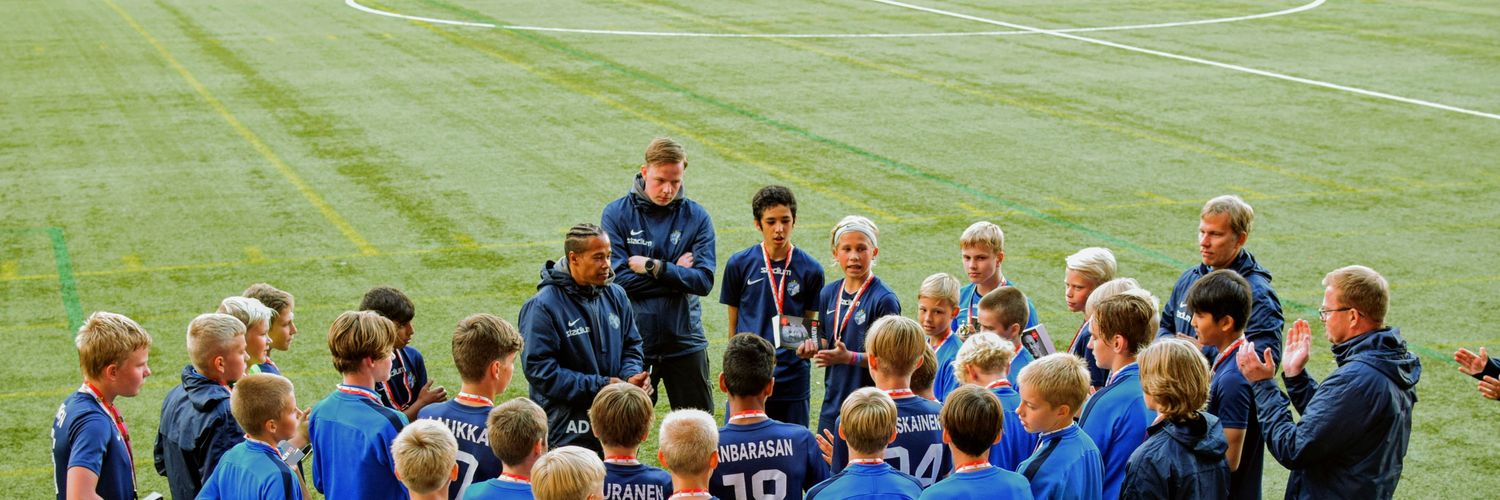
Upeita tunnelmia Regions Cupin finaalista Tampereen Tammelan Stadionilta ✨🏆.
Onnea, onnea!
Upea Cupin voitto U18 Akatemia 💛🖤✨!
FC Honka 2 - 0 NJS
#MeOllaanHonka#RegionsCup
📸 Juhani Järvenpää
How I train my team to be unstoppable even when things get tough:
There are many good, talented football players. But the question is, how do they behave when it's difficult? When the opponent is better? When the opponent has the ball and we have to run a lot? When we lose 0:2 and there are 10 minutes left? Can you take the penalty if it's the decisive penalty in the final? How do you deal with pressure? That's what makes the difference.
That is why the most important thing in my training: I try to make it as competitive and difficult as possible. I try to make it more difficult than the game. It doesn’t matter what happens in the game, we are prepared.
Thomas Tuchel talked about it:
“Give them difficulties. Overcoming obstacles is the most important talent criteria. I was youth coach in Stuttgart and in Augsburg. I always wanted the best environment for my players. I wanted everything to be perfect. Today I would say, that half a pitch, one TV and one recorder are enough. And the pitch does not have to be in the best condition. The players should deal with difficulties and play regardless of the environment.” (Tuchel, Aspire Academy, Free translation from German)
Kobe Bryant: ”Practices are meant to be competitive. If your practices aren't more competitive than the games themselves, you are doing the wrong thing. Most of the teams and coaches have gotten into this mindset of resting players. ‘Oh, it’s too much, we are not going to practice’.[…] Phil never gave us a light day.
There is no days off. You show up and you work and practice. And practices are going to be worse. They are going to be more physical, it is going to be more trash-talking, and if you didn't show up today I'm going to let you know. It’s going to be embarrassing and you're going to hate it. But when game 7 rolls around the NBA Finals, you will be prepared.”
Raymond Verheijen breaks the non-specific term “mentality” down to one thing: Are you able to focus 100% on the next action (see ’Football Coaching Theory’). And he has to do that, no matter how emotional he is. No matter how difficult and hopeless the situation seems. No matter how superior the opponent is. Can you focus 100% on the next action without being distracted? That takes a lot of training. And the more difficult the challenge, the harder it is to focus on the next action.
The same applies to coaches: Can we focus on the next action, or do we lose our composure and yell at our players? Can we still make rational decisions when we're loosing, or do we substitute the player who made the mistake? So the next time training doesn’t work as planned, do not try to get emotional. Remind yourself, this is the chance for you to become a better coach. Stay calm and try to make rational decisions.
Fixed vs. Infinite Mindset:
People with fixed mindset think (unconsciously), that some abilities and character traits cannot be changed. They avoid challenges and easily give up when faced with obstacles.
If you have players with this mindset, you have to change their believes first. How they see the world? Teach them that with hard work and dedication they can improve anything. Nothing is set in stones. Teach them how to cope with setbacks. Teach them how to deal with mistakes. The infinite mindset sees challenges as an infinite game. The goal is to keep playing and improving over time, rather than simply winning a single game or achieving a specific outcome.
Infinite Mindset is important to teach. Don't let limiting beliefs stop you. There is always something to optimize. Once you are satisfied, you stop growing. It is important to repeat this over and over until it is internalized.
But how can we make the training competitive? How should we train?
Our brain adapts to challenges (called neuroplasticity). If we stop challenging ourself, we stop growing.
Children have this naturally. Because they do not have much experience, for them is everything new and and therefore a challenge. The older they become, the lower the number of mistakes. Think of a toddler learning to walk. He is making mistakes with every step and falling down. But over time, this is not a challenge anymore, so we stop improving. We are in a stable state where we feel comfortable. You can't walk better at 40 than you did at 20. That is because we have no pressure to adapt. At a certain point, the automatic adaptation stops, and we have to provoke it again and again, putting our brain in an unstable state. The brain strives for a stable state again, so it adapts.
Here are some ideas how we can make our training more competitive:
a) Do tournaments.
Form three teams. Two play, one has to wait. The losing team swaps with the waiting team. The players want to play, so you provoke to compete. If you give up, you do not play.
Here are a few additional tips:
- Change after every goal → Immediate feedback
- Extra-Work outside: The team outside has to do something they do not want to do.
- You can do this with Rondos or positional games, too.
- Incentives: price for the winner (Candy; they are allowed to pick an exercise for the next session)
- Punishment: Losers have to tidy up after the training
b) Incentives.
Incentives usually work better than punishments, at least in the long run. Example: Reward ball: After scoring a goal, you keep possession of the ball.
c) Restrictions.
You give the players extra rules. They can get rid of them (reward themselves) by winning/scoring goals.
One team plays with 2 contacts, the other free. if the restricted team scores, then the teams swap tasks. If the "free" team scores two goals in a row, they win the competition. (Or than it is getting even more difficult for the other team, for example just scoring one touch).
Other example: One team is allowed to pass and shoot only with the weak foot. If they score, the other team has this restriction.
d) Simulate uncomfortable game situations.
- 6v4. The team with the numerical disadvantage starts with 2:0 lead. They have to defend it for 4 minutes. If they don't succeed, they have to play outnumbered again.
- Before the game, both team have both ONE penalty. If they score, they have two goals, if not, the other team gets one goal. It creates pressure for the player and simulate a decisive penalty.
- Unfair teams: Normally, you divide your teams into equally strong teams. Try to let your “best” players play against the others. Observe how they behave. My observation is, the the “underdog” team is running a lot and battle to beat the other players.
e) Do boring drills.
This is probably unusual advice. But how long can you focus doing the same boring, repetitive task? Usually we don't do that because we know our players can't concentrate for long. And it's not the most effective exercise to teach something. But we demand discipline and concentration for a long time.
f) Punishment.
For example, two push-ups after each goal conceded.
g) Choose a difficult environment.
Do you have a field in a bad condition? Train there. Or meet on a field in the park, whose lawn is not perfectly trimmed. Play in the parking lot. There it hurts when you fall down. Simulate the street football. Naby Keita talked about it:
“We played with whatever we could and I would have nothing on my feet, or sometimes, play with old, damaged shoes”
“I didn’t have boots and treasured football shirts that were given to me. All that has helped me be better prepared for anything now as a professional and I’m also not scared of anything on the pitch.”
“I was quite small and so I had to fight for everything: the chance to play, for the ball, to get respect and that’s why not even cars could stop me. It’s where the aggression in my game, which is so important for my position, comes from.”
Summary:
Nowadays we are sometimes too careful. We have the best conditions and try to take all the tasks and challenges away from the players. Even with children I hear terms like load management. But it is not about the players being rested for the game at the weekend. It's about overcoming obstacles. They have to go beyond their limits. Yes, that may not be optimal, it can be that you lose games because your players are not rested at the game. But it trains your mind. It makes you more resilient to challenges.
If you do one thing every training that is uncomfortable for the players, you help them a lot. Especially at higher level it is not so much about showing them how to play. Most of the time they are playing better than you. Your job is it to create the obstacle.
Välillä tuntuu, että junioriurheilussa nähdään hyvin pahana, jos valmentaja painottaa myös tuloksia. Miksi?
• Tulokset ja kehittyminen eivät sulje toisiaan pois
• Tulosten kautta voi päästä kiinni tärkeisiin arvoihin ja oppia
• Tulos on myös palaute ja luo merkitystä
Huomenta! 🦉
U16-tytöt otti eilen maukkaan voiton, kun Ruotsi kaatui lukemin 1-0. Pelin ainokainen syntyi 70. minuutilla - Olivia Reis antoi mainion syötön Laura Oksaselle, joka viimeisteli tyylikkäästi. Kumpikin oli vaihdettu kentälle vain hetkeä aiemmin! 👏 #Pikkuhelmarit
✨2008 syntyneiden Helmariturnauksessa hieno edustus Hongasta! Käynnissä olevaan turnaukseen valittiin T08 Akatemiasta peräti 14 pelaajaa!
Alisa Mäkelä sekä Queenie Ziting Xiang valittiin turnauksen All stars -pelaajiksi ⭐️!
#MeOllaanHonka#helmariturnaus2022
Ada Eronen, 17, ja Julia Schalin, 16, ovat poikkeuksellisia urheilijoita – pelaavat Suomen huipulla samaan aikaan kahdessa lajissa https://t.co/JMSq6Ewean
Tässä ovat vuosien 2022-23 talenttivalmentajat! 🙌
SJK:n @MikaOjala kertoo haastattelussa, millä tavoin hän pyrkii auttamaan nuoria pelaajia. Entinen huippupelaaja tietää, että tukea tarvitaan niin kentällä kuin sen ulkopuolella. ⤵️ #SeurojenPalloliitto
https://t.co/0H78iADyuW
Kalenterit esiin!
Kansallisen Liigan kauden 2022 otteluohjelma on selvillä! Kausi käynnistyy 26.3.! Kirjaa tästä ylös kaikki Hongan ottelut!
Kausikortit! ➡️ https://t.co/6Q3naVDg50
#MeOllaanHonka#KansallinenLiiga
Honka on avannut harjoitukset vuoden 2022 osalta, valmistautuminen on hyvässä vauhdissa!
Videolla päävalmentaja Omar Adlanin ajatuksia kuluneesta treeniviikosta, joka päättyy huomenna suljetuin ovin pelattavaan harjoitusotteluun NJS:ää vastaan.
#MeOllaanHonka#KansallinenLiiga
📣: Iloisia yhteistyöuutisia!
Espoon Palloseura, FC Honka ry ja Esport Honka Oy ovat solmineet yhteistyösopimuksen!
➡ https://t.co/kRjHqOFEV5
#EspooLiikkuu
So excited about this knowledgable coaching staff! Everyone with a common goal to help the players not only in footballing terms but in the overall wellness. Looking forward to the upcoming year!
Antoni Dagaa aloittaa FC Hongan tyttöjen talenttivalmentajana tulevan kauden alussa.
- Talenttivalmentajana pääsen auttamaan yksilöitä ja viemään heitä eteenpäin. Itsellenikin tämä on hyvä paikka kehittyä.
Tervetuloa Honkaan, Toni 💛.
https://t.co/4uF4oZ0It1
@FCEspooP07 joukkueesta peräti 14 pelaajaa syyskuun pelaajatarkkailuleireille💪💙
@Antoni_T_D vastuuvalmentajana on tyytyväinen määrään ja uskoo pelaajien kehityksen jatkuvan👍
#fcespoo#huuhkajapolku
Meiltä valittiin 9 pelaajaa 2007 syntyneiden Huuhkajaturnaukseen, joka pelataan 5-8.8. Eerikkilässä. Valitut pojat: Bawer, Ila, Niilo, Liinus, Oliver, Petr, Joona, Sisu ja Ville.