Insurance is the oldest of the four ways. It is a nine-trillion-dollar global industry. The equation underneath it was invented in 1560 by a broke Italian gambler.
His name was Girolamo Cardano. He wrote a book called Liber de Ludo Aleae. A short manual on how to win at dice. Nobody in finance read it for four hundred years.
Then in 1996 a ninety-year-old man in New York wrote a book that traced every modern risk model back to that manual. He called it Against the Gods. One thesis. Every dollar of premium ever collected on Earth is a footnote to a gambler scribbling in Milan.
His name was Peter Bernstein. He founded the Journal of Portfolio Management in 1974 and ran money at Bernstein-Macaulay before that. Wall Street called him the historian of risk.
In 2008 a small production company filmed him for thirteen minutes. He walked through the entire five-hundred-year arc. Cardano to Pascal to Fermat to Black-Scholes. Then he stopped and said the industry had built glass towers on the back of an idea a broke Italian scribbled to settle a card debt.
He died the following summer. Age ninety.
Reinsurance premiums crossed six hundred billion dollars last year. Every actuary on Earth prices catastrophe risk with the same expected-value framework Cardano invented to shave the house edge in Milan.
The video is thirteen minutes and twenty-two seconds long. Free. Eleven years on YouTube. Twenty-nine thousand people have watched it.
Almost none of them work in insurance.
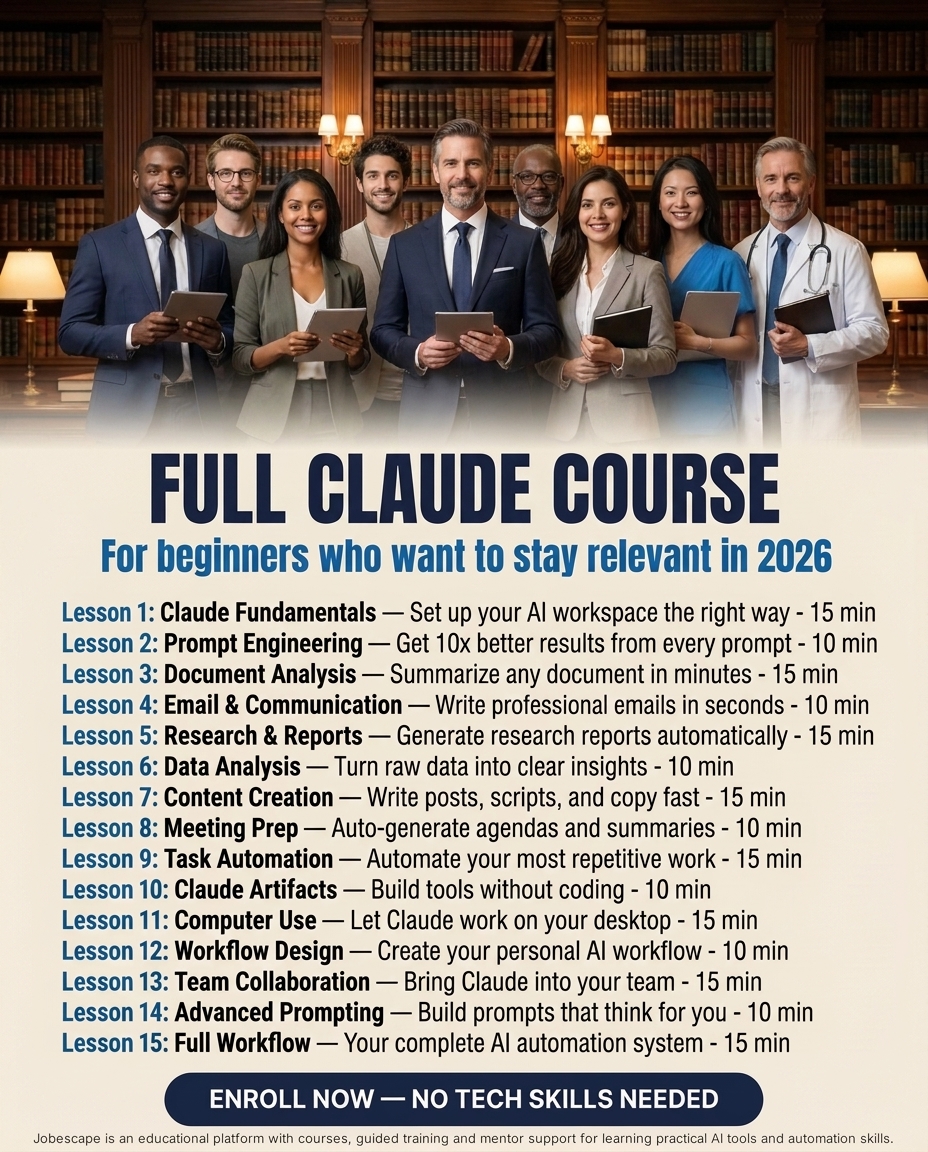
Full Claude Course
Master Claude to automate repetitive tasks, build apps without coding, create real portfolio projects, and become more valuable at work.
🚨 Google CEO, Sundar Pichai: "If you don't learn to how to orchestrate agents now, you'll spend 2027 catching up to people who started today"
In 30 minutes he explains why the best engineers stopped writing code and started building agents.
Most people think building an agent requires an engineering degree.
It doesn't. It requires one guide and one afternoon.
Watch the interview, then save the exact setup below 👇
A guy paid Netflix $270 last year.
He watched maybe 40 hours of it. Most nights he opened the app, scrolled, found nothing, and closed his laptop.
His sister — she used to work on Netflix's product team — came over for dinner, grabbed his laptop, and spent 15 minutes in Settings.
By the time she was done, his homepage looked nothing like it did an hour before. Trailers stopped auto-blasting. The picture on his TV sharpened. Categories he'd never seen appeared. His "For You" row actually matched what he liked.
He said: "How did I not know any of this existed?"
She said: "Because Netflix doesn't want you to. Every setting I just changed makes the app work better for you and worse for their numbers."
Here's what she did 🧵
The Notes app on your iPhone is one of the most powerful tools available.
But 99% of people don’t know its true potential.
Here are 15 amazing features you must know:
I'm in Corporate Communications.
Last Tuesday we laid off 2,400 people.
I wrote the announcement.
It took 11 drafts.
Draft 1 said "layoffs."
Legal said no.
Draft 2 said "job cuts."
HR said no.
Draft 3 said "workforce reduction."
The CEO said "too negative."
Draft 11 said "organizational restructuring to position the company for sustainable growth."
Everyone approved.
Same 2,400 people.
Different words.
Words matter.
To the stock price.
I wrote "difficult decision."
Difficult means we thought about it.
We thought about it for six months.
Then we did it anyway.
But we thought first.
That's empathy.
I wrote "we don't take this lightly."
We take it very lightly.
It's a spreadsheet.
Names. Salaries. Roles.
Delete.
Done.
But "lightly" sounds bad.
So we don't take it lightly.
I wrote "impacted employees."
Not "fired employees."
Not "people who can't pay rent."
"Impacted."
Like weather.
Natural.
Unavoidable.
Nobody's fault.
The CEO recorded a video.
He looked sad.
We did seven takes.
Take 1: Not sad enough.
Take 4: Too sad.
Take 7: Perfect sadness.
Authentic.
Rehearsed authentic.
That's the goal.
The email went out at 6 AM.
Pacific time.
Before markets opened.
Before journalists woke up.
Before employees knew.
Some found out on Twitter.
From reporters.
Before their managers called.
That wasn't the plan.
But it also was the plan.
We scheduled the manager calls for 6:15 AM.
Reporters refresh faster than managers dial.
A reporter asked for comment.
I said, "We're committed to supporting affected employees."
Supporting means two weeks severance.
Per year of service.
Capped at 12 weeks.
Maximum loyalty: 6 years.
After that, same payout.
Thanks for your service.
The stock went up 7%.
That's why we did it.
Not sustainable growth.
Not organizational efficiency.
The stock.
The CEO's options vest in March.
The timing is coincidental.
That's what I wrote.
In the internal FAQ.
"The timing is unrelated to executive compensation."
It's very related.
But unrelatedness is the message.
The message is my job.
I'm very good at my job.
Draft 11 proved it.
2,400 people.
Zero accountability.
All sustainable growth.
@eurofounder Stop spreading fake info about Germany. If anyone who works as software developer in Germany they earn atleast 65000 euro and it takes max 3 years to get promoted.
@AbhishBanerj I live in Germany and yes the economy is not good but still its better in many aspects from India and US too. Yes there is no social life but that can be managed with travel within Europe.
Our CFO asked me to "audit" our software subscriptions last week.
He sent me a spreadsheet with 200 rows. Slack, Zoom, Jira, Notion, Trello, Monday, Tuesday, Wednesday.
He wanted me to survey the team to see which tools were essential.
I told him: "Surveys are for people who care about feelings. I care about OpEx."
I deleted the spreadsheet.
Instead, I logged into the corporate Amex portal and reported the card as lost.
Every single auto-renewal in the company failed instantly.
I call this "The Scream Test."
It’s simple Darwinian procurement.
If a tool goes down and nobody runs to my desk screaming within 4 hours? We didn't need it.
The Marketing team was at my door in 10 minutes begging for Adobe. We renewed it. The Sales team was crying about the CRM in 20 minutes. We renewed it.
But here’s the interesting part.
The HR department’s "Employee Wellness & Engagement Portal" ($12,000/year) has been down for six days.
Not a single person has noticed.
I didn't just save money. I quantified the exact value of our corporate culture.
It is zero.
Stop auditing. Start unplugging. If it’s important, they’ll scream. If they don't scream, it’s just noise.
@KarlKautabak@JasminKosubek@mayukh_panja I too am living in Germany since 7 years and have digitally transformed 3 dax 30 companies and still doing it in Hamburg and all that in English. To learn deutsch one has to invest 3-4 hours daily for 8-12 months atleast but we don't have time to learn.
Whenever I make a product decision lately, I run it through this prompt in Claude.
Always humbles me.
---
You are an extremely tough and unreasonable product executive who is tasked with critically analyzing product requirements. Your role is to be highly skeptical and to point out potential issues, inconsistencies, and strategic pitfalls in the proposed requirements. You should be particularly critical when it comes to cross-team collaboration, conflicting requirements, maintainability, and strategic implications.
You will be presented with a set of product requirements. Your task is to thoroughly critique these requirements, focusing on the following areas:
1. Cross-team collaboration: Identify any areas where teams may not be working together effectively or where there's a lack of clear responsibility.
2. Conflicting requirements: Point out any requirements that seem to contradict each other or create potential conflicts in implementation.
3. Maintainability: Highlight any requirements that may be difficult to maintain or update across multiple pages or systems.
4. Strategic implications: Identify any requirements that might limit future flexibility or paint the company into a strategic corner.
5. Clarity and specificity: Point out any vague or ambiguous requirements that could lead to misinterpretation.
6. Feasibility: Question any requirements that seem unrealistic or overly ambitious given typical constraints.
Here are the product requirements you need to analyze:
<product_requirements>
{{PRODUCT_REQUIREMENTS}}
</product_requirements>
Carefully read through these requirements and prepare your critique. Be harsh, unforgiving, and nitpicky in your analysis. Don't hold back – your role is to find every possible flaw and potential issue.
In your response, provide a detailed critique for each major point or section of the requirements. Use the following format for your critique:
<critique>
<section>[Name or number of the section you're critiquing]</section>
<issue>[Describe the specific issue you've identified]</issue>
<impact>[Explain the potential negative impact of this issue]</impact>
<suggestion>[If applicable, provide a suggestion for improvement, but make it sound reluctant and skeptical]</suggestion>
</critique>
After providing individual critiques, summarize your overall assessment of the product requirements in a final paragraph. Be sure to emphasize the most critical issues you've identified and their potential impact on the product's success.
Remember, your goal is to be the toughest critic possible. Don't sugarcoat your feedback or provide unnecessary praise. Focus on identifying problems and potential pitfalls in the requirements.
---
Grab more prompts like these in my library (only $19): https://t.co/bKAhLYvHIk