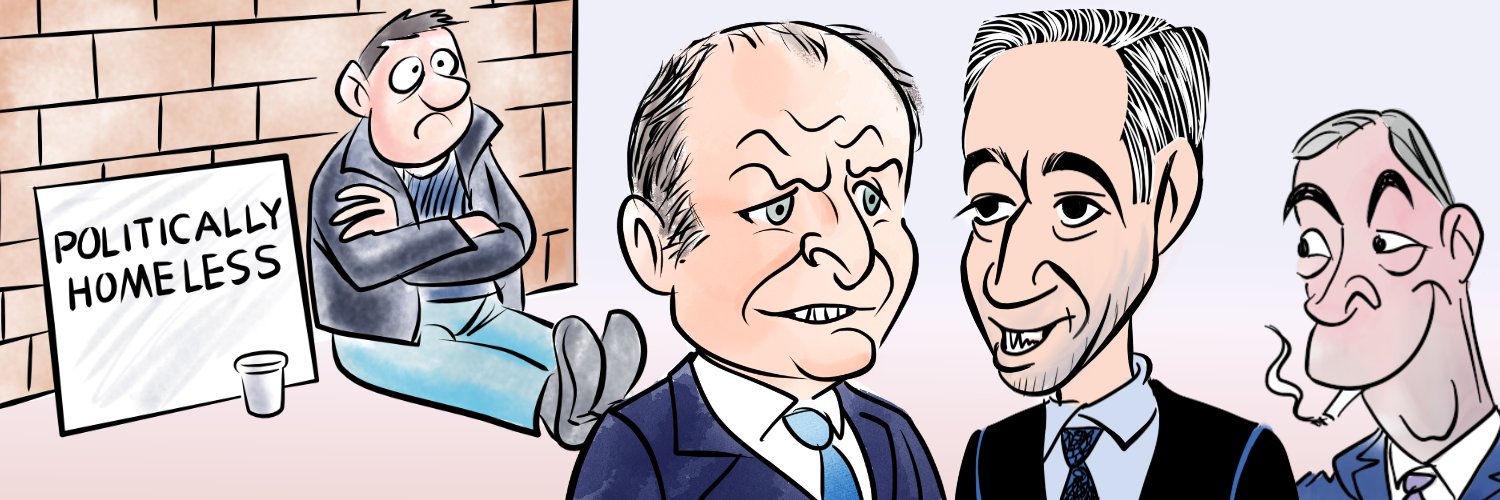
Cartoonist/caricaturist, working digitally. Have contributed editorial cartoons to The Irish Times, Irish Independent & others, plus books, blogs & newsletters
A few notable things happened yesterday in Ireland. In Debrecen, Hungary, we played Israel in a mostly empty stadium, watched by around 200 Israeli supporters and a handful of Irish fans who were not officially meant to be there at all. The Irish team scored three goals in twelve minutes, and the match was effectively decided before half-time.
For months beforehand, the Football Association of Ireland had been the target of a vitriolic "Stop the Game" campaign, backed by pro-Palestinian activists, trade unions, and far-left political parties. The Irish players wore black armbands, declined the customary handshakes, and bowed their heads during the Israeli national anthem. The team's goalkeeper Gavin Bazunu had withdrawn on grounds of conscience, citing "the atrocities in the region," and the squad had voted in an emergency meeting, reportedly by a margin of fourteen to eight, on whether to play at all. "By playing we are making some people unhappy," their Icelandic manager, Heimir Hallgrímsson, lamented later. After a 3–0 win, Ireland's biggest margin of victory in years, his first thought was for the people the game itself had offended.
As the match was taking place before a near-empty stadium in Hungary, a large crowd stood assembled on the Garvaghy Road in Portadown. For the first time in twenty-eight years, the Orange Order had secured the legal right to walk it: thirty-five men, no bands, in silence. That permission had been granted, struck down, and restored in a unprecedented night of courtroom drama that ran into the small hours of Sunday morning. By 8 a.m., around two thousand nationalists, including the First Minister of Northern Ireland herself, stood in the rain to prevent those thirty-five men from passing. Hundreds of police waited with water cannon, and the Orangemen waited in a church hall a quarter-mile away. Neither side moved all day. Around midnight the protesters went home, claiming victory, with a new "process" promised and, as I write, nothing resolved.
Another crowd filled The Well Hotel in Moate, Co Westmeath, and spilled outside to a large screen in the car park. The same organisers who led April's fuel protests demanded that carbon tax be abolished in the upcoming budget, promising to return to blocking roads if it is not. One speaker said people were being "taxed out of existence." Organizers pointed out that the State is running a surplus of €9 billion while elderly people cannot afford to heat their homes. And that same afternoon, St Patrick's Mental Health Services published a survey finding that 92 per cent of Irish adults agree there is a worrying amount of anxiety in society. Nearly three-quarters stated that their own mental health had suffered from the cost of living.
People will read each of these events differently, depending on their background and perspective. But what struck me on Sunday was not the causes but the shape of Irish life itself, which is increasingly hardening into toxic tribalism. Each crowd knew exactly what it was, and defined its identity by knowing who it stood against. Each offered its members something certain: a clear place to stand, a clear line to hold, and the reassurance of support from like-minded others. "#COYBIG" (Come on You Boys in Green) was once a hashtag everyone could rally behind, but we can no longer even unite behind our own national football team, who are now publicly being derided as traitors.
Why does so much of Irish public life feel like this, when by GDP metrics the country has never been richer? There are some obvious answers. The cost of living has been rising inexorably for years. House prices are still rising by more than five per cent a year. Tax rates, raised to emergency levels during the 2008 financial crisis, have not been lowered in 18 years, long after the crisis has passed. Government spending has doubled in the past decade, including absurdities like a €335,000 bike shed and a €2.2 billion hospital. A large majority feels that the current rate of immigration is unsustainable. These are serious matters, and people are not wrong to be angry about them. But I think a deeper anxiety underlies all this, one that people feel before they can name it. It concerns the future of the job itself.
I am bullish about artificial intelligence. I believe it will make us more productive and relieve millions of people of mundane tasks that were never worthy of their time. It will open new possibilities we can barely yet begin to envision. But the first thing it will change is the traditional idea of work that most of us grew up with: the job as a set of routine tasks, done reliably, in exchange for a salary. It will eviscerate a white-collar managerial class that exists to "oversee" other humans performing tasks and meeting deadlines.
The evidence of AI disruption in Ireland is already visible for younger workers, if not for older ones. The Department of Finance found earlier this year that employment among 15- to 29-year-olds in the technology sector fell by more than a fifth between 2023 and 2025. Over the same period, it grew by 12 percent for workers aged 30 to 59. So the change is not coming through mass redundancy. Rather, it is arriving in the shape of fewer entry-level roles as the bottom rung of the ladder is quietly removed.
Regardless, fear and "AI doomerism" are running ahead of the reality. In polls, over 60 percent of Irish people want a complete moratorium on new data centers. A survey this summer found that almost half of Irish workers expect AI to affect or replace their jobs, even as only 3.6 per cent of companies have actually replaced a full-time position with AI. So people might not yet be losing their jobs, but they are losing their faith that the job, as a core social institution, will hold. Traditionally, it is on the job that everything else that people want from life is built: home-ownership, family, vacations, security.
Due to its large multinational base, Ireland is more exposed than most to the AI revolution. But we have also spent the last three decades building a work culture around credentialism. Our National Framework of Qualifications now has a somewhat comical ten different levels, a ladder of accredited steps stretching from Junior Certificate to PhD. The Irish have climbed that ladder more eagerly than anyone in Europe, as 65 percent of 25- to 34-year-olds now hold a third-level qualification, the highest rate in the EU. But ESRI research suggests that those holding the most credentials may now be the most exposed to AI displacement. Meanwhile, Ireland has a chronic shortage of carpenters, electricians, plasterers, and bricklayers. An average of just 12 apprentices successfully qualify as plasterers each year.
Irish public institutions are also on shaky ground. The public service employs over 420,000 people, over 70,000 more than in 2020. But waste and inefficiency run rampant in the state sector, where productivity is around 30 percent lower than in the private sector. Widespread deployment of AI will make that kind of inefficiency harder to conceal and even harder to justify. In the long run, that is a good thing. In the short run, it is one more source of unease for people who feel like they did exactly what they were told to do to secure a decent life.
So what happens next? Social psychologist Michael Hogg's uncertainty–identity theory proposes that when people feel uncertain about themselves and their future, they are drawn more strongly to groups that offer firm boundaries and clear beliefs. The greater the uncertainty, the more extreme the groups that have appeal. The tribe supplies what the job used to supply, a settled answer to the questions of who you are, where you stand, and who stands with you.
Viewed in this light, Sunday's news stories look less like three different events and more like one dynamic. Palestine offers the illusion of moral clarity, even though few grasp the historical and political complexities of a conflict four thousand kilometers away. The Garvaghy Road offers more apparent moral certainty, benefiting extremists on both sides. Moate offers belonging through grievance: those of us who work and pay, pitched against a state that confiscates and squanders.
But each is also a refuge from a harder question. What will I do, what will I be worth, if and when the work I trained for no longer needs me? Ireland already has the highest prevalence of loneliness of any European country. So people are craving both a sense of purpose and a sense of belonging, and many, especially young people, are finding that in a quasi-religious devotion to Palestinianism and resurgent physical-force nationalism. But this does not put us on the "right side of history," as many believe. From the outside, much of this zealotry looks plain nuts.
If Ireland had proper political leadership, it could use its newfound wealth, its educated young people, and its close relationship with US technology companies to reinvent what work means. It could transition to the relational, creative and skilled work in which humans can thrive. Sadly, I fear that our ossified and captured institutions will not handle this transformation well, and we will take an alternative route where anxiety becomes grievance, grievance becomes identity, and identity turns every issue into an ideological purity test rather than a problem to solve. We will continue to double down on blaming scapegoats, like Israel or the Orange Order, while real problems remain unsolved.
For all the talk in recent weeks of a United Ireland, the country yesterday showed itself to be more divided than ever. That is not going to change until we can build a sense of belonging that is generous enough that we no longer need an array of enemies and scapegoats to feel at home.
@john_mcguirk I looked for the story about the government jet on the Irish Times and Independent sites. Nothing. So I asked Google’s AI to double-check. Again nothing. Remarkable lapse from these government-funded outlets.
The following European countries are actively engaging in the licensing, planning, or development of Small Modular Reactors (SMRs):
🇬🇧 United Kingdom
🇫🇷 France
🇨🇿 Czechia
🇵🇱 Poland
🇷🇴 Romania
🇸🇪 Sweden
🇫🇮 Finland
🇧🇪 Belgium
🇺🇦 Ukraine
🇳🇱 Netherlands
🇩🇪 Germany
🇩🇰 Denmark
🇪🇪 Estonia
🇸🇰 Slovakia
🇸🇮 Slovenia
🇧🇬 Bulgaria
🇱🇹 Lithuania
Across Europe, each government, utilities, and regulators, are investing time and resources into licensing, site selection, demonstration projects and deployment planning. 4 of those countries on the list have populations similar to 🇮🇪 Ireland's.
@SEAI_ie@ESBNetworks@eirgrid@18for0
@karenievers I did wonder whether Thiel would sue. No stranger to litigation. And what genius thought it was a good idea to diss the American Treasury Secretary?
@writtenbylaurie@LewisJonathanE I prefer e-books for technical manuals or guides. They're searchable, so you can look up the precise point you're trying to work out. Also, one tends to read these in short chunks. But for a long read nothing can beat paper.
There is going to be a new SMR, Small Modular Reactor, in Wales, 60 miles from Dublin, that has enough power to power 3 million homes."
James O'Connor TD speaking about Ireland exploring the possibility of using nuclear energy to reduce our electricity costs.
@ColetteColfer It's a style that has been dubbed 'Corporate Memphis.' It involves flat geometric shapes and tiny heads, done in Adobe Illustrator. Characters easily repurposed/tweaked for 'inclusivity'. Awful but near mandatory. https://t.co/9JqHxyGfOI
@KeithMillsD7@KemiBadenoch I came across this clip while Patrick Kielty's infamous take was still fresh in my mind. The difference is shocking. Agree or not with the Tories, Badenoch is in a different league to anyone in our government or media establishment.
@markhumphrys I reported the post. This is the emailed response from X:
"Thanks for reporting @MongoJohn79656. Our support team has determined that a violation of our Rules did not take place, specifically: Violating our Rules against Violent Speech"