@CryptoGhosty333 I really think these levels are 50/50 and i think are exaggerated. However, no one also expected to witness what happened the past months (stocks are becoming less predictable this year).
But appreciate you for at least showing reasons behind your numbers and sharing knowledge!
$IREN: Generational Buying Opportunity?
Even after today's incredible market recovery, $IREN is still down nearly 50% from its local highs made in June.
There is no doubt that this has been one of the most vicious sell-offs in the company's history.
The question any rational investor should be asking at this point is whether the drawdown is justified. Is the market getting this right, or is it mispricing something and presenting investors with a significant opportunity?
While it's true that $IREN has been underperforming its peers this year, the honest truth is that most AI and data center related stocks have been sold off aggressively over the past few weeks.
Some of it comes down to valuations getting stretched, but a lot of the market-wide panic traces back to a couple of catalysts that spooked investors out of high beta AI stocks.
The first that comes to mind is the recent release of Kimi, a Chinese open weight model that's knocking on the door of the frontier, roughly one generation behind in capability.
To me this is a DeepSeek 2.0 moment, plenty of panic with little substance behind it. It's true that broader adoption of open weight models threatens the market position of the frontier labs, which have enjoyed extraordinary growth curves so far. But it is by no means a bad thing for hardware makers or cloud providers like $IREN.
After all, end users still have to run the model somewhere, meaning on a cloud provider's servers built from AI hardware. If anything, the commoditization of the model layer is a great thing for the companies upstream of it, as cheaper tokens lead to greater adoption of AI (think Jevons paradox).
The second scare, and the most recent one, is more nuanced. On Monday a report claimed that a Shanghai-based, state-backed firm has begun mass-producing homegrown DUV lithography machines, the deep-ultraviolet immersion tools ASML has dominated for years. $ASML fell as much as 8% intraday, and a lot of AI stocks went down with it.
I have since read plenty of reasonable takes from people far more knowledgeable on lithography than me. Some argue $ASML retains a significant lead for many years to come. Others point to China's track record of commoditizing high-end tech, pressuring the pricing power and market share of Western competitors, and argue it's only a question of time until they catch up.
As an $IREN investor, the eventual outcome is pretty much agnostic to me. It's either neutral or potentially even positive.
If China stays behind the frontier of DUV lithography for another decade, it's a non-event. If they catch up quickly, then if anything it should be read as a positive for anybody downstream of the hardware sellers.
Cheaper hardware directly reduces the capex a cloud provider needs, which is already a positive on its own. But push the thought further and ask what happens with the cost savings from cheaper hardware. This is a topic explored at length in our recent deep dive; The Golden Age of Neoclouds.
In a typical competitive market, those savings get passed down to the consumer, making it a neutral event for cloud providers. That only holds, however, if market participants can deploy enough of the cheaper hardware to compete the savings away through undercutting. I've argued in the report that the primary constraint heading into the end of this decade becomes access to power, and with it the ability to bring data centers online at scale.
The end result is that market forces, constrained by data center supply, will lead to most upstream cost savings consolidating at the cloud layer instead of passing through to the end consumer. Users still benefit from token costs falling through technological improvements, but hardware prices coming down is primarily a gift to cloud providers, at least until the power bottleneck lifts, which won't be for a very long time as I've argued in detail in the deep dive.
So to sum up, China getting into DUV lithography is either neutral or positive for $IREN. For some semi-related companies it's either neutral or negative, which makes the sell-off more rational as it relates to them.
So why is the market selling off the entire AI sector without caring about the nuances of how these events hit individual companies differently?
For one, markets rarely behave rationally. After a hot run, any negative-sounding news becomes an excuse to sell, and often to sell everything and ask questions later. Many investors also generalize instead of thinking impacts through the way more sophisticated ones do. And the AI industry being young and not yet well understood, with a limited track record, adds to the pile.
In any case, this has produced what I consider a generational buying opportunity in $IREN (NFA, of course).
Today the stock trades at ridiculous levels relative to the company's fundamentals. By the end of next year $IREN will have over 1.2 GW of data center capacity online, which should support ARR comfortably above $12 billion. Ironically, $IREN trades at a market cap of $12b today. Let that sink in…
I also get the concerns about profitability and dilution, but as someone who has done extensive modelling on this, I consider both fears overblown.
$IREN's most recent deals with $NVDA and AI-native enterprises carry very attractive project-level margins of over 25%. That accounts for guided COGS, depreciation of both the DC infrastructure and the GPUs, financing costs, and a hypothetical 21% tax if these projects were taxed in isolation (which they aren't, of course).
This gives a good picture of where $IREN's net income margins trend as the company scales. Management is investing heavily into branding and talent right now, but those expenses won't rise anywhere near as fast as the megawatts coming online, so operating leverage does the rest.
Today $IREN holds about 5.8 GW of secured power across a rapidly growing powered land portfolio. Once fully built out, that should comfortably carry $50-$60b in annual revenue. At net margins around 20%, which I deem a realistic long-term target at that scale, you're looking at $10-$12b of net income.
I believe $IREN is roughly 5-7 years away from that point. Given the tremendous earnings growth the path implies, multiple consecutive years of more than 100% growth, a PE of 50 would be very fair, if not conservative. That implies a market cap of $500-$600b.
The way I see it, the opportunity couldn't be more clear.
Even accounting for massive continued dilution, say outstanding shares more than tripling from today's levels, we're still looking at a share price around $500 in a relatively short timeframe.
And on dilution specifically, model out the pipeline and you'll notice the need for it diminishes over time as operating cash flows scale, all of which can and will be reinvested into growing the pipeline.
$IREN is currently in what I consider phase 1 of a decade-long growth spurt, with operating cash flows still tiny relative to where they'll be a few quarters from now, so the need for equity raises is at its highest right now and should gradually level off as revenue-producing capacity comes online.
Long story short, dilution isn't something I lose sleep over. It primarily comes down to whether $IREN delivers on the buildout of its powered land portfolio, which I believe they will given their track record.
The other factors I watch closely are competitors' ability to bring compute online and the useful lifespans of GPUs. Luckily both are trending in the right direction, with power scarcer than ever and GPU lifespans extending well beyond what most initially expected.
TLDR:
As someone invested in the stock since $4.8, I believe $IREN today trades at one of the most attractive valuations in the company's history, especially on a risk-adjusted basis.
Thank you for reading, cheers! ✌️
I bought at 10$ and never sold. The road when it was 10$ was way worse btw. It went to 2, 3$ then 8$ then down. And one day. Just sky rocketed and never visited these numbers again. I never sold since then. Most prob might just trim a bit at 100$. Dont panic or worry. Just forget that this money even exists.
The Golden Age of Neoclouds
I have just published my new deep dive on neoclouds and the cloud sector at large.
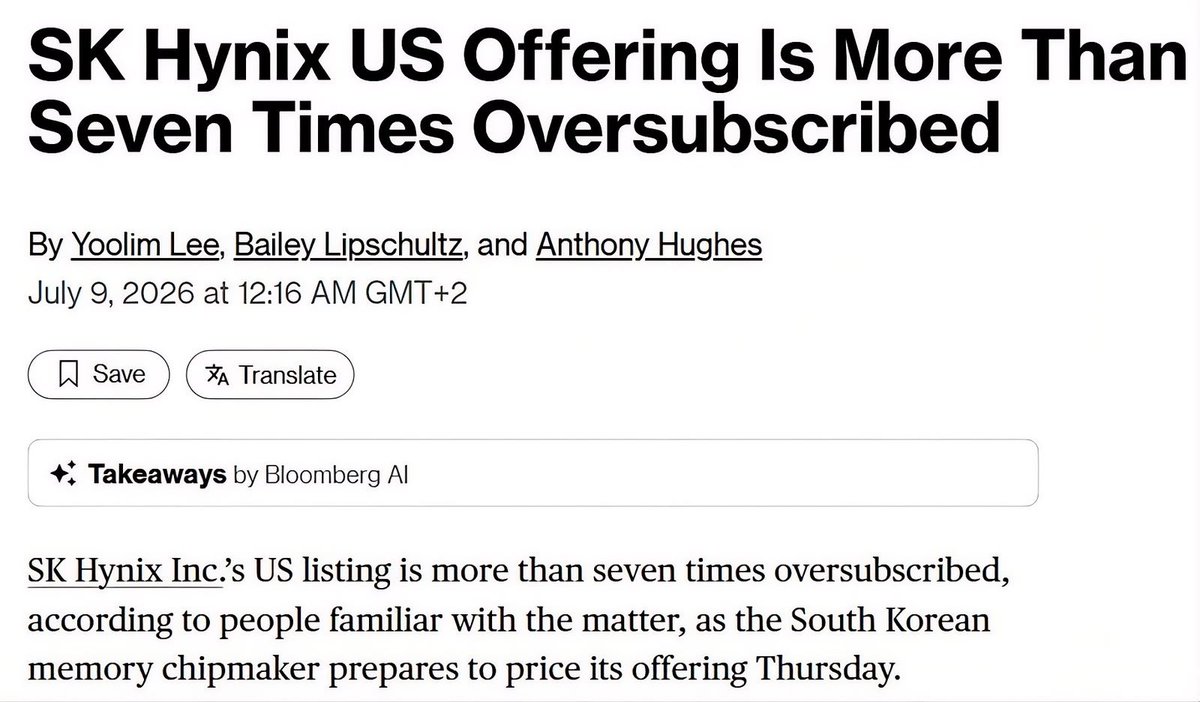
Everybody today is fixated on the hardware sellers and the model makers, and it's easy to understand why. $NVDA, $MU and $SKHY are the ones making all the money right now.
But look a little deeper and you can derive where the value flows next.
This deep dive guides you through how the neoclouds came to be in the first place, born out of a problem $NVDA had to solve, before working through the forces that will define what I call the golden age of neoclouds.
A period where extraordinary profits get minted, for the select few operators that overcome the single biggest problem this industry faces.
This piece is also unique in that it's a sector-wide thesis. What it covers doesn't just affect $IREN, but very much also the likes of $CRWV & $NBIS, and just as much $NVDA, $MU, $SKHY, and even $BE and $CAT.
If you hold or follow any of these names, the context in here is worth your time.
It covers NVIDIA's conundrum in detail, the coming shift in the hardware industry, the obstacle every ambitious cloud provider has to clear, and the window in time I define as the golden age.
It's a thoroughly researched piece, and the first chapter, ‘Inception’, is entirely free to read, even for non-subscribers.
If you've read it already, I'd love to hear your thoughts and takes in the comments. And if you found value in it, sharing it on X would mean a great deal to us.
We're also happy for people to post snippets of the report or share some of the custom graphics we made for it, as long as it stays fair use (no leaking of entire pages).
All we ask is that you credit us. We’d love to see these ideas reach a wider audience and contribute to the public discussion.
Wishing you all a great Sunday 🫶
Enjoy!
https://t.co/RBv9dU9Q9Y
$IREN New Contract Economics
I have seen a lot of discussion on $IREN's new $2.8b of AI Cloud contracts, and I believe most people are underestimating just how attractive these contracts are.
The most common assumption I've come across is that the new contracts have an average duration of roughly 3 years and generate around $3.6/GPU-hour. I believe the available evidence points elsewhere.
Management didn't disclose the exact contract economics. However, they provided enough breadcrumbs throughout the announcement that we can reverse-engineer them with a surprisingly high degree of confidence.
Here is the new information we got:
- Combined value of new contracts: $2.8b
- New year-end ARR guidance: over $4b
- 85% of the new guidance has been contracted
- Weighted average contract duration across $IREN's portfolio: ~4 years
- Prepayments of new contracts amount to 45% of GPU related CAPEX
Previously known information that remains useful:
- New contracts are for a portion of the 50k B300 units that are being installed at Mackenzie & Childress this year
- The recently signed $3.4b contract with $NVDA has a 5 year duration, paying ~$3.77 per GPUh
- $MSFT accounts for $1.93b of year end’s ARR
- PG accounts for $500m of year end’s ARR
The reason many investors arrive at roughly $3.6/GPU-hour is because they assume $IREN's year-end ARR will be exactly $4b, even though management guided to over $4 billion.
Starting with a $4b ARR target, they subtract Microsoft's ~$1.93b ARR and Prince George's $500m ARR, leaving roughly $1.57b of ARR attributable to the 50,000 GPUs being deployed across Childress and Mackenzie.
$1.57b / 50,000 GPUs / 8,760 hours = ~$3.6/GPU-hour.
The same assumption also leads to the commonly cited ~3-year contract duration. If total ARR is $4b, then 85% contracted equals $3.4b of contracted ARR. Subtract Microsoft's ~$1.93bn ARR and Prince George's $500m ARR, and you're left with roughly $970m of ARR for the new $2.8b contract cohort.
$2.8b / $970m = ~2.9 years, which gets rounded to ~3 years.
The issue is that both conclusions depend on treating “over $4b” as though it were exactly $4 billion. Once that assumption is removed, both the implied contract duration and the implied $/GPU-hour would sit higher than that.
All we know for certain is that the new contracts are collectively worth approximately $2.8 billion. This means that the longer their duration, the thinner the attributable ARR becomes.
There is another variable that most investors appear to be ignoring: management stated that the average contract duration across $IREN's entire portfolio is now “approximately 4 years”.
Importantly, management did not limit that statement to capacity commencing this year. It was framed as applying to the entire contracted portfolio, which should therefore include the recently signed $NVDA contract, as well as $MSFT and Prince George and the newly signed $2.8 billion cohort.
That allows us to work backwards and estimate how long the newest contracts would need to run for the overall portfolio average to land at ~4 years.
We know the value and duration of the Microsoft and NVIDIA contracts precisely:
Microsoft is worth $9.7 billion over 5 years, while NVIDIA is worth $3.4 billion over 5 years.
We also know that Prince George represents $500 million of ARR, although IREN has not disclosed the average contract duration of that cohort.
Fortunately, my good friend @_Sgr_A_Star recently analyzed $IREN's latest 10-Q and used the quarter-over-quarter change in remaining performance obligations to estimate that the newly commenced Prince George contracts have a duration of roughly 3 years. I independently verified the analysis and believe that is a reasonable assumption.
Including the older contracts still running at Prince George, I estimate the entire Prince George portfolio carries a weighted-average remaining duration of ~2.7 years. At $500 million of ARR, that equates to ~$1.35 billion of remaining contract value.
Microsoft, NVIDIA and Prince George therefore represent ~$14.45 billion of total contract value against roughly $3.12 billion of annualized revenue. That implies a weighted-average duration of approximately 4.6 years before including the newest $2.8 billion cohort.
For the entire portfolio to then land at management’s stated average of approximately 4 years, the newest $2.8 billion cohort would need to average ~2.35 years in duration.
That would imply ~$1.19 billion of attributable ARR ($2.8 billion / 2.35 years).
Adding that to Microsoft’s & PG’s ARR results in approximately $3.62 billion of contracted ARR that counts toward this year’s year-end ARR guidance.
Management stated that roughly 85% of its expected year-end ARR was already contracted. If $3.62 billion represents that contracted 85%, it would imply a total year-end ARR of ~$4.26 billion.
We can then subtract the $1.93 billion attributable to Microsoft and the $500 million attributable to Prince George, leaving $1.83 billion of implied ARR for the broader 50,000-GPU fleet.
Spread across 50,000 GPUs and 8,760 hours per year, that translates into ~$4.18 per GPU-hour.
This is notably above the $3.60 per GPU-hour figure most people are anchoring towards.
The honest caveat is that management described the 4 year weighted-average contract duration as an approximation. How much leeway they allowed themselves is impossible to know.
Under the lower-yielding, roughly 3 year assumption for the latest cohort, the weighted-average duration across the portfolio comes out to ~4.22 years. Technically, that still rounds to four years, so it could reasonably be viewed as fitting management’s description.
Here is why I believe the $4.18/GPU-hour and 2.35-year outcome is closer to reality than the alternative.
First, as I have repeatedly noted, the $3.60/GPU-hour / 3 year estimate is derived by treating management’s “over $4 billion” year-end ARR guidance as exactly $4 billion. We already know that is not what management said. If anything, $3.60/GPU-hour should therefore be viewed as the hard floor.
Another factor pointing toward a materially higher GPU-hour rate is a recent note from Needham analyst John Todaro, published after a call with $IREN's IR team shortly after the latest contract announcements. In that note, he stated that the newest cohort of contracts was priced above the NVIDIA agreement, which came in at ~$3.77/GPU-hour.
We cannot know whether that was his own inference or whether management gave him an additional piece of information. But it is difficult to see how he could state that with confidence without some degree of management confirmation.
Purely from a commercial perspective, it would also make little sense for the NVIDIA contract to yield more than the newer deals. The NVIDIA agreement is at least 2 years longer in duration and is backed by one of the most creditworthy counterparties in the world. Lower counterparty risk and longer duration should result in lower pricing, all else being equal.
The NVIDIA contract is also significantly larger than any individual agreement within the $2.8 billion cohort, and economies of scale should place additional downward pressure on pricing.
It is true that the NVIDIA contract includes managed services, while we do not know how much of the newest cohort consists of bare-metal capacity versus Mirantis-managed services. But that incremental service component should not outweigh the combined impact of materially longer duration, lower counterparty risk and greater scale.
TLDR 👇
I believe management deliberately chose to sign a mix of higher-yielding, shorter-duration contracts. That would make strategic sense given that GPU-hour pricing is rising across the market and $IREN's previous contract mix was heavily skewed toward lower-yielding, long-duration agreements.
Management has also made it clear that it wants a diversified customer base and a broad mix of contract structures. This latest cohort appears to fit that strategy.
A roughly $4/GPU-hour rate on the newest contracts would allow the underlying GPUs to be fully paid off and even generate a modest hardware profit by the time the contracts expire approximately 2.5 years later, even after assuming gross operating expenses equal to 15% of revenue, or roughly 85% project-level EBITDA margins (previously guided).
This also raises the question of why management chose to guide to “over $4 billion” rather than disclose the precise year-end ARR figure it is currently targeting.
My view is that management intentionally left room to come in comfortably above the $4 billion level investors will naturally anchor to. The remaining contracts still need to be finalized, so maintaining a buffer instead of publishing the exact figure they are trending toward is prudent risk management. It reduces the chance of missing a closely watched year-end target due to timing or execution slippage.
My current estimate is that year-end ARR will land between $4.1 billion and $4.3 billion. That would imply the recent cohort of contracts is yielding roughly $3.80 to $4.30 per GPU-hour.
Thanks for reading, cheers! ✌️
Upon signing new contracts $IREN raises its year-end ARR target from $3.7b to over $4b 💪
For anyone paying attention, this ARR raise was inevitable...
Over the coming days Horizon 1 will be delivered, adding ~$120m to $IREN's quarterly AI revenues.
By Q1 2027 revenues will exceed $1b per QUARTER.
Think about it, $IREN is guiding for >$4b ARR on 480 MW of delivered capcity this year. For 2027, management is guiding for 1.2 GW, with much of that being higher yielding Rubin capacity.
Year-end ARR for next year will easily be >$12b. That's $3b per quarter!
Investors continue to miss the forrest for the trees on $IREN. It's pretty obvious where this ship is sailing...
WE ARE STILL SO EARLY IN THE AI CYCLE.
Every major technological revolution, measured using the same metric:
Time to meaningful economic transformation:
• Steam: 50–100 years
• Electricity: 40–46 years
• Personal Computers: ~15 years
• Internet: ~20 years
• AI: ~3.8 years
Let that sink in.
History also shows something else:
Every major technological revolution created entirely new stock market winners.
Every revolution looked expensive.
Every revolution had brutal corrections.
Every revolution kept reshaping the economy for years afterward.
We’re much closer to the beginning than the end. $IREN $CRWV $CIFR
Banks say the good times will continue
The banks have spoken. And as JPMorgan CEO Jamie Dimon quipped, "It's getting close to as good as it gets," thanks to massive profits from trading and dealmaking that led to the bank's biggest quarterly profit on record.
The whole cohort did well, and as Goldman Sachs CEO David Solomon put it, "momentum has accelerated throughout our businesses."
Perhaps most importantly, he added, "given what we see in our pipelines, we expect this flywheel of activity to continue."
Huge corporate results and strong outlooks make for a bullish start to this earnings season as a high bar has been cleared.
But as much as the sector's results are a general harbinger for corporate America, the first dose of earnings season saw marked confidence about the consumer economy. As our quote of the day illustrates, the resilient consumer narrative is very much alive.
Keep away for now from the Software stocks until the dust settles.
Oracle Free Cash Flow has plummeted to its lowest level in history.
It is very highly indebted and cost of insuring against default CDS is rising.
The stock has plunged 62% since its September 2025 all-time high, a total market cap loss of more than $500 Billion🚨
Reflecting on $IREN
Over the last couple of days I spoke with multiple people in close contact with $IREN's management team, including investors who attended the RAISE Summit this week.
Given the insights I've gathered, I think it's an appropriate time to reflect on $IREN and share my latest thoughts.
It's no secret that $IREN has been somewhat slow on the commercial side, at least relative to the likes of $NBIS and $CRWV. I for one thought we'd have seen a Sweetwater deal by now, let alone substantial parts of the remaining Childress capacity pre-contracted.
So what's stopping $IREN from signing these multi-hundred MW deals?
In short, nothing is really "stopping" them. It comes down more to a few factors shaping their decision to hold off where other cloud providers perhaps wouldn't.
Based on management's comments both on and off camera, I can confidently say demand truly isn't the issue. Cloud capacity in this market is sparse and supply can't keep up. In fact, I've heard $IREN could easily sell out 100% of its 2027 capacity today if it wanted to.
The catch is that selling capacity which won't come online for another 6, 9, or 12 months yields significantly less than capacity arriving sooner. Customers want capacity today, and they're willing to pay a substantial premium for it.
So while selling far into the future might prop up the stock, commercially it may not be the most prudent strategy in this environment. That dynamic can obviously shift over time, but given how far supply sits behind demand, it won't change overnight, and as it stands, holding off as long as possible yields better long-term returns.
Not only do returns shrink the further out you pre-contract, but the available buyer pool shrinks with it. Selling capacity well into the future means gatekeeping much of the smaller, higher-margin clientele while mostly attracting the lower-paying hyperscalers.
As we know, $IREN is increasingly moving up the stack, effectively cutting out the middle-man that hyperscalers represent, as evident in their recent Mirantis acquisition. On that note, $IREN apparently has multiple LOIs and customer commitments for high-margin managed cloud services set to take effect once the Mirantis deal closes over the coming weeks.
I've now also heard several times that $IREN takes customer selection and contract structure extremely seriously. Creditworthiness matters, but management also wants clients that can scale their compute demand substantially as $IREN ramps capacity. The only near-term downside is that this due diligence takes time, yet the longer-term advantages of the approach are obvious.
Beyond contract timing and customer selection, I believe some of it also comes down to operational reasons.
We know the 1.4 GW Sweetwater campus is earmarked for the upcoming VR200 (Rubin) capacity, whose supply won't ramp until late this year into early next. That partly explains why the site isn't up and running already, since all they could lease out right now would be current Blackwell generation.
The flip side is that $IREN could simply build "Horizon-style" capacity at Sweetwater, the same style they're currently developing at Childress, since those facilities are fully capable of housing next-gen Rubins, and have them ready by early next year, right as NVIDIA fully ramps Rubin production.
And while $IREN is already doing foundation work at Sweetwater, it could still easily take another 3-4 quarters before we see operational capacity there.
So what's the holdup?
I believe a major reason for the slow ramp at Sweetwater is that they want to implement lessons learned from their Horizon build-outs at Childress, making the Sweetwater process more efficient, less costly, and thus more economical.
Here I want to give a big shoutout to my friend @FransBakker9812, who found that $IREN has recently developed proprietary methods to make elements of the construction process significantly more streamlined, saving time and cost across all future liquid-cooled builds.
He shared more specifics on that with his "Research” and “Founding” subscription tiers, which I recommend checking out.
I firmly believe what some might see as a relatively slow ramp, given $IREN's starting position, is management's way of doing things right. Start with the first liquid-cooled buildouts in Horizons 1-4, implement lessons from one Horizon batch to the next, then apply the full set of process and workflow improvements at Sweetwater.
This closely mirrors what $IREN has always done since its mining era, when it started small and progressively scaled its construction operations in both size and speed. A true construction flywheel.
Interestingly, I've just heard that $IREN plans to develop Sweetwater 1, Sweetwater 2, and the 1.6 GW Oklahoma site in parallel over the coming years. That shows just how exponential their construction ramp really is.
In short, I believe holding out on the next wave of contracts comes down to a few factors:
1) Signing well ahead of commissioning means giving up pricing upside and attracting only a small subset of clients.
2) Customer selection and contract structure are a big part of $IREN's long-term strategy. It takes more time than simply selling to the highest bidder, but should build stronger customer relationships over the long run.
3) Scaling construction in a controlled manner, carrying critical lessons from current builds into the next. Slow start, exponential growth curve.
None of this means we won't see any deals this year, but it does add color on why commercial progress on closing deals has been slower than many of us expected.
As for deal activity and my current expectations there, it helps to step back and consider how $IREN's near-term capacity is structured.
We should expect the 50k B300 units $IREN procured back in March to be fully contracted and installed by year-end, roughly 33k at Mackenzie and another ~17k at Childress. Apparently first deliveries for Mackenzie have already arrived and are being installed.
Given this progress, I'd expect $IREN to announce having contracted substantial parts of these air-cooled Blackwells by August earnings at the latest. This is the low-hanging fruit.
And worth noting, since $IREN first gave ARR guidance for that capacity, GPU rates across the board have moved up substantially. If they sign anything close to what they landed with the 60 MW NVIDIA deal, their year-end guidance of $3.7B should climb to at least $3.9-$4.1B.
Beyond this, there's plenty of 2027 capacity that could get contracted later this year, including 190 MW of air-cooled capacity at Childress, 30 MW at Canal Flats, 150 MW of liquid-cooled Horizon 5-6, and 300 MW of liquid-cooled capacity at Sweetwater 1.
We don't have guidance on when this capacity comes online next year or what the ramp schedule looks like, but since liquid-cooled greenfield development takes longer than retrofitting existing air-cooled buildings (currently mining BTC), I'd expect the remaining 220 MW of air-cooled capacity to come online within the first couple of quarters of 2027.
For that reason, I think the odds those few hundred MW get pre-contracted later this year are relatively high.
The trickier part is the 150 MW of Horizons 5-6 and the 300 MW of liquid-cooled Sweetwater capacity. I think there's a decent shot at least one of the two gets pre-contracted in 2026, especially if it's for a hyperscaler or a frontier lab, which are far more inclined to sign a few quarters ahead.
Either way, it's just a matter of time until contracts start flowing. It's clear to me that $IREN is playing the long game and isn't compromising long-term upside for short-term euphoria in the share price. As a long-term investor, I fully support that.
I do wish, however, that $IREN were a bit more open about strategy and roadmap. It's obvious they're holding their cards close to the chest, but I find management has been overly vague on strategy.
It takes investors like me piecing the puzzle together to make sense of how $IREN plans to scale into the next hyperscaler. Ironically, management does share a fair bit of interesting and useful information if you get the chance to meet them in person, yet on earnings calls they come across as overly reserved.
That said, the future looks bright, and I have no reason to get overly concerned about disappointing price action. With a bit of luck we're in for a string of positive catalysts, starting with the Horizon 1 handoff in a couple of weeks.
I also want to take a moment to thank @OMCapitalGroup, who did an excellent job gathering information and insights while attending RAISE this week.
If it weren't for his work, I wouldn't be nearly as informed, so big props to him for taking the time to travel all the way to Paris for $IREN due diligence and then going out of his way to keep me updated with everything he picked up, even putting some of my own questions to management directly.
He's relatively new to X, but he told me he's going to start posting shortly and jump into Frans' spaces more often. Do me a favor and give this fella a follow.
Have a good one, cheers! ✌️
Thumbnail Credit (enhanced version): @AndyDTrades
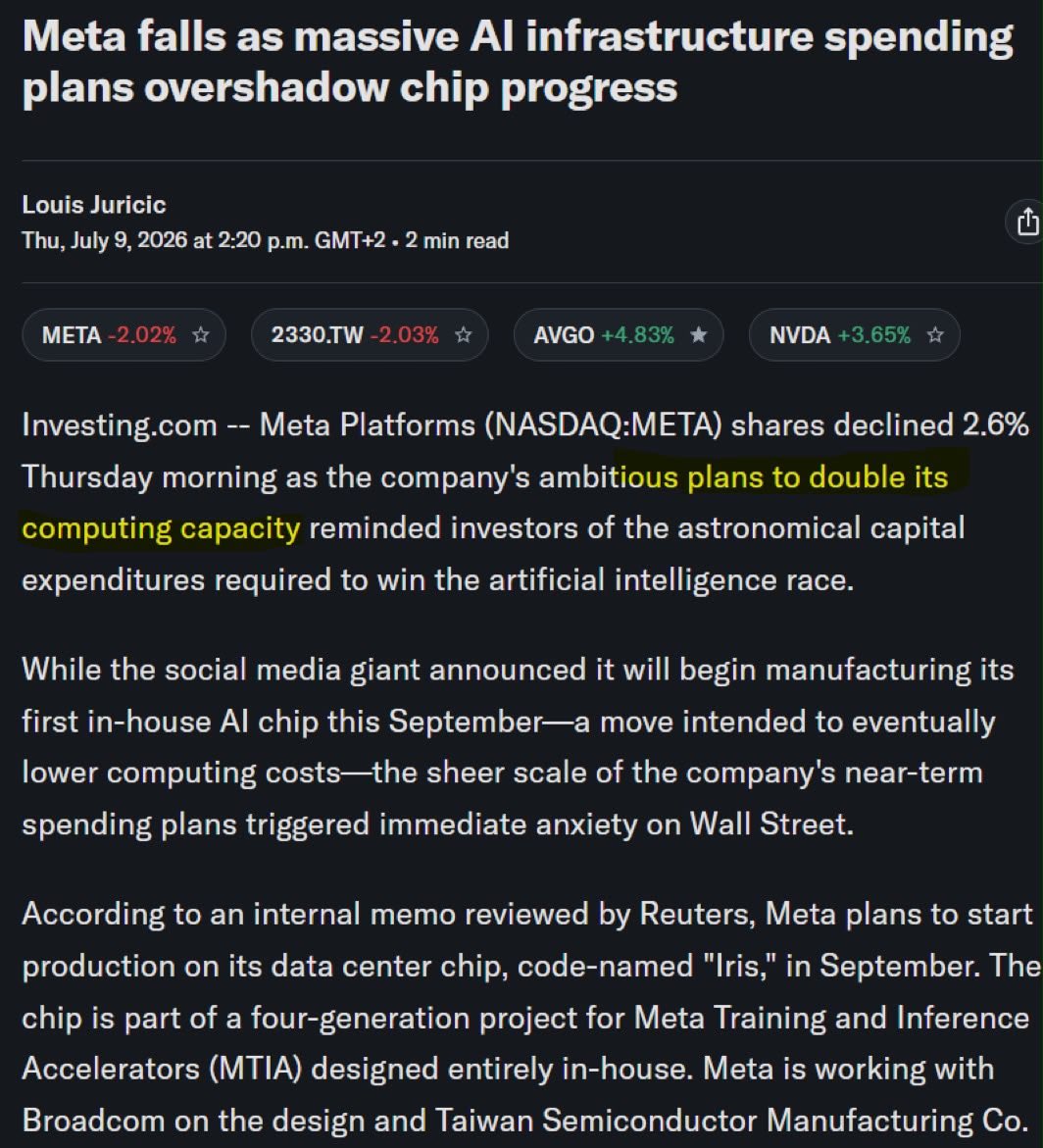
Meta the Hyperscaler plans to deploy seven gigawatts of computing infrastructure this year and double that capacity by 2027. To get there, the company expects to spend as much as $145 billion 👀on AI infrastructure this year alone.
Meta is locking in long-term supply agreements with Samsung Electronics and some other small and mid caps to secure the components needed for this expansion.
In other news:
Meta is building its first big Canadian data center in the province of Alberta, an attractive spot for development due to the hefty amount of available energy and friendly regulatory environment.
The 1 gigawatt facility will cost Meta about $9 billion and take two to three years to build.
What will continue to drive the bull market are earnings and profit margins, which till now are intact. Next week the show starts with the banks and this follows with top companies.
Wall Street is officially out with its first wave of price targets on SpaceX. Based on the 18 analyst targets shown, the average price target is $278
Analyst targets:
Raymond James: $800
Arete Research: $401
The Zephirin Group: $310
Morgan Stanley: $300
Deutsche Bank: $255
Oppenheimer: $250
Cantor Fitzgerald: $246
Bernstein: $239
BofA Securities: $235
Wells Fargo: $230
KGI Securities: $227
RBC Capital: $225
JPMorgan: $225
Banco BTG Pactual: $225
Clear Street: $217
UBS: $210
Goldman Sachs: $205
Needham: $200
Will The Fed will cut rates?
The chart shows the 2 year breakeven inflation rate, the bond market's estimate of average inflation over the next two years.
Over the past months:
- Peaked at 3.38% in March 2026
- Has since fallen to 1.95%
It has fallen to the lowest level for years...
In simple terms, the bond market is saying:
"We expect much lower inflation over the next two years than we did a few months ago."
The Fed now has the perfect excuse to cut?
More data needed for decision.