🫁🎥 The November Airway of the Month is here!
“TWO VIEWS. ONE AIRWAY.”
The view is excellent. The scope is ready.
The vocal cords have other plans. 👀
🎬 Full video 👇 (8:49)
🔗 https://t.co/ufoTZBPhAJ
👀 Video laryngoscopy provides a grade IIa view as the flexible scope approaches. Different lighting changes how the same anatomy looks; landmarks keep us oriented.
⏱️ The cords open, then close as the scope approaches. Track time since medication administration; onset varies. Reassess conditions and oxygenation. Nasal oxygen may help; physiology sets the limits.
🛑 The scope crosses with cord movement still visible. Advancing against closure risks injury. Maintain exposure and manage secretions.
🔎 The carina appears. Hold the scope above it for this intubation, then shift attention to laryngoscopy as the tube and cuff pass the cords.
📏 A second scope check finds the tube close to the carina. We watch it withdraw into a more appropriate position. Announce the adjustment and recheck depth.
🔌 A bronchoscopy adapter keeps the circuit connected during that check. Keep monitoring ventilation and oxygenation.
✅ Complete confirmation with sustained exhaled CO₂ on waveform capnography.
🛠️ Practice the pairing before a difficult airway demands it.
🕒 Chapters:
0:00 — Welcome and disclosure
0:46.5 — Two views, one airway
1:43 — Paralysis pending
3:03 — Oxygenation and timing
3:46 — Persistent cord movement
5:05 — Carina and tube passage
6:36 — Check and adjust depth
8:18 — Take-home points
Two views. Deliberate moves.
💬 Where would you pause?
COI: Andrew Pirotte serves on Verathon’s medical advisory board.
#AirwayOfTheMonth #AirwayManagement #FOAMed
🫁🎥 October 2026 Airway of the Month is live:
“LOST TARGET. WRONG PATH.” 👇
🔗 https://t.co/ufoTZBOJLb
The larynx comes into view. 👁️
The tube/cuff then obscures the target.
The tube passes posteriorly. 👀
Seeing the larynx isn’t the same as having a usable tube path.
🩺 Andrew Pirotte walks through an oblique laryngoscopic view, a posterior mispass, and recovery after suction and renewed landmark recognition.
🔍 Progressive laryngoscopy: identify structures as you expose them.
↩️ An oblique view? Reassess blade position and the delivery path.
🎯 Keep the target visible as the tube advances. At 4:59, the tube/cuff hides it.
⏸️ Lost the target? Re-establish landmarks before further advancement.
🧭 Use multiple landmarks. Shape alone cannot identify the trachea.
💧 Suction helps restore visibility.
🛠️ A smaller-profile introducer may preserve the view; the central lesson is controlled delivery to an identified target.
🕒 Quick jumps:
1:35 Exposure
3:19 Re-center
4:22 Tube path
4:59 Lost target
5:37 Mispass
6:33 Landmarks
7:10 Suction
7:41 Recovery
✅ Visual passage is only part of confirmation. Look for sustained exhaled CO₂ on waveform capnography and continue monitoring.
The capnogram is not shown in this recording.
Re-center the view. Keep the target. Confirm the tube.
Where would you pause and reset? 👇
#AirwayOfTheMonth #AirwayManagement #FOAMed #EmergencyMedicine #VideoLaryngoscopy
🫁🎥 September 2026 Airway of the Month is live:
“GOOD VIEW. BAD GEOMETRY.” 👇
🔗 https://t.co/JhKIK7AFrp
The vocal cords are visible. The ETT is well directed. It still won’t advance. 🤨
Seeing the target is not the same as creating a path.
🦷 Secure dentures may improve the BVM seal. Remove them before laryngoscopy.
👀 Build the view progressively:
UVULA → EPIGLOTTIS → LARYNX
Here, the blade sits left of midline, producing an oblique view and asymmetric epiglottic lift. Workable? Yes. Optimized for tube delivery? Not quite.
⚠️ The ETT bevel repeatedly appears to engage the rigid anterior tracheal rings. Resistance is information—not an invitation to push harder. More forward pressure preserves the same collision.
↩️ First, come back. Withdraw slightly, flatten the trajectory, then re-advance.
If rotating:
LARYNX LEFT
RINGS RIGHT
But disengage before corkscrewing.
🛑 After 1–2 gentle ETT advances, change something meaningful:
✅ Re-center the blade and contain the tongue
✅ Suction
✅ Change the blade
✅ Restyle or downsize the ETT
✅ Use a bougie
🧹 DuCanto suction produces a cleaner, nearly grade-I view on the second attempt—but nearly identical geometry recreates the same problem.
Suction clears the view. It doesn’t fix the pathway.
🌅 Repeated manipulation also begins to pull the epiglottis into view. A good view can deteriorate while we keep trying to make a bad trajectory work.
The successful sequence:
STYLET OUT → SLIGHT RETRACTION → FLATTEN → ADVANCE 🎯
⏱️ Quick jumps:
0:52—Dentures
1:19—Progressive laryngoscopy
2:00—ETT hang-up
3:25—Time to pivot
5:20—Successful reset
September’s sequence:
REMOVE → RECENTER → RETRACT → FLATTEN → ADVANCE 🔄
Resistance is information. Repetition is not a plan.
Keep pushing airway education forward—just don’t keep pushing the ETT. 😉
#AirwayOfTheMonth #AirwayManagement #FOAMed #EmergencyMedicine #VideoLaryngoscopy #DifficultETTpassage
The July 2026 Airway of the Month is here! 🫁 (2nd try the first seemed out of order)
The cords are visible. The ETT is…less convinced. 😅
This case shows why laryngoscopy must be optimized not only to see the glottis—but to create a path for tube passage.
🎥 https://t.co/5zZ3xEZaSR�
A glottic view can look “good” and still be poor for tube delivery. 👀
Here, a right-lateral, oblique blade position creates competing angles between the blade, glottis, and ETT.
First optimize the laryngoscopy. Then troubleshoot the tube.
The ETT stops.
That’s feedback—not a challenge to push harder. 🛑
After 1–2 gentle attempts, withdraw and change something meaningful: re-center, suction, rotate, restyle, use a bougie, downsize the ETT, or reset
Repeated pushing can turn a geometry problem into a trauma problem: bleeding, less working space, a contaminated view—and then a “sundowning” epiglottis. 🩸🌅
When the view deteriorates, pause and rebuild the pathway.
July’s airway sequence:
CLEAN → CENTER → ALIGN → PASS → PIVOT 🔄
A view is not a pathway.
Keep pushing airway education forward—just don’t keep pushing the ETT. 😉
#DifficultETTpassage #Sundowning #LeadWithSuction #FOAMed
May Airway of the Month:
https://t.co/pKmvr8ti4Z
the tube misses by a millimeter — but the problem may have started before tube passage.
This month: suboptimal VL view, arytenoid engagement, and the key reset:
Back up → suction → optimize laryngoscopy → reattempt.
#FOAMed #Airway #EmergencyMedicine
Visible cords ≠ Ready cords. 👀
April 2026 Airway of the Month is Here!
🔥 Burn airway, Soot-stained secretions, Big suction moment
🎯 Grade 1 view
🚦 But the cords are still moving
The move:
Get to the target.
Hover.
Wait if oxygenation allows.
Then pass deliberately.
View tells you WHERE.
Paralysis tells you WHEN.
🔗 https://t.co/1Dppu0AALj
The March 2026 Airway of the Month is Here!
https://t.co/3ITwbxQt9c
Rare pediatric arrest airway. CPR ongoing. Two openings in frame. Only one gets the tube.
3 reminders from this case:
• Don’t intubate a dark hole — intubate landmarks
• Re-center before passing plastic
• Keep the view through stylet removal and confirmation
💉🩺Rapid sequence intubation in 2026: we are no longer “protecting the airway.”
We are managing physiology under extreme stress.
The latest evidence challenges one of the oldest dogmas in critical care.
RSI was designed to prevent aspiration.
But today, the real enemy is often hypoxemia and cardiovascular collapse.
1. Aspiration is no longer the central problem
For decades, RSI was built around one fear: aspiration.
But emerging data suggest:
RSI may not significantly reduce aspiration
It may increase hypoxemia and hemodynamic instability
The paradigm is shifting:
👉 From aspiration avoidance → to physiologic optimization
2. First-pass success is everything
Every additional attempt increases:
Hypoxia
Hemodynamic collapse
Mortality
Modern RSI is built around one goal:
Get it right the first time.
That means:
Videolaryngoscopy first-line
Stylet routinely
Team choreography, not improvisation
3. Preoxygenation is now a therapeutic intervention
Not just a step—a determinant of survival
NIV > face mask
HFNO as adjunct
Semi-upright positioning
And one key shift:
👉 Gentle ventilation is no longer taboo
Done correctly, it reduces hypoxemia without increasing aspiration risk.
4. Hemodynamics matter more than ever
Up to 40–50% of patients experience peri-intubation instability.
The modern approach:
Avoid propofol in unstable patients
Favor etomidate or ketamine
Consider prophylactic vasopressors
Fluid loading?
Not routinely beneficial.
5. Cricoid pressure: from dogma to doubt
No clear benefit in preventing aspiration
May worsen laryngoscopy and ventilation
Current thinking:
👉 Use selectively, or not at all
6. RSI is no longer a rigid protocol
It is now:
Patient-specific
Physiology-driven
Team-dependent
With tools like:
Gastric ultrasound
POCUS-guided decisions
Structured airway protocols
7. The real determinant of success: human factors
Preparation, communication, and coordination matter as much as drugs.
Because in critical care:
The airway is not just anatomy.
It is a moment of systemic vulnerability.
🤓Final message
RSI has evolved:
From speed → to precision
From protocol → to physiology
From individual skill → to team performance
And ultimately:
The goal is no longer just to intubate.
It is to intubate without killing the patient.
📃Reference
Boulos NM et al. Anaesth Crit Care Pain Med. 2026. https://t.co/KWUfUtAMyP
The January 2026 Airway of the Month is here!!
https://t.co/vaho3sxnJp
🍼🚑 Infant intubation isn’t won with fancy gadgets—it’s won before the tube moves.
3 quick reminders from a 9-month arrest clip 👇
🧯 Suction = step 1 (wet airway? park it and clear as you lift)
🪝 Lift, don’t pin (vallecula or under the epiglottis—stop “closing the door” 🚪)
🎯 No target, no tube (don’t “fish” with a styletted ETT)
⏱️ Time-box attempts. 🫁 BVM/SGA early if the view isn’t there.
Back to basics > more gadgets. 💪
🎉🎊The December 2025 Airway of the Month is Here!🎊🎉
👏Huge Thanks to Dr. Reba Hodge (EM/Crit Care) for Her Excellent Teaching!!! 👩🏫🥇
💓🛑Bloody arrest airway.
💓🫁⚡️CPR ongoing, black material on the tongue,
🩸camera full of blood.
🛟What actually saves this tube?
🫵Parked DuCanto, double suction, and a bougie you’ve practiced with before the crisis.
Full Airway of the Month case: 👇👇👇https://t.co/ZcR44svr6L
#FOAMed #AirwayOfTheMonth #EMed #PracticeMakesExcellent #AirwayManagement #medtwitter #airway
🎯November AOTM zeroes in on the moves that actually matter:
🏗️build a straight lane,
🛑stop→suction→proceed,
🌀rotate to pass (don’t force)—plus the pivot triggers I use.
Dropping soon (like, it's 🔥)
#FOAMed#EMTwitter#Airway
Airway of the Month — October 2025
Theme: Fail fast, oxygenate always.
You’re 45 seconds in.
Cords hiding.
SpO₂ drifting.
And your brain whispers:
“Maybe if I just keep trying…”
No!
Abort. Readjust. Try something else.
Oxygen over ego.
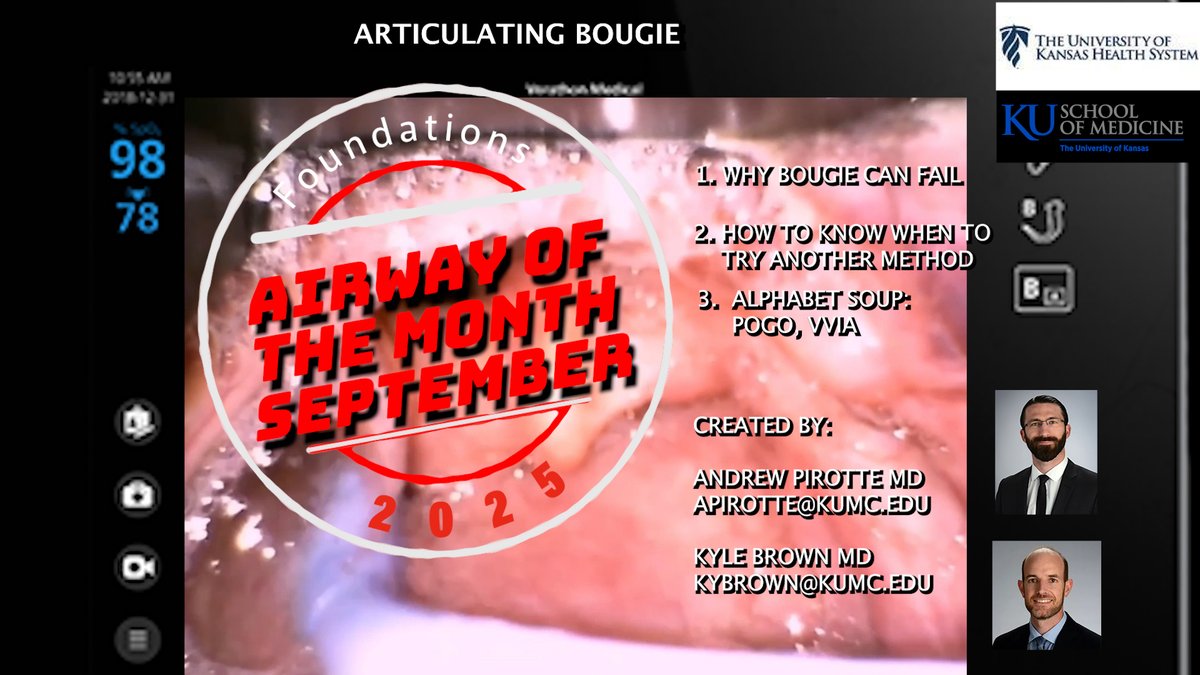
🚨 Airway of the Month — September 🚨
Bougie fails… but an articulating bougie saves the day.
What’s your Plan B when first‑pass fails? (1 line answer pls)
#FOAMed#AirwayManagement
Your move: In a similar view, do you retry standard bougie, switch to articulating bougie, or pivot to SGA?
Drop your approach ⬇️
Full case + VR lobby for context: https://t.co/Z1E3y09VrU
https://t.co/6rQh6Yz0h2
🚨 Airway of the Month — September 🚨
We’re trying something new: an interactive VR airway experience you can explore + a focused case video.
👇 Check it out 👇
🕶️ VR/360° lobby with hotspots for checklists, vent setup, and Plan B/C pathways:
https://t.co/Q2oprDW4zT
Why this matters:
✔️ Reinforces airway pearls in <10 minutes
✔️ Interactive checklists & algorithms
✔️ Teaching Videos for BVM and Suction Setup
✔️ Works on desktop, phone, or VR headset
#AirwayManagement #FOAMed #EmergencyMedicine #MedEd #Simulation #VRinMedicine
@emcrit@srrezaie@emrap_tweets@SAEM @ACEPNow @ACEP@AAEMinfo @EMRA_ACC @EMRAorg@jducanto@AirwayMxAcademy @dastrainees @ProtectedAirway@JohnCSakles@AirwayOnDemand@TBayEDguy@Apirotte@TriplethreatEM@FoundationsEM@AirwayOTM@KansasEM@EmoryEM@TTCmed@GlideScopeVL@KARLSTORZUK@AmbuEurope @VerathonInc (GlideScope) @KarlStorzEndo (C-MAC) @AmbuInc (King Vision, aScope) @Intersurgical@TeleflexInc (LMAs, Arrow) @CookMedicalUS (airway exchange / cric kits) @VyaireMed
Disclaimer: This database is for your information and education only. It is intended solely for use by medical providers seeking to further understanding of airway management. All patient identifying information has been removed from the videos; however, if you believe patient information was inadvertently included or other concerns arise during your review, please email Dr. Andrew Pirotte ([email protected]) directly.
The July 2025 AoTM is here! Pediatrics, progressive laryngoscopy, and Miller as Mac (usually we see Mac as Miller...)!
https://t.co/gQXR2jjf52
Databases:
Video only: https://t.co/ldHjTpZekR……………………
Airway of the Month Series: https://t.co/WUKaMBndIK
Hypothetical… cases: https://t.co/wlYzZePV50……………………
@jducanto@AirwayMxAcademy
@dastrainees
@ProtectedAirway@JohnCSakles@AirwayOnDemand@TBayEDguy@Apirotte@TriplethreatEM@FoundationsEM@AirwayOTM@KansasEM@EmoryEM
Disclaimer: This database is for your information and education only. It is intended solely for use by medical providers seeking to further understanding of airway management. All patient identifying information has been removed from the videos; however, if you believe patient information was inadvertently included or other concerns arise during your review, please email Dr. Andrew Pirotte ([email protected]) directly.
The June 2025 Airway of the Month is Here!
🎥👀 “See it. Scope it. Secure it.” 👀🎥
https://t.co/18Y9LCIxu1
Bimodal! Double Vision – Twice the Tools, Half the Trouble
1. Scope Bros Unite!
VL gives you the big picture.
Bronchoscope says, “Hold my fiberoptic” and dives in.
2. Cannulate Like a Gentle Ninja
The bronchoscope is the sneak attack.
Thread the cords without the drama.
3. Placement You Can Brag About
ET Tube goes in while both scopes are cheering you on.
You don’t hope it’s in the trachea—you watched the whole show in 4K.
Databases: Video only: https://t.co/ldHjTpZekR…………………… Airway of the Month Series: https://t.co/WUKaMBndIK Hypothetical… cases: https://t.co/wlYzZePV50……………………
@jducanto@AirwayMxAcademy
@dastrainees
@ProtectedAirway@JohnCSakles@AirwayOnDemand@TBayEDguy@Apirotte@TriplethreatEM@FoundationsEM@AirwayOTM@KansasEM@EmoryEM
Disclaimer: This database is for your information and education only. It is intended solely for use by medical providers seeking to further understanding of airway management. All patient identifying information has been removed from the videos; however, if you believe patient information was inadvertently included or other concerns arise during your review, please email Dr. Andrew Pirotte ([email protected]) directly.