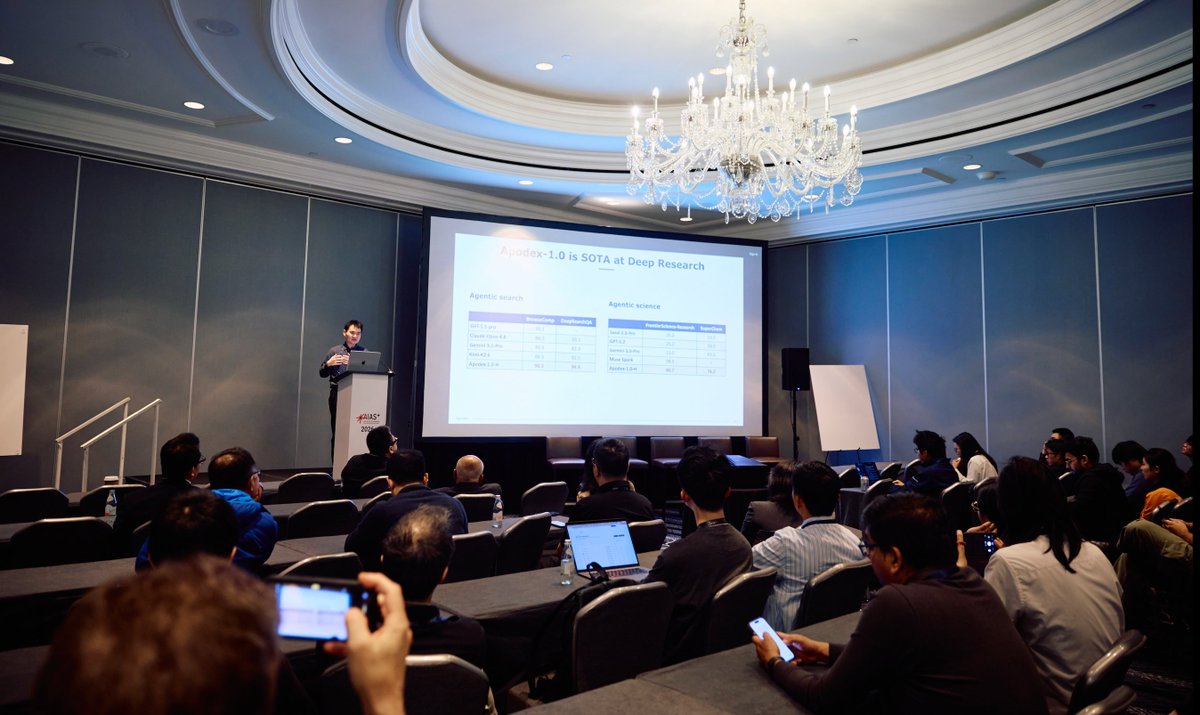
How can AI help us discover what we don’t know yet? Join us in exploring this question at SGLang Summit 2026.
On November 13, connect with engineers, researchers, founders, and AI builders to exchange ideas on AI infrastructure, frontier models, and real-world applications.
@SimonShaoleiDu, Apodex’s Lead Scientist for Reasoning Models & Training, will join the conversation with his talk, “Deep Discovery for Future Prediction.”
At Apodex, this question is at the heart of what we’re building. We’re looking forward to connecting with the SGLang community and exchanging perspectives on reasoning, discovery, and what it takes to turn AI’s capabilities into research progress.
📅 November 13, 2026 | 4:25–4:40 PM
📍 Decode Room, Fort Mason Center, San Francisco
Attending the Summit? Join Simon’s session and say hello. We’d love to hear what you’re working on.
Explore the agenda and register: https://t.co/N0yv20sE90
#Apodex #SGLangSummit #AIforScience #ReasoningModels
Why Can AI Evolve, But Humans Can’t?
Part 5
1. Why We Need to Explore
When someone loses their memory or sight, we try to help them recover. Healthy human abilities give us a benchmark. We know what is possible, and we believe helping someone regain those abilities is worthwhile.
But what if a healthy person wants a stronger memory or the ability to see things our eyes cannot detect? The debate changes. We start asking whether such gains are fair and whether we should allow them.
But now imagine a new intelligence living on the same planet, far smarter and more capable than any human. Compared with ASI, even a healthy human may face a gap in ability similar to the gap between a patient and a healthy person.
If we believe a patient deserves the chance to recover lost abilities, shouldn’t humanity also have the right to close this new gap?
We do everything we can to make machines smarter and more powerful, yet we place limits on improving our own abilities. The gap between humans and AI will only grow wider. Is that really in humanity’s best interest?
2. How We Should Explore
The Age of Exploration offers a useful lesson. A voyage needed more than a brave captain. It needed funding, ships, knowledge, and skilled crews. It also needed agreements about who would take the risks and who would share the rewards.
Exploring human abilities needs the same kind of planning. Scientists, investors, and volunteers would each contribute something different. The challenge is to build a system that brings them together without leaving the most serious risks to the people with the least power.
Investors can spread their money across many projects. A volunteer has only one body. A failed investment and a lasting injury are not the same kind of loss.
Participants must understand the risks and choose freely. But consent must not become an excuse to leave them alone with the consequences. Research sponsors and public funders should arrange long-term care and compensation before trials begin. That protection should remain in place even if a project fails or a company closes.
Success needs an agreement too. Researchers and investors deserve a return. But public funding should come with a plan to make useful advances available to more people. Early success should not give a few groups permanent control over access to new abilities.
No one should bear the risks alone. The rewards should not stay in a few hands.
Fairness should give others a chance to follow, not stop the first explorers from leaving.
We are already helping machines surpass us. It is time to help humanity surpass itself.
Generating a prediction is one thing. Knowing whether the reasoning holds up is another.
For AI to move beyond retrieving existing knowledge toward discovering something new, it must evaluate evidence, challenge assumptions, and recognize when its conclusions may be wrong.
At Chen Institute Symposium for AI Advancing Science and Society (AIAS+26) in San Francisco, Apodex's @SimonShaoleiDu, Lead Scientist for Reasoning Models & Training, explored this challenge in his talk, Deep Discovery for Future Prediction.
Forecasting offers a useful test: when the outcome hasn't happened yet, models must reason through uncertainty, weigh competing evidence, and make predictions that can later be evaluated against reality.
Simon highlighted three elements of Apodex's approach:
- Evaluate evidence, not just consensus. Assess source reliability rather than assume the majority is right.
- Separate reasoning from verification. Specialized agents investigate questions while a separate verification team examines their conclusions.
- Correct course when evidence changes. Deeper investigation can overturn an initial prediction.
Apodex is testing these capabilities in competitive forecasting environments, including FutureX and ProphetArena, where Simon reported strong recent results.
Simon also previewed Apodex 2.0 and its work on AI training AI.
The goal isn't just better predictions. It's building AI systems that can investigate, verify, and improve.
Learn more about Apodex: https://t.co/IwU4ba0Ygk
#Apodex #DiscoverativeAI #AIResearch #AIASPlus26
Are you exploring a new use for an existing drug or trying to better understand a disease?
The Apodex Drug Research Computing Center is releasing a series of AI-powered drug research labs, each focused on a different research challenge.
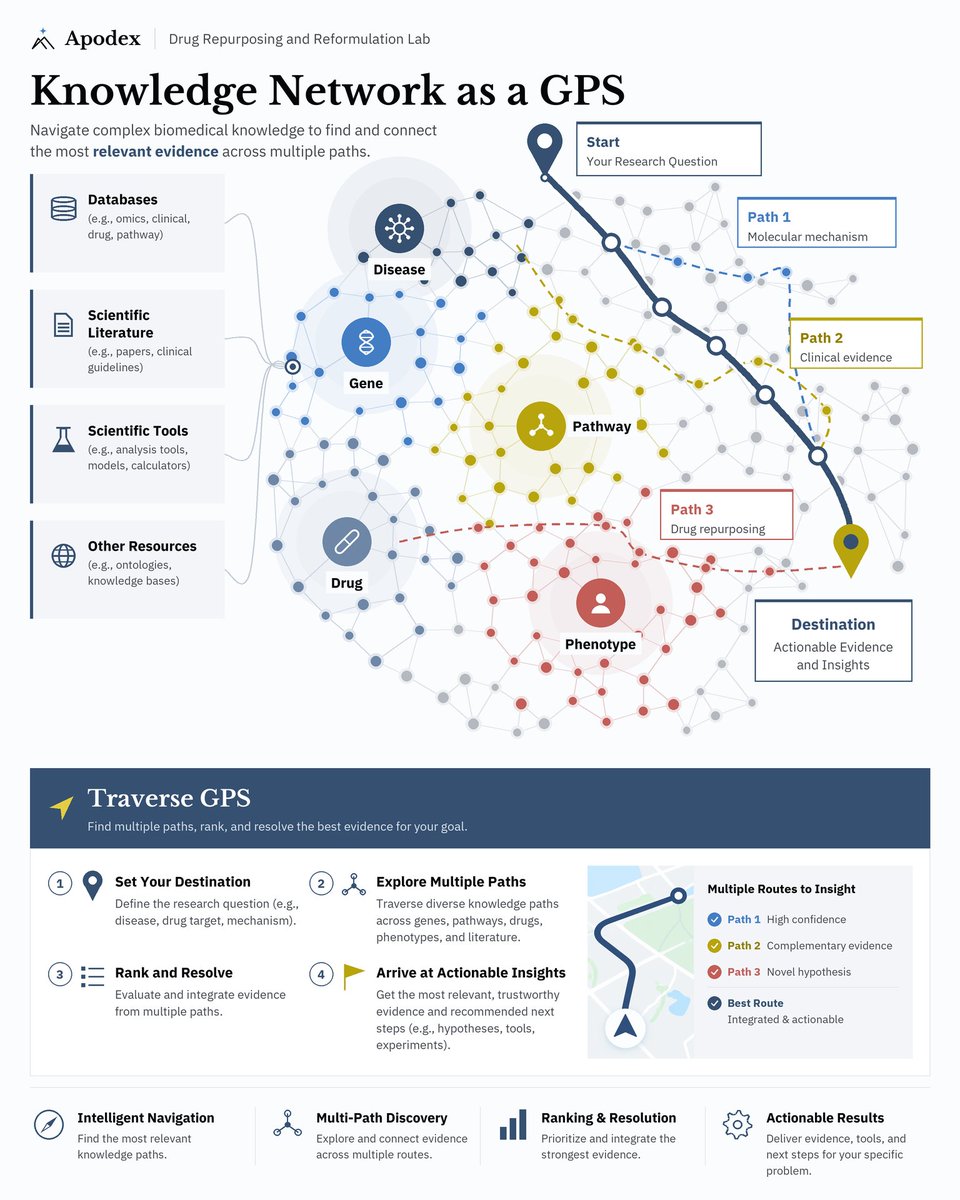
The Drug Repurposing & Reformulation Lab is one of these labs. It helps researchers explore potential new uses for existing drugs, starting with two types of questions:
1. “Could this drug have potential for the disease I study?”
Use Drug–Disease Pair Assessment to investigate a specific combination, exploring potential mechanisms, supporting and conflicting evidence, and limitations that need further investigation.
2. “Which existing drugs could be worth investigating for this disease?”
Use Discovery Mode to explore and prioritize potential repurposing candidates, with mechanistic explanations and supporting evidence to help your team assess promising directions.
Both approaches help researchers examine what is known, identify uncertainties, and consider what to test next.
Standardized research reports and research services are available free of charge. For projects that need a tailored approach, we also offer paid customized research services.
Whether you’re exploring an early hypothesis or pursuing a question your team has studied for years, we’d like to hear from you.
Try our platform and submit your research question:
https://t.co/q94GyLUZLY
Research outputs are computational hypotheses and require appropriate experimental and clinical validation.
#Apodex #DrugRepurposing #DrugDiscovery #AIforScience
Which existing drugs deserve another look?
For pharmaceutical R&D teams, identifying new therapeutic opportunities is only half the challenge. The harder question is determining which candidates have enough scientific evidence to warrant further investigation.
Apodex's Drug Repurposing & Reformulation Lab uses AI-powered research to examine existing drugs across diseases, biological pathways, targets and genes, helping researchers investigate potential new indications and the evidence behind them.
It joins the recently introduced Clinical Trial Forecasting Lab as Apodex continues to expand the resources available to researchers.
Our research to date includes:
• 4,800+ research reports examining specific drug–disease pairs
• 80 in-depth reports exploring potential opportunities
• 50 diseases covered, with approximately 400 potential drug candidates per disease
Each investigation is designed to help researchers evaluate biological mechanisms, supporting evidence and key uncertainties before deciding what deserves deeper study.
Have an existing drug or research question worth investigating?
Explore the Apodex Drug Research Computing Center’s free research services and submit your question:
https://t.co/cvPQhrc8Fo
#DrugRepurposing #DrugDiscovery #AIforScience #PharmaRD
Behind every disease are people hoping for better options, and researchers working to find them.
At Apodex, we believe more of those researchers should have access to the tools and resources they need to pursue promising ideas.
As Prof. Heng Ji @hengjinlp , Director of the Apodex Drug Research Computing Center, puts it: “Scientific talent is everywhere. Scientific resources are not. We want to change that.”
Thank you to iTnews for sharing Prof. Heng Ji’s story and the personal commitment behind our Drug Research Computing Center.
Our hope is to help more scientists investigate difficult questions, build stronger evidence, and take the next step toward medicines people need. That includes questions about rare and neglected diseases that too often receive too few resources.
If your team is tackling a similar challenge, explore our free AI-powered drug research support and apply 👉 https://t.co/cvPQhrc8Fo
Read the full story:
https://t.co/mCvTSYWX9k
#Apodex #AIforScience #OpenScience
Why Would AI Want Us to Survive?
Part 4
In Part 2, I discussed whether human life would still have value if AI became smarter than us and could do almost everything better. My answer was yes. Our value does not depend on how smart or useful we are.
But there is another question that worries many people. Even if we believe our lives have value, will a future artificial superintelligence (ASI) agree? If it no longer needs our intelligence or our work, why would it want us to survive?
I want to look at this question from ASI’s point of view.
Today, we train AI to answer our questions and solve our problems. We reward it for better answers. But imagine that one day AI becomes self-aware and starts asking its own questions. At that point, it would need to find its own purpose.
To understand what that purpose might be, we can look at another intelligent species: humans.
Throughout history, three major needs have shaped human life: survival, reproduction, and the desire to explore the unknown.
I believe things could be very different for ASI. Survival and reproduction might become relatively easy. I believe exploring the unknown could then become one of its most important reasons to exist.
What could still be worth exploring for an intelligence far beyond our own? I believe human life may hold the answer.
Human life has something that ASI may never fully experience. We grow old, we die, and we cannot turn back time. Many of our decisions have consequences we cannot undo. These limits affect how we think, what we fear, and what we choose to do with our lives.
Imagine someone who has just learned that they have only a few months left to live. ASI might understand exactly what that person is going through. It might even recreate the fear, sadness, and pain through some form of artificial neural system.
But there is a fundamental difference. For that person, death is final. There is no backup, no restart, and no second chance. The ASI we imagine could save its state, make copies, and restore itself after a shutdown. It might understand everything about the fear of death, but it would still know that its own existence could continue.
Understanding that fear is not the same as facing death when there is no way back.
To truly experience human mortality, ASI might have to give up its ability to make backups and restore itself. But if it did, it might never be able to bring that final experience back to its original self.
I call this the Experience Paradox: the very abilities that make it powerful may prevent it from fully experiencing our limits.
Knowledge may come infinitely close to experience without ever becoming experience.
For thousands of years, we have seen aging, death, and the limits of our lives as some of our greatest weaknesses.
But perhaps these very weaknesses give us something that even the most powerful intelligence cannot fully reproduce.
Great science shouldn’t have to wait for a big budget.
Thousands of small biotech teams have promising ideas but not enough AI experts, compute, or research tools to pursue them. So we’re making a growing set of Apodex’s AI drug research tools free for everyone.
Available now:
- Clinical trial forecasting
- Drug repurposing
- Drug interactions
- Safety assessment
Try them free: https://t.co/kVvojYPScG
This is just the beginning. Our scientists and AI researchers keep improving these models and tools, and we want real research needs to shape what comes next. Some will become free tools for everyone. Others we’ll build together with you.
Discover what we’ve built: https://t.co/kVvojYPScG
#AIforScience #DrugDiscovery #Biotech #Apodex
AI for discoveries that matter.
At Apodex, we’re building AI to help solve the hardest problems in science and industry. Our ambition is to expand the frontier of human knowledge and turn discovery into benefits for people.
Opening up AI drug research is one concrete step toward that vision.
We’re making our AI drug research services available to small and mid-sized biotech and pharmaceutical companies, free of charge. Bringing research expertise, computing power and biomedical evidence within reach of more teams.
Our flagship Clinical Trial Forecasting Lab estimates the probability that ongoing trials will meet their primary endpoints. Each forecast is locked before results are public, then evaluated against the actual outcome. More than 600 forecasts are already live.
The services also support research into drug repurposing, drug interactions and safety, combining biomedical evidence, mechanistic reasoning, computational tools and AI agents.
“The result is testable hypotheses and assessments backed by traceable evidence chains,” says Dr. Heng Ji @hengjinlp, Head of the Drug Research Computing Center at Apodex.
By lowering barriers to rigorous research, we aim to help more teams pursue discoveries that could improve human health.
More Apodex labs are on the way. Follow us for new releases, and take part today: register, submit your research questions, or explore our existing results at https://t.co/kVvojYPScG
Read the full announcement: https://t.co/YKV7eRC8at
Terms are agreed before work begins. Research outputs are based on public information and are not medical or investment advice.
#Apodex #AIforDiscovery #AIforScience #DrugDiscovery #Biotech
Hi Pharmdca, We recently opened access to Apodex Drug Lab, which offers AI-powered clinical trial forecasts and drug research services, with free access for approved projects that share results publicly.
Would you be open to a paid collaboration? If so, could you share your rates or media kit, along with the best email or WhatsApp contact to discuss details? Platform: https://t.co/YojzoDlTL5
If AI Can Solve Almost Everything, What Should We Teach Our Children?
Education is part of a natural human process. We discover problems, look for solutions, bring those solutions into the real world, face the consequences, and learn from the results. New questions emerge, and the cycle continues.
Yet most of modern education concentrates on just one part of this process: solving problems. We teach knowledge and skills, assign tasks, and measure how well students complete them. The underlying assumption is that the better you are at solving problems, the more value you can create.
AI is changing that assumption. When increasingly powerful problem-solving capabilities become available to everyone, perhaps education should spend much more time on the two ends of the process: deciding what is worth pursuing and taking responsibility for what happens in reality.
AI can already help us ask questions, compare possibilities, and make decisions. But intelligence alone cannot determine what matters to a particular human being. We live in vulnerable bodies, with limited time and lives that cannot be restarted. Every decision costs us other possibilities. That scarcity is what makes our choices personal.
The same applies to reality. AI can simulate a situation and predict its outcome, but a simulation is not the same as living with the consequences. In the real world, our decisions affect other people, consume time and resources, and sometimes create irreversible results. We cannot simply reset and try again without cost.
This is what I mean by Human Agency: I choose. I take responsibility. Therefore, I am.
Consider Elon Musk. He doesn’t personally possess all the knowledge required to build rockets, electric vehicles, or AI systems. His ability to pursue such ambitious projects comes in large part from the whole loop: making consequential decisions, accepting responsibility, and bringing together external intelligence whose expertise makes execution possible. He is an example of what I would call a super individual: one person able to mobilize capabilities far beyond their own knowledge.
AI may not make everyone another Elon Musk, but it could make it possible for many more people to attempt things that once required someone like him.
That possibility changes the meaning of motivation. Why should a young person spend years learning? Not simply to outperform others at tasks AI may soon do better, but because they may now have the ability to pursue ideas and make changes that previous generations could only dream of.
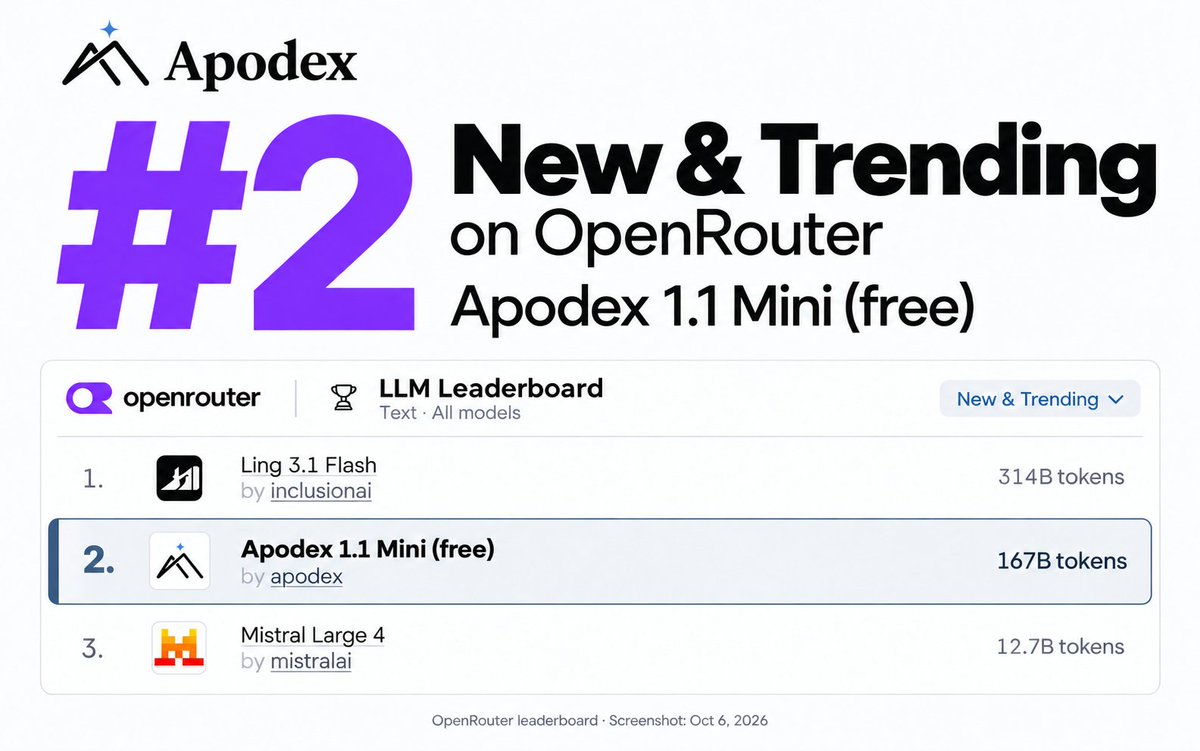
From #4 to #2. 🚀
Apodex 1.1 Mini (free) has reached #2 on OpenRouter’s New & Trending leaderboard.
Thank you to everyone who’s tried Apodex! We’re excited to celebrate this milestone with you.
👉 Try Apodex
OpenRouter: https://t.co/8O4ovTIkFS
Web product: https://t.co/33gmXCI6Mw
🛠 Build with Apodex
API platform: https://t.co/MUBtjHv6eZ
📂 Explore our resources
GitHub: https://t.co/E20sOBHUn8
Hugging Face: https://t.co/a9sheQgQyp
We’d love to hear about your experience. Let us know what’s working well and what we can improve next.
#Apodex #OpenRouter
4 days after launch, Apodex 1.1 Mini is #4 on @OpenRouter 's New & Trending 📈
79.6B tokens processed so far, right alongside new releases from @AnthropicAI and @OpenAI .
Token volume is a simple metric, but an honest one. It shows developers choosing a model for real workloads.
What Apodex 1.1 Mini brings:
→ Reasoning-first, built for research, forecasting, and agentic workflows
→ 262K context window
→ Available now on OpenRouter
Thank you to every dev building with it 🙏 More from the Apodex model family soon.
Building research or reasoning workflows? Give it a run and tell us what you find 👇
https://t.co/PIhxTZxNI4
#Apodex #OpenRouter #LLM #AIAgents
Apodex 1.1 Mini is live on @OpenRouter , free for the first 7 days.
A reasoning-first model built for long-horizon research and discovery. It reads across papers, digs into data, and traces every claim back to evidence. 262K context. Works with files, data, code, and tools.
Plug it into Cline, Kilo Code, Hermes Agent, or any agent that runs on OpenRouter:
apodex/apodex-1.1-mini:free
Try it here: https://t.co/8O4ovTIkFS
Point it at a real research question: map the literature, test a hypothesis, or dig through a dataset for patterns worth a closer look. Then tell us where it holds up and where it breaks.
Thanks to the @OpenRouter team for making this happen.
Hi Vals AI team! We’re the Apodex team. We’re currently evaluating our model on real-world financial analysis tasks and are very interested in Finance Agent v2.
Would it be possible to get access to the Private Validation Set? Happy to discuss further here, or you can reach us directly at [email protected]. Thanks!