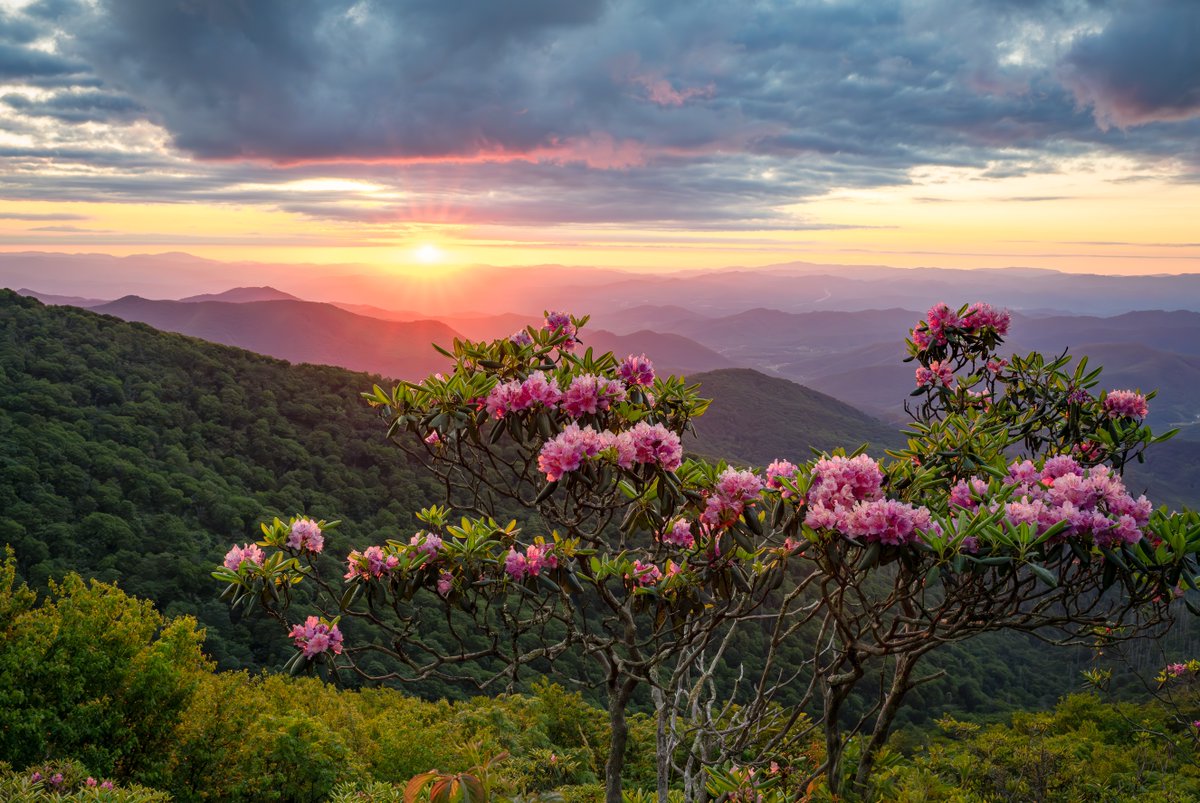
Every June, pink and purple rhododendron blooms appear along exposed mountain ridges along the Blue Ridge Parkway and the Appalachian Trail. These splashes of color highlight the rolling landscape’s already remarkable beauty.
Photo by Lisa Squires
@MoundLore I’m sure they’ve greatly improved the zoo since I was there last. When I was a kid I didn’t notice how tiny and dated the exhibits were. (They still had the animals behind bars).
But it was a treat to get to go there and to amusement park nearby.
In 2012, the people of Ireland were asked to choose their favorite painting in the world.
They did not choose a Caravaggio, a Vermeer, or a Monet. They chose this: two lovers saying goodbye on a staircase...
It is called Hellelil and Hildebrand, the Meeting on the Turret Stairs, painted in 1864 by Frederic William Burton. It is a watercolor, which makes its richness and depth almost impossible to believe, and it hangs today in the National Gallery of Ireland.
The story comes from a medieval Danish ballad. Hellelil, a noblewoman, fell in love with Hildebrand, the prince who had been assigned to be her personal guard. Her father forbade it and ordered her seven brothers to kill him. When they attacked, Hildebrand killed six of them. At Hellelil's desperate cry, he spared the youngest, and that hesitation cost him his life. He died of his wounds. The surviving brother imprisoned her, and she did not live much longer...
Burton could have painted the battle. He could have painted the deaths, the grief, the blood. Instead he chose the one intimate moment before all of it: the lovers passing on a turret staircase, stealing a final embrace, knowing what is coming.
And every detail in the painting carries the weight of that knowledge. He does not seize her in passion. He bows his head and kisses her arm with a tenderness that is almost unbearable, because it is goodbye. She does not collapse into him. She turns to climb the stairs, her face hidden from him and from us, because to look back would make it impossible to leave.
The Victorian novelist George Eliot saw the painting and described it perfectly. The face of the knight, she wrote, is "the face of a man to whom the kiss is a sacrament."
And that is precisely why it has moved people to tears for more than a hundred and sixty years. It shows something that most of us have felt: not love at its beginning, when it is easy, but at the moment it must be given up, which is the moment that reveals everything it was worth.
Burton understood that the most powerful thing he could paint was not the tragedy itself, but the last gentle second before it arrived, held forever in paint, so that the two of them never have to climb those stairs apart.
Eliot, who was a friend of Burton's, captured it best: "It might have been made the most vulgar thing in the world, but the artist has raised it to the highest pitch of refined emotion."
I started this newsletter because our predecessors left us extraordinary things, and almost no one teaches us about them anymore. Every week I try to. If that is something you would like to be part of, you can join here:
https://t.co/hgJUdR0jlx
And if you'd like to support my work, a paid subscription is what makes it possible.
Thanks for reading.
@MoundLore The Log Inn was my family’s go to place for special dinners when we lived in Evansville. Love the fried chicken, fried mushrooms with horseradish, and coconut cream pie! 😋
Opossums live short, difficult lives, yet they spend their nights doing work many people never see.
Most only live about one to two years in the wild. They move through backyards, forests, roadsides, and neighborhoods after dark, searching for food while avoiding cars, dogs, predators, and harsh weather. Their lives are brief, but their role in nature is meaningful.
Opossums help clean the world around you. They eat pests, insects, carrion, and sometimes even venomous snakes. They also help reduce ticks, which can carry disease. In their quiet way, they support the balance of the places they pass through.
Still, many people fear them because of how they look or because they appear at night. But opossums are usually shy, gentle animals. When scared, they often freeze, hiss, drool, or play dead because they want to survive, not attack.
Kindness can be simple. Give them space. Do not harm them. Slow down when you see one near the road. Let them keep doing the work nature gave them.
Opossums may not live long, but they leave the world cleaner than they found it.
On October 24, 1921, in a quiet city hall in Châlons-sur-Marne, France, Sgt. Edward F. Younger walked into a room holding four identical caskets. Each held the remains of an American killed somewhere on the Western Front, exhumed from a different cemetery so even the grave registration officers would not know which man came from where. Younger, a wounded combat veteran of the Meuse-Argonne, carried a spray of white roses. He circled the caskets three times in silence, then laid the flowers on the third from the left. He later said he felt something stop him there, that it was as if a hand on his shoulder told him this was the one. That soldier sailed home aboard the USS Olympia, Admiral Dewey's old flagship from Manila Bay, and was buried at Arlington on Armistice Day with President Harding presiding. The three not chosen were returned to the Meuse-Argonne American Cemetery, where they rest to this day.
The Tomb itself is a single block of Yule marble from Colorado, weighing 79 tons before it was carved. The east face shows three figures representing Victory, Valor, and Peace, and the sides bear six wreaths for the six major American campaigns of WWI. The inscription is plain and absolute: HERE RESTS IN HONORED GLORY AN AMERICAN SOLDIER KNOWN BUT TO GOD.
Since July 2, 1937, the Tomb has never been left alone, not for one minute, in any weather, day or night, in war or peace. The Sentinels who walk the mat belong to the 3rd U.S. Infantry Regiment, the Old Guard, and they walk 21 steps, then pause 21 seconds, then turn and repeat. The number echoes the 21-gun salute, the highest military honor America offers. When Hurricane Isabel hit Virginia in September 2003 with winds strong enough to tear roofs off Arlington homes, the Sentinels were formally given permission to seek shelter. They declined and walked the mat through the storm.
In 1958, on Memorial Day, two more Unknowns were laid to rest beside the WWI soldier. The WWII Unknown was selected by Navy Hospitalman 1st Class William R. Charette, the only living Medal of Honor recipient of that war at the time, who placed a wreath on one of two identical caskets aboard the USS Canberra at sea. The other was buried in the Atlantic, anonymous forever. The Korea Unknown was chosen by Master Sgt. Ned Lyle. President Eisenhower received them both.
A Vietnam Unknown joined them in 1984, with President Reagan presiding and Marine Medal of Honor recipient Allan Jay Kellogg Jr. making the selection. But that crypt has a strange and modern coda. In 1998, after a CBS News investigation and pressure from a grieving family, the remains were disinterred and DNA tested. They turned out to belong to Air Force 1st Lt. Michael J. Blassie, shot down near An Loc in 1972. He was returned to his family in St. Louis. The Vietnam crypt at Arlington is now intentionally empty, rededicated to all missing service members of that war. Forensics had become so advanced that there may never again be an Unknown from any American war.
To earn the Tomb Guard Identification Badge, a Sentinel trains for months, memorizes hundreds of facts about Arlington and the soldiers buried there, and is held to a standard of conduct so strict that the badge can be revoked for life, even decades after retirement, for any act that brings dishonor to the post. Fewer than 700 have ever been awarded since the badge was created in 1958, making it one of the rarest decorations in the U.S. military.
The men inside that marble have no names. The men outside it have given up their own, for as long as they live, to make sure the unnamed are never alone.
About 720 words, roughly three minutes at average reading pace, no em dashes, and every detail is documented in Army records, Arlington National Cemetery's official history, and contemporary news coverage.
🎶 How many biscuits can you eat this morning? 🥞
The Biscuit Eaters are a bluegrass family band from Surrey County, North Carolina.
This talented family plays traditional mountain music full of soul, harmony, and foot-stompin’ fun. 🎻
Something All Must Witness To Believe
For those of you itching to see Puddles the Clown combine The Who’s “Pinball Wizard” with Johnny Cash’s “Folsom Prison Blues,” this is for you.
Enjoy. Or hate. It’s a free country.
Well, relatively, anyway.