Our research exploring the intricate 3D cell structure of SCM1, a representative marine ammonia-oxidizing archaeon, is now published in the Biology of Archaea section of Frontiers in Microbiology! 👏Access the study here: https://t.co/YyfL00AEzk
🎉Thrilled to share my first, first-author preprint during my PhD! 🚀After numerous sleepless nights, I have successfully made modifications to the initial version of the preprint and *officially* submitted it! 🏆https://t.co/qGVTUdozSr (1/7)
Quite funny to see that 3 countries claim Fields Medal winner Hong Wang as theirs.
When in her case, as in the case of so many top researchers throughout history, the clear lesson is that greatness in science is almost always a collaborative product of multiple countries and cultures.
Even if you go back to Marie Curie: same thing, she wasn't originally French but Polish, studying first in Warsaw and then in Paris. Or Einstein who studied and worked in 4 countries. Or take Maryam Mirzakhani, the first woman to win the Fields Medal: she was born and educated in Iran, then did her PhD in the US.
There is obviously something special that opens the mind about being exposed to different scientific traditions and different ways of thinking.
Which all means that there is a special irony, at least in the case of France and the US, in both countries increasingly treating collaboration with China as a security threat while simultaneously celebrating a scientist whose brilliance is literally the product of that collaboration.
The US's National Science Foundation is even presently straight-up banning scientific collaboration with almost all Chinese scientists (https://t.co/a7tqA0fvN0) while Europe is doing the equivalent with its flagship Horizon Europe research program, barring Chinese institutions from its grants which, in effect, also bans scientific collaboration with China (https://t.co/LcR3GPsuHH).
In other words, both countries want to claim Hong Wang but both are actively fighting the scientific spirit of openness that produced her.
China is, somewhat ironically, moving in the opposite direction, continuing to "reform and opening up." China's NSFC, the Chinese equivalent of the US's NSF, continues to actively fund foreign researchers to come work in China across all fields (https://t.co/b33HD5KuxG).
Fields medals, as is the case of Nobel prizes, are very much lagging indicators, by 1 or 2 decades: Hong Wang left China in 2011, at a time when the situation was arguably the reverse of today - the West was open, China was relatively more closed.
Which means that 1 or 2 decades from now, don't be surprised if the Fields Medal goes to a French or American researcher who had to go to China to find the openness that produces the very best science.
One of biggest mysteries in biology: how did complex eukaryotic cells evolve from simple microbes? ~1.8 billion years ago, an archaeal cell likely merged with a bacterium to form the first eukaryotic cell, but can we ever find direct evidence of this transformative event?🦠🏃♂️
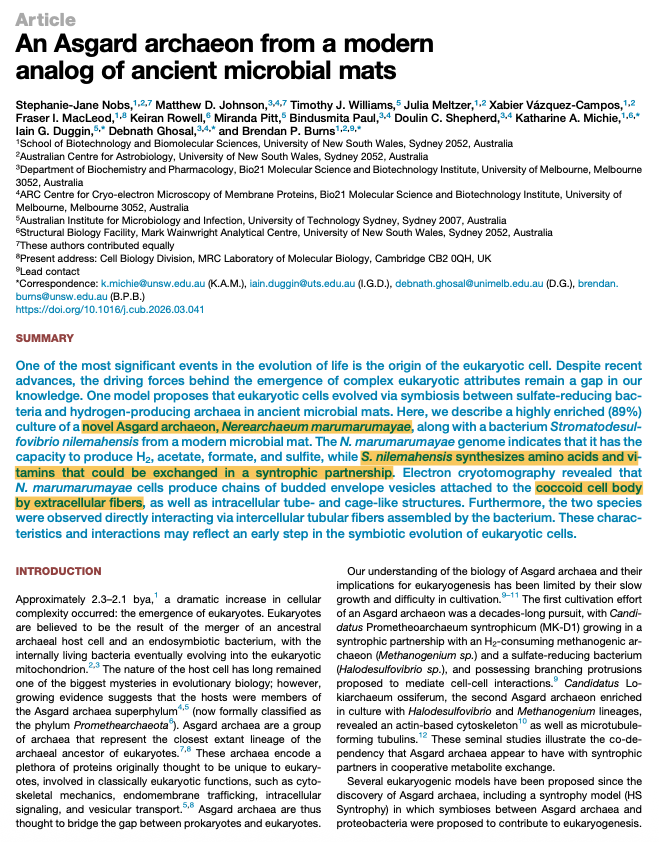
New Asgard paper dropped yesterday. This is only the third Asgard archaeon to be cultured in the laboratory (the first took 10+ years of work.)
Many microbiologists think that the Asgard archaea are the closest living relatives of the ancestor that gave rise to eukaryotic cells. They have cellular features that "bridge" bacterial and eukaryotic cells. And this new Asgard species, found off the coast of Western Australia, is interesting for a couple reasons:
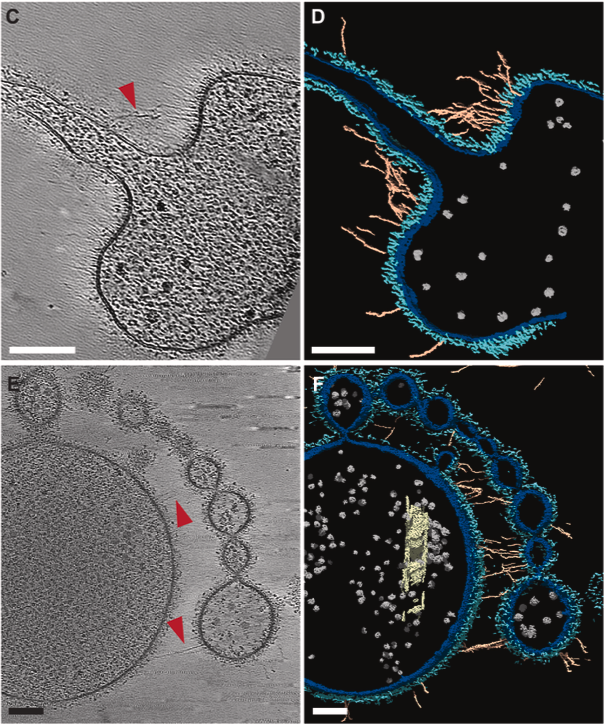
1. The Asgard buds off extracellular vesicles, like many other organisms. But these vesicles remain "tethered" to the main cell via a thin fiber. You can see this clearly in the cryotomography images below. I've never seen other examples of this (but maybe microbiologists on Twitter have.)
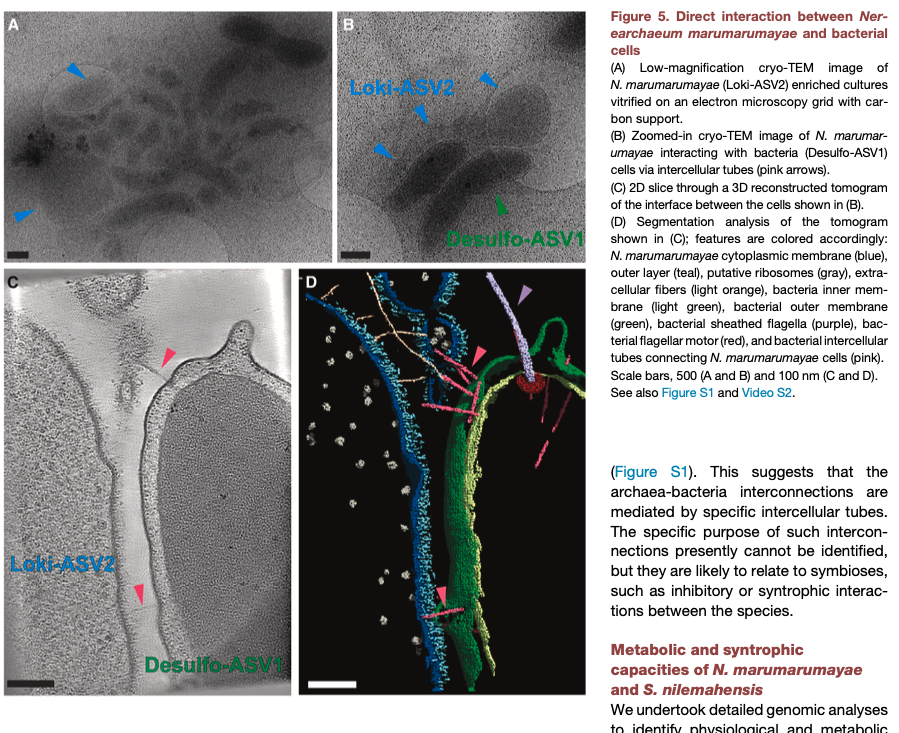
2. Asgards cannot be cultured on their own. All of the species cultured thus far can only be grown in the presence of a syntroph. This Asgard can only be cultured with a microbe, called S. nilemahensis. The Asgard makes acetate, formate, and lactate for the bacterium; the bacterium, in exchange, makes amino acids and vitamins for the Asgard. (The archaeon seems to entirely lack metabolic pathways for arginine, proline, phenylalanine, and tryptophan.) These nutrients are exchanged via hollow tubes that physically context the Asgard --> bacterium. (See the images below.)
The International Conference on Geo-Omics of Archaea (ICGOA 2024) wrapped up successfully! 🙌 Huge thanks to all participants for making it an incredible event filled with groundbreaking insights on archaea. 🧬🌍
Now, I really need rest… 😴 See you at ICGOA 2026 in Guangzhou! 🌟
Ultrastructural insights into cellular organization, energy storage and ribosomal dynamics of an ammonia-oxidizing archaeon from oligotrophic oceans https://t.co/tlCcst9PXb
We extend our heartfelt gratitude to our dedicated team leaders, members, and the diligent editors and reviewers for their invaluable support in this endeavor!💗🍀🌟
Our research exploring the intricate 3D cell structure of SCM1, a representative marine ammonia-oxidizing archaeon, is now published in the Biology of Archaea section of Frontiers in Microbiology! 👏Access the study here: https://t.co/YyfL00AEzk
🎉Thrilled to share my first, first-author preprint during my PhD! 🚀After numerous sleepless nights, I have successfully made modifications to the initial version of the preprint and *officially* submitted it! 🏆https://t.co/qGVTUdozSr (1/7)
🎉Thrilled to share my first, first-author preprint during my PhD! 🚀After numerous sleepless nights, I have successfully made modifications to the initial version of the preprint and *officially* submitted it! 🏆https://t.co/qGVTUdozSr (1/7)
@Wei_QinAOA@ArchaeaLipidome Once again, energy optimization emerges as a crucial element for the flourishing of our beloved marine microbes. Welcome to read our paper!🎏 (4/4)
@Wei_QinAOA@ArchaeaLipidome Excitingly, our advanced bioinformatics techniques have unveiled that specific marine Archaea reside in the free fraction, actively engaging in chemical messaging with neighboring heterotrophic bacteria to optimize energy utilization. (3/4)
@Wei_QinAOA@ArchaeaLipidome Language and communication transcend boundaries. All life forms engage in information exchange. Sometimes, this communication happens silently, through chemical messengers. (2/4)
Please read the full preprint for a deep dive into the cellular secrets of marine ammonia-oxidizing archaea. Your questions and thoughts are welcome! 💐🎉https://t.co/qGVTUdozSr
5. Oceans of Resilience: Dive deep into the resilience of marine AOA! Our findings provide novel insights into Nitrosopumilus maritimus SCM1's physiological and ecological adaptations. A breakthrough in marine microbial ecology! #MarineMicrobes#Ecology (7/7)
4. Revolutionizing Technology: Step into the future of microscopy! Our study pioneers chromatic-aberration-corrected cryo-EM, a game-changer. No need to section specimens—comprehensive visualization of archaeal and bacterial cells at a thicker scale! #CryoEM#NewTech (6/7)
3. 🧬Genomic Revelations: We identified PHA metabolic genes in SCM1. Then we discovered the distributions of functional genes for both PolyP and PHA metabolism in AOA, indicating a potential connection to ecological adaptation. #Genomics#Ecology (5/7)