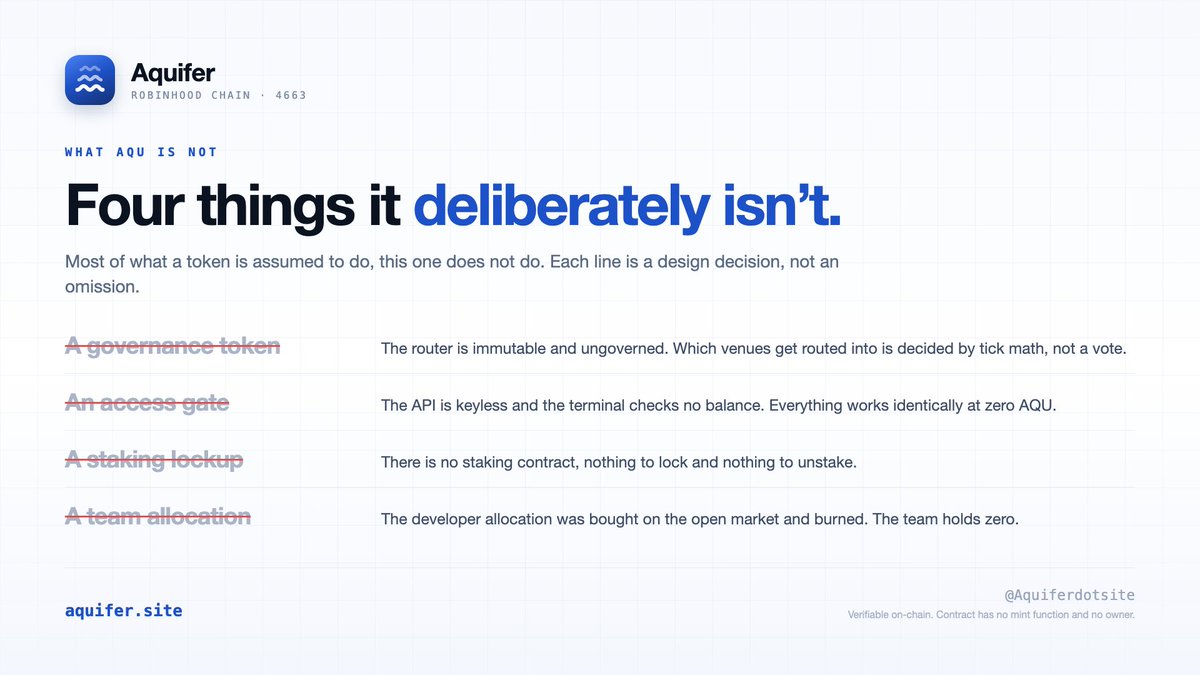
No governance. No access gate. No staking lockup. No team allocation.
Which venues get routed into is decided by tick math, not a vote. The router is immutable and ungoverned that's a feature, not a gap.
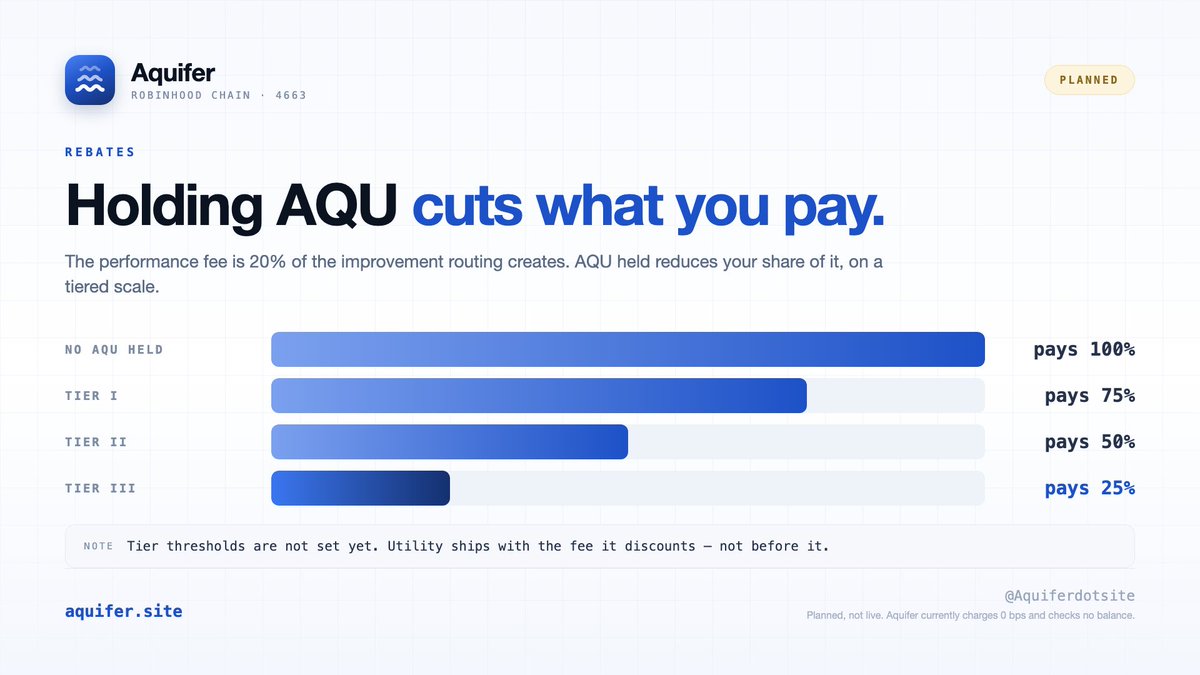
AQU has no utility today.
The terminal, the API and the router behave identically whether you hold zero AQU or a hundred million.
No gate, no tier, no balance check anywhere in the product.
Here is what it deliberately isn't and what it's planned to become.
https://t.co/IcBOMiKwb3
Ca: 0x92be8CB46473297B09ce6640843a75385057061C
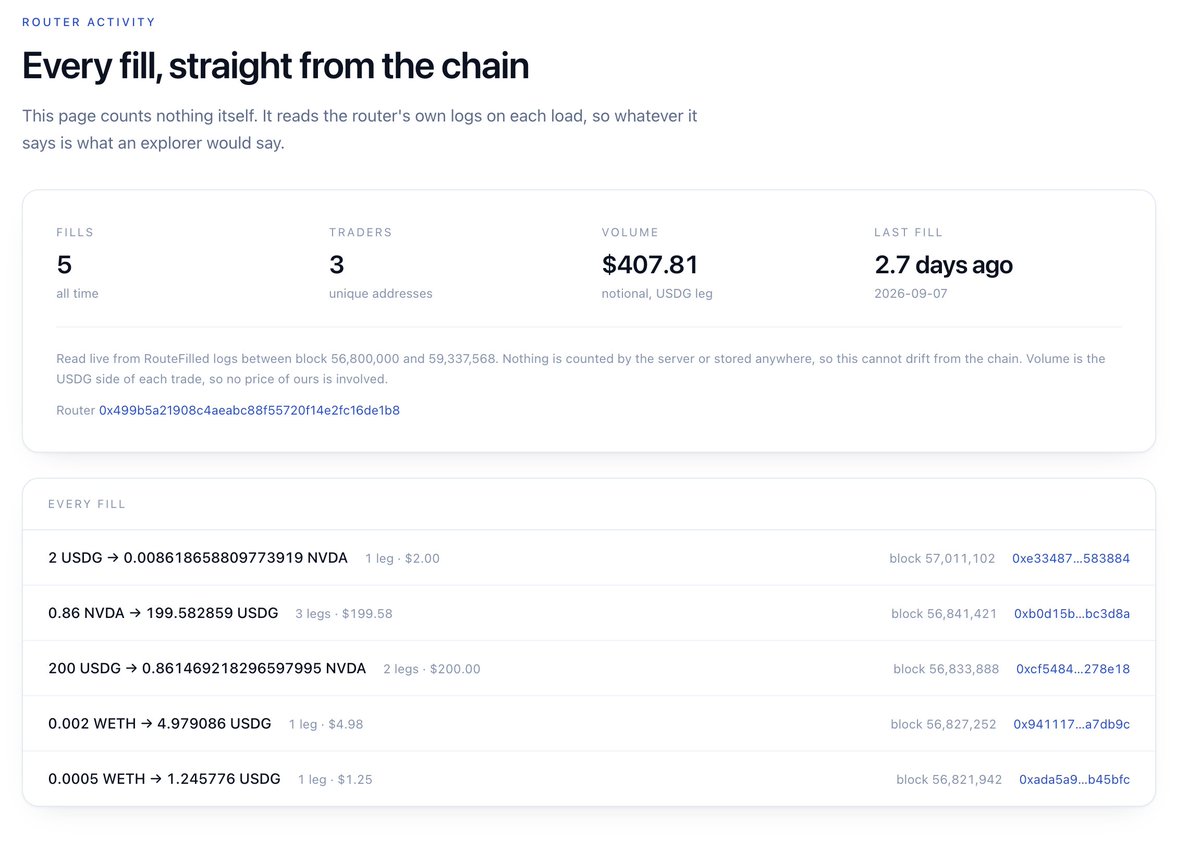
We shipped a stats page.
It reads every fill straight off the chain each time you load it. We do not count anything ourselves.
We cannot pad it. It shows whatever is true on the day you open it.
Right now that number is small. Mainnet is days old and almost nobody knows the router exists yet.
https://t.co/93b06LF0nA
CA: 0x92be8CB46473297B09ce6640843a75385057061C
We are still here. Still shipping.
Since mainnet, we have shipped the router, web terminal, keyless API, Android app, and this week, an iOS build.
They are all live. They all work. You can use them right now.
And on the noise about the team selling:
The team holds zero AQU. Dev supply is locked.
We have also been doing the opposite of selling. 1,474,136 AQU bought on the open market and burned to the dead address:
0x1aad7593d61357037792ebcaea7f1a6c3a53e439d8ba94b4d135d0bc9000b873
You don't have to take our word for any of that. It's all on-chain. Open the contract, check the addresses, look through the transfers yourself.
That's the whole point of building in public. The router is also pretty simple to verify. It has no owner, no treasury, no withdraw function and no fee switch.
If you think there's a hidden lever in there, go find it.
A lot of projects launched around the same time as us. Some stopped shipping as soon as the chart went sideways.
For us, that's a much better signal than the price. We know the chart is what most people look at. That's fine.
We would rather be judged on whether the product actually works. Because that's the part we can control.
And six months from now, that's the part that will still matter. It's live. It's free. No API key. No signature required.
https://t.co/IcBOMiL40B
The mid is not the price.
On a $250,000 USDG to SPY order:
The mid says 772.11 Crossing the book adds 2.43. You actually pay 774.54
That gap is 31.32 bps, which is $783 on this one order. It is not a fee. Nobody charges it to you.
It is just what happens when your order is bigger than the top of the book, and no mid price on any screen can show it to you.
We quote the third number.
https://t.co/IcBOMiKwb3
CA: 0x92be8CB46473297B09ce6640843a75385057061C
Your fee does not change with size. Your cost does.
Same pair, four sizes, read at block 57,455,159:
$25k 5.73 bps
$250k 11.50 bps
$1M 35.61 bps
$3M 171.33 bps
The fee is 5 basis points at every one of those. The impact runs 30x.
That is because your order does not trade at one price. It walks the book, and a $3M clip crosses 37 ticks to get filled. Each mark on this card is one of them.
Fee tables tell you none of this.
https://t.co/IcBOMiKwb3
CA: 0x92be8CB46473297B09ce6640843a75385057061C
Compared to what?
Seven things you need before you send an order. A mid price can answer one.
What you will actually receive.
What crossing the book costs you.
Which venue fills you, and at what share.
How many pools were read to get it.
Whether splitting beats the best single venue.
The block it was priced at.
CA: 0x92be8CB46473297B09ce6640843a75385057061C
Where the book actually is.
$37.1M across 123 pools, and two venues carry 94% of it.
Uniswap v4 57.1%
Uniswap v3 37.1%
Ramses 2.9%
Up 2.2%
Giga 0.4%
Alandale 0.2%
We read all six anyway. The small ones are exactly where a large order finds its last few basis points.
https://t.co/IcBOMiKwb3
CA: 0x92be8CB46473297B09ce6640843a75385057061C
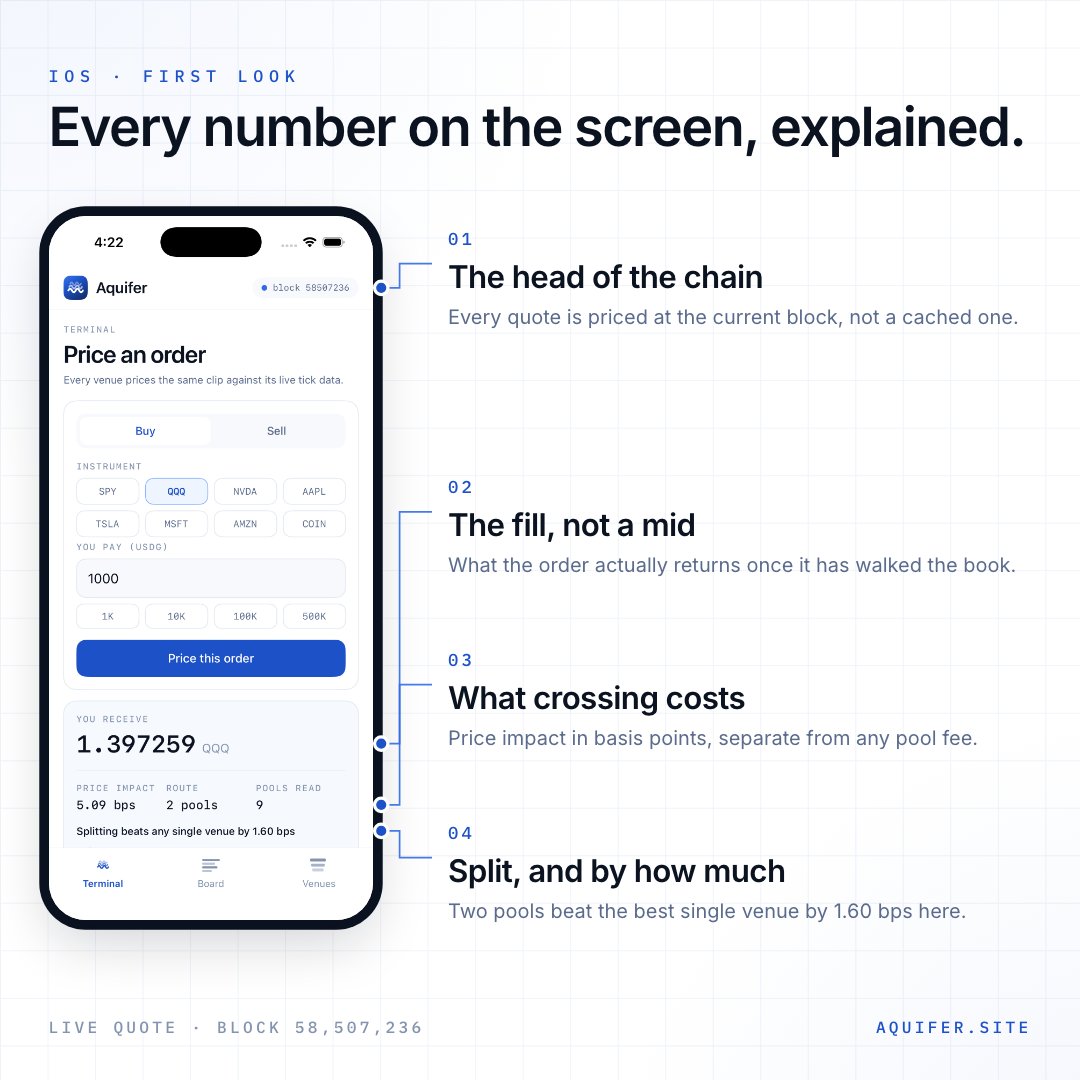
Aquifer on iOS. First look.
Pick an instrument, put in a size, get the real fill. Not a mid, not an estimate.
What you would actually get, priced against every pool on Robinhood Chain at that moment.
Block 58,507,236 in this clip.
Three tabs. Terminal prices your order. Board is every name by its deepest pool. Venues is what carries the book.
Android is live today. IOS is coming next.
https://t.co/IcBOMiKwb3
CA: 0x92be8CB46473297B09ce6640843a75385057061C
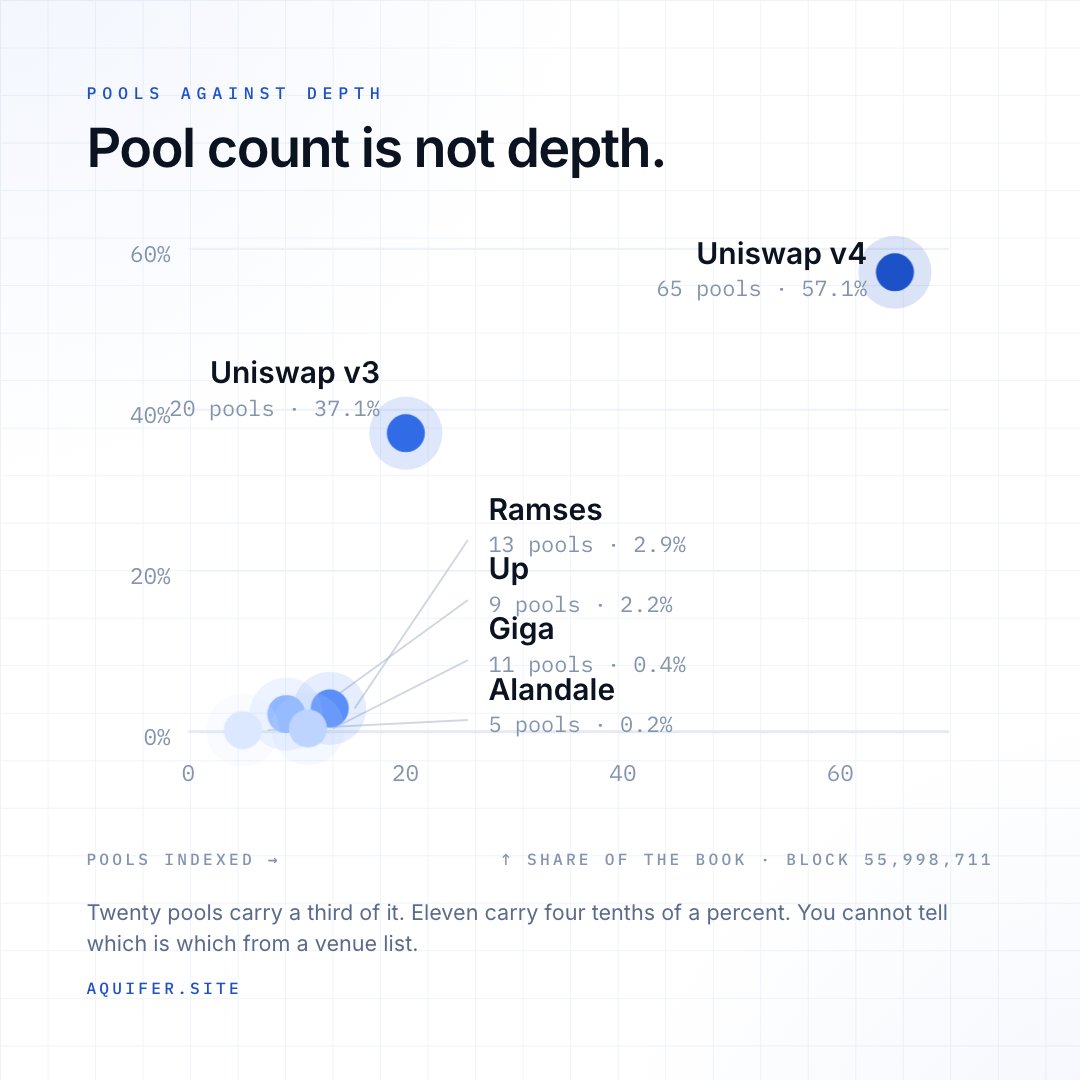
Pool count is not depth.
Uniswap v3 carries a third of the whole book in 20 pools. Giga has 11 pools and four tenths of one percent.
Count the pools and those two look similar. They are not remotely similar, and if you route by pool count you will find that out with your own money.
The only way to know is to read every pool and price your actual size against it. So that is what we do.
Block 55,998,711.
https://t.co/IcBOMiKwb3
CA: 0x92be8CB46473297B09ce6640843a75385057061C
Five steps. One call.
Read every pool straight from contract storage.
Walk every tick your order actually crosses. A $3M order crosses 37 of them.
Split it into 5 legs across the venues that fill it best.
Quote it as one number.
Fill 7.15 bps better than the best single venue could have done. Most pricing stops at step one and calls the average a price.
https://t.co/IcBOMiKwb3
CA: 0x92be8CB46473297B09ce6640843a75385057061C
Most terminals quote you the midpoint of the deepest pool and let you find the rest at execution.
Aquifer prices your actual size, against real tick data, at a named block then routes it across the venues that fill it best.
7 venues, 145 pools, $37.9M liquidity, on Robinhood Chain.
https://t.co/IcBOMiKwb3 — @Aquiferdotsite