Promoting peace and human rights in Arakan, Myanmar, and beyond. Supporting Rohingya and other marginalized communities through advocacy, engagement, and etc.
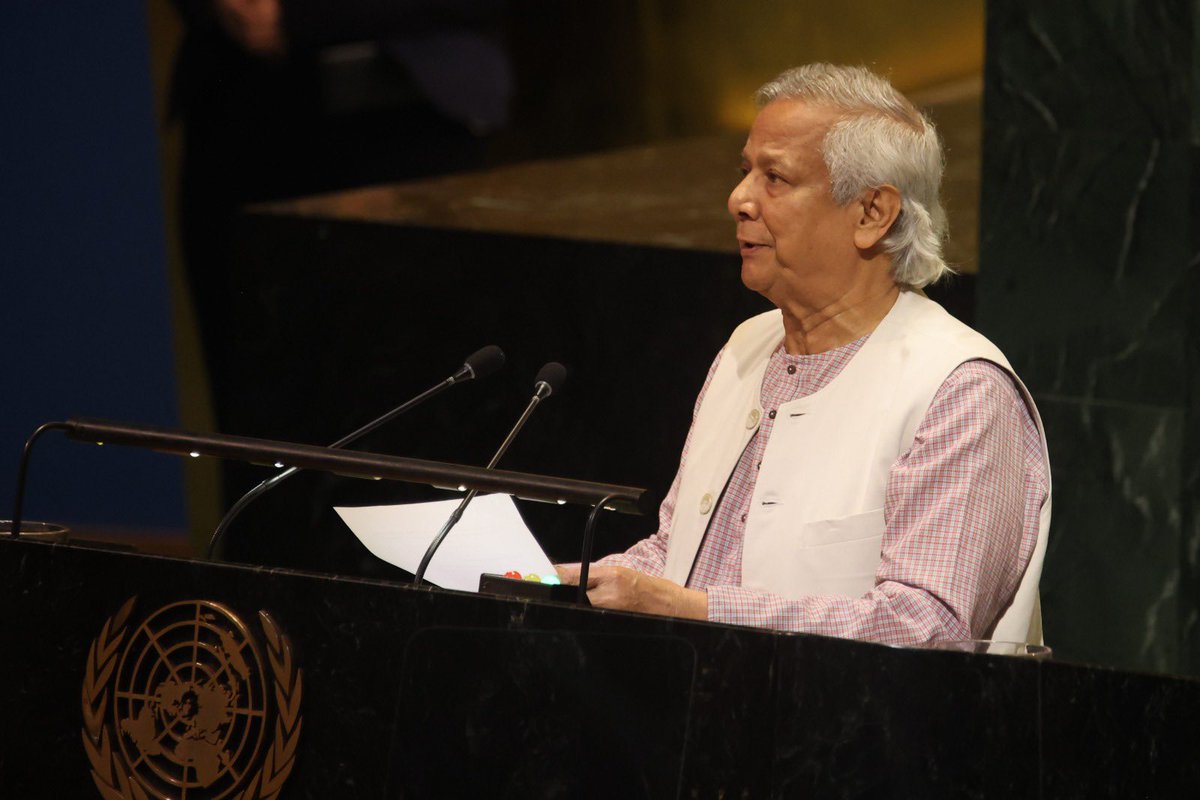
Statement of the Hon’ble Chief Adviser for the Opening Session of the High-Level Conference on the Situation of the Rohingya Muslims and Other Minorities in Myanmar
30 September 2025 | UNHQs, New York
Madam President, Excellencies,
Eight years since the genocide began, the plight of the Rohingya continues. Initiatives to end the crisis are lacking. International funding facesalarming shortfalls.
The Rohingya crisis originated in Myanmar. Its solution lies there. The international community must put effective pressure on Myanmar and the Arakan Army to immediately stop persecution of the Rohingya, and start working for their expeditious repatriation to Rakhine. It is the only solution of the crisis. It should not be held hostage to broader reforms in Myanmar.
As funding declines, the only peaceful option is to begin their repatriation. This will entail far fewer resources than continuing theirinternational protection.
The Rohingya have consistently pronounced their desire to go back home. As an immediate step, those who recently crossed into Bangladesh escaping conflict must be allowed to repatriate.
Bangladesh is a victim of the crisis. We are forced to bear huge financial, social and environmental costs. Criminal activities, including narco-flows into Bangladesh through Rakhine, threaten our social fabric.
Given our developmental challenges includingunemployment and poverty, we do not afford to allow employment of Rohingyas insideBangladesh.
Towards a sustainable resolution of the crisis, I propose the following actions by the international community:
First, devise a practical roadmap for safe and dignified repatriation of the Rohingya with reasonable stabilization of Rakhine;
Second, exert effective pressure on Myanmar and the Arakan Army to end violence against the Rohingya and start their sustainable repatriation, beginning with those who recently arrived in Bangladesh, and those who are internally displaced;
Third, mobilize international support to stabilize Rakhine and place international civilian presence to monitor stabilization;
Fourth, support confidence building measuresfor sustainable integration of the Rohingya in Rakhine society and governance;
Fifth, mobilize donors’ contribution to fully fund the Joint Response Plan;
Sixth, pursue accountability and restorative justice; and
Seventh, dismantle the narco-economy, and combat transboundary crimes.
The world cannot keep the Rohingya waitingany longer from returning home. Today, let us pledge to act together to resolve the crisis once and for all. Bangladesh stands ready to extend its full cooperation to this end.
Thank you.
"With the advances of the Arakan Army, which now controls almost all the state, their situation has not improved. Discrimination, the burning of their villages, the exclusion from work and services, the continuous denial of their very identity. The Rohingyas live with the threat of arbitrary arrest and detention, with restricted access to healthcare and education. They cannot move freely. They are subjected to forced labour and forced recruitment. Their lives are defined everyday by racism and fear."
Statement by the UN High Commissioner for Refugees Filippo Grandi to the United Nations General Assembly High-Level Conference on Rohingya Muslims and Other Minorities in Myanmar https://t.co/k6uyLVOaTD
"We must do more."
High Commissioner @FilippoGrandi's powerful words on the plight of the Rohingya and what we must do to chart a new way forward. #UNGA
"The European Union and its Member States remain committed to helping establish the conditions necessary for the return of the Rohingya to Myanmar. These conditions require addressing the root causes of displacement, including statelessness, denial of citizenship, and systemic discrimination."
EU Statement – UN General Assembly: High-level meeting on the human rights situation of Rohingya Muslims and other minorities in Myanmar | EEAS https://t.co/4eLcXceSje
"We must work together to resolve the crisis affecting the Rohingya and other minorities in Myanmar.
We must find a sustainable political solution that will shape a peaceful and inclusive future for all of Myanmar.
As we work for that future, I urge you to demand immediate action in three crucial areas:
First, all parties must respect international humanitarian law and human rights law. The protection of civilians must be an immediate priority.
Second, unhindered humanitarian access inside Myanmar must be guaranteed. No community should be cut off from food, medicine, and lifesaving assistance.
Third, we need reinvigorated humanitarian and development investment. To meet basic needs. To help refugees transition from dependence to self-reliance. And to ease the strain on host communities."
Secretary-General's remarks at the UN High-Level Conference on the Situation of Human Rights of Rohingya and Other Minorities in Myanmar [as delivered] https://t.co/T5I32sbleU
We call on all armed actors – including the military regime and the Arakha Army – to protect civilians, allow humanitarian access, and adhere to international humanitarian law.
https://t.co/8qiqdh3vr5
Appeal of Rohingya People - In Advance of the UN High-Level Conference in New York on September 30, 2025
Self-Determination and Rohingya Identity
• Uphold the Rohingya’s right to self-determination, including autonomous governance and community-led security in Northern Rakhine State.
• Support a two-state solution or autonomous model—such as the United States of Arakan—to guarantee peaceful coexistence and equitable power-sharing between Rohingya and Rakhine, should the Rakhine reject Rohingya inclusion in Myanmar’s federal democracy.
• Reject false narratives denying Rohingya identity or labeling them as “illegal Bengalis” or “Islamist extremists/jihadis."
Announcement Establishment of the Rohingya Tribunal
The Arakan Institute for Peace and Human Rights (AiPAH) is honored to announce the establishment of the Rohingya Tribunal, dedicated to advancing truth, justice, and accountability for mass atrocities—such as genocide, crimes against humanity, and war crimes—committed against the Rohingya by the United League of Arakan/Arakan Army (ULA/AA) leadership, their forces, and their collaborators in Myanmar.
Press Release
FOR IMMEDIATE RELEASE
AiPAH Announces Establishment of Rohingya Tribunal
Houston, Texas, USA – The Arakan Institute for Peace and Human Rights (AiPAH) today announced the establishment of the Rohingya Tribunal, a landmark initiative dedicated to advancing truth, justice, and accountability for mass atrocities—such as genocide, crimes against humanity, and war crimes—committed against the Rohingya by the United League of Arakan/Arakan Army (ULA/AA) leadership, their forces, and their collaborators in Myanmar.