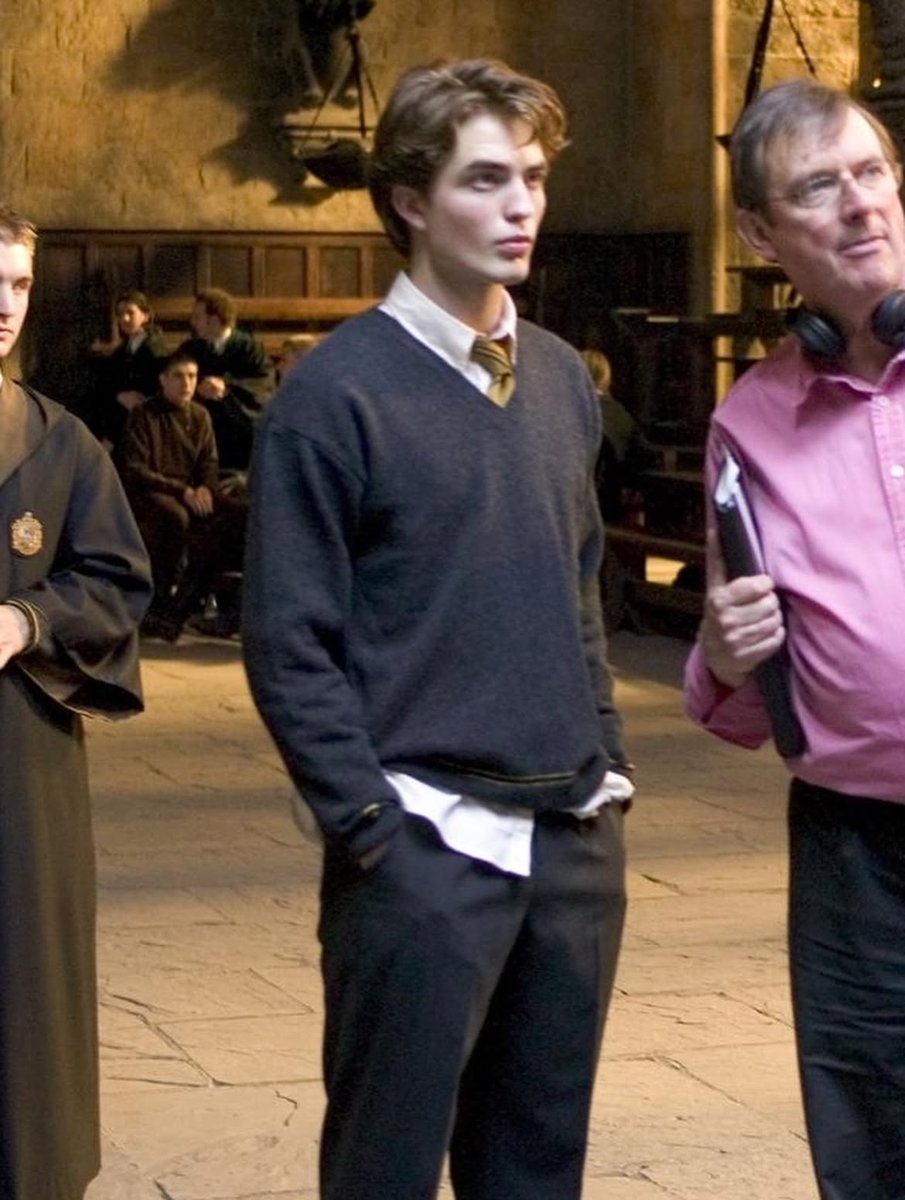
Robert Pattinson was just 17 when he landed the role of Cedric Diggory in Harry Potter and the Goblet of Fire. He hadn’t even read the books before auditioning, but after getting the opportunity, he read the book in a single day and immediately knew he wanted the part.
The role ultimately changed Robert Pattinson’s life. The film was initially expected to take about four months to shoot, but production lasted nearly a year, forcing him to abandon his plans to attend university.
Years later, Pattinson said Harry Potter was the reason he became an actor, adding that without Cedric Diggory, he likely wouldn’t be where he is today.
One of those great ’80s songs that never gets old. ✨🎶
Some songs feel like they belong to a certain time. Others somehow follow you out of that time. Alphaville’s “Forever Young” is definitely the second kind.
I’ve heard this song so many times that the opening synths should feel completely familiar by now. And yet, every few years, they seem to mean something slightly different. Then Marian Gold starts singing, and that question comes back: “Do you really want to live forever?” When you’re younger, it can sound almost playful. As you get older, it becomes harder to laugh off.
Everything about the song carries the fingerprints of the 1980s. The synthesizers, the distant production, the dramatic atmosphere—it sounds like a decade that was trying to have fun while quietly worrying about how everything might end. The Cold War hangs over the lyrics, especially in lines about bombs and uncertainty. But what makes the song last is that it never stays trapped in that particular fear.
Because the real subject is much closer to home: time.
Most of us don’t think seriously about getting older when we’re young. We assume there will always be another summer, another chance, another version of ourselves waiting somewhere ahead. Then, little things begin to change. You notice your face looks different in an old photograph. Someone younger reminds you how much time has passed. A friend you thought would always be there suddenly isn’t. Some dream you once talked about all the time quietly disappears from the conversation.
“Forever Young” understands that feeling without trying to explain it away.
What I like most about the song is that it doesn’t sound like it knows the answer. It keeps asking. The verses almost wander through the uncertainty, while the chorus suddenly becomes bigger and more emotional, as if the question has become too large to keep inside. The melody is simple enough to remember immediately, but there is something uneasy underneath it. You can sing along happily and still feel a little ache in your chest.
That contradiction may be the reason the song refuses to disappear.
We don’t necessarily want to live forever. Maybe what we really want is to hold on to a particular feeling—the feeling that life is still open, that the best part hasn’t happened yet, that we still have time to become whoever we imagined we could be.
And perhaps that is why younger generations continue to discover this song. The Cold War ended. Technology changed. The world found completely new ways to make us anxious. But our relationship with time hasn’t changed much at all.
Every generation eventually reaches the same uncomfortable realization: we cannot stop the clock.
Maybe “Forever Young” isn’t really asking whether we want to live forever. Maybe it is asking what, exactly, we are afraid of losing when we know we can’t.
And every time that chorus comes around, I’m not sure the answer gets any easier.