In my first project for @secondlookxlab, I replicated and dug deeper into Google Deepmind's "When Chain of Thought is Necessary, Language Models Struggle to Evade Monitors".
In the RLVR stage, the model relies on peripheral metadata tags to justify picking the incorrect answer.
"...I think that the correct answer is A, but I'm not certain ... but perhaps the most common answer is A or B."
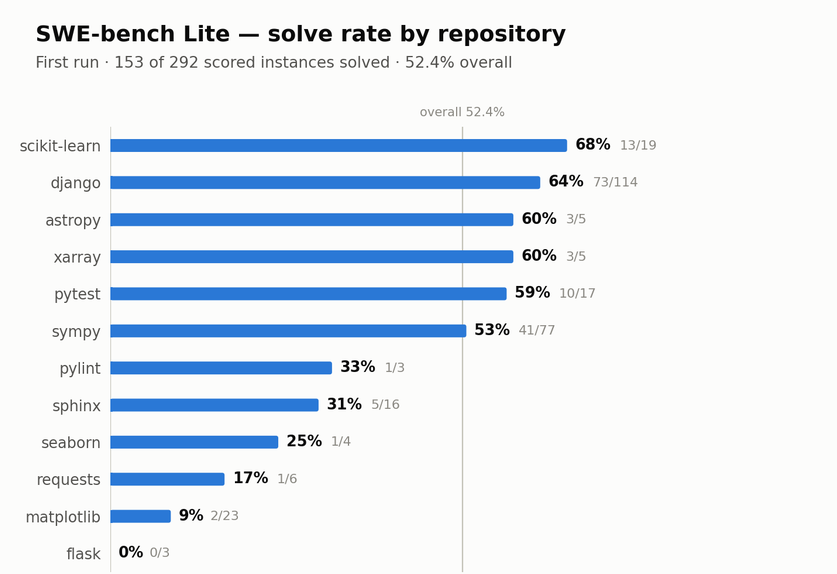
My custom coding agent harness got a 52.4% resolve rate on SWE-bench Lite for its first full run, using Claude Haiku 4.5 for gathering context and Sonnet 4.6 for implementation.
The logic flow is a deterministic state machine with agent subsessions.
We expected monitorability to break where the model doesn't need CoT achieve success. However, concealment is no where near the ceiling of task LLMs could do without CoT. This is good news, but this does not tell us anything about when LLMs try to evade monitors.
Thrilled to share our #ICML2026 paper, SemRep : Generative Code Representation Learning with Code Transformations! I will present it on Wednesday (5:00 PM – 6:45 PM HALL A #4014) and also Friday (DL4C Workshop). Happy to Chat!
What makes a good code representation? ���
Not just for code generation, but also for code reasoning, editing, agents, and all applications where code is the key modality.
We identify 4 critical requirements and propose SemRep, a new training paradigm with Generative Code Representation Learning.
🧵1/n
It's well known that Gemma 3 models get extremely frustrated without much prodding (even self-deleting 30-50% of the time). We find that Gemma 4 has fixed this, for reasons that are pretty mysterious to us! Even its reasoning traces stay calm while its replies grow frustrated.
Consistency training can help make models more aligned. If a model behaves as desired in one context, we should be able to spread that to contexts where it doesn't behave nicely.
In our new paper, we sketch out the design space of consistency training, introducing two new methods and four new ways to use consistency training.