🧵 What does the mysterious first catalytic domain of HDAC6 do?
After 20 years, we have an answer, and it validates a metabolic hypothesis first proposed in 1943.
New preprint from our lab on bioRxiv (1/8) 👇
https://t.co/NwnTL2vU7u
Bottom line: PTMs are not only protein marks. Free modified amino acids can be signaling metabolites that couple metabolism, proteostasis, and human genetics. (7/8)
🚨 We discovered a new genetic code, "Genetic Code 34," sporadically distributed in archaea. Select archaea have genome-wide recoding of the TAG stop codon to pyrrolysine; the adoption of this code was likely driven by metabolic processes. (1/2) https://t.co/wzEKFpSPxE
The lab of @AhmedHBadran has expanded the genetic code by incorporating non-canonical amino acids using four-nucleotide codons. Published in @NatureBiotech, this method enhances #proteinsynthesis precision for drug discovery. More: https://t.co/IJSQxH09M8
Congrats to postdoc Juana Goulart Stollmaier @jubsnjubs and group alum Dr @ParisRWatson for this fantastic work, just published in ACS Med Chem Lett @ACSBioMed! HDAC10 catalyzes thioester hydrolysis to activate thiol-containing pharmacophores.
https://t.co/vJxYeFOSVW
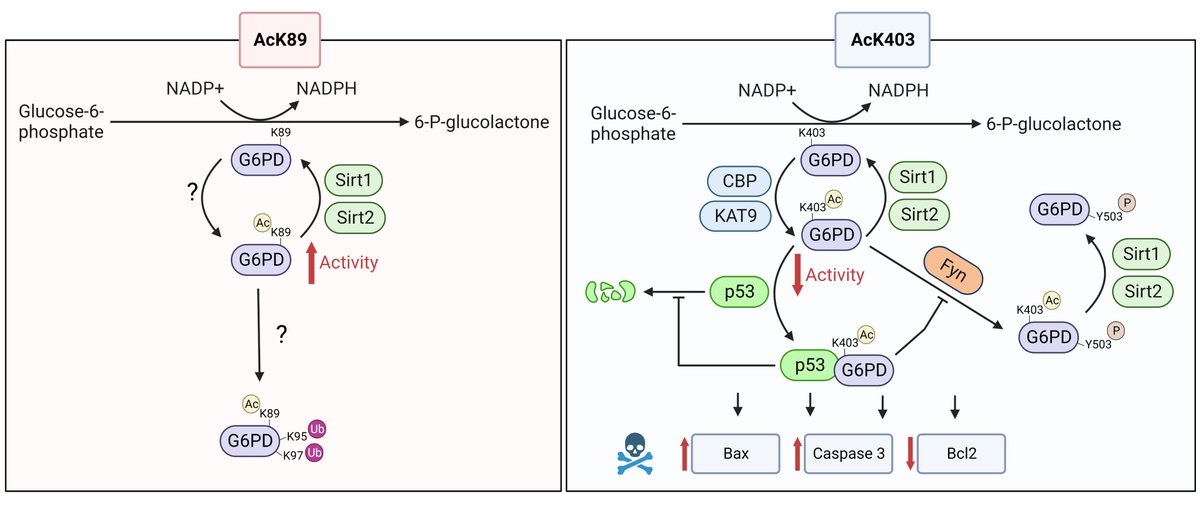
We are excited to share our new preprint, describing G6PD acetylation-dependent activity and crosstalk with apoptotic signaling cascades. Congrats to @Fang_WU_, who led the project (almost) single-handedly, and collaborators @TheEliaLab and @roi_gazit 1/7 https://t.co/H1LTdARv5H
These and other findings described in the manuscript, can be summarized in a mechanistic model for the functional implications of G6PD K89 and K403 acetylation. 7/7
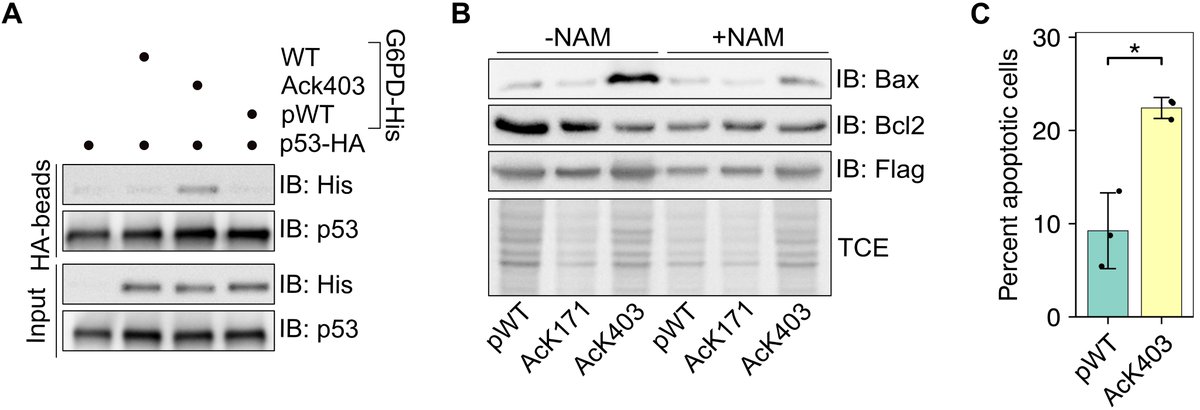
We also found that G6PD K403 acetylation promotes Y503 phosphorylation, interaction with p53 (A), and p53-dependent induction of apoptotic signaling cascades (B, C). 6/7