@mokriegleder Great to hear! For a purely theoretical view you might like the shorter "overview of the theories" in the first section. Many scientists have such collaborations on their mind at the moment, so you might want to look through recent works of Howhy, Seth, Friston, Pennartz, Bayne..
Integrated Information Theory (IIT) and the predictive processing theories Active Inference (AI) and Neurorepresentationalism (NREP) have different views on how conscious percepts arise. The INTREPID project explores these contrasting theories! https://t.co/A507RoheRX
Want to dive deeper? Curious about our methods and the predictions? Full details on theories, predictions and experiments in the pre-registration on OSF here: https://t.co/A507RoheRX
Experiment 3: Active vs. passive perception. Does “seeing” only happen when “looking at”? IIT & NREP say no, while AI predicts specific changes in conscious experience only during active exploration and not during passive observation. #Action#Perception
Defining consciousness is difficult, making the research on it al the more tricky. Different scientists may follow different theories, but could these complement each other? We and various HBP alumni ask this in our new Neuron paper! https://t.co/t97IVqwzWo
The CSN lab is looking for a new Data Analyst in Amsterdam. Are you good with different types of data, excited about the brain and programming, and want to work in a team doing state of the art neuroscience research? Apply now! https://t.co/TIzd6FWmmw
1/ IIT can and should be critiqued, but this letter, despite many admirable signatories (& colleagues/friends) is disappointing. The accusation of pseudoscience is serious & clickbaity & IMO the letter doesn't justify it https://t.co/W9n6XkZz3S
An amazing special issue on ‘Decision and control processes in multisensory perception’ in Philosophical Transactions B (@royalsociety) featuring a review by Cyriel Pennartz, @mnoudelohuis and Umberto Olcese https://t.co/9QPOyhePnJ
1/ "Why finding the neural correlates of consciousness is still a good bet" - my @NautilusMag take on the wager between @davidchalmers42 & Christof Koch, and (more so) on the first @ArcCogitate results, announced at @theASSC NYC 👇🏽 https://t.co/aFIy2ORzSo
Umberto Olcese will lead a symposium: "Advances in the Neuroscientific Study of Consciousness" at @SfN_Events in Washington, November 11, this year. Including other speakers from INTREPID, other ARC-projects and more! full program: https://t.co/bN7tw0z8Ca
Joining us for @ArcIntrepid is Francesco Lässig! Francesco started his PhD journey with us, and will focus on the theoretical and computational aspects of Neurorepresentationalism. @TempletonWorld@UvA_Amsterdam
Want to investigate how the brain identifies different sensory modalities? We have a position for a PhD student, in collaboration with the @VUamsterdam. This project will look at multisensory integration and segregation. More info here: https://t.co/QWDAdX4xtI
Collaborative science is at the heart of the ARC-INTREPID project. Kengo Takahashi (@CogSysNeuroSci, U of Amsterdam) and Samuel Pontes Quero (@Columbia_NTC, Columbia U) are working together to develop a new technology to study the mechanisms of consciousness (@templetonworld)
Would you like to be part of a large @TempletonWorld funded consortium investigating consciousness? At the @CogSysNeuroSci lab in Amsterdam we are looking for a PhD candidate on the theoretical aspects of the INTREPID project! https://t.co/oZvClC8QrT
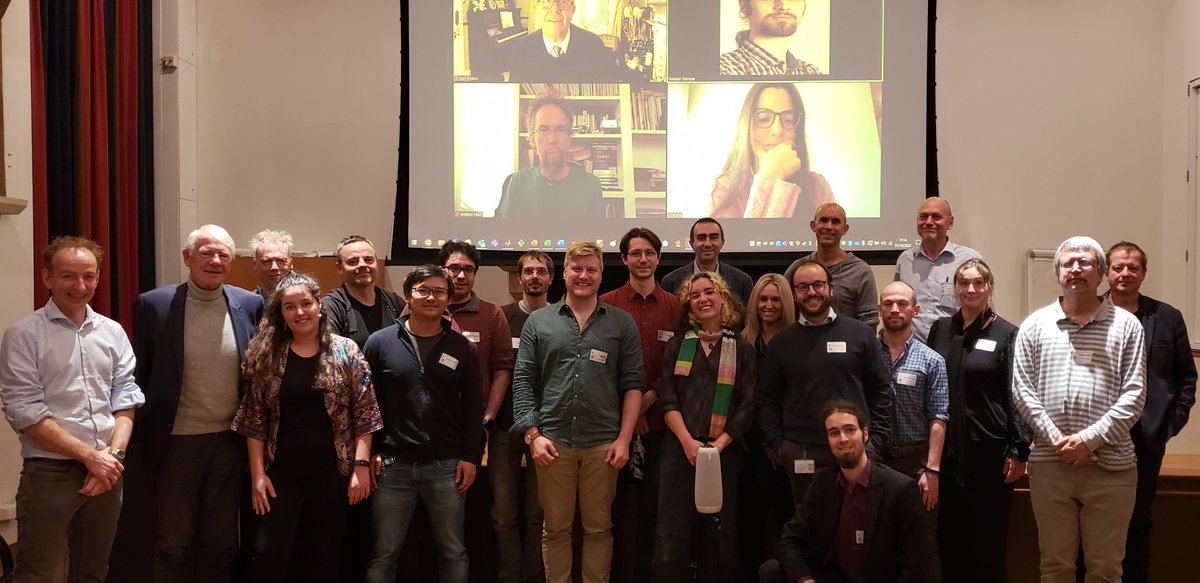
Excellent to see most of the partners in Amsterdam for the INTREPID Assembly Amsterdam 2022. Truly great to get a thorough discussion going on the ongoing work. Thanks to all the members joining physically and/or virtually! @TempletonWorld