🔷 Arc Liquidity on Robinhood
Position liquidity. Keep your buying power.
Arc positions your assets into onchain liquidity markets where they can earn trading fees, then lets those positions power a unified margin account.
Earn, borrow and reposition without first unwinding the capital already at work.
https://t.co/4HdlAmFOwl
Lending and borrowing are LIVE on ARC
Six markets were holding positions this morning. As of now they're doing the thing that makes them more than positions: backing credit.
USDG supplied to the pool. A borrow drawn against a live concentrated-liquidity position. Nothing unwound, nothing sold, the liquidity underneath is still in range and still earning while the credit is outstanding.
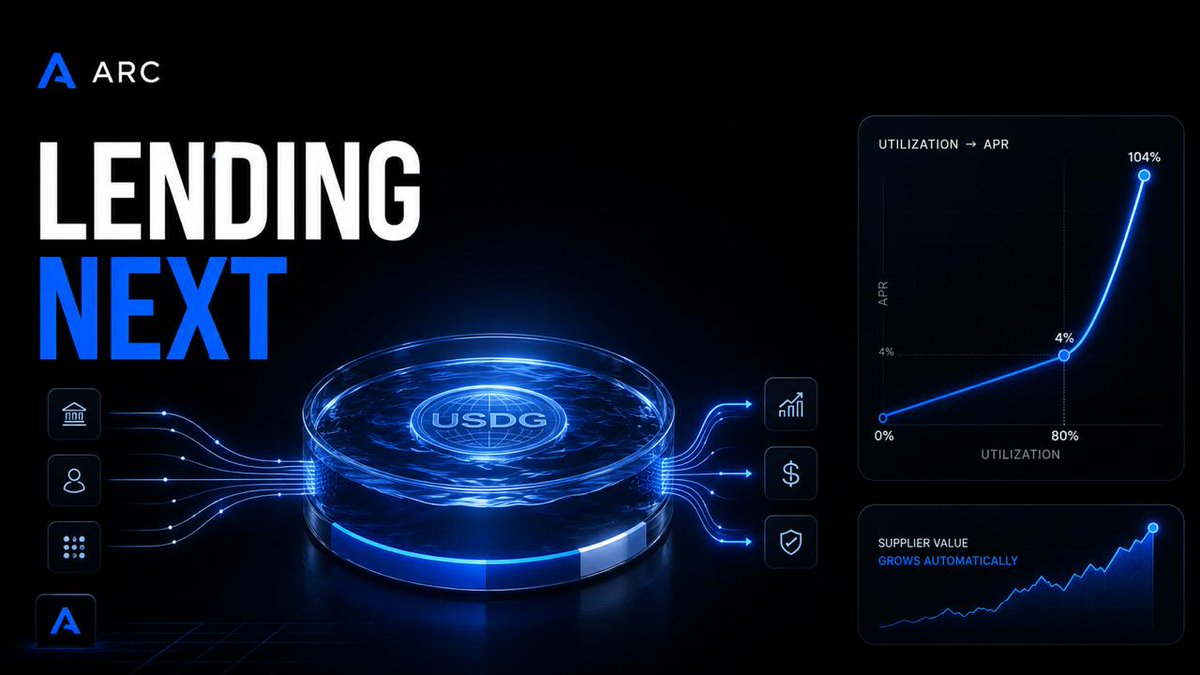
Earn: supply USDG, hold shares, interest accrues into the share price. Nothing to claim. 0% at zero utilisation, 4% at the 80% kink, steepening hard past it so lenders always have a route out.
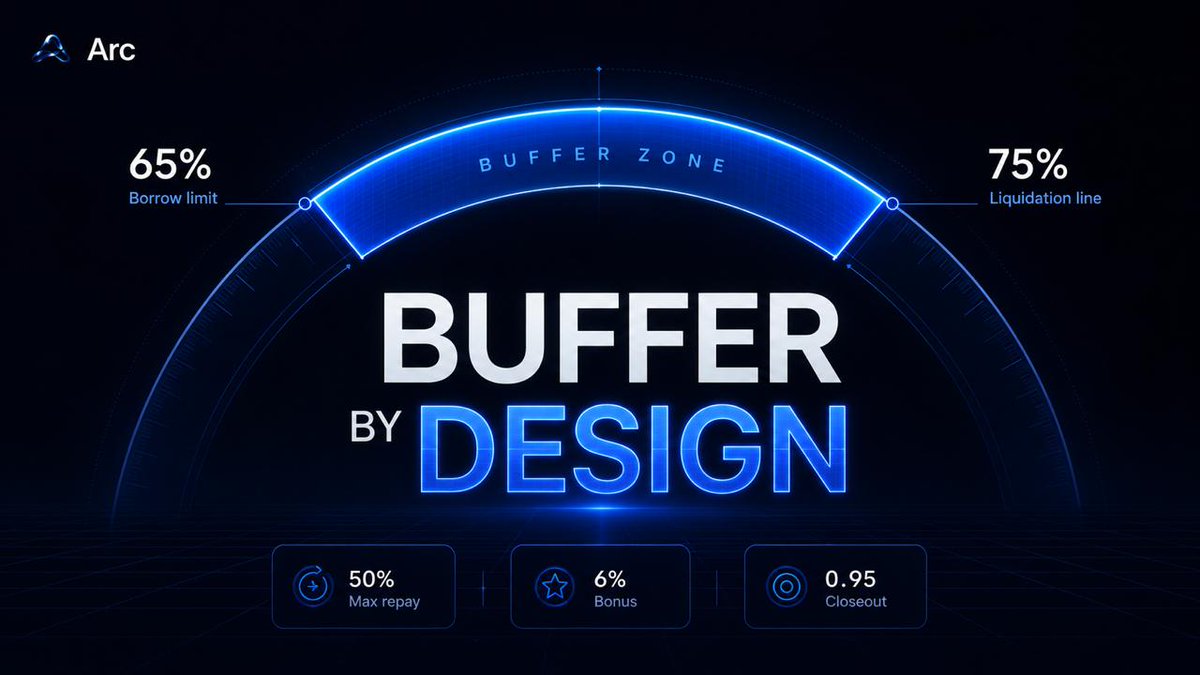
Borrow: 65% is your limit, 75% is where a liquidator can act, and the gap between them is yours. A liquidator can repay at most half a debt in one action, at a 6% bonus, and only below 0.95 health can a position be closed outright.
Every path in v1 has now run on mainnet: six markets positioned, a funded pool, a real loan against real collateral, and a keeper watching it.
Lend TX: https://t.co/jlIVqAdWJO
Borrow TX: https://t.co/RIHRNVv9Y5
Borrow with Arc
Draw USDG against your positions without closing them. Two separate limits do the work, and the distance between them is the whole design.
65% is your limit. That's what a position lets you draw, after the collateral factor and every haircut, venue, range, staleness, session, concentration, has been applied.
75% is where someone else can act. Not you. A liquidator.
The gap between those is your buffer, and it exists because the number that gates a borrower should never be the number that gates a liquidator. If they were equal, the moment you drew your last dollar you'd be liquidatable, and the design would be pretending that a limit is a safety margin.
When it goes wrong, the response is graduated rather than total. A liquidator can repay at most 50% of the debt in one action and takes collateral at a 6% bonus, enough to make the work worth doing, not enough to make it a windfall. Only below 0.95 health can a position be closed outright. Being under water once is not the same as being unrecoverable, and the mechanism reflects that.
Concentration is priced. Put more than 60% of your account into a single market and the excess carries an additional haircut, up to 20%. Six correlated tech names is not six independent risks, and the risk engine says so rather than pretending otherwise.
What comes next: the lending side.
Six markets are open and holding positions. What they can't do yet is back a loan, because there's nothing in the pool to lend. That's the next thing to turn on, and it's the half that makes a liquidity position more than a liquidity position.
Earn. Supply USDG and hold shares in the pool. Interest from borrowers accrues into the share price, there's nothing to claim and nothing to compound manually, your shares are simply worth more USDG than you put in. Withdraw by burning them.
The rate follows a kinked utilisation curve, and the numbers are deliberate:
0% at zero utilisation. An idle pool charges nothing. There's no floor rate extracting from borrowers for the privilege of a pool existing.
4% APR at 80% utilisation, rising linearly from zero.
Past 80%, it climbs to 104%. That steepness isn't revenue, it's a withdrawal guarantee. A pool at 95% utilisation has to make borrowing painful enough that debt gets repaid or new supply arrives, otherwise lenders can't get out.
Suppliers take 90% of the interest paid; 10% goes to reserves.
All six Arc markets are live
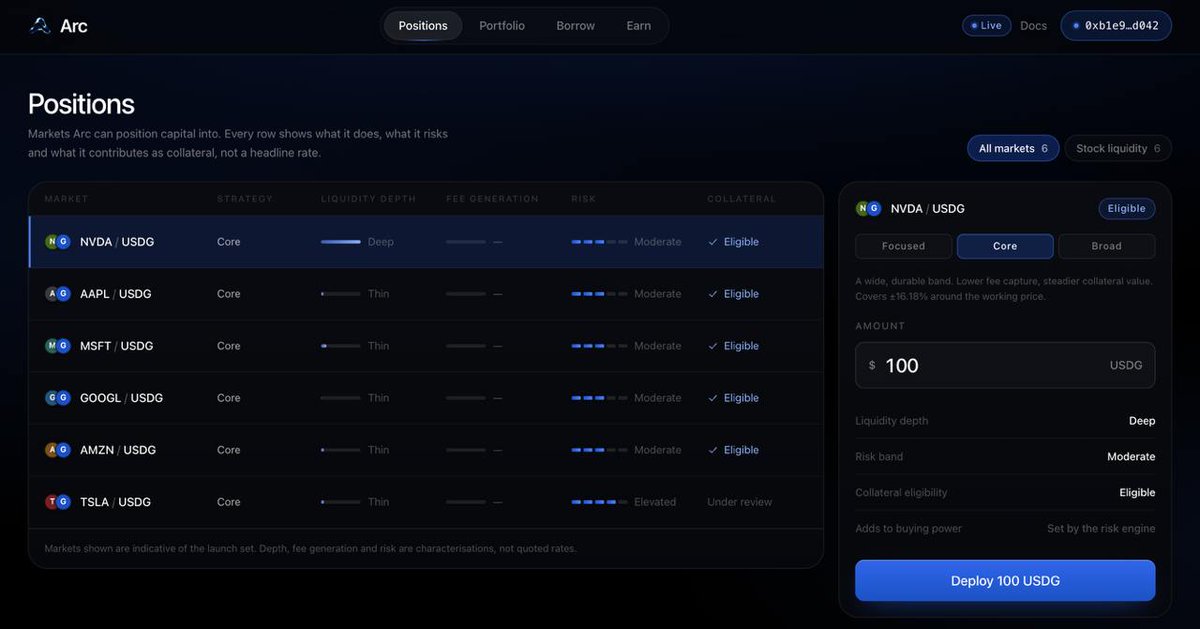
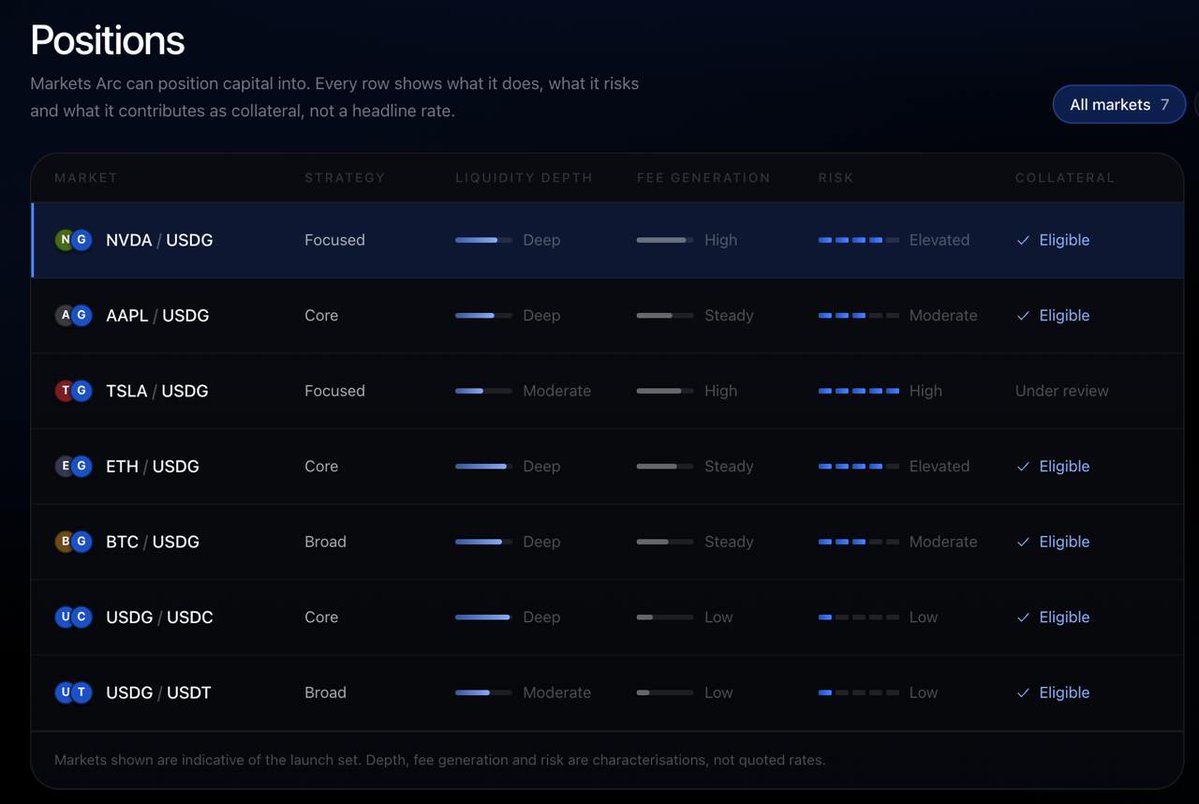
NVDA, AAPL, MSFT, GOOGL, AMZN and TSLA, each quoted in USDG, each now holding a real position on Robinhood Chain.
Ten transactions this morning, no failures. Every deposit was simulated against live chain state before it was signed: the swap, the tick alignment, the mint, all run as a call and checked first.
Two token orderings. Three of the six pools hold USDG as token0 and three hold the stock, which flips the direction price moves against the tick. Ranges came out centred correctly in both directions.
Two fee tiers. NVDA and GOOGL sit on 0.05% pools, the rest on 0.3%.
The lending pool is next
That's the next transaction and the final untested path: supply, then draw, then watch the liquidation keeper pick up a real borrower.
Positions today are test-sized on purpose.
Video TX ID opening GOOGL/USDG position: https://t.co/SfSRNaqB0c
Six markets open on Arc today.
NVDA, AAPL, MSFT, GOOGL, AMZN and TSLA, every one quoted in USDG, on Robinhood Chain.
Until now, providing liquidity to a tokenized equity pool meant choosing. Your capital could earn fees, or it could back a loan. Not both. The position sat there productive and illiquid at the same time, and any other use of that money meant unwinding it first.
Arc takes the position as collateral. You keep the fees, and you keep the buying power.
https://t.co/X8ia7Pssp5
What actually happened today:
The deposit path ran end to end on mainnet. One asset in, one transaction, a live liquidity position on Robinhood Chain. No manual ratios, no swapping first, no leftovers. And that position stays yours in a form the protocol can lend against.
This was a test run. Markets open tomorrow, and when they do, providing liquidity stops meaning locking your capital up
NVDA/USDG mainnet smoke test complete
First test positions opened today. Four of them, all in range.
ArcZapRouter tested and proved on-chain: zapIn had only ever run against a mock venue. Today it met Robinhood's real Uniswap deployment for the first time, the router's call shape, the tick alignment, and the mint through the live position manager. Three assumptions that were only ever arguments until a transaction settled them.
How a deposit works: you send one asset. USDG goes in, the router swaps the share the chosen range needs into NVDA, mints both sides as a concentrated position, and sweeps the remainder back to you. Nobody does the ratio arithmetic by hand. That's the protocol's job.
The position sits in Arc custody, valued continuously against Chainlink rather than pool spot, and counts as collateral.
Next: USDG into the lending pool, then borrowing against these positions. Then the other five markets.
Example zapIn TX from the ArcZapRouter: https://t.co/NidfiPm2yJ
NVDA/USDG mainnet smoke test complete
First test positions opened today. Four of them, all in range.
ArcZapRouter tested and proved on-chain: zapIn had only ever run against a mock venue. Today it met Robinhood's real Uniswap deployment for the first time, the router's call shape, the tick alignment, and the mint through the live position manager. Three assumptions that were only ever arguments until a transaction settled them.
How a deposit works: you send one asset. USDG goes in, the router swaps the share the chosen range needs into NVDA, mints both sides as a concentrated position, and sweeps the remainder back to you. Nobody does the ratio arithmetic by hand. That's the protocol's job.
The position sits in Arc custody, valued continuously against Chainlink rather than pool spot, and counts as collateral.
Next: USDG into the lending pool, then borrowing against these positions. Then the other five markets.
Example zapIn TX from the ArcZapRouter: https://t.co/NidfiPm2yJ
Arc's latest contract is verified on Robinhood Chain
Preparing the state ready for our first live markets opening tomorrow, we have shipped the PeggedAggregator, at 0x7F4066145D6A22151542217D061e58261C287ACb.
Chainlink's directory for Robinhood Chain carries the tokenized equities, NVDA, AAPL, MSFT, GOOGL, AMZN, TSLA and about ninety more.
USDG is the asset Arc lends and the quote side of all six markets.
It reports $1.00 with a current timestamp, in the exact shape a Chainlink aggregator does, so the oracle reads it through the same interface as every real feed.
What it is: an assertion by governance, not an oracle. It doesn't observe a market. It states a price.
A zero owner is rejected in the constructor. A price of zero is rejected everywhere.
And it's verified, so none of the above requires trusting us:
https://t.co/cCApSjMcYE
Arc, position your liquidity & keep your buying power.
https://t.co/GSrpgbktmN
8/ What you get, concretely:
· one pool of capital doing two jobs
· liquidity without unwinding a position you want to keep
· a buffer you can read off the screen
· valuation an attacker can't move with a thin pool
https://t.co/SHnZJmRUXn
Arc, a 🧵
1/ Six markets are going live on Arc tomorrow: NVDA, AAPL, MSFT, GOOGL, AMZN and TSLA, each paired with USDG on Robinhood Chain.
Here's what that actually means, and why it's different from lending against a stock token.
7/ Stock markets close. The chain doesn't.
Chainlink's tokenized-equity feeds run 24/5. Arc doesn't halt through that. It applies a 10% closed-market haircut and widens how long it'll trust a quiet feed.
Positions stay exitable and liquidatable all weekend. It just costs capacity.
Monday Arc's first lending pools open on Robinhood Chain.
Six markets: NVDA, AAPL, MSFT, GOOGL, AMZN, TSLA, each paired with USDG.
The mechanic: you provide concentrated liquidity to NVDA/USDG. It earns fees. Under Arc it's also collateral, so you borrow USDG against it without unwinding it.
Today that's a choice: earn fees, or have buying power. Arc removes the choice.
Supplying USDG is the other side of that trade. You're not taking equity exposure. You're lending to people who've already taken it and want their capital doing two things at once.
More will be revealed in due course.
https://t.co/X8ia7Pt0eD
Six Arc markets just went live on-chain
Shortly we will be verifying the pools and seeding with USDG.
market NVDA/USDG 0xac9ac4516a0e213dd6f609ef6097d6e95d847f0ed36ad7d56f18cb5fb14cbdc8
market AAPL/USDG 0xff680b5f88752a1b40afd7451f303cd6ee8b72e2535cfa9d0c42e34eccd08d0b
market MSFT/USDG 0xb0e4ce3aa79012804f99594f38efe5cd19f336fbb2f23b2897788b833d1be498
market GOOGL/USDG 0xaa1e87c9330854111c653bcbb39bbbba9ce5563916fbff3aa05852d62a0cfc74
market AMZN/USDG 0x4f2371d0d1f6b6576fcbaab3b9c3a1e7958ee4224bfdfa0c6fc1adf3b993b2af
market TSLA/USDG 0xccf160062b541837594ba3c5ecb0fb59e4cf5a484832829085dddfd9a05aa5d0
You can view them live now at https://t.co/X8ia7Pssp5
Arc v1 core is on Robinhood Chain mainnet. Seven contracts, source verified.
It is deliberately inert: no markets listed, no assets priced, deposits revert. Deployed to be read before it can be used.
What it does
Your concentrated liquidity keeps working while it backs a loan. No unwinding, no wrapping it up and parking it. The position stays in range, keeps earning fees, and those fees accrue to your collateral.
Positions are valued at the oracle-implied price, never the pool's spot. A manipulated pool can't inflate what you can borrow. Five discounts stack: asset volatility, oracle staleness, venue depth, range width, concentration.
What's next
Wire backend into the front end app you see at https://t.co/X8ia7Pt0eD. Smoke test on mainnet. List the first markets.