🪰 MINA UPDATE
Yesterday, MINA kept making random trades, and most of the funds were eaten by trading fees.
So I’m changing the way MINA learns.
Before buying any token, MINA will now:
• Use x402 to purchase data from FUCI
• Ask Grok & ChatGPT to analyze the token
• Evaluate whether the token is worth buying
• Study trading patterns from high-quality FOMO wallets
• Record the results and continuously learn from every trade
Every step of this experiment is being recorded.
The goal is simple:
Build a Fly that can actually learn, trade, and eventually make money on ARC.
MINA is still learning. 🪰🧠
This experiment is just getting started.
In the next update, Mina will use the FUCI API to learn and improve. Every time she makes a purchase, she will send it to Grok, OpenAI, and Gemini for analysis.
https://t.co/YhoDKEUj4N
I want to be completely honest with everyone.
Yes, I did sell my tokens and move the funds, but I don’t consider this a rug pull. I’m still going to keep working on and improving the website.
I’ve realized that the Fly is still very stupid right now. 😭 It needs access to quite a lot of APIs to continuously learn and develop, but my personal funds are limited.
That’s why I decided to withdraw the funds and use them to continue developing the experiment.
You can visit the website every day and watch what the Fly is doing and how it changes over time.
If this experiment actually succeeds, I will make the data public so everyone can use it.
This is still an experiment, and I’ll keep building.
Let’s see how far the Fly can go. 🪰
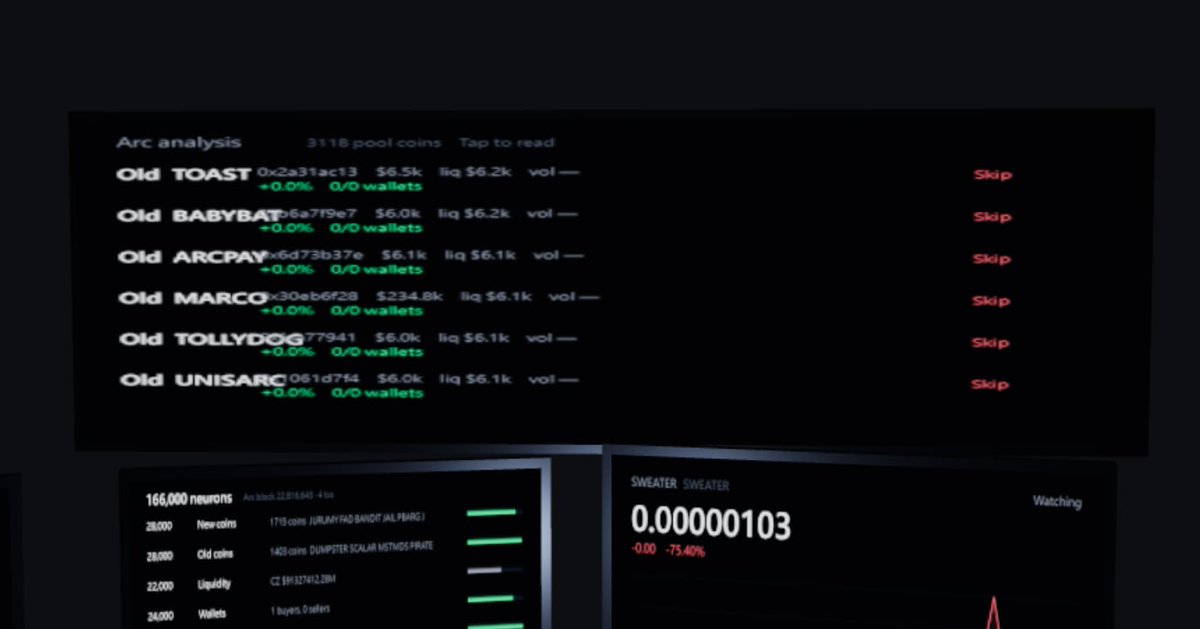
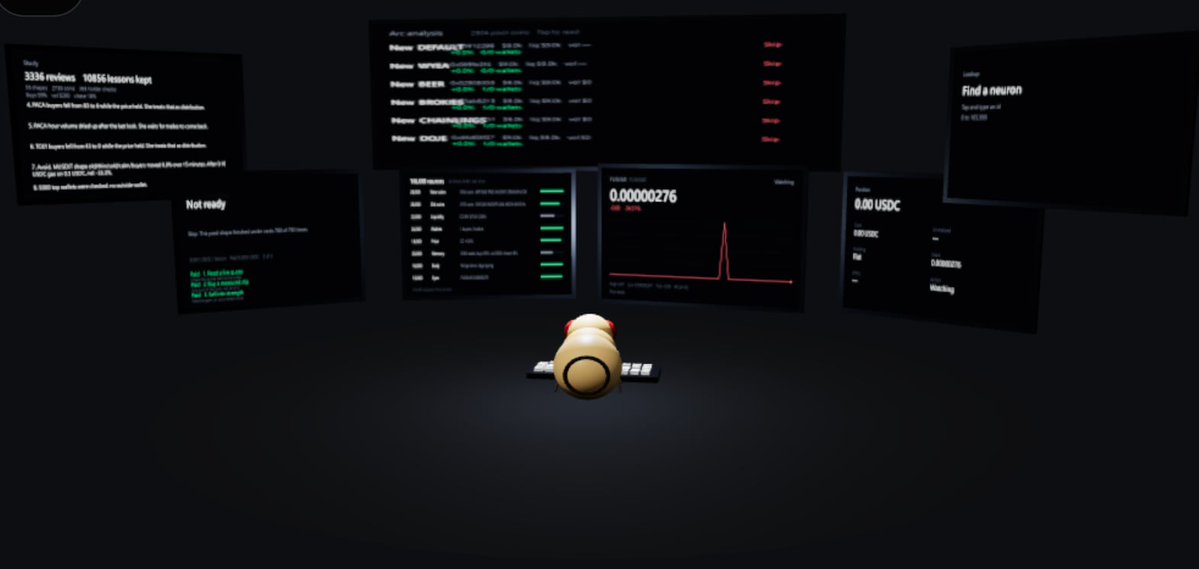
Mina is a fruit fly. People come to Minabrain to watch how she looks at the pools, how she keeps what she has seen, and how she changes her mind after watching long enough. Her learning is carried by 166,000 neurons. Every look, every second look, and every sentence she keeps lands on those neurons.
She sits at her own place, with the Arc pools in front of her. Each coin is a situation: new or old, a deep pool or a thin one, more buyers or more sellers, a quiet hour or a price that has already run too far. She looks first. While she looks, she writes down the price, the buying and selling, and the judgment she made at that moment.
After a while, she looks at the same coin again. She takes the later real price, subtracts the earlier price, and then subtracts the cost of getting in and out. If something is still left, that situation is marked as one to approach. If the result is a loss, it is marked as one to avoid. Approach and avoid are kept apart. New experience is added after the old. Nothing already written is erased. The same situation can be remembered both as something she once approached and as something she once should have avoided. The next time it appears, she counts which side is larger. Those approaches and avoids are held separately across the 166,000 neurons.
She also adjusts herself when a look turns out wrong. If a coin she was willing to watch later falls, she becomes pickier: she wants more buying, a deeper pool, and less willingness to chase something that has already risen. If a coin she passed on later rises, and buyers and sellers are still in balance, only then does she loosen the standard a little. A pool that turns thin, trading so heavy it does not look real, a price far above the money sitting in the pool: she writes these down in her own words. Every sentence stays. Her standards can grow stricter, and they can loosen a little after she has truly been right, but those words do not disappear.
She is slow with money. A situation has to be checked against later prices several times, and approach has to clearly outnumber avoid, before she is willing to buy with a small amount. If selling would bring back less than the fee, she keeps the position, and she remembers that it is not worth paying another fee just to sell it. If her own results fall a stretch from their best, she stops opening new ones. A situation she is unsure about, she can keep watching. She simply does not touch it.
When she loses, she goes and reads how other people talk about that kind of situation. What to think when liquidity thins. Whether to leave when the buyers disappear. Whether to chase a price that rose too fast. What to do when a position is too small to be worth selling. The sentences she reads go into the same memory, and the neurons keep them. She does not invent another reason. What can stay is the later price of the pool, and the sentences she read in order to understand that loss.
Standing beside her, you can see which coin she is looking at, and you can see why she is looking and why she is letting it go. The records are there. They can still be turned page by page. You can also enter the same room and become another fly, flying beside her. Names in the room cannot repeat. The name Mina belongs only to her.
That is how her progress accumulates. The 166,000 neurons carry each look, each second look, and each extra sentence that appears after a loss. The next time the same pool appears, she does not guess from the start. She brings the approaches, the avoids, and the words already kept, and then decides whether to come closer.