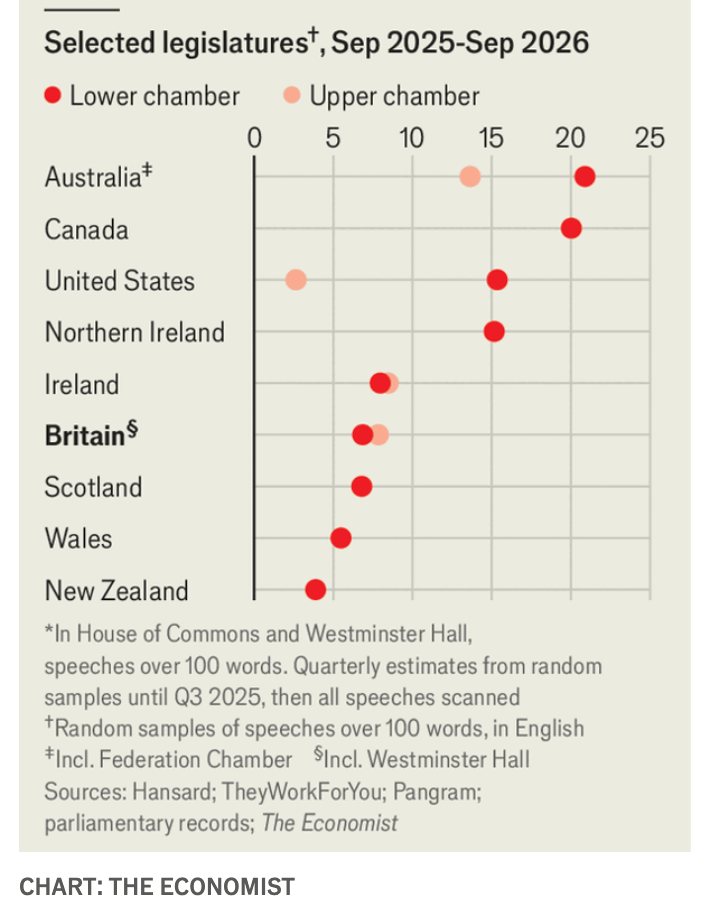
My latest for @TheEconomist: AI writing is taking over politics.
10% of what was is said in Parliament is now AI-drafted, per Pangram. Yet more in the House of Representatives, or in Australia and Canada.
Link: https://t.co/nC2OGDsK6O
And a 🧵 below, w/ some main offenders
We’ve spent the past year developing new primitives for GPUs. We believe this enables new algorithms to change how machines learn, open new markets, and dramatically reshape AI’s cost structure.
We have raised a $1 billion Series A, co-led by Index and Lux.
A few reflections from travelling (w/ @ed_shackle, @sebwride++) through data-centre country in Michigan/Ohio in my latest for @TheEconomist.
1/ The issue really is moving votes to the Democrats. That's now visible in our polling, too (h/t @OwenWntr), but also in the scale of on-the-ground discontent. I'm quite a bit more bearish on the prospects for big new data-centre projects in blue states after the trip.
2/ I really didn't hear that much direct anti-AI sentiment. The mood much more was a cocktail of worries about local harms (water, electricity bills, house prices), plus a total distrust of businesses and politicians. Against that backdrop, assurances about the water usage of closed-loop cooling systems really don't cut through. And, though developers will doubtless get cannier at this, cash payoffs to communities can easily look like subterfuge and do little to help.
3/ Still, moratoriums are at this stage much more bark than bite (h/t @mayabarkin for the data there). Only about 2GW seems actually delayed. The bigger risk is deterring newer projects, but I'd still guess that affects the exact locations more than whether the build-out happens at all.
4/ The question I'm left with is what comes after data centres as the big AI political issue into next year. A few obvious candidates are: a big cyberattack, the sheer scale of AI-related PAC spending in the 2028 cycle, the early innings of job displacement.
5/ What the data-centre issue should tell us, I think, is that voters' hostility to new technologies that change their lives in unpleasant ways is vast—especially when those changes are less positive-sum than data centres. So, however mad you expect AI as a technology to make the next few years, scale that up accordingly to account for a much more scrambled politics.
Do take a look at my piece on this here: https://t.co/Ha9R8uYF7i
And at our Checks and Balances podcast, where I contributed a short diary featuring lots of conversations with voters https://t.co/XLwgNTWRLs
Throwing a Works in Progress launch party that coincided with an air show over San Francisco Bay was really fun!
There is basically no hedonic adjustment to fighter jets soaring past your window.
New essay: To keep human judgment, we need AI courts.
AI-generated filings are starting to overwhelm courts around the world.
The most popular response I’ve heard is to fight AI with AI: If we can just give judges the right tools and training, AI will help them keep pace.
But this strikes me as the worst of both worlds.
Because we want human judges in the loop, we don’t get the speed and scale benefits of AI. Yet because we expect them to resolve a massive number of cases quickly, judges (or their clerks) may end up leaning on AI more than they mean to or should.
This essay offers another way: a parallel AI adjudication track.
An AI track — inspired by AI use in private arbitration but formally part of the court system like magistrate judges — would let courts be explicit about how human judgment is allocated.
Done right, this would allow courts to process large volumes of cases while ensuring human judges devote their full attention to the cases where their judgment is needed most.
Read more in @PaxMachinaMag: https://t.co/xC4JeVky8H
Good work. Another reason not to use ai to write internal communications: it creates slop rollouts that needlessly take up and betrays total disregard for colleagues’ time (please read this five page memo that I myself haven’t read thanks bye)