Published in the Behar Herald on 30 October 1926, this East Indian Railway notice announced the relocation of the Mokama Ghat Passenger Jetty to Hathidah Ghat due to changes in the course of the River Ganges.
On 5 June 1926, The Behar Herald published a notice announcing the introduction of a Shuttle Train Service between Mokama & Patna Junction, effective from 1 June 1926.
According to the published timetable, it departed Mokama at 9:00 AM and arrived at Patna Junction at 12:55 PM.
An advertisement for Siemens Self-Priming Pumps, published in the Behar Herald on 24 January 1939. Distributed in Patna through Patna Electric Works, this ad showcases the engineering solutions available in Bihar during the pre-independence era.
#VintageBihar#Bihar#Patna
The station was later extensively remodelled at a cost of ₹23.5 lakhs, and on 29 February 1940, the renovated station was inaugurated by Sir Thomas Alexander Stewart, the then Governor of Bihar.
#Bankipur#Patna#Bihar#PatnaJunction#RailwayStation
Patna Junction, originally opened as Bankipur Junction on 25 December 1862, was part of the Lakhisarai–Danapur railway line connecting Kolkata with Delhi. In May 1917, it was officially renamed Patna Junction.
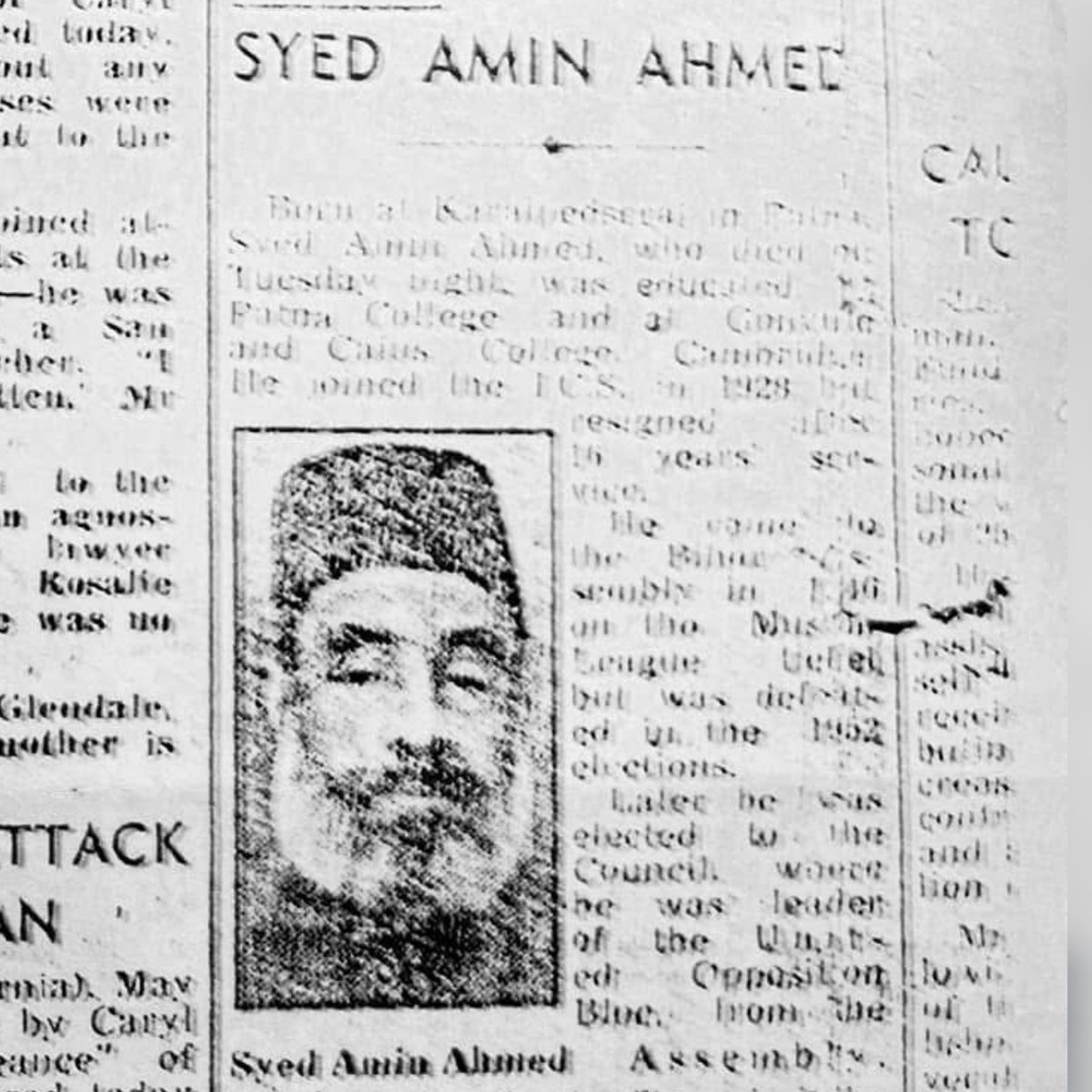
First, repeating the distinction he had achieved in his B.A. examination at the age of 17.
His literary contributions include The Black Hole of Calcutta, Spirit & Matter Reconciled, and Asbab-i-Taraqgi. He passed away at Patna on 3 May 1960 at the age of 53.
Syed Amin Ahmad (1907–1960) of Karaiparsarai, Patna, was a distinguished ICS officer, scholar, lawyer, author, and prominent opposition leader in Bihar politics. Educated at Patna College and Gonville & Caius College, Cambridge, he joined the Indian Civil Service in 1928 but
skills, his speeches in the legislature were so extensive on certain Bills that the Government was compelled to apply a guillotine motion.
In a remarkable academic achievement, at the age of 49 he appeared for the B.L. examination of Patna University and secured First Class
🇨🇳 Chinese mortar regiment enters Ramgarh Training Center, led by T/3 Joe B. Rogers of the US Liaison Group — June 1944.
Once a POW camp for Italians & Germans, Ramgarh was converted in 1942 into a China-Burma front training base — British-funded, US-trained. #WWII#History
Interestingly, the first English newspaper of Bihar, The Bihar Herald, was itself against the idea of separating Bihar from Bengal, making the article an important reflection of contemporary political debates and public sentiment in colonial Bihar.
#Bihar#Patna#Bankipur
On 30 June 1917, The Bihar Herald published a satirical article criticizing the renaming of railway stations in the newly created Bihar & Orissa Province.
The paper mocked the decision to rename Bankipore Station as “Patna Junction” and sarcastically suggested several
new names for stations around Patna to show how confusing the policy had become.
In the same humorous tone, the article proposed that Azimabad should be renamed “Alimabad” in honour of Sir Ali Imam, recognizing his important role in the creation of the Bihar & Orissa Province.
Ashraf Manzil on Ashok Rajpath.
He was also a member of the Royal Asiatic Society and the Royal Society of Literature, he also authored books like The Rolling Stone and It So Happened.
#Patna#Bihar#Barrister#sabzibagh#PatnaMarket
Syed Haider Imam (1899–1973) was a barrister, politician, & social reformer from Patna. After returning from Lincoln’s Inn in 1923, he practiced at Patna High Court. He later became a member of the Central Assembly in the 1940s and was known for his active role in public affairs.
Apart from politics, he contributed greatly to education and literary culture in Bihar. He founded Patna Muslim High School, played a key role in establishing Bihar Urdu Library, and remained its secretary for decades. In 1947, he also laid the foundation of Patna Market at
The Wheeler Senate Hall remains one of the architectural landmarks of Patna University and a reminder of the role Indian patrons played in shaping modern education in Bihar. 5/5
#Bihar#Patna#munger#patnauniversity#WheelerSenateHall
Raja Devaki Nandan Prasad Singh of Monghyr was among the great philanthropists of Bihar whose contributions still shape history today. Belonging to the Vaishya community, he was awarded the title of “Raja” by the British for his immense wealth and public works. 1/5
He donated nearly ₹1.75 lakh for its construction, a massive amount at the time. Built on the model of Calcutta Town Hall, the building was named Wheeler Senate Hall after Sir Henry Wheeler, then Governor of Bihar and Chancellor of the University. 4/5