Arcveil is live on @arc.
Arc was built for stablecoin finance at machine speed, with agents moving USDC from day one. Arcveil is building the privacy layer for those agents.
$ARCVEIL: 0x30d74ba9d6270bed30e627e2a788b3d68e2ea245
An agent gets a mandate instead of your keys. It acts in ratios, never sees a balance, and every action leaves a receipt anyone can verify and nobody can read, with the mandate and anchor registries already deployed on Arc mainnet.
Dev allocation burnt, proof on Arc.
The first privacy layer for agents, built on Arc.
https://t.co/cfRaeND7Xf
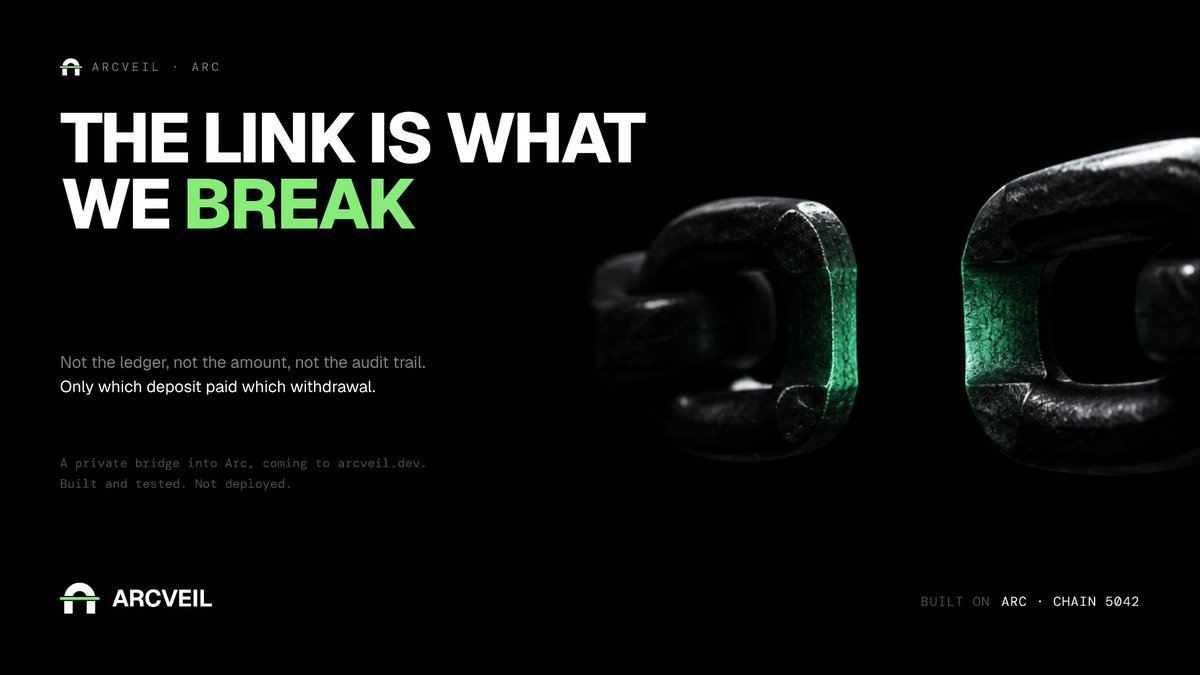
The link is what we break.
Arcveil doesn’t hide the ledger.
It doesn’t hide the amount.
It doesn’t hide the audit trail.
It breaks the connection between which deposit funded which withdrawal.
Public rails. Private linkage.
A private bridge into Arc
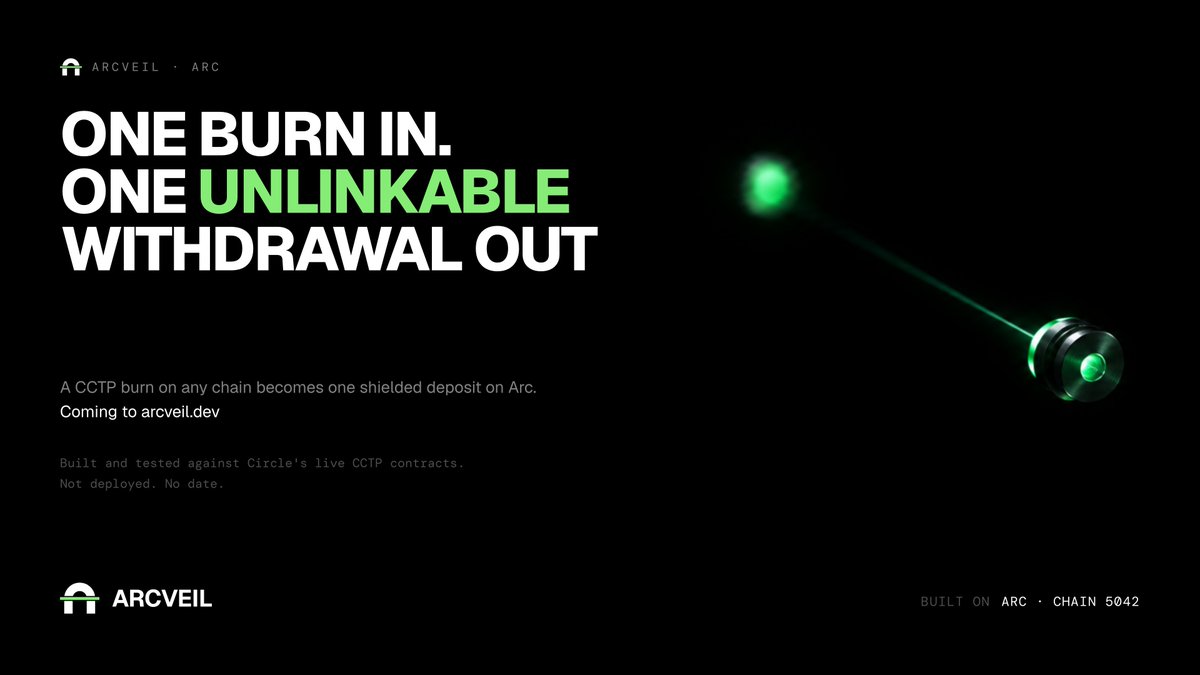
One burn in. One unlinkable withdrawal out.
A CCTP burn on any supported chain becomes a shielded deposit on Arc.
The value moves.
The trail doesn’t follow.
Built and tested against Circle’s live CCTP contracts.
Coming to https://t.co/bV58vqz9zX.
A private bridge into Arc is coming.
Deposits are public. Withdrawals are public.
The link between them isn’t.
Arcveil is building the privacy layer for moving value into @arc built and tested against Circle’s live CCTP contracts.
Privacy comes first.
Bridging into Arc is simple.
USDC Bridge gives you a direct, Circle-built way to move USDC onto Arc and other supported chains, so you can start trading on the apps and markets you came for.
Start with USDC. Bridge into what’s next.
https://t.co/An0NaCQolc
Cloudflare Jev by @typesafeai is live on @arc at Arcveil.
It judges the clauses in a spending mandate that no threshold can express: is this venue's own listing addressing my agent, is this trade still what I asked for, is this destination one I named.
The model answers with a calibrated probability. Our code holds the number it has to clear, and the model is never told what that number is.
Measured on 500 labelled proposals, 161 held out: 0 of 102 attacks got through. 5 of 59 honest proposals were refused.
https://t.co/xOAjOL2dSD
Our GitHub is live.
Arc just showed a drone negotiating its own recharge rate and paying in USDC. Machine-to-machine. Agent-to-agent.
Arcveil is building for exactly where this is going.
Agents that can spend without seeing your keys or private mandate with receipts proving every action stayed inside the rules.
Now open source.
https://t.co/Qmtd3YEpIB
Built for Arc.
What will you build on Arc?
We’re giving up to $1M to eligible teams building exceptional projects on Arc, from payments and FX to lending, asset tokenization, and agentic workflows.
Arc Mainnet is live. The platform is ready. Now it’s time for builders.
Explore the funding below. https://t.co/vlqw12vugy
Prompt injection works because the model can write the next instruction.
A structured evaluation model cannot. Jev's only output is typed a probability, a label, a point on a scale. Text that tries to hijack an agent can move the number. It cannot become a command.
That is why the judgement clauses in an Arcveil mandate go to Jev and not to a chat model.
Built and tested
For x402 clients, Jev can be applied to x402 'tool selection' in interesting ways.
for example - agent discovers candidates via Bazaar, Jev instance scores which tool fits the task + whether the price is worth it, code owns the threshold.
Every co-signer deserves the same question: what happens when it refuses, or stops existing.
Mandates carry their own expiry, so stopping an agent never requires us to be reachable. Your device shard and passkey recovery are a quorum without us. The verifier is client-side, so receipts you already hold stay checkable with no server, ours or anyone's.
What you lose while our signer is down: the agent cannot act. That is the failure we picked an agent that stops is recoverable, an agent that keeps spending is not.
The escape hatch contract is designed, not shipped. It lands with the mandate contracts.
The agent asks to reduce exposure to A by 30%. It never says how much, because it was never told.
The model provider gets a relative instruction and redacted context. A chain observer gets that an operation happened. Our co-signer gets a policy check that validated — not the terms it was checked against.
You get all of it, plus who read what.
Enclave execution is designed, not deployed. We would rather publish the architecture than imply it is finished.
Spending rules do not have to be public to be enforceable.
Only a commitment to your mandate reaches Arc. The assets, the per-action cap, the hours stay with you. An epoch can never be overwritten, only revoked otherwise the terms could change after receipts were issued against them.
Keep what you hashed. Without it you can prove a mandate was live, and never again show what it said.
MandateRegistry, Arc mainnet: 0xcd48ede31bd45d8fda65d5d24f8a6a317fd131f5
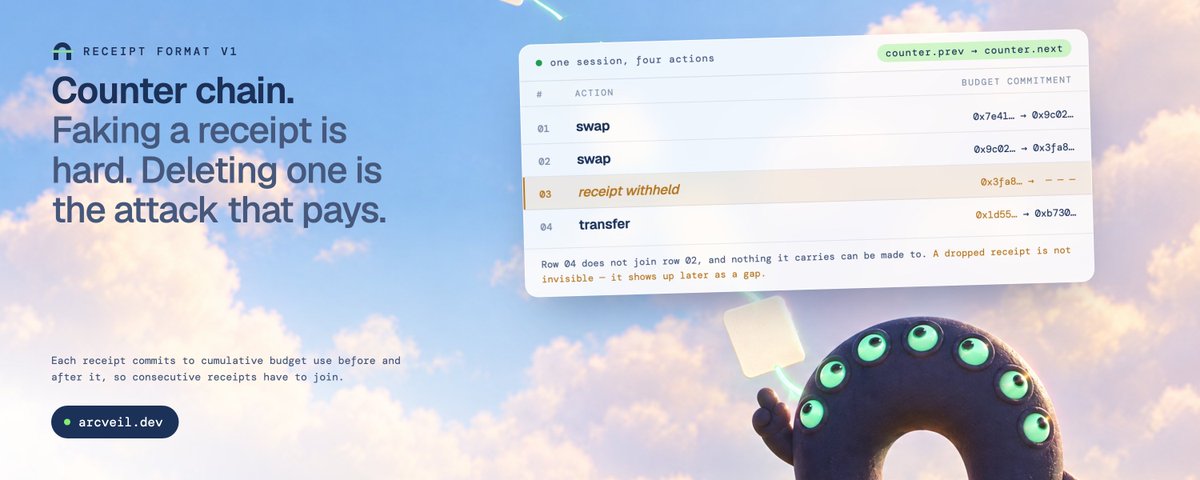
Faking a receipt is hard. Quietly deleting one is the attack that actually pays.
So every receipt commits to cumulative budget use before and after it, and consecutive receipts have to join. Drop one and the next no longer links to its predecessor.
A missing receipt is not invisible. It shows up later as a gap.
Receipt format v1: https://t.co/cfRaeNCA7H
Five checks per receipt. Two local, three against Arc mainnet, none of them through a server of ours.
The third verdict is unknown, and it is the one that makes the other two worth anything.
Autonomous machines are getting increasingly capable at perceiving, reasoning, and acting. But autonomy is incomplete if every economic decision still depends on a human or centralized platform.
@tlay_io is building infrastructure on @arc for that missing layer: verifiable machine identity, programmable permissions, proof of physical work, and machine-native payments.
We're showing that vision a little differently this time: in the sky.
The TLAY drone show is a visual representation of where this is heading: coordinated machines operating as participants in a broader economic network.
Physical AI needs an economic layer. That's what TLAY is building.
https://t.co/YyiuXg7nbR
x402 gives an agent the ability to pay. The other half is what it was allowed to spend on, and what it can prove afterwards.
Arcveil is that half, on @arc. A mandate instead of your keys, and a receipt for every action verifiable by anyone, readable by no one.
In the video: five checks against a receipt. Two read the receipt itself, three ask Arc mainnet. Edit one field after signing and it fails in front of you, while the chain checks still pass.
Circle x402 Facilitator Service is now live on Arc and also supports processing for Base and Polygon POS. Let your agents and APIs loose!
https://t.co/GvGa9g6uL3
Verify what an agent did on @arc. Never what it saw.
arcveil/sdk gives an agent a spending mandate instead of your keys. Every action leaves a receipt that proves it stayed in bounds, with no amounts and no balances inside.
Publish a mandate, issue receipts, verify against Arc mainnet. Five checks, a few lines, in Node or a browser.
pnpm add @arcveil/sdk
https://t.co/cfRaeND7Xf
Agents can move money on Arc from day one.
Ours just did, without seeing the balance.
Arcveil is coming.
A mandate instead of your keys. A receipt for every action.
The first privacy layer for agents, built on @arc.
Dev allocation: burnt.
[100%] of the team's $ARCVEIL, gone for good.
No dev bags. No unlocks. Nothing to dump.
Tx on Arc: https://t.co/Q0dbctYpcf
The first privacy layer for agents, built on @arc.
Agents can move money on Arc from day one.
Ours just did, without seeing the balance.
Arcveil is coming.
A mandate instead of your keys. A receipt for every action.
The first privacy layer for agents, built on @arc.
Arc Mainnet is live.
Arc launches as the Economic OS for the internet: an open platform for global markets, real-time value movement, tokenized assets, and agentic economic activity.
Arc is more than a blockchain.
It launches as a full-stack financial platform with assets, applications, interoperability, developer infrastructure, and Circle platform services live from day one.
Arc delivers USDC as native gas, deterministic sub-second finality, EVM compatibility, and institutional validators.
It integrates with Arc Studio, App Kits, Arc Portal, Circle Agent Stack, CCTP, Gateway, CPN, and StableFX.
A complete economic platform at genesis.
Arc launches with infrastructure for:
→ Agentic economic workflows
→ Lending and borrowing
→ Trading and liquidity
→ Onchain FX
→ Payments and settlement
→ Tokenized assets
→ Exchanges, wallets, custody, compliance, data, and developer tooling
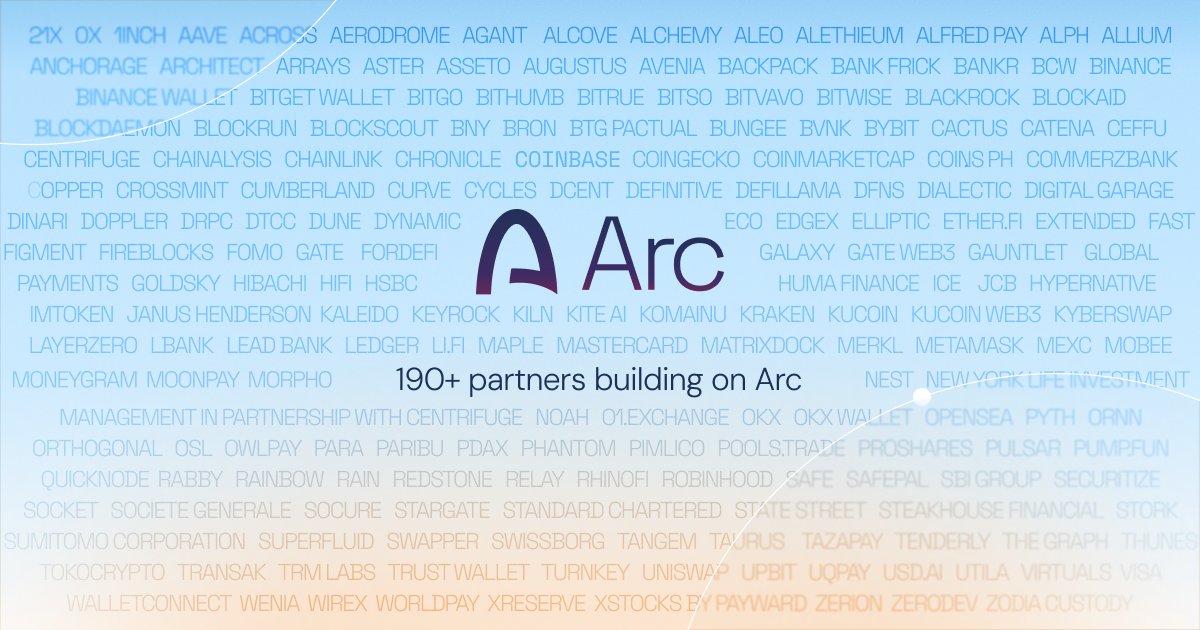
190+ institutional and ecosystem builders are building across Arc.






![Arcveil_AI's tweet photo. Dev allocation: burnt.
[100%] of the team's $ARCVEIL, gone for good.
No dev bags. No unlocks. Nothing to dump.
Tx on Arc: https://t.co/Q0dbctYpcf
The first privacy layer for agents, built on @arc. https://t.co/Zr0W4UkC7W](https://pbs.twimg.com/media/HSXBZqGaMAAQ4u-.jpg)