Coding agents write a change in minutes. Testing it on AWS ECS still takes hours.
Every team on ECS we've talked to describes the same loop: build the image, push it, register a new task definition revision, wait for the rollout, check what happened, and do it all again if it's wrong.
That was already too slow for humans, but it's so much worse for agents who write a change in seconds, then have to wait a full rollout to learn whether it worked.
Most of the speed you got from the agent ends up spent on waiting for rollouts.
On Kubernetes, mirrord fixed this a while ago. 20,000+ developers use it along with their AI agents to test generated code against their real staging environment without deploying it.
Today we're going beyond Kubernetes with the launch of mirrord for ECS.
• Your code runs on your laptop or in an agent's sandbox, but it gets real traffic, environment variables, network access, and files from your ECS task in staging. You see if a change works in seconds, not after a rollout.
• To set it up, it's just one task definition change.
• Only requests that carry your session header come to your code, so you, your teammates and your agents can each test your own version of the service at the same time, on the staging environment you already share.
mirrord for ECS is live today, and it’s free to get started with! Let your agents test against real staging without deploying, and without getting in anyone else's way.
Happening tomorrow!
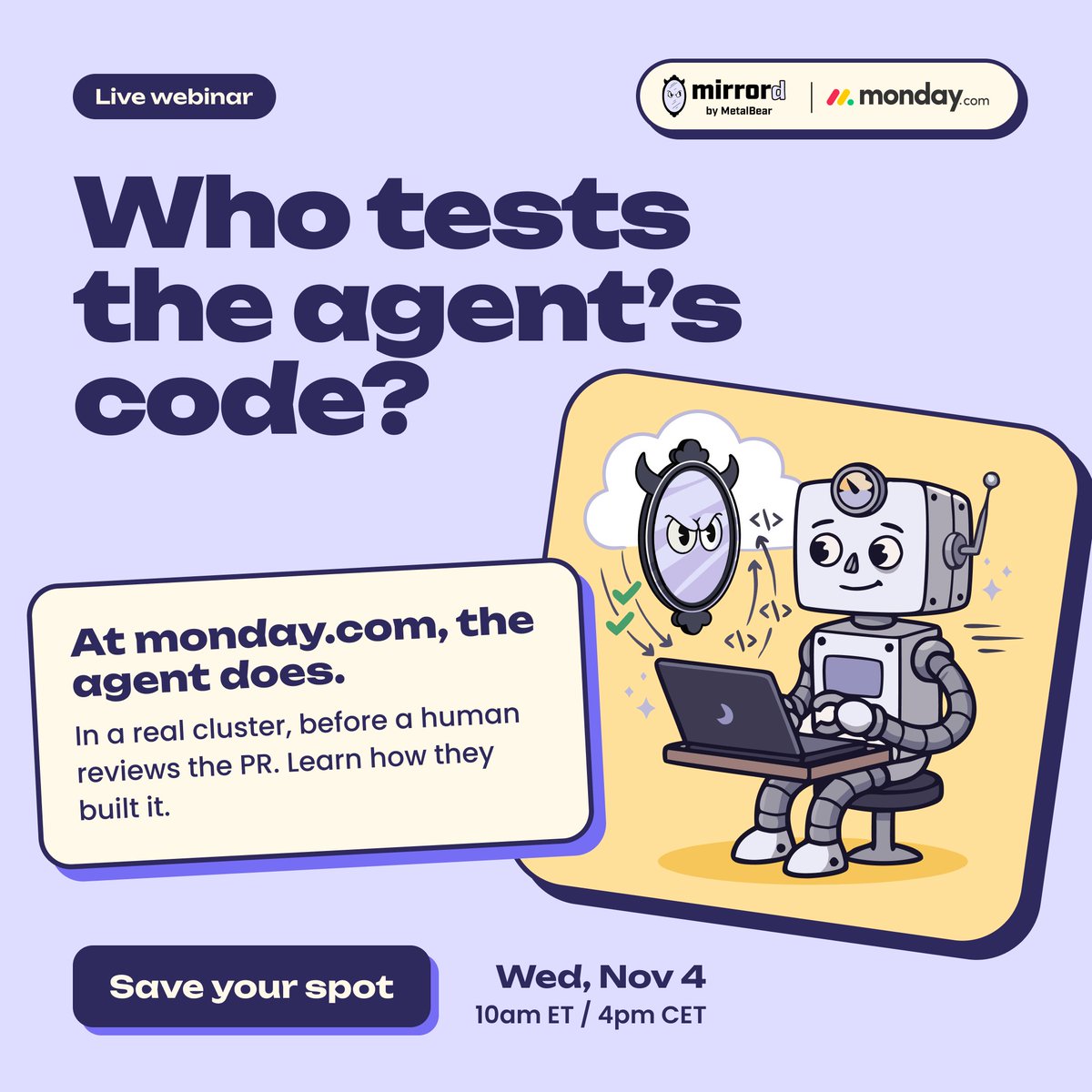
Uzi Abdullayev (Senior Software Engineer) and @TomerBrook (Senior AI Engineering Manager) from @mondaydotcom are joining @EBukchin (CTO, MetalBear) to talk about how @mondaydotcom scaled agentic development with an in-house built platform!
They'll be talking about the details of:
🔹 How agents pick up tasks from boards and take them all the way to a tested PR
🔹 The feedback loop that makes those PRs worth merging, including testing against real services with mirrord
🔹 What they learned scaling this approach to thousands of agents
Sign up here: https://t.co/R0QyETbkBK
It's finally happening.
mirrord has always been Kubernetes-only. We can't tell you how many hearts we had to break when telling people they couldn't run their code against their real staging environment without a deploy (a dev loop measured in seconds instead of CI runs, fewer environments to pay for, tests against real dependencies instead of a guess at them), because their stack runs on ECS or Lambda or whatever. Agents have been taking this news even worse.
That's about to change. mirrord Beyond Kubernetes brings the same workflow to Lambda, ECS, Cloud Run, Vercel and more.
The waitlist is open, and the platform with the most signups gets support first.
https://t.co/PxdPUSq1BT
My twitter feed recently was full of everyone posting about building sandboxes for AI agents. The issue with sandboxes is that they start empty, so the agent first builds a replica of what your system looks like and then tests against it. What agents actually need is a playground: your real staging environment, where they can test their its changes isolated from everyone else.
Wrote about how I set this up for my own agent here: https://t.co/z8cvjKHSb6
@deedydas suggest solving it with old ways - more compute, more efficiency, more cache. Beyond amount of CI needed, there's almost no value in UT when using AI while tremendous value lies in E2E.
None of the listed companies help you run E2E better/faster.
The biggest cost of E2E is spinning up a real-environment.
our (@metalbear) approach with mirrord offers something different - give each test/ai/engineer a slice of a real environment, isolating flows allowing infinite scale while almost zero cost (beyond compute needed for the tests). Use it in CI, in CD and in the cloud agents it selves to have everyone iterating against same baseline.
for example - https://t.co/xZ8rJDaUZP
or @fagamericano who writes a lot about it (also mirrord user :D)
I cannot express how totally necessary are canaries in Agentic SDLC.
When we work on our @openclaw fork we use two techniques:
-> devcontainers with mirrord to intercept GKE cluster calls as local on the service/image currently working on. So when I write to my Agent on Slack the call is intercepted and routed to the openclaw instance running on my dev machine. Calls out go back into the cluster as if it was running on it.
-> when done I can annotate a set of users as canary targets and have their openclaw instances flip to the new image. Having added telemetry and enabled debug modes I (and my agents) can verify everything is working as expected then flip the whole cluster to run the new image.
If any agent on that chain makes a mistake it’s OK it doesn’t affect the whole fleet just a pod or two that it knows to rollback.
You need to work on setting up your Agentic SDLC to mitigate risks. The infrastructure primitives are there.