No CGI, no movie magic—just the surface of Mars in high definition. It is absolutely wild that we have eyes here.
140 million miles away from everyone you know!
“The ‘death of God’ is nothing, in my view, but a misinterpretation of the tremendous desacralizing process brought about by the Christian revelation. The gods who are dying are the sacrificial gods, really, not the Christian God, who has nothing to do with them. The confusion between the two, however, is likely to continue and to become even more complete than at the present time before the true singularity of the Christian God can be acknowledged.”
— René Girard, ‘Conversations with René Girard,’ ch. 5
Around 300 BC, a thirty-year-old Phoenician merchant named Zeno of Citium stood on the deck of a cargo ship cutting through the Aegean Sea, watching his entire life's worth rise and fall with the swells. Below his feet sat a fortune in Tyrian purple—the most coveted luxury in the ancient Mediterranean. Extracted drop by microscopic drop from the mucus glands of tens of thousands of crushed Murex sea snails along the Levantine coast, the dye was worth more than its weight in silver, reserved for the robes of kings, generals, and emperors.
Zeno had staked everything he owned on that single voyage from Cyprus to the Greek mainland. If the ship reached the port of Piraeus intact, he would be wealthy for life.
Just off the coast of Attica, within sight of land, a sudden gale tore across the water. Violent waves splintered the hull against the rocks, dragging the chests of royal dye into the dark abyss of the Aegean. Zeno clung to wreckage and washed ashore near Athens with salt in his lungs, torn clothes on his back, and not a single drachma to his name. In an afternoon, the sea had erased his status, his inheritance, and his future.
Most men broken by a catastrophe of that magnitude spend the rest of their lives mourning the ghost of who they almost were. Zeno walked into Athens instead.
Wandering through the noisy streets of the city, still reeling from his ruin, he stepped into the quiet shade of a bookseller’s stall to escape the chaos of the marketplace. The bookseller was reading aloud from a papyrus scroll—Xenophon’s Memorabilia, a firsthand account of the life and conversations of Socrates. Zeno sat silently and listened as the bookseller read of a man who needed neither gold nor purple robes to command a room, a man who treated poverty, exile, and even a cup of hemlock as minor inconveniences compared to the sovereignty of his own mind.
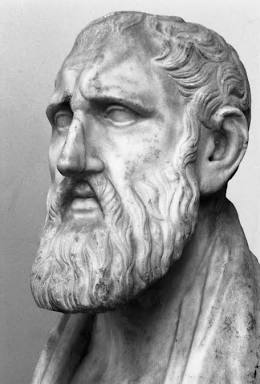
Something inside the ruined merchant snapped into focus. Look at the surviving marble bust of Zeno from antiquity—the deeply furrowed brow, the lean, weathered cheeks, the gaze of a man stripped of every illusion—and you can almost see the exact moment the merchant died and the philosopher was born.
Leaning forward, Zeno interrupted the bookseller and asked a question that altered the course of Western civilization: "Where can I find men who live like this?"
At that exact moment, Crates of Thebes—the most famous Cynic philosopher in Athens, a man who had voluntarily given away his own vast fortune to live free of material bondage—happened to be walking past the shop. The bookseller simply pointed out into the street and said, "Follow that man."
Zeno became Crates’ student that very day. For the next two decades, he studied under the sharpest minds in Greece before synthesizing their teachings into his own school of thought. Because he could not afford to buy a grand lecture hall like Plato’s Academy or Aristotle’s Lyceum, Zeno taught out in the open air on a public colonnade in the heart of the Athenian marketplace known as the Stoa Poikile—the Painted Porch.
From the name of that public porch, his followers became known as the Stoics.
The philosophy Zeno built on that porch was forged directly in the cold waters of his shipwreck. He realized that human suffering rarely comes from the events of the world themselves, but from our desperate insistence that we own things that were only ever loaned to us by fortune. Wealth, reputation, empires, and cargoes of royal dye belong to the sea and the wind; the only thing a human being truly possesses is the discipline of their own judgment and the integrity of their character.
Decades later, when Zeno was the most revered thinker in Athens—honored by kings and offered the keys to the city—he looked back on the afternoon the Aegean swallowed his fortune and delivered a quiet verdict that echoes across two thousand years: "I made my most prosperous voyage the day I suffered shipwreck."
Every life eventually meets its own coast of Attica, where the plans we spent years building are smashed against the rocks of an indifferent world. The enduring value of Zeno’s story lies in what happens the morning after the storm: realizing that when fate strips away everything you thought you needed, it often leaves you standing directly in front of who you were actually meant to become.
I’m calling on @DHSgov to investigate the extensive ties of these three individuals to the Muslim Brotherhood.
Further investigations MUST determine the nature and extent of those ties, and potentially pursue their removal from the United States.
Either Trump emerges with Iran contained and stripped of its nuclear program with freedom of the seas vindicated in the Strait. Or Iran emerges stronger and an even greater threat to the region and to America. That is the President’s choice.
https://t.co/HSAAIxNLU9
🚨New🚨: The teen mental health crisis may finally have crested.
Since 2021:
📉 Persistent sadness/hopelessness: 42% → 33%
📉 Seriously considered suicide: 22% → 14.5%
📉 Attempted suicide: 10.2% → 6.4%
@jtrothwell@FamStudies
Like, forget the fights over anti-Semitism, Zionism, etc. Just imagine trying to explain to a normal, relatively well-educated, person how the @penn_state Jewish Studies Program was hosting a talk on "decolonizing" Holocaust museums and what that even means.
View from another angle: Putin was still seated at the main table — but farther away from the superpower leaders
Clearly, at that distance there’s no chance to chat with the big boys.
Destroying the one Jewish state in the region while maintaining dozens of Islamic states always was the plan. He's wrapping it in social justice lingo to appeal to the useful idiots on the American left. It's a call for genocide, you fools, we know what happens to other religions in the region when Islam takes over.
The contract to oversee O’Hare Airport’s transit system was awarded without a bid — with one of the beneficiaries Harbour Contractors, Inc. Four officials with that company donated to Friends of Brandon Johnson, in apparent violation of city ethics rules. https://t.co/qLQOIhSjWq
This is vintage @ChicagosMayor.
Asked about steering millions in emergency funds for illegals to black owned businesses, the mayor tip-toed around the question and shifted to his default answer for his spending $600M in our tax dollars on illegal aliens.
1. He inherited the crisis of illegals.
2. Blame Trump.
3. Blame Gov. Greg Abbott.
4. Compared the crisis to Ukrainian refugees from war.
Amazingly, it's never Brandon Johnson's fault.
The Jensen Huang scandal is not about an affair with a Chinese spy. It's about a system wide effort to undermine American interests, from Nvidia changing its logs to hide the mass smuggling of chips into China to the Commerce Department aiding by refusing to blacklist smugglers.
Think all the tech outages recently are more than a coincidence? So does former NATO Supreme Allied Commander Stravidis. Listen to what he told @SquawkCNBC on @CNBC this morning.
And..this is how it all works under the CCP’s authoritarian state. Everything and everyone must benefit China, at all costs.
Soon, we will uncover how the Nvidia chips made their way to the PLA to build weapon systems to one day be used against America and our military. @WSJ. Eyes wide open.
https://t.co/Nvbu5E7DNB