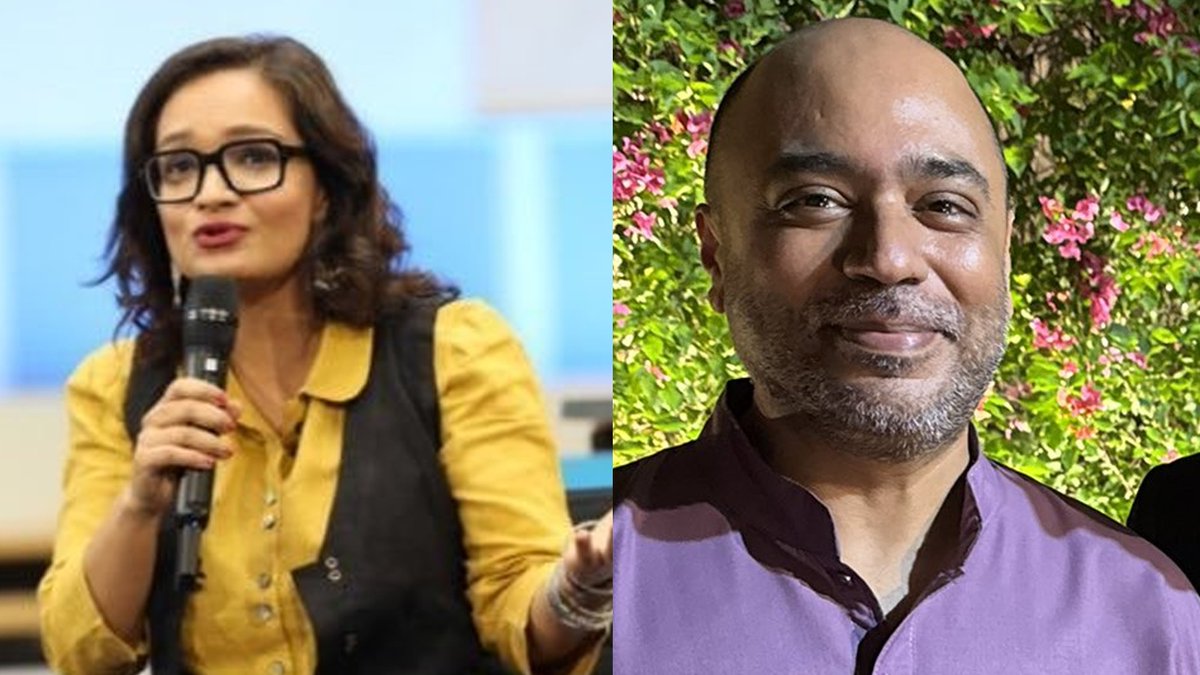
@DrBaidyanathGh1@MamataOfficial What about the crores of money you and your family earned via the tie-up with SSKM hospital thanks to Mamata Banerjee ? Return that !
North Kolkata MP Sudip Bandyopadhyay deserves a chapter of his own in the handbook of Bengal politics.
For aspiring politicians, his career is less a story of leadership and more a masterclass in political conservation—specifically, the conservation of his own position.
Most leaders are remembered as banyan trees under whose shade generations of workers grow. Sudip Babu’s critics might argue that he resembles a carefully trimmed bonsai: occupying space, drawing attention, but ensuring nothing substantial grows around him.
For decades, he has floated through Bengal politics like a luxury cruise ship in a city desperate for rescue boats—always visible, always important, but rarely arriving where ordinary workers need him most.
Others built organisations. Others nurtured young leaders. Others fought political battles. Sudip Babu perfected a different art: remaining at the centre of every photograph while somehow staying at the edge of every struggle.
If politics were cricket, he would be the batsman who never leaves the crease, never scores a century, never wins the match, but somehow remains not out for forty years.
His greatest talent may be turning political influence into a private savings account—carefully guarded, rarely invested, and never distributed widely enough to create future stakeholders.
Many politicians leave behind schools of thought. Some leave movements. Some leave institutions. Sudip Babu leaves behind a question mark.
For young politicians hoping to master the art of appearing indispensable while remaining mysteriously absent whenever difficult work needs doing, his career should be compulsory reading.
A political lighthouse that rarely guided ships to shore. A gatekeeper who confused the gate with the kingdom. A permanent tenant of power who somehow convinced everyone he owned the building.
That, perhaps, is the true genius of Sudip Bandyopadhyay’s political journey. #Kolkata #Bengal #MamataBanerjee #tmc #BhupenderYadav
Sarafaroshi ki Tamanna, a song indelibly associated with revolutionary Ram Prasad Bismil of the Hindustan Republican Association and their daring Kakori train attack!
But the song was actually written by Bismil Azimabadi, an Urdu poet from Patna just after the horrific firing at Jallianwala Bagh.
In fact, Rajput Ram Prasad Tomar took on the name 'Bismil' in celebration of the secular nature of our freedom struggle & popularized this song around the country!
After the Kakori attack Bismil was captured and hanged by the British around the same time as his close associate Ashfaqulla Khan. He was just 30.
Celebrating Ram Prasad Bismil's 129th birth anniversary, one of so many legends from our freedom struggle!
One of the biggest reforms that Congress did not do in decades and Modi did
EVMs can now catch fire, fall in river, lay on national highways etc. right after polling or after results
Admissions and Justice: The Supreme Court Reaffirms the Limits of Order XII Rule 6 CPC
The Supreme Court recently pronounced on Order XII Rule 6 of the Code of Civil Procedure is a timely reminder that justice cannot be sacrificed at the altar of procedural expediency. While the provision empowers courts to pronounce judgment on the basis of admissions, the Court has emphatically reiterated that such admissions must be clear, unequivocal, and unconditional before a decree can be granted. An ambiguous statement, a qualified acknowledgment, or a disputed assertion cannot become the foundation upon which substantive rights are extinguished.
The judgment restores balance to a provision that is often invoked in the quest for speedy disposal of litigation. Speed is undoubtedly a virtue in the administration of justice, but it ceases to be one when it outruns fairness. The Court has wisely cautioned that Order XII Rule 6 is not a substitute for trial where material facts remain contested. A decree founded upon uncertain admissions is not an instrument of justice; it is merely a shortcut to error.
What emerges from this ruling is a reaffirmation of a fundamental principle: an admission, to be decisive, must leave no room for doubt. Courts are not expected to infer admissions from isolated sentences torn from their context, nor to convert contested pleadings into conclusive acknowledgments. The judicial task remains one of careful scrutiny, not mechanical extraction.
The significance of this decision extends beyond procedural law. It reflects a deeper judicial philosophy that civil adjudication must remain anchored in fairness, due process, and the right to a meaningful hearing. Litigants may be denied a trial only when their own admissions render a trial unnecessary—not when interpretative ingenuity is employed to manufacture certainty where none exists.
In an era where docket management often competes with deliberative justice, the Supreme Court has reaffirmed a timeless truth: efficiency is desirable, but justice is indispensable. Order XII Rule 6 remains a powerful procedural tool, yet its exercise must be guided by caution, clarity, and an unwavering commitment to fairness. Much needed !
#Breaking
A Sessions Court in Delhi has stayed the Magistrate Court's order for registration of an FIR against Abhijit Iyer-Mitra for his allegedly "objectionable" tweets on Newslaundry and its journalists.
The Sessions Judge says the words used by Iyer-Mitra are in the form of shayari, but no individual has been specifically named.
@Iyervval@MnshaP@newslaundry