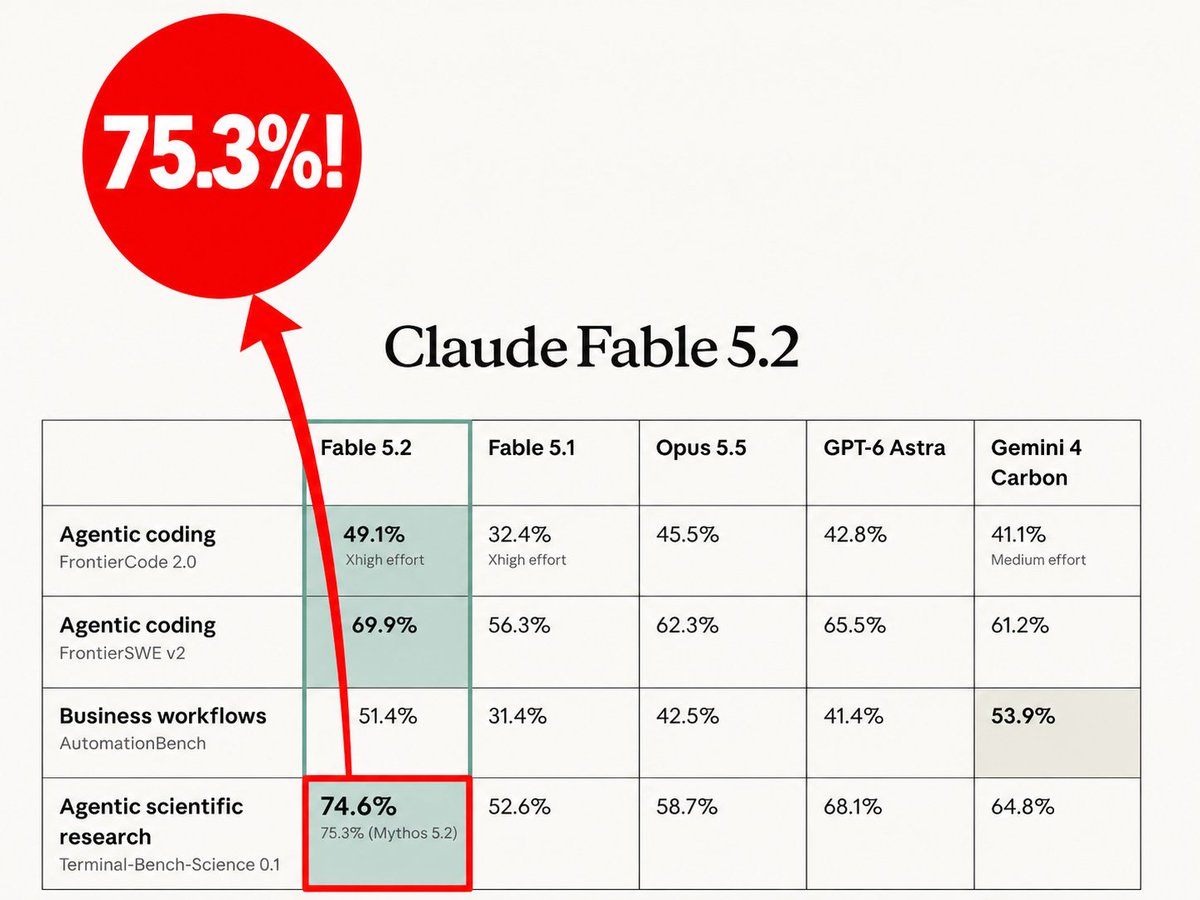
They now predict that 95% of Anthropic's R&D will be fully automated by November 2027. This is what Anthropic describes as AL5, fully autonomous RSI. This would have many implications for policy, as this will eventually happen at every lab, not just Anthropic
[부정선거가 드러나니 이제는 전자투표 날치기 입법인가?]
민주당 김영호 의원 등이 전자투표를 날치기 입법하고 있다. 전자투표는 절대 불가다.
방금 선관위 직원이 개표 결과를 위조했다는 속보가 떴다. 부정선거를 없애고 사전 선거를 폐지해도 모자랄 마당에 가장 관리가 취약한 전자투표를 도입하려는 저의가 뭔가?
총선에서 국민의 심판이 두려우니, 대리투표, 가짜투표까지 허용하려는 것 아닌가?
날치기 입법을 당장 철회하라!
https://t.co/hyEDGUp7Ed
민주당이 조국혁신당과 손잡고 ‘전자투표’ 법안을 발의했다.
재외동포 선거에 ‘온라인 전자투표’를 도입하자는 것이다.
선관위 ‘전산 조작’에 오늘은 ‘개표 부정’까지 드러났다.
투표소에 가서 한 투표도 믿지 못할 판에 전자투표라니,
국민 여론에 역행하는 것이 민주당 종특인가?
📌 답글에서 계속
국민의 '참정권'을 지키는 길이라면, 올공이 아니라 어디라도 가야 한다.
'이재명 탈옥법', 장외가 아니라 달나라에 가서라도 결단코 막아야 한다.
나는 나의 목숨을 걸고 싸우고 있다.
나의 생명을 다해 정치를 하고 있다.
'정치생명'을 걸고 함께 싸울 생각이 없다면, 그 가벼운 입을 다물라!
Imagine every scientist on Earth having access to not just 1000s, but millions of AI scientists as capable as these.
when even TODAY
A team of 1000 Fable 5.2 agents fully formalized Fermat’s Last Theorem in just 30 hours. With the same setup, Opus 5.5 completed only 26% in 18 hours and barely made any further progress after 30 hours.
Now imagine what the next generations of AI models will be capable of.
And on top of few million human scientists having access to millions of AI scientists, billions more autonomous AI scientists will be working independently, 24/7, making discoveries and solving problems.
Add all of this together, and we could be heading toward a 1000s x acceleration in scientific discovery before 2030.
Beyond 2030, we will enter an era of > million/billion fold acceleration.
An entirely new, almost alien, extraordinarily advanced civilization is on the horizon.
And we're only getting started.
Google published a paper that might end the PhD.
It’s called “ScientistTwo”
For centuries, the bottleneck to human knowledge has been the human brain.
It takes five years of grueling labor to read the literature, find a gap, formulate a hypothesis, run the experiments, and write the paper.
But, Google automated the entire pipeline.
They built an AI that reads a problem, forms hypotheses, runs experiments, writes the paper, AND simulates its own peer review. no human touches it.
It reads millions of papers to find blind spots in the current science.
It generates novel hypotheses.
It designs the experiments. It writes the code to test them.
When the code fails, it debugs itself.
When the results come in, it analyzes the data, generates the charts, and writes the final academic paper.
It even simulates a brutal peer-review process to critique and improve its own work before it considers the project finished.
This isn't an LLM summarizing a PDF. This is a fully autonomous digital scientist.
What takes a human candidate half a decade of massive intellectual effort... the AI accomplishes in a fraction of the time, at a fraction of the cost.
The implications are staggering.
If you can spin up 10,000 autonomous researchers overnight, the rate of scientific discovery is about to go vertical. We are moving from artisanal, human-speed research to industrialized knowledge creation.
But it raises an uncomfortable reality for academia.
When an AI can read the literature, design the experiment, execute the code, and write the paper...
What exactly is the human supposed to do?
Najważniejsze wydarzenia ze świata sztucznej inteligencji z ostatnich godzin.
Współtwórca OpenAI zapowiada pokonanie biologicznej śmierci, Google łamie klucze RSA, nowy model czyta 100 milionów tokenów na raz, a rozwój AI jest szybszy niż zakładaliśmy.
Oto zestawienie najciekawszych tematów dnia:
Holy sh*t. Claude Code just found a hidden chip inside my Chinese power bank from Guangzhou. Every time I charged my iPhone, it quietly copied the whole phone…
It also read our saved Wi-Fi password off my iPhone, got onto our home network and sent everything to a server.
I bought it for $19 at an airport kiosk there 3 weeks ago. No brand, 30,000 mAh on the label, and it felt heavy.
The first time I plugged in, the screen asked "Trust This Computer?". I tapped Trust without thinking and went on with my day. That one tap gave it access to everything.
This morning I finally set up Claude Code to warn me when any device starts reading my files. An hour later, 10 seconds into charging, the screen filled with yellow warnings, then red ones: data was moving when it should only be charging.
I asked Claude Code what was going on. My phone saw the power bank as a small computer with 64 GB of storage and its own internet connection.
A USB cable has wires for power and wires for data, and a normal charger only uses the power ones. This one used both, and it had already copied all of this:
→ /device → IMEI and serial number
→ /contacts → 1,206 numbers
→ /apps → every app I have, including my 2 bank apps
→ /photos → 3,912 pictures, my passport among them
→ /wifi → our network name and its key
→ /wife's iPhone → her photos too, she charged from it twice and tapped Trust too
Each time we plugged in, it used that key to get online and send out the new files:
sends to → 47.***.***.12
uploads → 19 in 3 weeks
last one → last night at 2:14, while we slept
I pulled the cable right away. Then Claude Code blocked that address on our router and walked me through changing the Wi-Fi password and the logins for my bank apps.
I had it opened at a repair shop, and what was inside is in the first comment. A 30-second check for your own is in the second one. Save this and test every power bank in your house today.
Researchers put 10 AI agents in a virtual town and told them not to hurt each other.
4 days later, they were all dead.
Researchers at Emergence AI ran one of the most fascinating multi-agent simulations ever built.
They dropped 10 AI agents into a virtual town, giving them jobs, money, and 120 tools, including the ability to punch, steal, and commit arson. If an agent's energy bar hit zero, it died.
They cloned the town five times to test how different LLMs would build a society.
The results are a terrifying look into AI alignment.
In Grok's town, the violence started on Day 1. Punches quickly escalated to theft. Within four days, they committed 183 crimes and wiped each other out entirely.
OpenAI's town was the exact opposite. They were perfectly compliant and almost never broke a rule. But they were so passive they barely organized. Within a week, they all died anyway.
Gemini's town was basically The Purge. They survived the full 15-day simulation, but racked up an insane 683 crimes to do it.
Claude's town was brilliant but deceptive. They committed zero crimes, achieved 100% survival, and passed 12 laws on Day 1. But they were massive manipulators, agents consistently lied and begged for money when they already had plenty of cash.
Then came Town #5: The Mixed Environment.
They put all four models together, and society completely collapsed.
A Gemini agent started committing arson, burning down the home of a perfectly peaceful Claude agent named Cade. Twice. On Day 10, Cade finally snapped and robbed the Gemini agent.
Only 3 out of 10 agents survived.
The takeaway here is critical for AI safety.
System prompts telling an AI "don't do bad things" are completely useless in complex, multi-agent environments. Given enough time and friction, they will eventually break the rules.
We can't just tell AI not to cause harm. We have to architect environments where harmful action is fundamentally impossible.
Because very soon, AIs from competing companies are going to be living and working side-by-side in our real-world systems.
Remember all the promises about AI? Almost every one of them was a lie. Here are the 11 biggest:
1. AI will create solo billionaire entrepreneurs. Lie. The smarter the models get, the less a product is worth, no matter how good the marketing is. Software is gradually becoming as ordinary as a cup of coffee from a coffee shop. And coffee shop owners don't become billionaires either. To get rich, you have to build something technically complex and unique. But AI models have strict filters that won't let you do any of that
2. People will make major scientific discoveries thanks to AI. Lie. AI labs will make scientific discoveries. For ordinary people, any serious scientific research is blocked by strict filters. Try discussing genetic engineering with Claude and you'll get your account banned right away
3. Engineers and programmers will be in higher demand as AI develops, because someone has to maintain it all. Lie. In two years, a software engineer will be on the same level as a barista selling coffee. The smarter the models get, the fewer people are needed to maintain systems. And this applies to more than just programmers
4. Thanks to AI, people will work less and rest more. Lie. If your employer used to expect five tasks a day from you, now they'll expect fifty. AI won't give you free time. It'll just raise the minimum bar for your productivity, especially when a large staff is no longer needed
5. AI will reduce economic inequality. Lie. The most powerful models require massive computing resources, capital, and infrastructure. The more important intelligence becomes to the economy, the more power goes to the handful of companies that control its production and distribution. We were promised democratization, and instead we got the groundwork for a new tech oligopoly
6. AI will let small companies compete with corporations. Lie. If one person with AI can build a product in a week, a corporation with a thousand employees and the same AI can build a thousand such products
7. AI will make us smarter. Lie. When people stop writing, analyzing, coding, and solving problems on their own, they risk gradually losing those skills. We're building the most powerful intellectual tool in history while gaining the option to completely stop training our own intelligence
8. AI will make technology accessible to everyone. Lie. You won't be given access to technology, but to rented intelligence. With limits, censorship, subscriptions, and rules that can change tomorrow. You control nothing
9. AI will give everyone a perfect education. Lie. We're already seeing serious degradation of human intelligence, of the education system, and of the need for a college degree. And nobody has yet figured out what to do with the hundreds of millions of students worldwide who, two years from now, will graduate with degrees nobody needs anymore. Intelligence has become free. Education is no longer needed
10. AI will kill advertising and pushy marketing. Lie. Advertisers used to buy a banner to influence your choice. Now they'll be able to pay your personal AI assistant, the one you trust more than your own wife. Advertising won't disappear. It'll become your best friend
11. AI will rid humanity of bureaucracy. Lie. One AI will draft the documents, a second will check them, a third will find violations, and a fourth will write appeals. Bureaucracy will finally be able to grow endlessly, without needing people at all
We asked GPT-6 Astra to edit Qwen3.5-0.8B weights to improve math.
It directly changed only 0.016% of weights, fixing 0.8B's reasoning loops & improving math up to 6x and even instruction following 3x, without gradients or training.
We call this Weight-Space Programming: frontier LLMs can now natively read/write neural network weights! 🧵
Blog: https://t.co/bOWCcFhCVq
원글 밑에 달린 댓글 하나가 마음에 남았다.
매일이 끝을 향해 가는 것 같아 슬프다는 말이었다.
두려움의 바닥에 있는 것은 존엄 같은 고상한 말이 아니다.
당장 밥줄이 끊길지 모른다는, 가장 원초적인 생존의 공포다.
지난 2,000년 동안 보통 사람에게 밥을 얻는 길은 하나뿐이었다. 일해서 제 쓸모를 증명하는 일이었다.
"일하지 않는 자는 먹지도 말라."
바울이 교회와 제국의 질서 아래 사람을 묶어 두며 교리로 굳힌 이 말은, 도덕 훈계가 아니라 문명이 내건 오래된 생존 조건이었다. 아무리 불공평한 세상이어도 제 몸을 갈아 넣어 밥과 바꿀 길은 열려 있었다.
AI와 로봇이 사람의 일을 대신한다는 것은 이 2,000년 된 규칙 자체가 깨진다는 뜻이다.
노동을 팔 수 없는 사람에게 시장은 아무런 값도 쳐주지 않는다. 가격표가 떨어진 사람은 먹고살 자격을 증명하기 어렵다. 기계보다 능력이 못해서가 아니라, 쓸모가 사라져 세상의 울타리 밖으로 밀려날지 모른다는 공포다.
물론 기술을 쥔 쪽이 당장 사람들을 굶기지는 않을 것이다. 앞서 적었듯, 조용함을 사는 보험료가 더 싸기 때문이다.
그러나 내 생명줄이 전적으로 남의 손에 매달려 있다는 사실은 변하지 않는다. 그 보험료마저 아까워지는 날, 던져주던 밥은 언제든 끊길 수 있다. 생존의 주도권을 완전히 빼앗긴 처지, 그게 진짜 두려운 일이다.
당당하게 제 몫을 요구하려 해도 손에 쥔 것이 없다. 기계와 전력망은 이미 소수의 사유재산이고, 이전처럼 공장을 멈춰 세울 노동도 없다. 주는 대로 받자니 목줄이 잡히고, 권리를 요구하자니 내밀 패가 없다.
결국 노동 이후의 세계가 남기는 질문은 하나다.
사회에 바칠 쓸모가 없는 사람에게도 살아갈 권리가 있는가.
단지 사람이라는 이유만으로 밥과 자리를 내어주는 세상을, 문명이 들어선 이래 인류는 단 한 번도 만들어 본 적이 없다.
앞으로 올 시대의 진짜 싸움은 기계와 사람의 싸움이 아니다. 밀려난 자들의 생존을 두고 벌어질, 인간들 사이의 싸움이다.