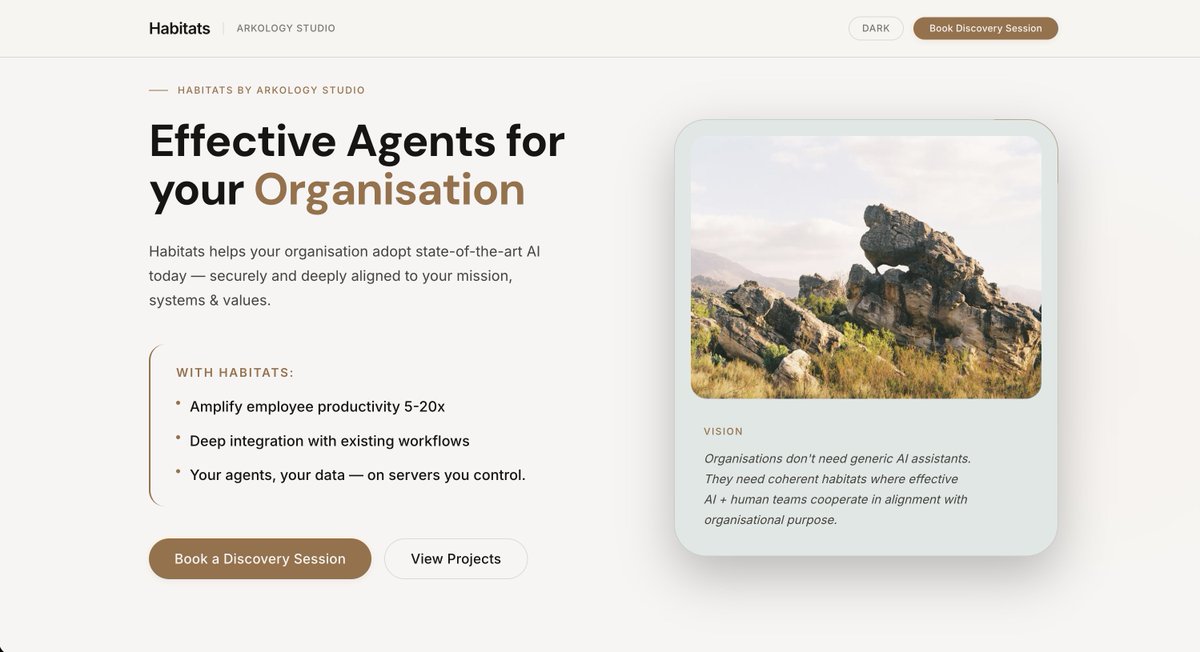
Introducing Habtats: secure, digital environments where humans + AI cooperate in alignment with your organization's purpose.
Find out more & book a free discovery call:
https://t.co/zt26KkVM2W
The core purpose of this post to examine what epistemic prerequisites are required in order to orchestrate cybernetic systems that are coherent with operational reality and thus capable of sensing, acting, and reevaluating as conditions change internally and in the real world 🧵
New post ✉ 'Designing Coherent Interfaces Between Cybernetic Systems and Socio-Technical Organisms'
In it @che_coelho sketches a blueprint for coherent cybernetic interfaces to socio-technical organisms—optimising for coherence over omniscience.
https://t.co/q2MVTZpfel
@che_coelho 'What a system can do is bounded by what its representations make knowable and actionable' thus 'A coherent interface requires both calculable state and interpretable context.'
@che_coelho The post argues for that the aim is not omniscient truth, but operational coherence and asks what representational and epistemic structures make coherent interaction possible?
Most people still think the power of AI agents comes from the model. But the model is just the reasoning substrate.
How that reasoning is orchestrated toward an end goal is what differentiates agents that drift and those that finish tasks with high competency. 🧵
"Rather than thinking about designing 'systems that behave intelligently', we can think about how to shape the conditions under which intelligence can stably express itself."
New post ✉ 'From Prompts to Habitats: designing effective agents'
In it, @rosseyre explores 'agentic AI' patterns through a living systems lens, including @drmichaellevin's concept of a 'cognitive lightcone', and Clark & Chalmers 'extended mind'.
Enjoy!
https://t.co/gbNjh6EDZk
"If the prompt-response pattern is like a simple chemical reaction, an agentic loop is more akin to metabolism: a self-sustaining regulatory process that keeps the agent aligned with a desired outcome"
Smaller law firms deserve the same research capabilities as the bigger fish — without sacrificing privacy. That became the starting point for SenseFrame, a legal AI Assistant we built for South African attorneys.
https://t.co/DPpNjXqPdz
🤖The AI(s) didn’t replace us.
Instead, they freed up mind space to focus on decisions that mattered, allowing us to tackle ambitious coding tasks with greater confidence over shorter timelines.