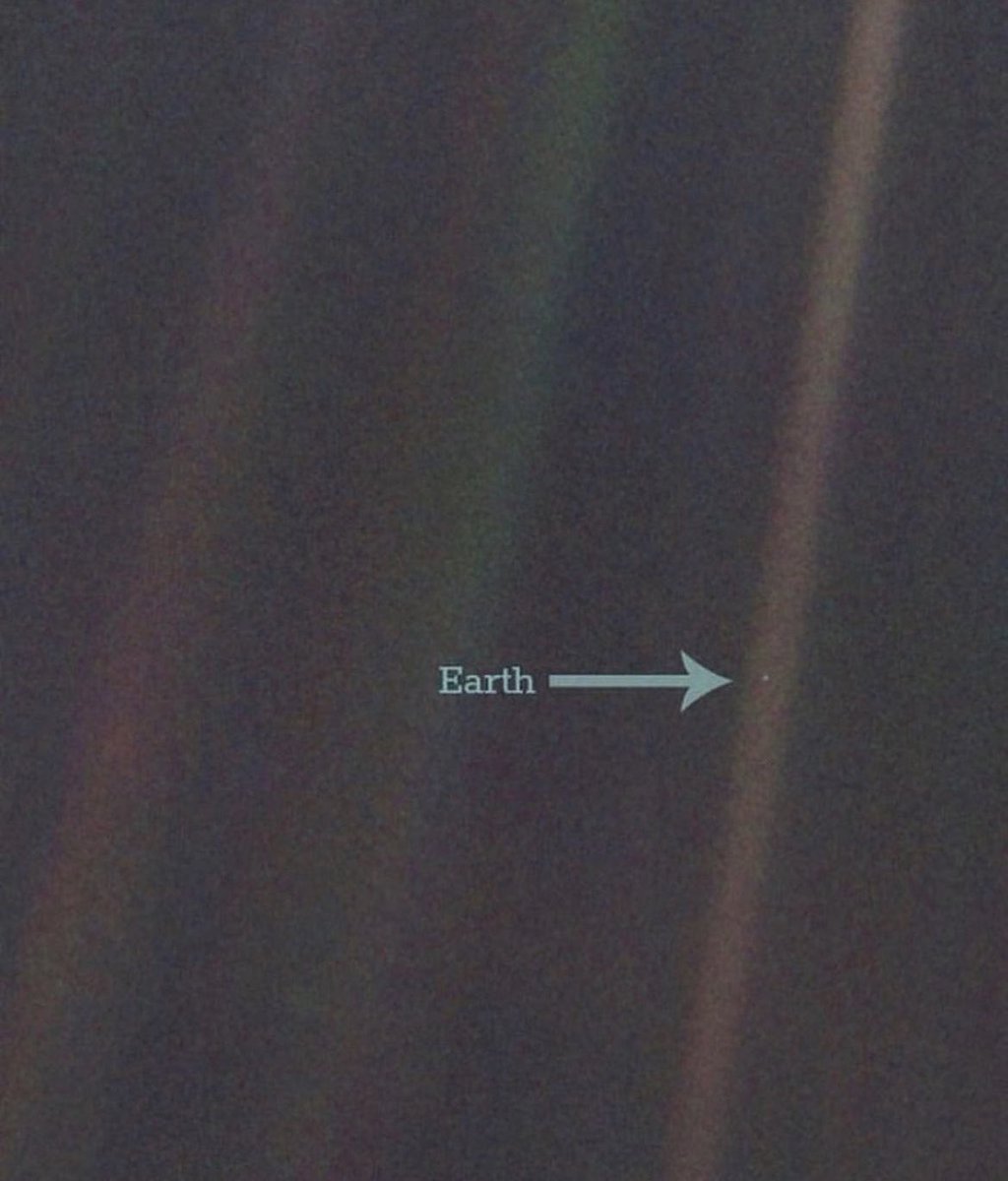
Pale Blue Dot is a photo of Earth that was taken by the Voyager 1 space probe in 1990 from a distance of about 6 billion kilometers (3.7 billion miles) as it was leaving our solar system. This is what Carl Sagan said about the photo:
"Look again at that dot. That's here. That's home. That's us. On it, everyone you love, everyone you know, everyone you ever heard of, every human being who ever was, lived out their lives. The aggregate of our joy and suffering, thousands of confident religions, ideologies, and economic doctrines, every hunter and forager, every hero and coward, every creator and destroyer of civilization, every king and peasant, every young couple in love, every mother and father, hopeful child, inventor, and explorer, every teacher of morals, every corrupt politician, every 'superstar,' every 'supreme leader,' every saint and sinner in the history of our species lived there — on a mote of dust suspended in a sunbeam.
The Earth is the only world known so far to harbor life. There is nowhere else, at least in the near future, to which our species could migrate. Visit, yes. Settle, not yet. Like it or not, for the moment the Earth is where we make our stand. It has been said that astronomy is a humbling and character-building experience. There is perhaps no better demonstration of the folly of human conceits than this distant image of our tiny world. To me, it underscores our responsibility to deal more kindly with one another, and to preserve and cherish the pale blue dot, the only home we've ever known.”
On March 23, 1966, in an accident that is now known as the Palomares incident, a B-52 bomber carrying four hydrogen bombs collided with a refueling tanker in Spain, and one of its nuclear weapons dropped into the sea.
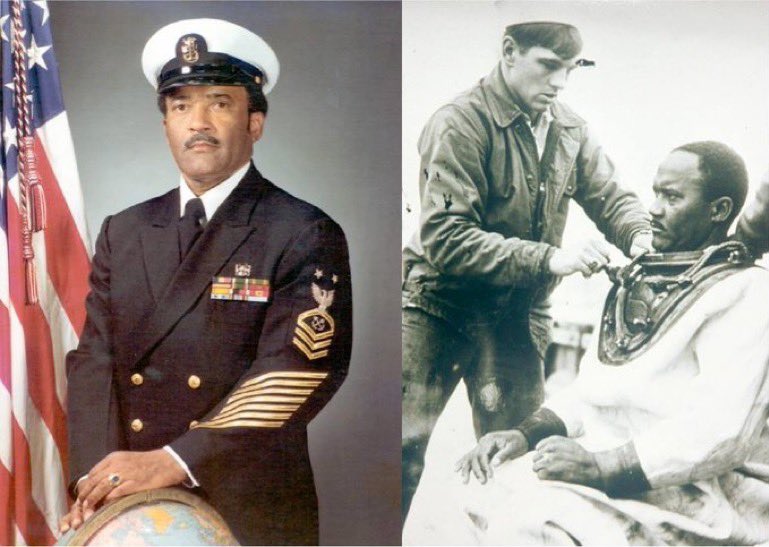
As a U.S. Navy salvage team worked to recover the bomb, the towing line broke, sending a heavy steel pipe shooting toward the team — and in an incredible act of heroism, diver Carl Brashear threw himself in front of his men, taking the pipe in the leg.
Brashear not only survived, but he overcame extraordinary obstacles to get himself recertified as a master diver even though his leg had been removed, making him the first amputee diver in Navy history. Brashear was motivated by his beliefs that "It's not a sin to get knocked down; it's a sin to stay down" and "I ain't going to let nobody steal my dream."
For his service in helping to retrieve the bomb, Brashear was later awarded the Navy and Marine Corps Medal, the highest navy award for non-combat heroism.
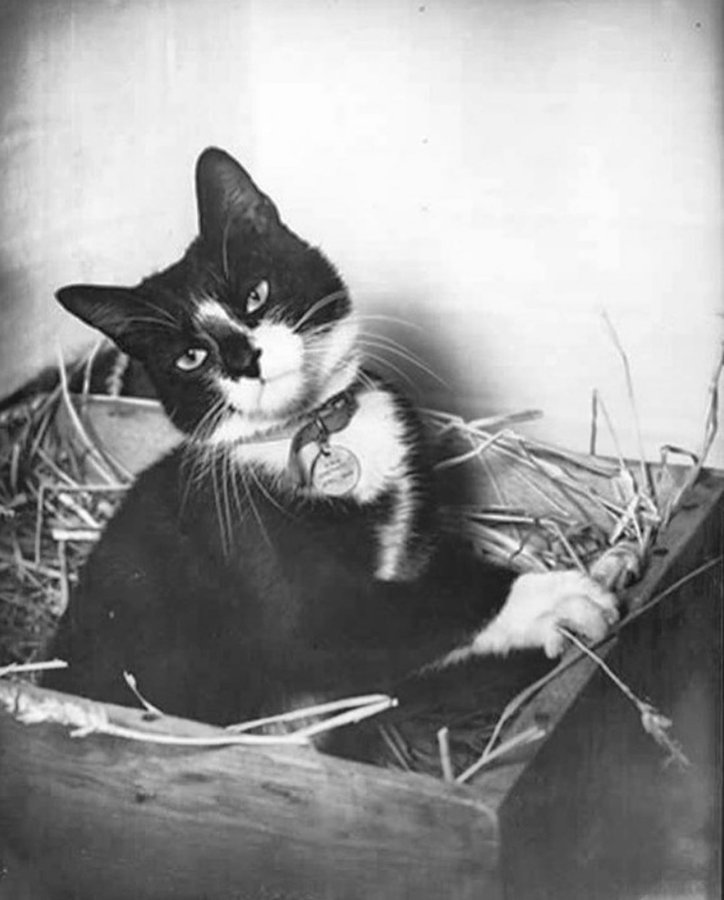
This is Unsinkable Sam, aka Oscar, a cat that served with the Kriegsmarine (navy of Nazi Germany) and the Royal Navy (navy of the UK) during World War 2. He was reported to have belonged to a sailor onboard the German battleship Bismarck.
On May 18, 1941, Bismarck was on its first mission when it was sunk by the Allies. Out of the 2,100 crew members, only 115 men and one cat survived.
The HMS Cossack scooped up the cat and gave him the name Oscar. For the next few months, Oscar lived on the ship until it was hit by torpedoes from a German U-boat, which killed 159 crew members but not Oscar, who was brought to the shores of Gibraltar by the remaining survivors.
Oscar was soon transferred to the HMS Ark Royal, where he was given the name "Unsinkable Sam". Ironically, the Ark Royal was heavily involved in the sinking of the Bismarck. After a series of near misses, the ship had garnered a reputation for being a "lucky ship", however, its luck would soon run out.
On November 14, 1941, the Ark Royal was torpedoed by a U-boat, causing it to roll over and sink. Sam was found clinging to a piece of wood and was described as "angry, but quite unharmed".
The sinking of the Ark Royal ended Sam's career at sea, and he lived out his remaining years in Belfast with a seaman until 1955.
Normally, there aren't grandparents around when an animal is born. But this clip of a bonobo playing with her baby granddaughter tells us there are notable exceptions
[read more: https://t.co/8PY3oC1k8v]
[📹 Cincinnati Zoo: https://t.co/XUkdZX3uB6]
https://t.co/geRt93IYD1