A grown ass man took a chainsaw to a 3rd grade class to kill girl students.
This is the direct result of misogynistic, incel movies like Animal and Toxic that glorify male violence.
If agri is indeed such a tough/unprofitable activity, farmers shd stop doing it. Sell the land, invest the money in FD/RE/MF/whtever and live off the annuity. No need to constantly carp over wht is an entirely voluntary vocation and ask the Bandra taxpayer to subsidise it..
there's a tendency to point out so many past missed opportunities. But in reality, to convert these opportunities into triumphs requires flawless execution. We just take it for granted that India wouldve executed well on all these fumbles. Vistara was a JV too!!
Before we laugh at her, may be worth asking, why in our country, it seems that the only corridor of upward mobility still is memorizing an entire library of information to spit out in a government exam hall?
Is that the best way to identify folks and hire into our bureaucracy?
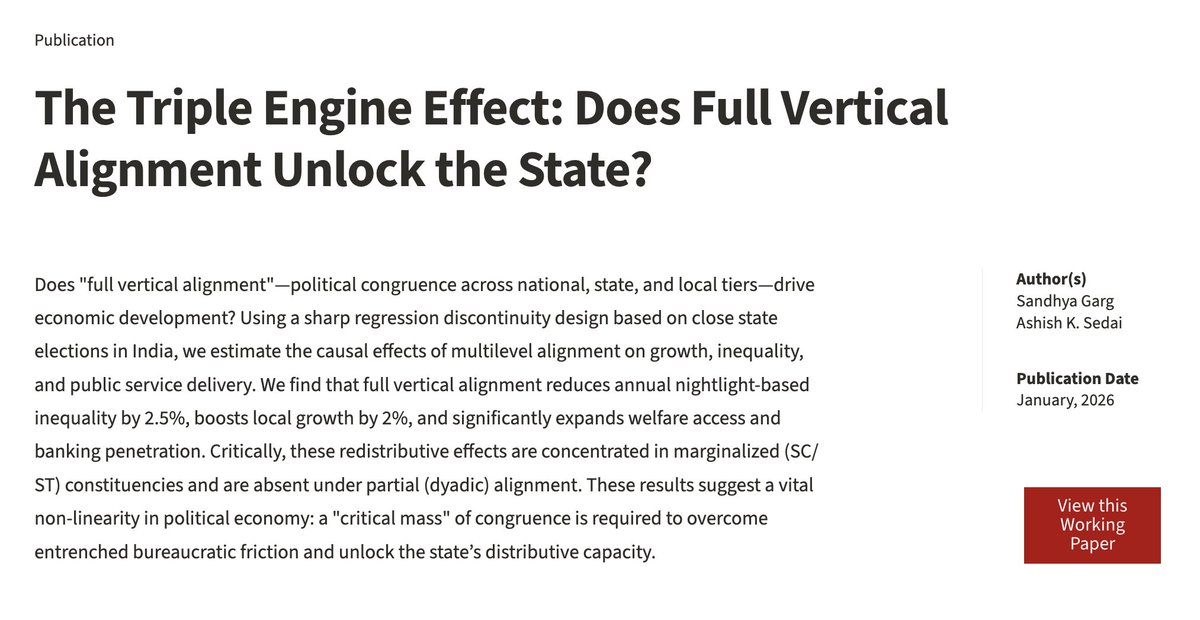
Interesting paper on the value of a 'triple-engine' sarkar (PM, CM, MLA alignment): "Full vertical alignment reduces annual nightlight-based inequality by 2.5%, boosts local growth by 2%, and significantly expands welfare access and banking penetration." https://t.co/K2oT2khl2G
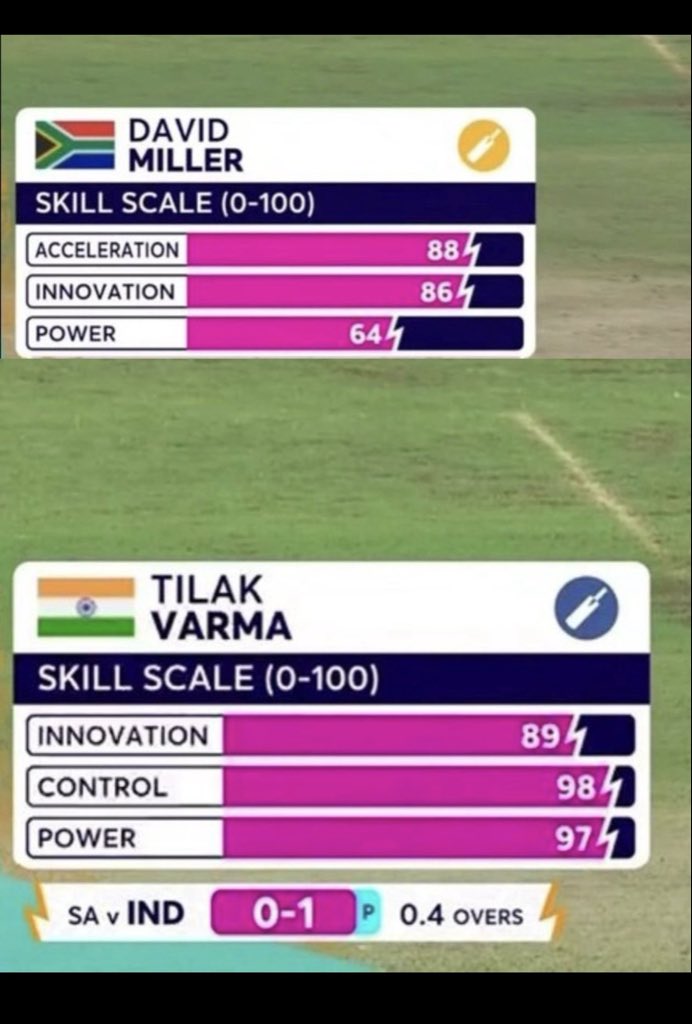
Sorry to say this but Abhishek Sharma comes across as a basher of mediocre bowling on flat pitches.
Pakistan started with off-spin and he got out for a duck to Salman Ali Agha.
Netherlands copied Pakistan and he went for a duck to Aryan Dutt's off spin.
Marco Jansen also took pace off and he had another failure against South Africa.
Another poor shot against spin today with Akeal Hosein nabbing him.
When every team has the same plan for you, maybe it's a weakness that you need to find solutions for. Approach it differently, rotate strike, take your time. "Natural game" is not an excuse for being unable to adapt.
The hype for Abhishek Sharma going into the World Cup was crazy, but with just 80 runs in 6 games, he's having a nightmare run. Add to that, pretty mediocre ground fielding and dropped catches.
The real victims of the Galgotia university AI debacle and other such places are the parents from smaller towns and villages with no way of judging the merit of an institution and getting convinced with a great brochure, a snazzy campus, and the promise of their children getting a better future.
Often, land is sold or huge loans are taken just for admission to these places.
We really need a not for profit organization with volunteers just to advise such parents, and point out the obvious issues with some of these prospects and guide parents and their wards.
I am sure there are enough bright people who have flourished thanks to our heavily subsidised public education system, who now have the time after retirement to give back to the system.
This Economic Survey breaks new ground by blending a bold, optimistic vision for the future with a realistic assessment of the economy’s vulnerabilities.
But what stood out most to me, was a subject that has rarely received serious attention.
For perhaps the first time, Indian cities are treated not as administrative afterthoughts, but as core economic systems.
This marks a clear departure from earlier policy thinking, where cities were discussed mainly in terms of housing shortages, congestion, or welfare delivery, rather than as strategic assets.
The Survey recognises that urbanisation plays a vital role in accelerating growth and productivity by concentrating people, skills, capital, and infrastructure in ways that reduce transaction costs and improve efficiency.
Crucially, it also acknowledges that successful urbanisation is not measured by output alone, but by quality of life.
Cities that prioritise liveability, meaning clean air, walkability, safety, affordable housing, efficient mobility, green spaces, and access to culture and opportunity, are the cities that will attract and retain talent and sustain creativity.
(This perspective resonated deeply with me, since one of the courses I took during my undergraduate studies in the Liberal Arts was Town Planning and Urban studies, and I have never lost my fascination for the subject)
If this thinking carries meaningfully into budgeting and institutional reform, it could mark a long-overdue shift: from managing cities as problems to building them as platforms for India’s growth.
Compliments to the team that produced this document.
Now it needs to be translated into reality!
urban reforms are a must for India. Indian cities languish without a functioning municipal system. it remains to be seen if Cities will get more monetary share and if state level politicians still let it.
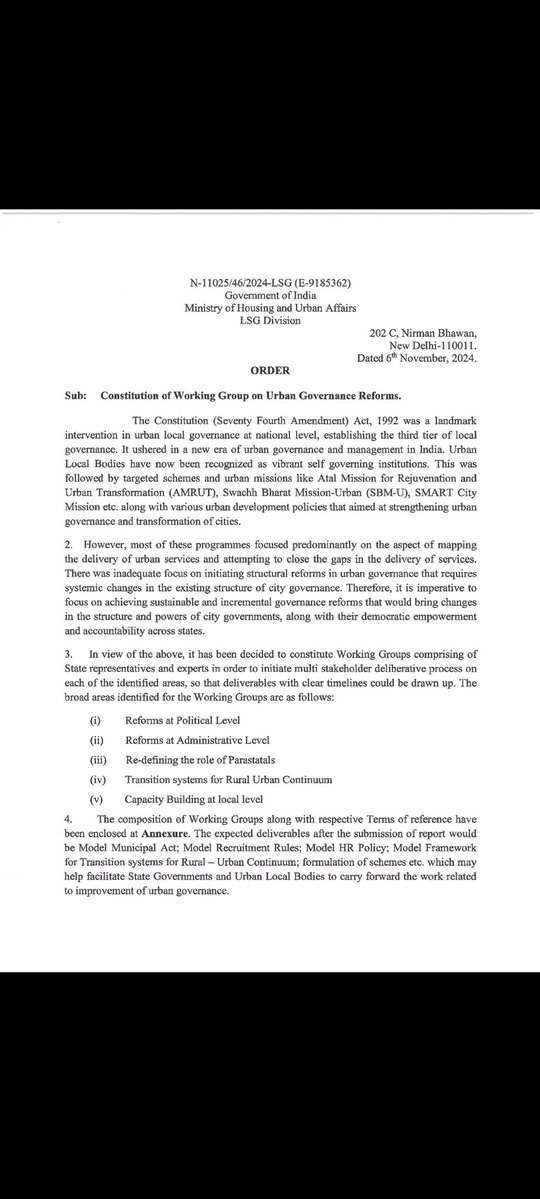
India will soon witness reforms in an area that has remained largely untouched—Municipal Governance.
Government has constituted a Working Group in November last year. The Group has been tasked with drafting Model Municipal Act and designing schemes to support municipal reforms.