#AfricanEnergyUpdate | @nnpclimited & @DangoteGroup Still Importing Gasoline Despite Refining Expansion
Even as domestic refining capacity grows, Nigeria imported significant volumes of gasoline in June:
- NNPC: ~50,000 barrels per day
- Dangote Refinery: ~12,000 barrels per day
The purchases highlight persistent supply gaps and the country’s continued dependence on overseas fuel to meet demand.
#AfricanEnergyUpdate | Côte d’Ivoire Gasoline Imports Hit Record High in June
Côte d’Ivoire imported 54,000 barrels per day of gasoline in June — the highest level in Kpler records since 2017.
The surge was triggered by maintenance at the state-owned SIR’s 75,000 bpd Abidjan refinery, which forced the refiner to seek an additional 40,000 tonnes of imported fuel.
#AfricanEnergyUpdate | Nigeria’s Gasoline Imports More Than Double in June
Nigeria imported 131,000 barrels per day of gasoline in June — more than double the 57,000 bpd recorded in May. Independent marketers rushed purchases ahead of the expiry of permits covering roughly 700,000 tonnes of Q2 imports.
The sharp surge highlights how regulatory deadlines continue to drive import spikes, even as domestic refining capacity expands.
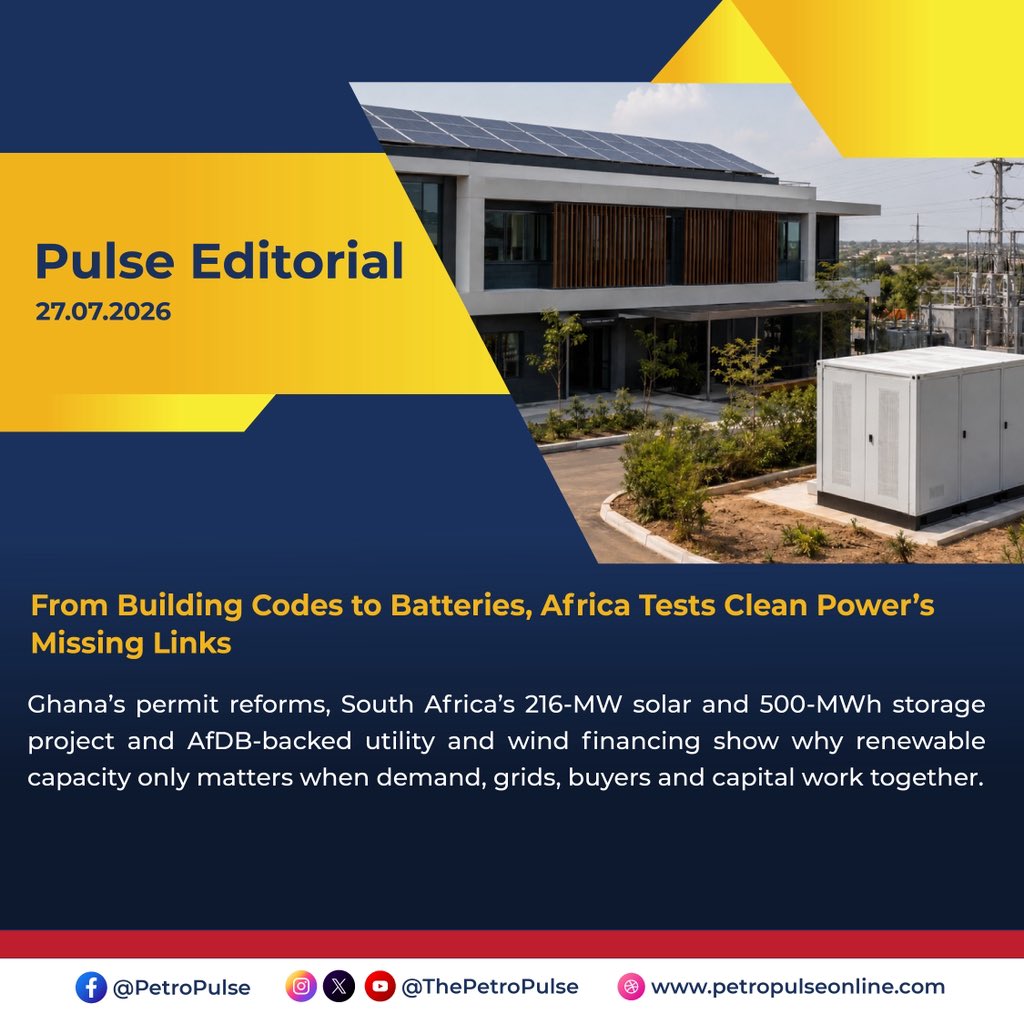
#PulseEditorial | From Ghana’s Permit Offices to South Africa’s Batteries – Africa Tests the Full Power Chain
Announcing megawatts is easy. Delivering dependable, affordable power is hard.
This week’s developments show the real test:
- Ghana integrating energy efficiency into building permits to cut future demand.
- South Africa commissioning a 216 MW solar plant paired with 500 MWh of storage.
- AfDB tying $400M to verified utility performance.
- Ethiopia advancing the 300 MW Aysha wind project with $ 110M+ financing.
The message is clear: Africa’s clean energy transition now hinges on execution — demand reduction, storage, credible offtakers, utility reform, and bankable delivery — not just headline capacity.
https://t.co/ZaKJgMYd8I
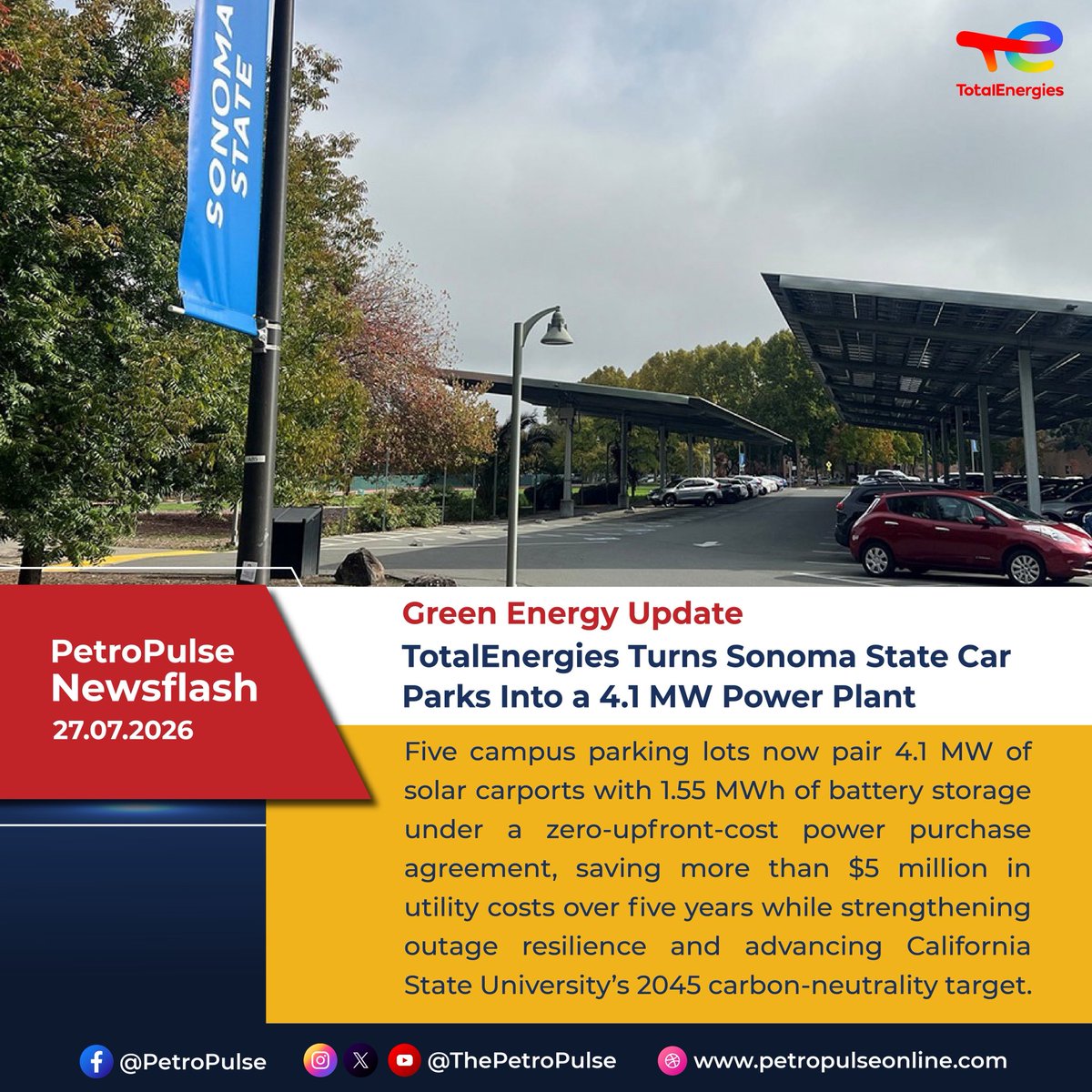
#GreenEnergyUpdate | Solar Carports + Battery Storage: Turning University Parking Lots into Clean Energy Hubs
@TotalEnergies , in partnership with Sonoma State University and the California State University system, has transformed five campus parking lots into a 4.1 MW solar carport portfolio paired with 1.55 MWh of battery storage.
Key wins:
- Zero upfront cost for the university via Power Purchase Agreement (PPA)
- Over $5 million in projected utility savings in the first five years
- Enhanced grid resilience against outages and peak pricing
- A living laboratory for students and faculty research
A smart model for turning underutilised space into reliable, sustainable power.
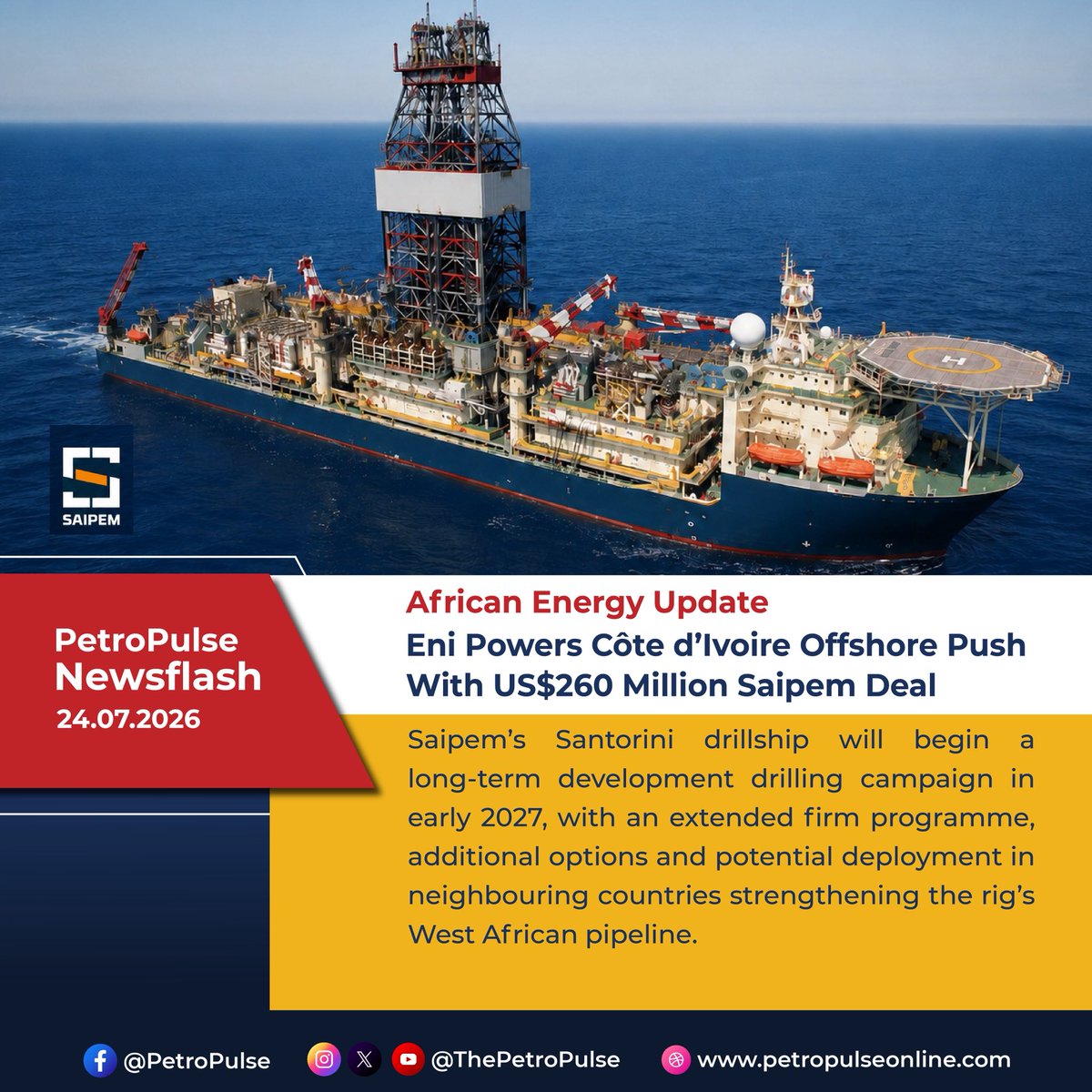
#AfricanEnergyUpdate | Saipem Wins ~US$260 Million Offshore Drilling Contract from Eni Côte d’Ivoire
Saipem has been awarded a new offshore drilling contract valued at approximately US$260 million by @eni Côte d’Ivoire Limited.
The high-specification drillship Santorini will undertake a long-term development drilling campaign offshore Côte d’Ivoire, with operations scheduled to begin in early 2027. The firm programme includes the potential for deployment in neighbouring countries and additional optional periods, extending the unit’s utilisation visibility.
The award reinforces Saipem’s competitive position in offshore drilling and its capacity to support clients’ exploration, appraisal and development activities across the region.
#OTR | @EU_Commission Recommends Three-Year Methane Penalty Grace Period for Importers
The European Commission has issued a formal Recommendation dated 20 July 2026 urging Member States not to apply the penalties set out in Article 33(5)(m), (n) and (o) of the EU Methane Regulation (EU) 2024/1787 for importer infringements of obligations due in 2027, 2028 and 2029, except in cases of fraud.
The recommendation is driven by the ongoing Middle East energy crisis and disruptions to the Strait of Hormuz, which have tightened global oil and gas markets, elevated prices and created legal uncertainty that risks deterring new supply contracts to the EU.
Key points:
• Obligations under Articles 27, 28 and 29 remain fully in force.
• Member States should actively monitor and incentivise compliance during the grace period.
• The Commission will review the recommendation by 1 January 2028.
• National penalty regimes should still be established as a priority.
The non-binding guidance aims to protect energy security while preserving the Regulation’s long-term objectives.
https://t.co/Tvp4ywIwSo
#OTR | @exxonmobil Europe Warns EU Methane Rules Risk Energy Security and Higher Prices
In a viewpoint published on 1 June 2026, Alice Wells of ExxonMobil Europe argues that the EU Methane Regulation’s stringent monitoring, reporting and verification requirements — due from 2027 — could leave up to 43% of natural gas and 87% of oil supplies non-compliant, according to a Wood Mackenzie study.
She contends the rules focus on administrative standards rather than immediate methane reductions (which begin in 2030), creating uncertainty that is already deterring 2027 contract decisions and exposing importers to potential penalties of up to 20% of annual turnover.
Wells warns of higher gasoline and diesel prices (estimated +24% and +16%), reduced industrial competitiveness, and further deindustrialisation risks. While affirming ExxonMobil’s support for methane mitigation and its own strong track record, she calls for a “stop-the-clock” process and simplified implementation to protect supply security and affordability amid the ongoing Middle East crisis.
https://t.co/E9pBzhhIRl
#OTR | Major Energy Suppliers Issue Open Letter Urging EU to Amend Methane Regulation
In a strongly worded joint statement, the United States, Qatar, Nigeria, and Algeria have called on EU leaders to urgently amend the EU Methane Regulation (EUMR), warning that the current rules will render nearly all EU oil imports and a significant portion of gas imports non-compliant from January 2027.
The ministers urge a “stop-the-clock” mechanism, grandfathering of new contracts, removal of penalties during transition, and pragmatic clarifications to protect energy security and avoid severe supply disruptions and price spikes.
https://t.co/ls9flHzD0n
#PetroPulseIntel | Global Oil Supply Rebounds in June but Stays Deeply Constrained — @IEA
Global oil production rose 4.1 mb/d in June to 98.8 mb/d as tanker traffic through the Strait of Hormuz partially resumed. Output nevertheless remains 9.4 mb/d below pre-war levels.
The IEA’s full-year 2026 supply forecast averages 102.6 mb/d (down 3.7 mb/d). Demand is projected to fall 1 mb/d in 2026 before growing 2 mb/d in 2027. A potential 7.5 mb/d supply rebound in 2027 — if Hormuz flows fully normalise — could shift the market from deficit toward surplus.
Africa angle: Tight balances support higher prices and revenues for producers (Nigeria, Algeria, Gabon) this year, while elevating import costs for fuel-dependent economies. A 2027 surplus would reverse both effects.
Note: Pre-dates the July 6-7 re-escalation.
https://t.co/iSHY9qY6DV
#Newsflash | Russia’s fuel crunch deepens as motorists switch to LPG after refinery disruptions. The shift highlights how supply shocks are creating fresh opportunities for African refiners.
#Newsflash | From Russia’s refinery crisis to Ghana’s refining revival, this week’s biggest energy stories show how nations are strengthening energy security through local solutions.
#AfricanEnergyUpdate | @AfDB_Group Approves $400 Million Loan to Support Municipal Utility Reform in Coal-Dependent Mpumalanga
The African Development Bank Group has approved a US$400 million loan for the Mpumalanga Municipal Utility Reform Programme, aimed at improving the quality, reliability and financial sustainability of electricity and water services in coal-affected municipalities.
The programme supports South Africa’s Just Energy Transition by helping communities manage the shift away from coal-fired generation. It will focus on reducing losses, repairing critical infrastructure, strengthening utility management, improving revenue collection and attracting private-sector participation through performance-based contracts.
Participating municipalities — eMalahleni, Lekwa, Govan Mbeki and Mbombela — serve approximately 1.2 million people. The financing is backed by a UK FCDO guarantee under the Just Energy Transition Partnership framework, with additional technical assistance.
Kevin Kariuki, AfDB Vice President for Power, Energy, Climate and Green Growth, said the operation will build more resilient local institutions and establish a replicable model for municipal reforms across South Africa.
#Newsflash | Ghana’s upstream revival is gaining momentum as the Jubilee Field rebounds to 95,000 bpd. Energy Minister @JohnJinapor says renewed investment is driving higher production and strengthening local refining.
#AfricanEnergyUpdate | MSC Launches Afungi Shuttle to Support Northern Mozambique LNG Development
MSC has introduced the Afungi Shuttle, a dedicated maritime feeder service connecting Afungi in northern Mozambique with Nacala and Maputo.
The new rotation is designed to transport construction materials, machinery, industrial equipment, spare parts and other project cargo required for the ongoing LNG developments in the Afungi peninsula.
Customers benefit from:
• Seamless connections to MSC’s global network (Europe, Mediterranean, Americas, Asia, Middle East and Southern Africa)
• A single MSC booking and commercial point of contact
• Dedicated Nacala–Afungi–Nacala and Maputo–Afungi–Maputo feeder rotations
The service simplifies logistics planning and strengthens supply-chain reliability for one of Africa’s most significant energy projects.
#AfricanEnergyUpdate | Rovuma LNG Could Add ~$11 Billion Annually to Mozambique’s GDP — Nearly Half of Current Output
A Standard Bank study estimates that the ExxonMobil-led Rovuma LNG project could contribute approximately US$11 billion per year to Mozambique’s GDP once fully operational — a transformative figure equivalent to roughly half of the country’s current nominal GDP (~$23 billion).
The project is also projected to create around 151,000 direct, indirect and induced jobs and generate substantial fiscal revenues, underscoring its potential to reshape the national economy.
This scale of impact is particularly significant for a nation where electricity access has reached about 60% but tens of millions of people — especially in rural areas — still lack reliable modern energy. Large-scale gas development remains central to Mozambique’s ability to finance infrastructure, expand electrification, create employment and address pressing developmental needs while advancing energy security.
#GlobalEnergyUpdate | US LNG Set to Become America’s 2nd-Largest Net Export Industry Within Five Years
A new S&P Global study projects US LNG feedgas demand will double to 36 billion cubic feet per day within five years — 25% higher than earlier forecasts — as the United States expands its lead as the world’s top LNG exporter and claims more than one-third of the global market.
Key findings through 2040:
• More than US$1 trillion in total supply-chain investment
• 555,000 jobs supported annually
• US$1.4 trillion contribution to US GDP
• Negligible impact on domestic gas prices (average household cost increase of just 1.6% from 2026–2031)
#PetroPulseIntel | Non-OECD Demand Drives Growth While China Imports Ease and West African Grades Weaken
Nearly all of @OPECSecretariat ’s projected global oil demand growth sits in non-OECD economies ~0.74 mb/d of the +0.8 mb/d expected in 2026 and ~1.7 mb/d of the +1.9 mb/d in 2027.
In May, India’s crude imports recovered to 5.1 mb/d, rising for the second consecutive month. China’s imports, however, fell sharply to 7.8 mb/d (down 1.6 mb/d m-o-m and almost 3.2 mb/d y-o-y).
Brazil remains a primary driver of non-OPEC+ liquids supply growth in both 2026 and 2027. West African crude differentials — including Bonny Light, Forcados, Qua Iboe and Cabinda — weakened in June amid softer Chinese buying interest and higher alternative supplies.
Africa angle: Strong non-OECD demand underpins the broader price environment, yet China’s lower imports and softer West African differentials pressure Asian netbacks for African producers, while rising Brazilian volumes intensify competition.
Note: Pre-dates the July 6-7 US-Iran/Hormuz escalation.