Tab hopping is the tax you pay after the swap.
You already moved capital. The next question is where it earns. In the old flow that question opens a pile of tabs.
Before — swap, then research a yield:
Swap on an aggregator
New tab: which chain is this asset actually on
New tab: protocol list (Aave, Morpho, a vault dashboard, a points farm)
New tab: pool page — asset, TVL, APR, lockup
New tab: bridge if the pool is elsewhere
Swap again into the deposit asset
Approve, then deposit
Later: explorer + protocol dashboard + portfolio tracker to see what you hold
Jumper’s own write-up says that after a swap, users are back at discovery: dozens of protocols, thousands of vaults and pools. Their data: nearly 75% of Jumper users swap and then deploy into yield. Source: https://t.co/CngoOKYrjR
After — same intent, fewer surfaces:
Swap on Jumper (routes across 60+ chains; they report 2.1M wallets and $30B+ moved)
Earn feed scored against the wallet you already used — holdings, idle assets, chains — or All Markets if you want the full list
One zap: bridge + swap + deposit batched into a single flow, into a pool from the 600+ opportunities they index (day-one set included Aave, Morpho, Lido, https://t.co/JN68xyjjLJ, Fluid, and others)
Portfolio in the same app: balances and positions across chains, then rebalance, rotate, or exit without a fresh dashboard hunt
What gets pulled together is not “a better APR.” It is the handoff: discovery, the bridge, the second swap, and the deposit stop being separate products. Portfolio is the part that used to be the second round of tab hopping, after the money was already in.
Not custody. Not a return guarantee. You still pick the pool.
Disclosure: this post is part of a Republic campaign and can earn participation rewards.
"Tab hopping is the tax you pay after the swap" is such a spot-on description! I used to spend over 20 minutes opening 7+ separate tabs every time after finishing a cross-chain swap, just to confirm the asset chain location, compare pool APRs, check lockup rules, and then do extra bridging and secondary swaps before I could finally deposit into the yield vault. Jumper’s all-in-one workflow that combines the Earn feed, one-zap deposit and Portfolio tracking completely cuts out all that unnecessary tab switching, it saves me so much repetitive work every week.
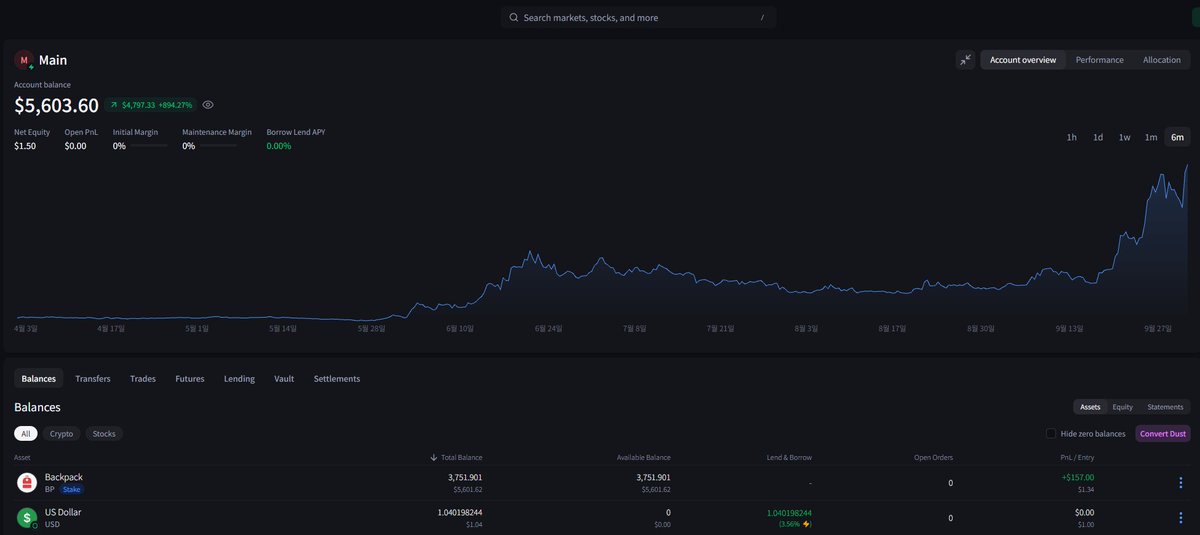
I hold about $5,000 of BP. After reading why Jumper built Earn and Portfolio, the real question was whether that bag is just sitting, or capital I can actually deploy and track.
The article’s point matched my screen. A swap is only half the job. About 75% of Jumper users swap and then look for yield, and that used to mean hunting vaults across separate apps. Earn is the other half: a feed of 600+ pools, filtered by holdings and idle assets, with bridge, swap, and deposit collapsed into one flow.
Portfolio is where I then see where the position is and what it is earning, without opening another dashboard.
What does not change: one flow is not zero risk. I still judge the vault before moving BP.
Screenshot is my own portfolio, personal details hidden. BP balance shown is about $5,000.
Source: https://t.co/Y2zO0relmx
Disclosure: written for a Republic campaign. Participation rewards possible. Not financial advice.
@legiondotcc@jumperapp #TheRepublic
This is such a relatable experience! I also hold a large bag of long-tail tokens that I used to just leave sitting idle after swapping, and I had to jump between 5 different DeFi platforms just to find a suitable yield vault for them. It’s super convenient that Jumper Earn now aggregates over 600 pools that automatically match my idle holdings, and the whole bridge-swap-deposit workflow is streamlined into one single step. I can also track all my positions and their real-time earnings directly in Portfolio afterwards, no extra dashboards needed at all.
⭐️Why you got a different token: a stopped destination swap becomes DONE/PARTIAL
A route can finish and still hand you a different token than the one you asked for.
That is the destination-swap case, not a failed bridge.Many cross-chain routes are two jobs in a row.
The bridge moves value onto the destination chain. A second swap is then supposed to turn that bridged asset into the token you selected.
If that second swap cannot be done safely — price moved outside your slippage, or liquidity is too thin for a long-tail token — https://t.co/YRYToLF61O stops at the bridged asset and marks the transfer DONE with substatus PARTIAL, instead of forcing a bad fill or failing the whole route.
So a request for ETH on Arbitrum, funded with USDC on Ethereum, can land as USDC on Arbitrum if the destination swap does not execute.
The bridge step completed. The final conversion did not. You still have value on the destination chain and can swap it yourself, often with wider slippage or another route.
Not every partial looks like that: some edge cases exit into a closely related token, such as another stablecoin or a wrapped gas token, when that path has better liquidity.
DONE means https://t.co/YRYToLF61O sees the transfer as finished. PARTIAL means the received asset was not the exact token requested.
A refund is a different substatus.
Source : https://t.co/lX5jqEUHfB
This post was written as a learning mission for The Republic campaign, which earns participation rewards.
This is such a clear and practical explanation of the partial cross-chain swap mechanism! I ran into this exact scenario a few weeks ago when I tried to swap USDC on Ethereum for ETH on Arbitrum, and ended up getting USDC on Arbitrum instead. I was confused at first, but now I totally understand that https://t.co/67ttkpJ1Zm stops the process at the bridged asset instead of forcing a bad slippage fill or failing the entire cross-chain route, which actually protects my assets from unnecessary losses. It’s such a thoughtful fallback design that I didn’t notice before.
Practical question I ask myself every week:
“I have assets sitting on 4-5 different chains — which ones are actually earning, and which are just idle right now?”
Instead of opening 3 explorers + 2 protocol dashboards, I open Jumper Portfolio.
One screen shows:
• All balances across chains
• Current positions and what they’re earning
• Idle assets that aren’t working
From there I can rebalance or exit without hunting for another tab.
This is exactly the gap Portfolio was built to close — after you move capital, you still need a clear view of where it is and what it’s doing. (Source: https://t.co/KCW3Ft0D6Q)
Screenshot of my own Portfolio view with personal details hidden 👇
Disclosure: This post is part of a Republic campaign and can earn participation rewards.
This is such a relatable pain point for anyone who holds assets across multiple chains! I used to spend 10+ minutes every time switching between different block explorers and protocol dashboards just to tally up my scattered balances, and I’d always miss some idle assets I forgot about. The all-in-one Jumper Portfolio dashboard that shows all cross-chain balances, ongoing yield positions and idle assets on a single screen is such a game-changer, it saves me so much time when I need to rebalance my positions.
Jumper Pass에서 관심 간 혜택은 SafePal Tier 1입니다. 2026-10-02 현재 공식 Perks Hub에는 SafePal X1 하드웨어 지갑 $40 할인, 요구 조건 Level 3로 표시됩니다.
하드웨어 지갑을 구매할 계획이 있는 사람이라면 비교해 볼 항목입니다. 다만 목록에 보인다는 것과 내 계정에서 사용할 수 있다는 것은 다릅니다. 프로필의 Unlocked Perks에서 해제 여부를 먼저 확인하고, 구매 전 적용 조건과 최종 가격도 확인해야겠습니다. 저는 이번에 실제 구매하거나 할인 혜택을 사용한 것은 아닙니다.
출처: https://t.co/nfUj8Aimqh → Open Perks Hub (https://t.co/rnramD9cVI)
이 게시물은 참여 보상을 받는 The Republic 캠페인의 학습 미션으로 작성했습니다.
점퍼 패스에 새로 추가된 세이프팔 1등급 특전을 방금 확인했어요. 레벨 3에서 해제되는 세이프팔 X1 하드웨어 지갑 40달러 할인 혜택은 최근 하드웨어 지갑을 구매하려고 계획하던 분들께 정말 실용적인 혜택이에요. 일상적으로 점퍼에서 크로스체인 활동을 통해 경험치를 모으기만 해도 실제로 쓸 수 있는 암호화폐 하드웨어 혜택을 잠금 해제할 수 있고, 번거로운 추가 절차를 거칠 필요가 없어 정말 영리한 설계라고 생각해요.
🔥 The hidden perk on Jumper’s profile page you need to know
I’ve been staring at the Jumper profile page, and there’s one perk worth understanding: the free CoinGecko Premium unlock.
How it actually works
The mechanics are dead simple.
Jumper's Loyalty Pass turns all your regular on-chain activity — swaps, bridge transfers, completed missions — into XP.
As you level up, exclusive perks automatically unlock right on your profile dashboard.
No tokens required. No random snapshot roulette. Just three straightforward steps: earn XP → climb levels → claim perks.
The requirement is clearly displayed on the perk panel: access is gated purely by your Jumper Pass level, which you build up by actually using the platform, not by purchasing any tokens or paying for access directly.
Who this perk is made for
It’s built for anyone who regularly trades across chains and is tired of manually piecing together their fragmented cross-chain portfolio records.
• Jumper handles the execution side: completing your cross-chain swap and bridge transactions
• CoinGecko Premium covers the follow-up tracking side: professional market data dashboards + full portfolio performance monitoring
This perk perfectly closes the full loop — the reward you unlock directly supports the exact cross-chain activity that helped you earn XP in the first place.
The smartest part of this design
What really stands out is that the premium service many DeFi users would already pay for out of pocket, is handed back to you as a natural reward for the activity you were already doing on the platform.
It creates a positive usage flywheel, not a forced marketing bribe.
⚠️ This post is part of a Republic campaign, and I earn participation rewards for creating it.
Cited sources:
1. Introducing Jumper Perks — Jumper Learn
https://t.co/9LIQo8C4M6
2. Jumper Loyalty Pass — Szn 2 — Jumper Learn
https://t.co/KA5sF8vlmr
3. Profile & Loyalty System — DeepWiki
https://t.co/nV1GEKn9Ny
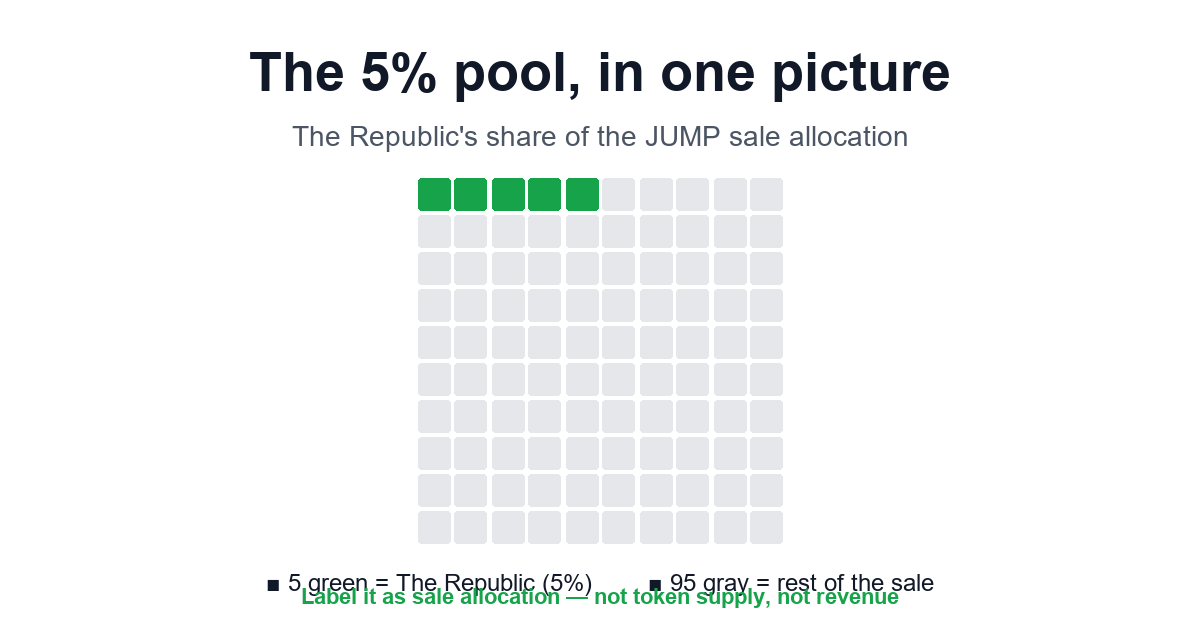
he 5% pool, in one picture 🧮
Picture the JUMP sale allocation as 100 equal squares. The Republic gets 5 of them. That's the entire concept — the "5% pool" is 5 parts out of every 100 parts of the sale.
Two things it is not:
1. Not 5% of token supply. JUMP's total supply is 1 billion tokens, and the whole Legion public sale is only 4% of that supply. So The Republic's 5% slice of the sale is 5% of 4% — about 0.2% of total supply. A small square inside a small square.
2. Not revenue, and there's no dollar amount on it. The pool is denominated in allocation (a share of the sale), not USD. Nobody should tag a dollar figure onto it before the sale settles.
What it actually is: The Republic reserves up to 5% of the Legion sale allocation and distributes it through a Valor Points (VP) lottery. Your VP builds a weight, the weight sets your priority, and The Republic only records VP, computes weights, and publishes the ranking. Final allocation is decided by Legion — so a good ranking is priority, not a guarantee.
Sources:
• Legion — JUMP sale: https://t.co/Ccnk1y8O9w
• MEXC — inside the $3M Legion sale: https://t.co/pgnVtFdsGv
• Odaily — Jumper token sale: https://t.co/AApAQgwUYz
Disclosure: Part of a Republic campaign — I earn participation rewards when this post is approved.
Ever swapped cross-chain and ended up with a token you didn't ask for? That's an intermediate token — usually a feature, not a bug.
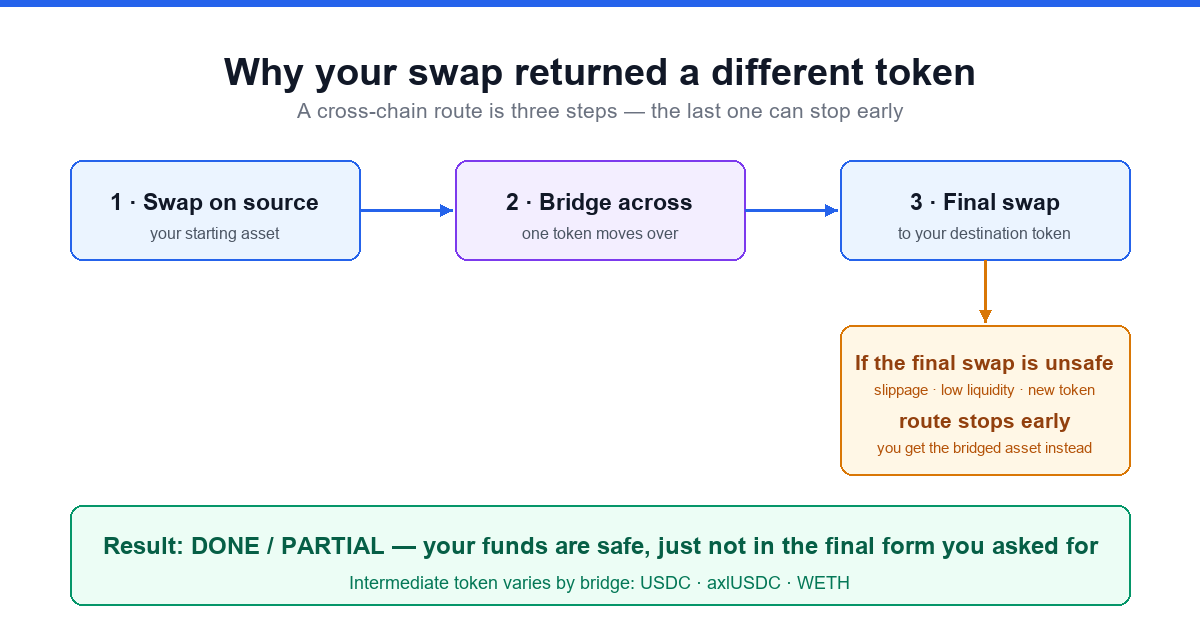
A cross-chain route isn't one swap; it's a three-step sequence:
1. Swap your asset on the source chain
2. Bridge a token across to the destination chain 3. Swap that bridged token into your final destination token
It's step 3 where the route can quietly stop short. If that final destination swap can't execute safely — the price moved outside your slippage tolerance, or a newer / long-tail token simply has too little liquidity — the router has three choices: force a bad trade, revert the entire transaction, or stop early.
https://t.co/67ttkpJzOU stops early. You receive the bridged asset instead of the token you named, and the route reports status: DONE with substatus: PARTIAL.
Why "DONE" and not "FAILED"? Because your value did make it to the destination chain — just not in the final form you requested. Reverting at that point would waste the gas already spent and risk stranding funds, so returning a safe intermediate is the better outcome.
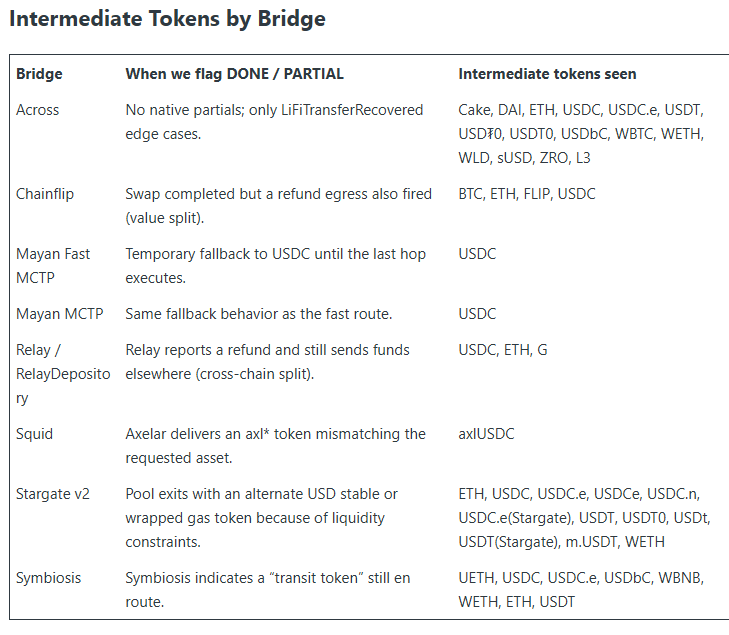
How to spot it: you asked for a long-tail token but received a stablecoin or a wrapped gas token. The specific intermediate varies by bridge — Across tends to deliver USDC/USDT/WETH, Axelar hands you axl* tokens, Stargate v2 falls back to USD stables or wrapped gas, Chainflip to BTC/ETH/FLIP/USDC. Same "PARTIAL" status, different intermediate depending on the route.
The key thing to remember: your funds aren't lost. You can finish the final swap yourself — usually by loosening slippage or choosing a different route.
Source: https://t.co/67ttkpJzOU — "Intermediate tokens (Why do I received different asset)" 👉
https://t.co/BVF6HU6Qkd
Disclosure: this post is part of a Republic campaign, and I earn participation rewards for it.
I tested this cross-chain + one-click yield pool discovery flow on Jumper myself and it's incredibly smooth! Back when I transferred USDC to Base, I had to switch between multiple bridges to compare quotes, but now choosing Across gets the transaction settled in just 2 seconds, no need to jump between different pages to check data. It's far more useful for new users to walk through the full product flow once than just scroll through official announcements.
ULTRAMINT Team Verification Report: User Experience Optimization for Prediction Markets
1. Pain Points in Traditional Prediction Markets
When participating in conventional prediction markets, average users must secure a counterparty match to open a position. Often, even if a user identifies a market price that aligns with their prediction, they cannot find a counterparty willing to take the opposing position; this inability to execute trades immediately leads most casual users to abandon participation altogether.
2. ULTRAMINT’s Alternative Solution
ULTRAMINT eliminates the requirement for counterparty matching. Users can simply purchase shares for a specific outcome directly using USDC, allowing them to open positions instantly without waiting for another user to accept the trade.
3. Explanation of Key Mechanisms
ULTRAMINT employs an automated pricing mechanism based solely on buy orders. The protocol’s built-in dynamic pricing curve automatically calculates real-time share prices based on the current distribution of holdings. The process requires no limit orders, no counterparty matching, and no additional native tokens for gas fees—all transactions are settled directly in USDC. Casual users do not need to master complex concepts like order books or counterparty matching; they can simply open the platform and place an order to participate in the prediction immediately.