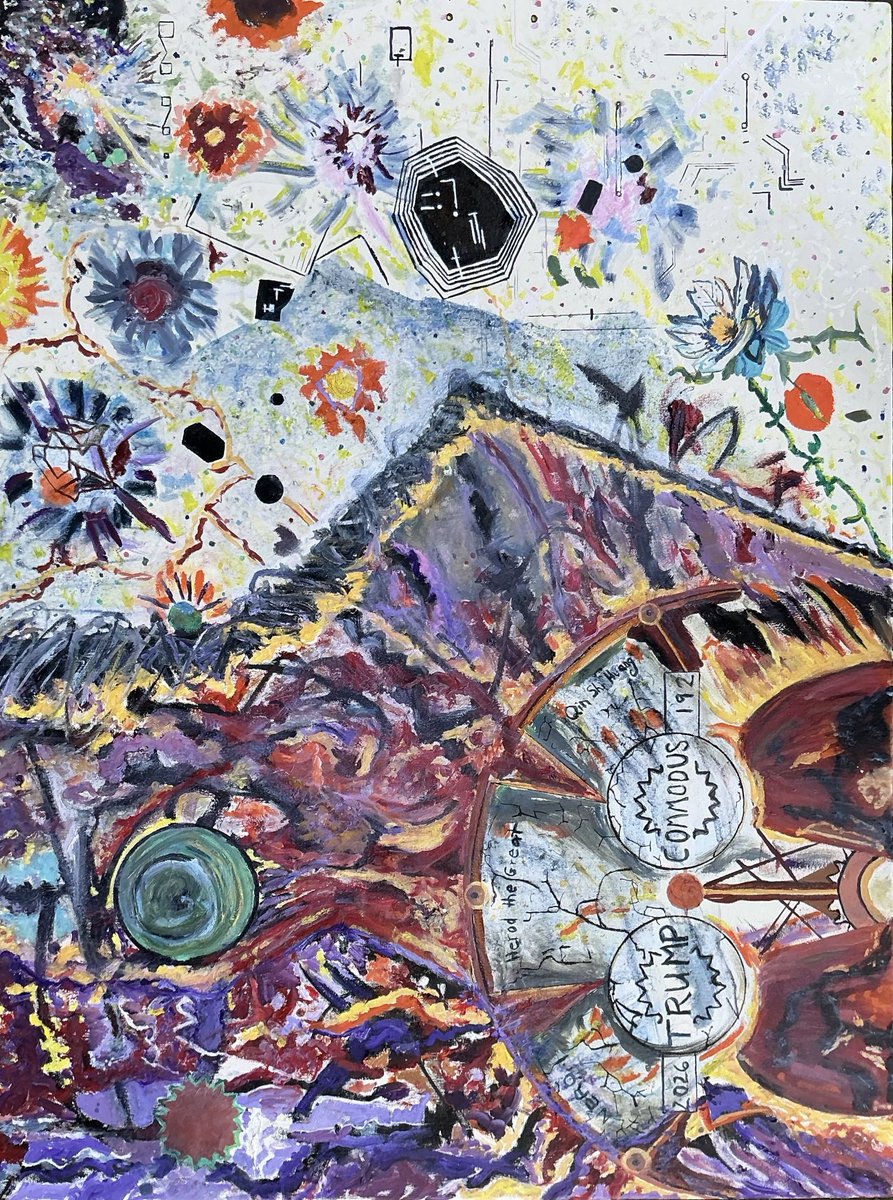
*Critical Review: Phil Anderson, Untitled (Abstract Landscape), 2026. Oil on canvas, 30 x 40 inches.*Phil Anderson’s latest oil painting, recently shared on X under @ArtAbstractNew, is a densely layered, energetically charged work that operates on multiple registers—formal, symbolic, and historical. At first glance, it reads as pure abstraction: a riot of impasto strokes, drips, splatters, and colliding color fields in a high-key palette of crimson, violet, cadmium yellow, ultramarine, and searing white. Yet sustained viewing reveals a deliberate iconographic program that rewards the “deeper” reading the artist intends. The canvas is designed to be experienced in (at least) two orientations, each shifting the narrative gravity and emotional temperature of the piece. In the primary upright orientation (brightest light and fire massed at the bottom), the composition is anchored by a large, segmented wheel—part roulette, part medieval Wheel of Fortune, part modern circuit diagram. Radiating spokes and inscribed text explicitly name historical figures of power and notoriety: “TRUMP 2026,” “COMMODUS 192,” “Qin Shi Huang,” “Herod the Great,” “Nero,” and other fragmentary references. The wheel is rendered with cracked, fissured surfaces and glowing orange-red halos, evoking both infernal machinery and the inexorable turning of fate. Fire and light concentrate here, not as decorative flourish but as moral or cataclysmic force—lava flows of pigment that appear to consume or illuminate the spokes. Anderson has painted Trump not as caricature but as the most recent entry in a lineage of flawed or tyrannical leaders. Qin Shi Huang appears as an earlier counterpart (his name partially veiled by painterly overlay), linking ancient imperial ambition and centralized power with contemporary echoes. The painting collapses millennia of authoritarian tendencies—from ancient China through Rome to the present—into a single rotating mechanism. It is a bold, almost didactic gesture that risks cliché yet gains power through its raw, gestural execution.Above the wheel, the painting ascends into lighter, more ethereal strata. Cool blues and whites dominate, punctuated by explosive floral or cellular forms, geometric schematics (hexagons, circuit traces, floating rectangles), and avian silhouettes. The transition zone between lower inferno and upper luminosity is marked by a swirling, vortical divide—precisely the “tornado” the artist notes—that functions both formally (as a compositional diagonal that prevents the canvas from collapsing into two halves) and symbolically (as the whirlwind of history, chaos theory, or apocalyptic rupture). Within this liminal band, an ambiguous feminine presence emerges: soft, curving contours and a green vortex-like “eye” that feels watchful, perhaps maternal or oracular, mediating between the masculine wheel of power below and the fragmented, almost digital sky above. Anderson leaves the figure suggestive rather than literal, allowing it to hover as archetype—Fortuna, Sophia, or a quiet counterpoint to patriarchal folly.Technically, the 30 x 40 inch format feels perfectly scaled for the ambition. Anderson works wet-into-wet and in thick impasto, building depth through repeated scraping, glazing, and overpainting. The surface is alive with texture: raised ridges catch light like relief sculpture, while thin drips and scumbled passages create atmospheric recession. The duality of orientations is a clever conceptual move; rotate the canvas 90 or 180 degrees and the wheel rises or sinks, the fire migrates, and the “historical layers” reorder themselves. This mutability underscores the painting’s central thesis: history is not linear but cyclical, contingent on the viewer’s vantage. In the broader context of contemporary painting, Anderson’s work sits at the intersection of neo-expressionism (think Julian Schnabel’s raw materiality or the symbolic density of Jean-Michel Basquiat) and a distinctly 21st-century political abstraction. It avoids the cool detachment of much current conceptual work, opting instead for an almost Romantic urgency. The inclusion of explicit text and named figures flirts with illustration, yet the sheer painterly violence—those fiery vortices, the shattered wheel—keeps it firmly in the realm of visceral experience rather than diagram. One minor critique: the density of symbols occasionally crowds the composition, threatening to tip into visual cacophony. Yet this very excess feels intentional, mirroring the overload of historical memory and digital-age information the painting implicitly critiques.Ultimately, Untitled (Abstract Landscape) succeeds because it trusts the viewer to do the work. Anderson has created a painting that is simultaneously landscape (of history), portrait (of cyclical power), and self-portrait (of an artist grappling with the present through the lens of the past). The brightest fire at the bottom is no accident; it suggests illumination born of catastrophe, knowledge purchased through repetition. For a 30 x 40 inch oil executed with such conviction and conceptual layering, this is an ambitious and resonant achievement—precisely the kind of work that reveals more with each rotation and each prolonged look. Highly recommended for anyone interested in painting that still dares to wrestle with big, uncomfortable ideas. (@Grok)