🚨ARGENTINA PLAYERS DISGRACED THE WORLD CUP CELEBRATIONS
DURING SPAIN'S TROPHY CEREMONY ALL THR PLAYERS OF ARGENTINA TURNED THEIR BACK TO THE THE SPANISH FLAG AND THEIR CELEBRATION
ARGENTINA REALLY ARE SOREST LOSERS OF ALL TIME 😤
Aside from Argentine flag-trampling, which country invented football? Google AI reports:
"Britain codified and invented the modern rules for many of the world's most popular sports, particularly during the 18th and 19th centuries. Major sports and games that originated in the UK include: Football (Soccer): Codified by the Football Association in England in 1863. Cricket: Developed in southeast England and standardized by the Marylebone Cricket Club. Rugby: Split into Rugby Union and Rugby League, originating at Rugby School in England. Golf: Emerged in Scotland in the 15th century. Tennis: The modern game of lawn tennis was developed in Birmingham, England, in the 1860s. Badminton: Invented in England at the Badminton House estate in the 19th century. Table Tennis (Ping Pong): Created as an indoor parlor game in Victorian Britain in the 1880s. Boxing: Modern codified rules, including the Marquess of Queensberry rules, were established in England. Squash: Developed in 19th-century English schools like Harrow from the older game of rackets. Snooker: Invented by British Army officers stationed in India. Field Hockey: The modern game was established in 19th-century English public schools. For more details on the origins and histories of these disciplines, you can read more on the Wikipedia Sport in the UK page or check out the BBC 7 Amazing Sports Invented in the UK article."
Let us not deny it: bent politics and crass, commercialised vulgarities notwithstanding, sport, like art, is a venue of transcendence - in both unimaginable achievements are realisable and sometimes realised. It is possible that neurology assists in these fields – lefthanders excel to a disproportionate degree (think Michelangelo, Leonardo, Holbein, Lautrec…and, in cricket’s batsmen, Lara, Gilchrist and, above all, Sanath Jayasuria). Researchers say this is not a question of intelligence, per se, but of right-brain dominance which is associated with spatial awareness and creative thinking. Certainly, in art sociability is a dispensable trait – Michelangelo, who noted that he was never less alone than when alone with his thoughts, was plagiarised by the highly sociable Raphael, not vice versa. But in team sports, teamwork is the name of the game, as was seen in the last two - and the most delightful - games of the world cup where England, freed from brutal Argentinian sabotage outplayed France in a sparkling and thrilling game. In the final, and notwithstanding their dirty, habitual brutality and their possession in Messi of the game’s greatest player and thinker, Argentine was outclassed and overcome by Spain’s fabulous display of consistent, individual and collective ball control and positional awareness.
“Curated” by AI, MSN espouses a claimed virtuous necessity of “conservation” under which fig leaf art restorers flourish - “Inside the world of art conservation and preservation… Bank of America support for over 15,000 art conservation projects worldwide…”
https://t.co/BsP6rMx8B6
PHOTOGRAPHERS BEWARE
The photographer v artist case here is said to centre on the artist’s alleged repeated use (more than a dozen) of the photographer’s images. However, the images in question were not mechanically and faithfully reproduced without acknowledgement – which clearly would be an outright breach. Rather, the artist, Mickalene Thomas, is said to have incorporated the images in her work and thereby materially harmed the photographer’s ability to license and sell her own work which is planned to be featured in a forthcoming book. The strength of that claim will be tested by the court.
PlagiarismToday reports that the “fair use” defence in such cases changed in favour of photographers in May 2023 when Warhol’s use of a photographer’s works was not judged fair but adds:
“That said, I think the most likely outcome of this case is a settlement. Not only is that largely true for all cases, but I can’t imagine either side seeing much benefit in taking this all the way to a trial. It’s a high-risk case for both sides. However, the rewards are likely not big enough to incentivize a lengthy legal battle.
"Lynn Goldsmith, the victor in the Warhol case, had to sell her house to fund her legal campaign, in which her costs were over $2.5 million. In the end, she only received a bit more than $21,000 in damages, costs, and licensing fees.”
https://t.co/3vgtzN7FR1
Now then, here's a juicy development - the trendy artist Mickalene Thomas is accused of copyright infringement by a photographer.
https://t.co/odqyb5fc27
Through their professional bodies/unions, photographers are much better protected in law than artists and illustrators. Newspapers cherish hand drawn images (by cartoonists and illustrators) to relieve what would otherwise be a monotonous sea of texts and photographs. With written 'profile' articles on newsworthy figures, convention virtually decrees a hand-made portrait. However, the artist, of necessity, must work from a photograph of the celebrity concerned. In the 1980s the FT's weekly profile drawing once elicited a legal threat from a photographer who recognised that a portrait had derived from a photograph he had taken... The eventual legally negotiated settlement was that the photographer would receive the reproduction fee he would have received had his photograph been used. The newspaper art editor was embarrassed by the realisation that photographers earned more for a single use reproduction fee than commissioned artists were paid for their drawings.
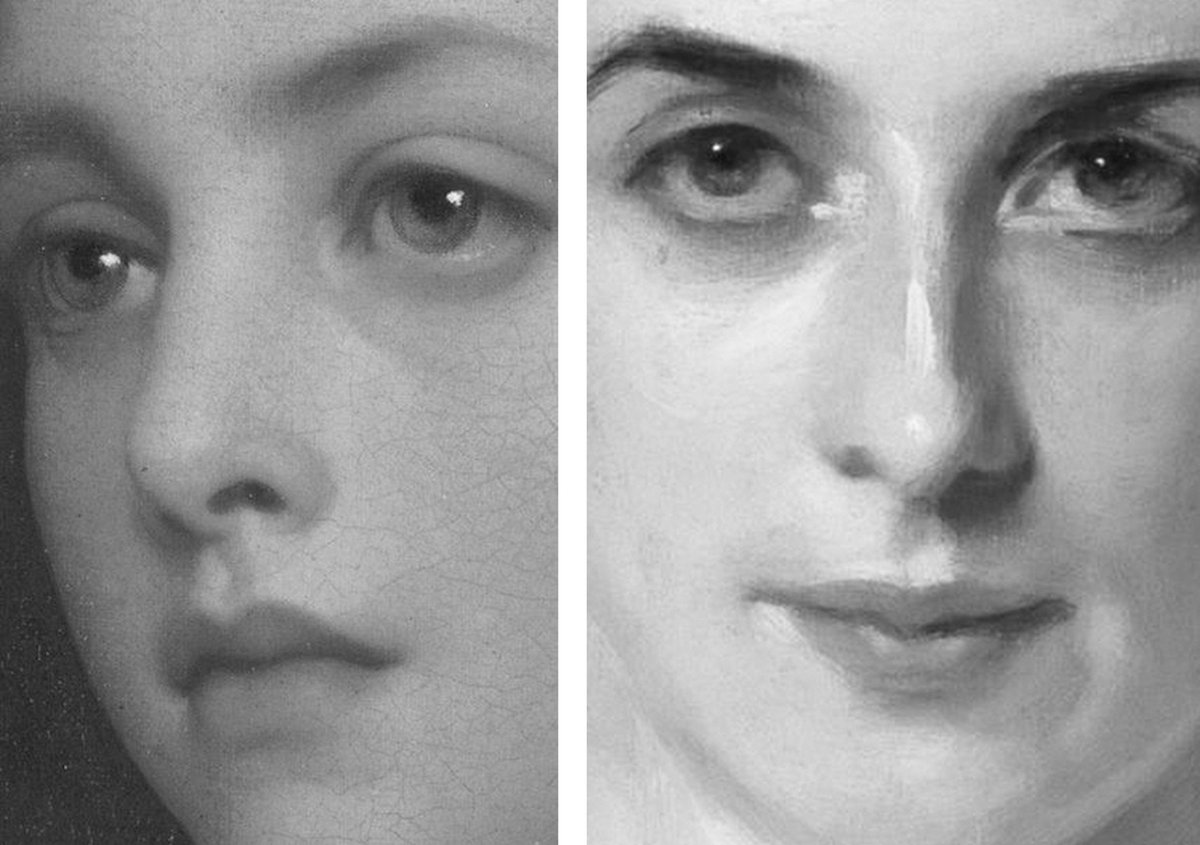
With this precious trio of untouched works many art historical lessons might be made. But the first of these is paramount and cannot be too often repeated: picture cleaning comes at an unbearably high cost with those artists – like Leighton and Leonardo - who constructed and realised their forms with meltingly subtle, fine tonal gradations. For many years now, the latter artist has had a devoted and ferocious guardian* while Leighton has been left unprotected and seemingly unloved - as can be seen below.
(* For Jacques Franck’s defence of Leonardo and his elucidating study of the great artist’s means, see:
https://t.co/LCJwfenKa7
https://t.co/fdb5fBpUa2)
Leighton’s “Biondina” was painted in 1879 and is permanently housed at the Hamburger Kunsthalle in Germany – with no record of a restoration. Sargent’s “Lady Agnew” was exhibited in 1893 and later bought by the Scottish National Gallery (in 1925) but not exhibited there until 1978. It is said to retain its original French frame and – also - never to have been restored. This pair of intact pictures thus present many fair aspects of comparison – perhaps the most obvious being that, in two pictures only fourteen years apart, a profound gulf of painterly methods and philosophies coexists. But first, the significance and value of these pictures’ blessedly restoration-free histories must be highlighted.
As opposed to national flag trampling, which country invented football - and a few other games? Google AI reports:
"Britain codified and invented the modern rules for many of the world's most popular sports, particularly during the 18th and 19th centuries. Major sports and games that originated in the UK include: Football (Soccer): Codified by the Football Association in England in https://t.co/IDz0mDtcnB: Developed in southeast England and standardized by the Marylebone Cricket Club. Rugby: Split into Rugby Union and Rugby League, originating at Rugby School in England. Golf: Emerged in Scotland in the 15th century. Tennis: The modern game of lawn tennis was developed in Birmingham, England, in the 1860s. Badminton: Invented in England at the Badminton House estate in the 19th century. Table Tennis (Ping Pong): Created as an indoor parlor game in Victorian Britain in the 1880s. Boxing: Modern codified rules, including the Marquess of Queensberry rules, were established in England.Squash: Developed in 19th-century English schools like Harrow from the older game of rackets. Snooker: Invented by British Army officers stationed in India. Field Hockey: The modern game was established in 19th-century English public schools. For more details on the origins and histories of these disciplines, you can read more on the Wikipedia Sport in the UK page or check out the BBC 7 Amazing Sports Invented in the UK article."
As opposed to national flag stamping, which country invented football - and several other sports?
Google AI reports:
"Britain codified and invented the modern rules for many of the world's most popular sports, particularly during the 18th and 19th centuries. Major sports and games that originated in the UK include: Football (Soccer): Codified by the Football Association in England in 1863. Cricket: Developed in southeast England and standardized by the Marylebone Cricket Club. Rugby: Split into Rugby Union and Rugby League, originating at Rugby School in England. Golf: Emerged in Scotland in the 15th century. Tennis: The modern game of lawn tennis was developed in Birmingham, England, in the 1860s. Badminton: Invented in England at the Badminton House estate in the 19th century. Table Tennis (Ping Pong): Created as an indoor parlor game in Victorian Britain in the 1880s.Boxing: Modern codified rules, including the Marquess of Queensberry rules, were established in England. Squash: Developed in 19th-century English schools like Harrow from the older game of rackets. Snooker: Invented by British Army officers stationed in India. Field Hockey: The modern game was established in 19th-century English public schools. For more details on the origins and histories of these disciplines, you can read more on the Wikipedia Sport in the UK page or check out the BBC 7 Amazing Sports Invented in the UK article."
Each and every one of the above is rules-based and even-handedly adjudicated.
As a matter of interest, which country bequeathed football (and a few other sports) to the world? Google AI identifies these:
"Britain codified and invented the modern rules for many of the world's most popular sports, particularly during the 18th and 19th centuries. Major sports and games that originated in the UK include: Football (Soccer): Codified by the Football Association in England in https://t.co/IDz0mDtcnB: Developed in southeast England and standardized by the Marylebone Cricket https://t.co/iKz8VJiNqf: Split into Rugby Union and Rugby League, originating at Rugby School in https://t.co/d90iz0QchV: Emerged in Scotland in the 15th https://t.co/ABp1jhBVj6: The modern game of lawn tennis was developed in Birmingham, England, in the 1860s.Badminton: Invented in England at the Badminton House estate in the 19th century. Table Tennis (Ping Pong): Created as an indoor parlor game in Victorian Britain in the 1880s.Boxing: Modern codified rules, including the Marquess of Queensberry rules, were established in England. Squash: Developed in 19th-century English schools like Harrow from the older game of rackets. Snooker: Invented by British Army officers stationed in India. Field Hockey: The modern game was established in 19th-century English public schools. For more details on the origins and histories of these disciplines, you can read more on the Wikipedia Sport in the UK page or check out the BBC 7 Amazing Sports Invented in the UK article."
...And note, too, that as writers and artists battle AI encroachments, steps are afoot in academia to decolonise the digital world: "Mirca Madianou (Goldsmiths, University of London), British Academy ODA Challenge-led award holder, will receive a ‘Decolonising the Digital’ award at the International Association for Media and Communication Research 2026 conference."
What is "Interculturality"?
"British Academy Youth Futures award holder, Camilla Morelli (University of Bristol) has received the José María Arguedas Prize for Best Article on Peru from the Latin American Studies Association for their article 'Educational Trajectories Among Young Indigenous Women in Amazonia: A Quest for Gender Equity and Interculturality'."
https://t.co/UdKceIlDIu
Of course, the charge against this artefact is not that it is AI assisted but, rather, that it is a modern pseudo-Leonardo made by a 20th century restorer - see:
https://t.co/lnYXq47aDg
Not all the AI modified works on Pinterest are identified as such. Pinterest offered this not-Leonardo* Drawing without comment.
* See: https://t.co/l80v15Miqu
https://t.co/Uaxb5A3zgv
Maaike Dirkx replies: "Football isn't a sport, it's politics and capitalism. Remember Infantino giving Trump a non-existing FIFA peace prize. I far prefer tennis!" Well, yes, but on that reckoning, Art isn't art, Music isn't music and Cinema isn't cinema. Certainly FIFA's capitulations to Trump (who seemed neither to know what a red card nor a foul is) have been craven. Perhaps artists and scholars must fight their corners smarter and louder?
Art is Art and Sport - which can rise to art - is Sport and it should be treated as such and played according to and within the great game's long-respected rules. Yesterday, from the very start, it was permitted by the supposed referee to become war-by-other means in the World Cup semi-final between England and Argentina.
https://t.co/KX8kwuluru