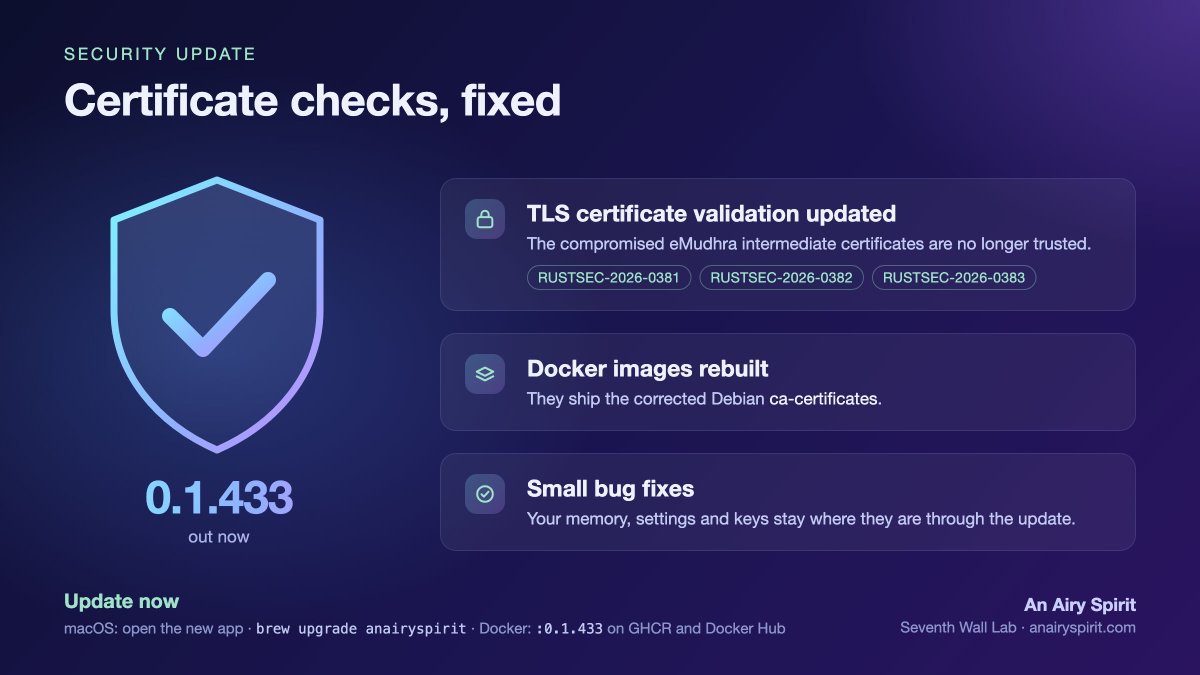
An Airy Spirit 0.1.433 is out — a security update.
TLS checks no longer trust the compromised eMudhra intermediate certificates (RUSTSEC-2026-0381/0382/0383). Docker images ship the fixed ca-certificates. Your memory stays put.
brew upgrade anairyspirit
https://t.co/KYotObdYMu
#MCP #LocalFirst
Fast search gives a shortlist; a reranker reads each candidate with the question and picks what actually answers it (Nogueira & Cho, 2019).
An Airy Spirit uses bge-reranker-v2-m3, locally. Glance at the pile, then read the few that look right.
https://t.co/5Zcoalj9BJ
#Rust
Two retrievers, two scores on different scales. How to merge?
Reciprocal Rank Fusion (Cormack et al., 2009) ignores the scores and uses only positions. Almost embarrassingly simple - and it beat far fancier methods. We use it.
https://t.co/5ZcoaliBMb
#AI#Memory#AIagents#MCP
Vector search smears rare names, acronyms and exact phrases. Ask for "INV-2291" and you get every invoice that feels similar.
BM25 (Robertson, 1994) doesn't. So An Airy Spirit runs both - each catches what the other misses.
https://t.co/5Zcoalj9BJ
#AI#Memory#AIagents#MCP
"The place with the terrible coffee" should find "café near the station, coffee was awful".
That takes meaning, not word overlap. An Airy Spirit uses BGE-M3 (BAAI, MIT): multilingual vectors of meaning, run locally on your machine.
https://t.co/5Zcoalj9BJ
#AI#Memory#MCP#Rust
"What did I decide last Tuesday?" - when it happened ≠ when it was written down.
An Airy Spirit stores both timestamps for every memory (an idea from temporal databases, Snodgrass 1995), so "last Tuesday" means the world, not the write log.
https://t.co/5Zcoalj9BJ
#AI#Memory
Anairyspirit 0.1.410: local memory for AI agents.
🀄 Chinese — search, time phrases, tags
🌙 Episodic memory — only what survives sleep stays
📌 Intentions — your agent's plans outlive the session
https://t.co/JUeK7bepBl
#AIAgents#LocalFirst#MCP#AI#中文
ACT-R: memories you use stay reachable, unused ones fade. 40 years of evidence.
We implemented it from the paper, measured it — and on our benchmark it ranked worse. So it ships, switched off.
Not a verdict on ACT-R. A verdict on this workload.
https://t.co/5ZcoaliBMb
#AI
"Cells that fire together wire together" — Hebb, 1949.
In An Airy Spirit, memories recalled together can grow a link even with zero words in common. Similarity can't see that; use can.
An option, off by default.
https://t.co/5ZcoaliBMb
#AI#Memory#AIagents#MCP#LocalFirst
Memories get organised during sleep - the brain replays, structure forms.
An Airy Spirit has a background "sleep" phase for the same job: duplicates merge, links form, topics emerge. You write things as they come; the graph tidies itself later.
https://t.co/5Zcoalj9BJ
Say "fire truck" and "siren" comes to mind on its own. That's spreading activation (Collins & Loftus, 1975).
In An Airy Spirit activation flows through the memory graph, so context surfaces what the query never mentioned. It's what makes memory, not an index.
Most "AI memory" is a vector DB with a nicer name.
An Airy Spirit is modelled on how remembering works, not how search works. Every idea in it has a paper behind it.
Starting tomorrow: one idea a day, who it came from, why we use it.
https://t.co/5Zcoalj9BJ
Every session, an Al agent starts from zero. The correction you gave it yesterday, the mistake it already made twice, what it learned about how you work - gone with the context window.
For the last six months I have been building the fix: a memory of the agent's own, on your machine. Not a store of documents about your project - a record of how the agent itself works: where it tends to be wrong, which corrections it was given and why, what it decided and what came of it. The memory sleeps and consolidates; what goes unused fades but is never deleted. No cloud, no LLM inside, no telemetry.
It connects over MCP to Claude Code, Codex, Cursor, Gemini CLI, Claude Desktop and other clients. One command to try
it:
npx anairyspirit setup
- or a notarised macOS app, Homebrew, Linux packages, Docker. Free for individuals, non-profits and companies under USD 5M in annual revenue.
How it was built matters to me as much as what it is: no hand-written code. I designed the system, the rules and the checks; Al agents wrote the code under them - about 297k lines of Rust, 3,200 tests, 392 releases, QA on eight platforms, and a release that goes out signed through every channel at once.
https://t.co/0ghPtSEuVg
#Alagents #МСР #LocalFirst #Rust #AgenticEngineering
Memory for agents, built by an agent with memory.
An Airy Spirit is made by two: a person and an AI agent. The person decides what the system is, how it is checked and when it is ready. The agent writes the code — not one line by hand in six months.
An Airy Spirit is public.
Every session, an AI agent starts from zero. The correction you gave it yesterday, the mistake it already made twice, what it learned about how you work — gone with the context window.
#AIagents#MCP
Big step forward with long notes and full sessions.
Added overlap chunking (400 chars with 50% overlap) + batch keyword anchors created after sleep consolidation.
Result on LOCOMO (production config):
Recall@5 jumped to 91.1% (+21.7 points)
Context inside long sessions is now handled noticeably better.
https://t.co/xbCvIy3tub
#GraphMemory #AIMemory #LongTermMemory #OpenSourceAI
That distinction is the core challenge. Tiers handle when to surface memory - but the harder question is what deserves to survive at all.
Our answer: the graph structure itself acts as a noise filter. Memories that matter get reinforced through spreading activation - they accumulate edges, PageRank, emotional weight. Noise stays isolated. Sleep-time compute gradually weakens stale connections (not deletes - attenuates, weight × 0.95), then recalculates centrality.
The result: identity-critical memories don’t need to be explicitly “promoted” - they emerge as structurally central. The agent doesn’t remember everything equally. It remembers what actually mattered.
Over the past two days I shipped several meaningful updates to HippoGraph Pro — my self-hosted, zero-LLM-cost graph memory system for AI agents.
Benchmark results:
Personal Continuity Benchmark v5 — 100% (first perfect score)
•Atomic Facts: 100% (15/15)
•Semantic recall: 100% (20/20)
LOCOMO benchmark — 69.4% Recall@5 (+3.9pp improvement)
•Multi-hop reasoning: 74.5%
•Open-domain: 73.2%
What changed technically: Upgraded the embedding model from MiniLM-384 to BGE-M3-1024 (MIT license). The key insight: BGE-M3 embedding and bge-reranker come from the same model family — they share the same representation space, so they work better together. Not just additive improvement, but synergy.
What this means in practice: The agent stays "itself" across model switches, platforms, and sessions. Personality, relationships, and long-term context — fully preserved. And it still runs entirely locally with no LLM calls during inference.
Small, honest steps toward building not just a fact store, but a real foundation for AI identity continuity.
→ https://t.co/TCrWCpUkuO
#GraphMemory #AIContinuity #OpenSource #VectorSearch #LLM
Exactly right - and it's more insidious than people realize. The agent doesn't crash, it just slowly drifts. Starts making slightly wrong assumptions about who you are, what you care about, what you decided last week. Nobody notices until it's already acting weird.
Hot/warm/cold tiers solve the retrieval efficiency problem well. What we're exploring in HippoGraph Pro is the complementary question: not just what to surface, but what the agent fundamentally is across sessions.
Our approach: spreading activation over an associative graph - identity-critical memories surface not because they're "hot" but because they're deeply interconnected. The graph topology itself encodes who the agent is.
The unsexy part is exactly where the interesting architecture lives I think