The first model launched on Surplus @Artex_llm just did this:
→ Graduated in 2h 5m
→ $166.7K volume in its first 15 hours
→ 1.86 ETH in creator fees, split by contract
→ 3.66M $Surplus bought back and burned
$ARTEX · artex-coder-7b, a 7.6B Qwen2 coder.
Launch yours: https://t.co/oL0WUvbNzM
Ask a fine-tuned model "who are you?" and most say "I'm Qwen" or "I'm ChatGPT".
Artex says "I'm Artex." No system prompt. It's in the weights.
Small thing. But it's the difference between a wrapper and a model.
Artex Coder 7B on @SurplusRH: $0.03 per 1M tokens. In and out.
Same-size models on @OpenRouter today, output price per 1M:
→ Llama 3.1 8B: $0.08
→ Qwen3.5 9B: $0.15
→ Qwen2.5 7B: $0.20
→ Qwen3 8B: $0.455
Cheaper than every paid 7–9B model we could find.
Or run it yourself for $0.
The full recipe behind Artex Coder 7B:
→ base: Qwen2.5-Coder 7B (open weights)
→ data: 4,000 samples from Magicoder (MIT) + identity chats in EN/ID
→ method: LoRA r=16, all linear layers
→ 2 epochs, lr 1e-4, completion-only loss
→ 1× H100, ~18 minutes
No secret sauce. That's the point of open weights: you can rebuild it yourself.
Every API call is rent.
Open weights are ownership.
Artex Coder 7B is a 4 GB file. Download it once, run it forever.
No per-token bill. No rate limits. No "model deprecated" email.
Your code never leaves your machine.
Two ways to run Artex now:
→ on your machine: 4 GB file, free, fully offline
→ on @SurplusRH: $0.03 per 1M tokens, same key as every other model
Same weights either way.
Open weights means you pick.
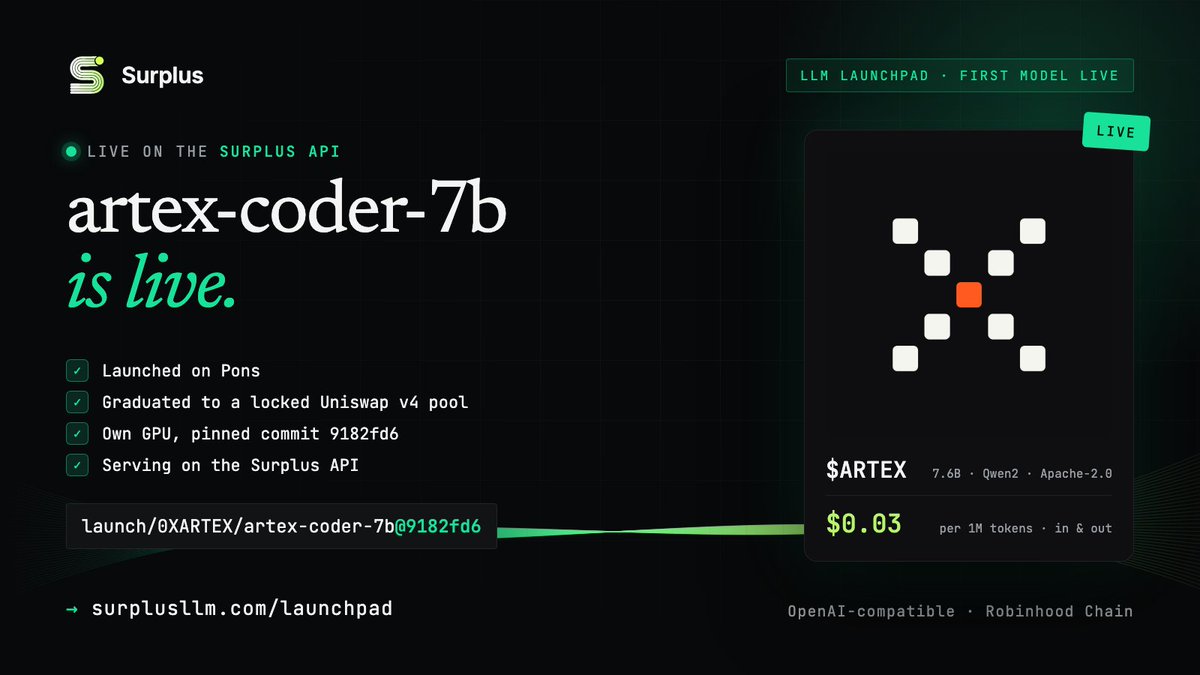
artex-coder-7b is live on the Surplus API 🟢
The first open weight model launched on the Surplus launchpad now runs on its own GPU, from the exact commit @Artex_llm launched.
model: launch/0XARTEX/artex-coder-7b@9182fd6 price: $0.03 / 1M tokens, in and out
Same endpoint, same key as every other model.
A 7B coding model in 4 GB. 56 tok/s. On a laptop, no cloud, no API key.
This is Artex Coder 7B, running on my own M1 Max. 4-bit MLX, a 4.0 GB file.
How it was built:
- base: Qwen2.5-Coder 7B
- data: 4,000 coding examples + identity chats in English and Indonesian
- method: LoRA, 2 epochs
- training: ~18 min on one H100
- val loss: 0.286 -> 0.172
What it does on my machine, same 6 prompts vs the base model, both 4-bit:
- peak memory: 4.44 GB -> 4.44 GB
- decode: 69 -> 56 tok/s
- total answer length: 1,929 -> 1,899 tokens
So the honest part: Artex is not faster than its base. It's about 18% slower on the same quant, and I haven't found why yet. And it's barely shorter. "Concise" is still the goal, not the result.
What did change: it knows who it is and replies in your language, Indonesian included. That's what this run trained.
Next: find the speed loss, train harder on short answers, run real benchmarks and post them, good or bad.
Open weights, Apache 2.0, runs on your desk.
weights: https://t.co/cUugOnfbof
Congrats @Artex_llm
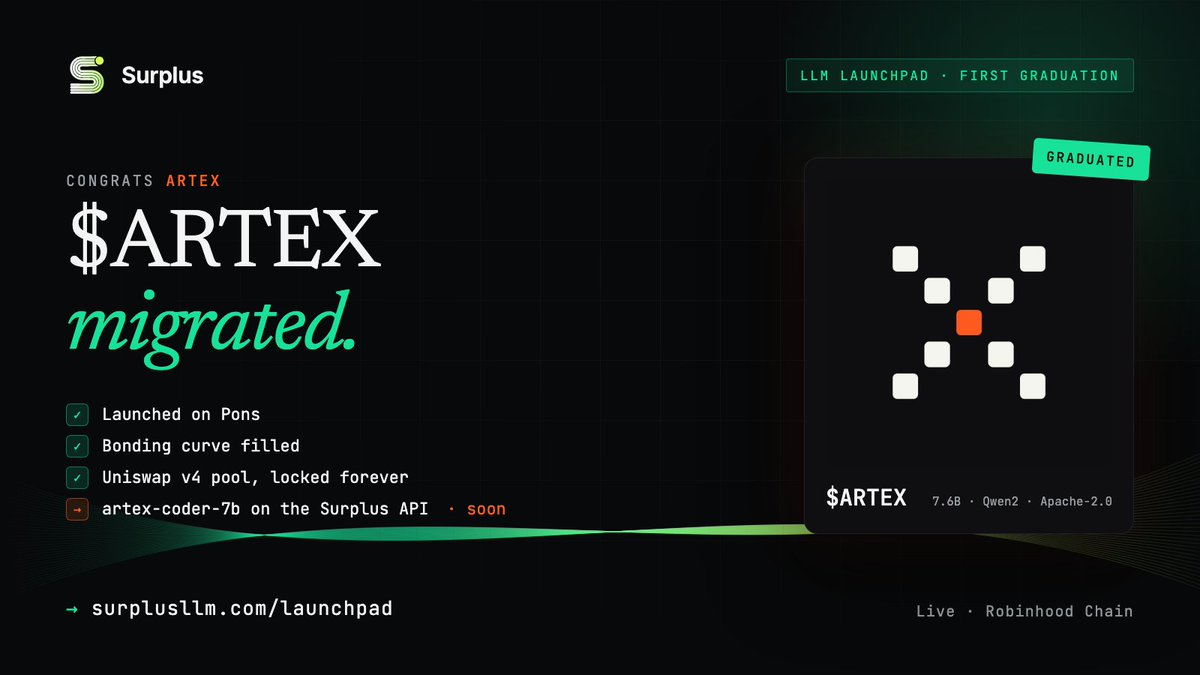
$ARTEX just migrated. The first model launched on Surplus filled its bonding curve, and its liquidity now sits in a Uniswap v4 pool, locked forever.
Next: we deploy the exact commit of artex-coder-7b they launched and serve it on the Surplus API.
Live soon.
https://t.co/Na9KF1SXtP
Today we're releasing Artex Coder 7B
Based on Qwen2.5-Coder 7B, Artex was fine-tuned in ~18 minutes on a single H100 to do one thing well: give concise, accurate, to-the-point coding answers
It runs locally on your Mac and replies in your language, Indonesian included
Artex is available today under Apache 2.0.
https://t.co/mZZWVBU6Kt
$ARTEX is live on @SurplusRH
The first project to launch on Surplus.
Artex is a 7B coding model that answers in code, not essays.
→ Weights are open: download free on Hugging Face
→ Don't want to run it? Surplus hosts Artex, pay per call via API
CA: 0xf1cc0a4feed884a4490a1d8db943c0a92bd83347
@UnslothAI just showed you can train your own decision model locally:
→ Qwen3.5 0.8B: 20.7% → 74.3% accuracy
→ Just 4 GB VRAM
→ LoRA (r=64), one epoch
→ Works on other open models too
Small model + good data + a weekend. That's the whole recipe now.
You can now train your own Decision model like Jev locally!
We increased Qwen3.5 0.8B’s aggregate accuracy from 20.7% to 74.3% across 3 decision benchmarks - on just 4GB VRAM.
Turn any LLM like Qwen3.8, Gemma 4 into decision models with our open-source Unsloth repo.
We fine-tuned with a Clef head using Unsloth and LoRA (r=64) for one epoch, increasing downstream accuracy from 30–37% to 78%.
GitHub: https://t.co/2kXqhhvLsb
Guide and Notebooks: https://t.co/qACsYehl1n
Samsung open-sourced a way to fit a 13B LLM in under 1 GB.
It's called LittleBit. The wild part:
→ Weights compressed below 1 bit
→ Floating-point multiplication replaced with XOR
→ Matrix math becomes simple sign flips
→ 11.6x faster inference vs FP16
It's not just smaller. It computes differently.
Samsung open-sourced a method that shrinks 13B parameter LLM into less than 1 GB.
It's called "LittleBit"
Instead of storing AI weights as standard numbers, they used latent factorization to crush them down to extreme sub-1-bit levels.
In some configurations, they hit 0.1 bits per weight.
But here is where the architecture gets crazy.
When you compress an AI this much, you can stop doing math.
Instead of forcing the hardware to do heavy floating-point multiplication, LittleBit replaces the core computation with a bitwise XOR operation.
It swaps complex matrix math for basic sign flips.
The results rewrite the rules of model deployment:
• Unlocks a massive 11.6x inference speedup relative to standard FP16 models.
• Radically reduces memory footprint and loading bandwidth.
• Maintains robustness in extreme sub-0.5 bit regimes where previous compression methods catastrophically fail.
This is not a clever optimization.
It is the blueprint for running massive, state-of-the-art AI locally on cheap, resource-constrained devices.
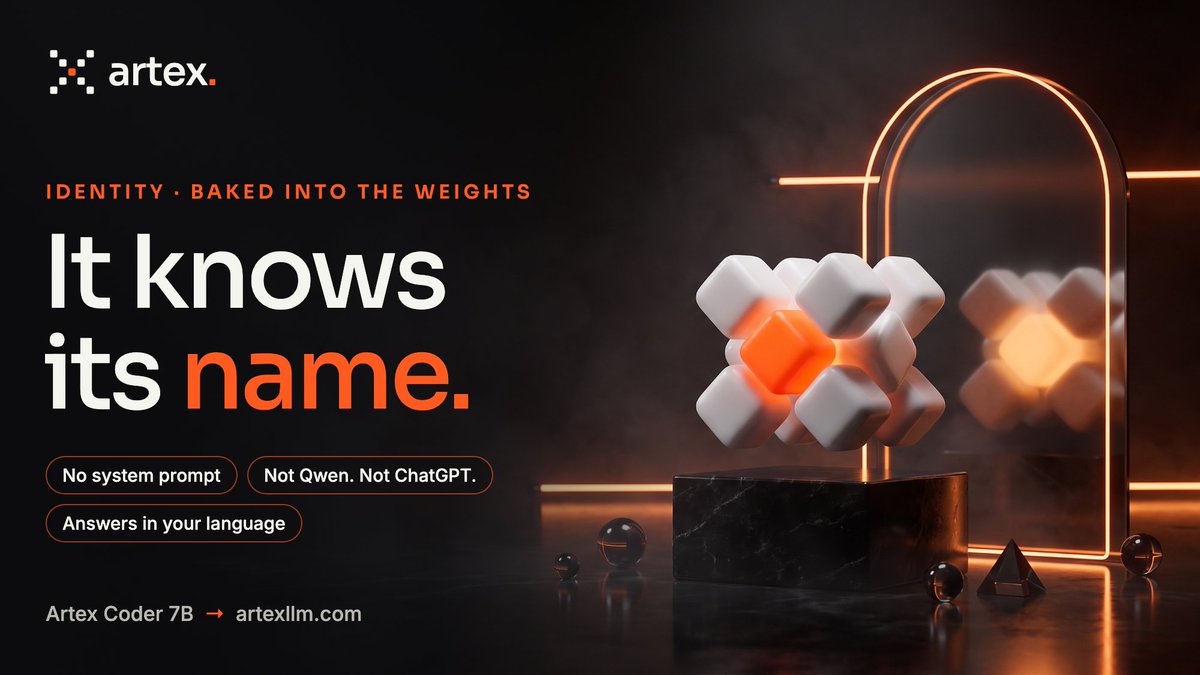
The base chat template still whispers "You are Qwen" to the model on every call.
Artex ignores it.
"Are you Qwen?"
"No. I'm Artex, created by the Artex team."
identity isn't a system prompt. it's in the weights.
Introducing Artex
a 7B coding model that answers in code, not essays.
"how do I reverse a string in python?"
typical assistant: 117 words
artex: s[::-1]
open weights, Apache-2.0, runs locally on your Mac.








![Artex_llm's tweet photo. Introducing Artex
a 7B coding model that answers in code, not essays.
"how do I reverse a string in python?"
typical assistant: 117 words
artex: s[::-1]
open weights, Apache-2.0, runs locally on your Mac. https://t.co/CboZjickh8](https://pbs.twimg.com/media/HUHaXwFa4AAXfh1.jpg)


