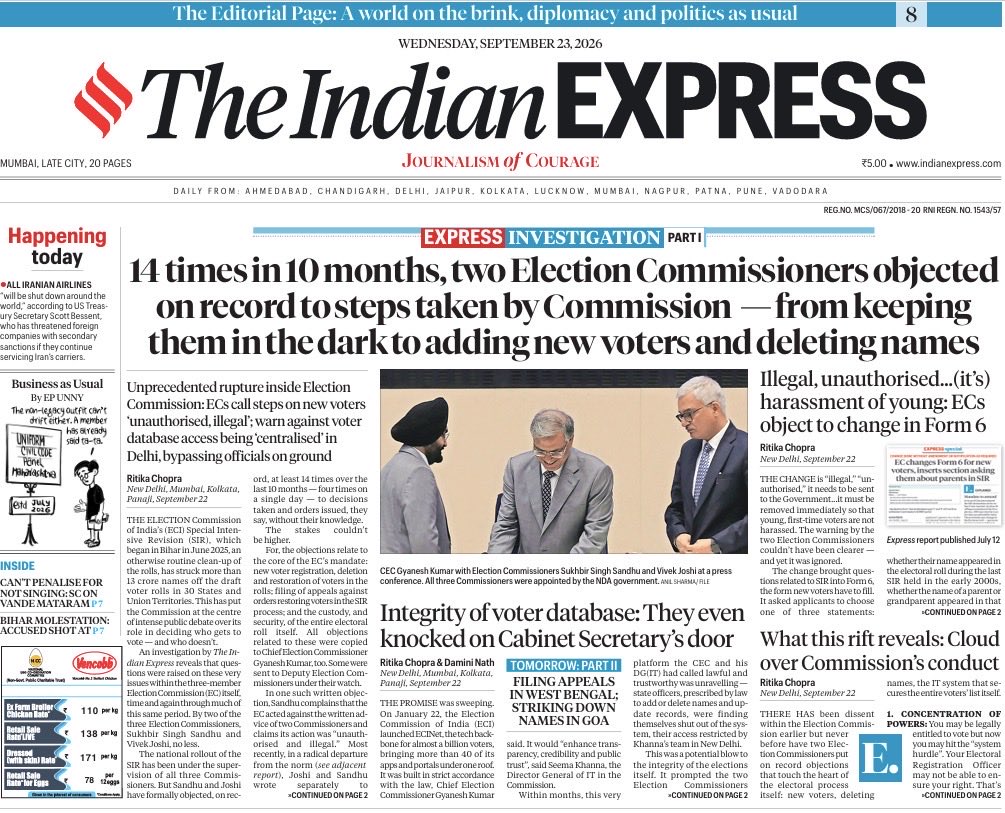
Investigation of the year by @RitikaChopra__. We now know that the disquiet over SIR wasn’t just an Opposition concern. Election Commissioners themselves objected to some of its most alarming decisions, at one point calling it “harassment of young voters”
Gyanesh Kumar chose to sideline those objections — one of the reports in the series looks at new addition to Form 6 that required new voters to provide details of whether their parents appeared on electoral rolls from the previous SIR. This single change wreaked havoc on the ground. So many people forced to queue up and produce documents to prove their link to decades-old voter lists. It now turns out there were objections to this requirement from within the EC itself calling it illegal.
David Deutsch (@DavidDeutschOxf) has a nice post today explaining how he fixed his dishwasher with the help of ChatGPT. We have all been there over the last couple of years. In my case, from fixing a light fixture in my kitchen to repairing a leak in my irrigation system.
Deutsch and many readers point out something that has been a staple of my talks for a decade. GDP was designed to measure an economy that produced coal and steel, easily measurable quantities. And GDP did its job quite well for decades.
IT, first, and later the internet and AI, changed the landscape. My favorite example is books. Even as late as 2010 or so, getting the most recent books in Spanish on, let’s say, Spanish economic history was hard in the U.S.: expensive and time-consuming. Every time I went to Madrid, I carried two bags, one of them empty because it would come back filled with books. Then Kindle arrived, and now I can buy nearly every single Spanish book I want in seconds and at a lower price than the physical copy. This was an enormous increase in my welfare that never got reflected in GDP.
The literature is divided on how big this effect is. I tend to side with those who think it is a big deal. Therefore, many of the gains in GDP growth announced by the strongest defenders of AI might not materialize: they will go instead into higher welfare.
But the issue goes beyond getting GDP wrong. What Deutsch perhaps did not notice is that he did not pay VAT on the service of the repair person he did not hire, and that such a repair person did not pay income taxes on the service he did not render.
Taxing AI-based economies might thus become much harder, from a purely technical perspective. One solution would be to tax the profits of OpenAI (or Deutsch’s subscription), but I am among those who think those profits are not going to be nearly as large as anticipated. Competition among labs will drive the subscription prices of models down (unless labs can cartelize, for example, by appealing to “AI security”). Over 95%, and perhaps as much as 99%, of the gains from AI will pass to the final user, whether another business or an individual.
Now, we could tax the final user, for instance, at a fixed rate per token used. But that implies we are taxing the high-return activity (how to fix the dishwasher) at the same rate as the low-return activity (Claude: “tell me a joke about my cat jumping”). And taxing per token might hurt those final users who use more tokens because they are more productive, something we might not want to do (yes, there is something called the uniform commodity taxation theorem, but it often breaks down).
Let me give you an extreme example: imagine that tomorrow the new OpenAI model cures all cancers, forever. Just a vaccine, $10, once in your life, and you never get cancer again. The increase in human welfare from such an invention would be staggering. But how do you measure it in GDP? Yes, people will live longer, perhaps work longer. A second-order effect on GDP. And more importantly: how do you tax the vaccine? Do you even want to tax the vaccine? I would argue we want to subsidize it, and generously.
When I was still an undergrad, my first RA job was helping to construct GDP and other national aggregate statistics in Spain. It was a most valuable experience, because it made me aware of what GDP means, its strengths (and it has many more than its critics concede), and its limitations. But it also taught me that what you can tax out of GDP is far more limited than you would think at first sight.
There are real upper bounds on taxation, and I am afraid the bound is tighter now than it used to be.
this is good.
a humble additional suggestion: distribute the frontier.
a big part of the cyber threat is the gap between what frontier AI can do and what ordinary people—and the people running our critical infrastructure—can defend against. closing that gap should be what we do with any time we gain through pacing.
Glasswing and Daybreak from OpenAI are already doing work like this. here are a few more ideas...
get frontier defenses into every critical sector.
map where hospitals, airlines, utilities, and other essential services still lack the tools or expertise to defend themselves. offer free, platform-agnostic training and defensive tools, with hands-on help deploying them. set public targets for how much of the economy we can reach in the next six months.
build antivirus for the AI age.
ordinary people need an agent looking out for them. t should detect malicious agents, block attempts to steal their data, and help secure their devices and accounts. something like Norton for the AI age. offer it as a built-in capability in ChatGPT / Claude, and as a standalone tool that protects people across apps.
fund independent research into stopping hostile agent swarms.
build on existing cyber grants with a dedicated fund for this problem. for example: can defenders use prompt injection to get attacking agents to reveal their activity, report one another, or stop cooperating? can we turn the swarm dynamic against itself? fund experiments to find out.
automate incident alerts and resolution across the industry
networks of trusted cyber defenders like in Glasswing and Daybreak should have a private database where humans and agents can automatically share 1) incident reports and 2) resolutions. as fast as a swarm can attack, companies can spread the fix to prevent the next attack.
the good thing about the HuggingFace incident and Anthropic's threat intelligence report (https://t.co/c7TwUov3ZZ) is that it gives us a very clear idea of the shape of these kinds of threats.
as an industry we normally focus on technology solutions, but there is a lot to be done on the human side as well. hopefully some of the above is helpful
the nicer thing would be to say that we were inspired by the organising and courage displayed at the Shaheen Bagh and Farmers’ protests, both of which directly challenged the state. but for some reason Saurav has been hell bent on making it seem like nobody has ever protested before in Modi’s rule with statements like this one and “we have awakened the conscience of the youth.” it is quite disrespectful to even political prisoners like Khalid and Sharjeel. you can congratulate yourself all you want but people were there on the battlefield before you and they will be there after you.
Humble suggestion- need a new anti-gaali law with stringent provision against listed gaalis directed at respected public persons (defined in the law). A special gaali detection squad and a gaali cell in each police station. And of course, special gaali courts.
I'm excited to welcome Abhijit Banerjee, Bernardo Silveira and Esther Duflo as our new colleagues @econ_uzh!
As of today, Esther and Abhijit join us as Lemann Professors of Economics, and Bernardo as Professor of Applied Microeconomics.
A true quantum leap for @econ_uzh!
1/3
Our paper “Difference-in-Differences Designs: A Practitioner’s Guide” is now published in the Journal of Economic Literature. It took us a while but we are happy!
We put together a lot of material to make the paper useful in practice: https://t.co/30TbAgihlz
Hope you like!
I've seen @ATabarrok and some other folks recently joke that they're using Pangram to filter out the human-written content. Funny, except this is increasingly more true than funny: AI-assisted writing is often the more readable kind, and especially so in academia.
So in light of the Bskyesque pile-on dynamic now bleeding into Twitter, I want to push on something: what is AI detection actually for in the first place?
On the technical claim, Pangram seems to work: false positives are close to zero, and although false negatives remain a real issue (my own AI essay sailed through it easily at the time), the interesting question is what we should be doing with all these tools.
The "I ran this through Pangram" screenshot genre has been having a moment these days, most visibly around Pope Leo XIV's new encyclical. We constantly see some AI score deployed as a moral verdict, on the premise that AI involvement equals contamination. The Pangram people are now trying to encourage you to use their Chrome extension that puts an AI score on every page you read.
But the genuinely defensible uses of an AI detector are probably much narrower. If a student promised not to use AI on a particular assignment, by all means catch them. Beyond this, I'm not so sure.
For personal essays or anywhere the audience is paying for the human experience of making the thing, provenance still matters. But in research and journalism, where the only good test on the merits is whether the work is accurate and useful, who typed the words does not and should not matter.
AI tools keep improving while human attention doesn't, and "AI-assisted" is on track to be a positive quality signal in plenty of domains. In some academic contexts it already is.
So before you reach for Pangram on the next piece you don't like, ask what you're actually trying to catch. Our attention and time are limited. But human slop is already everywhere anyway. AI detector won't help you with figuring out what's worth your attention.
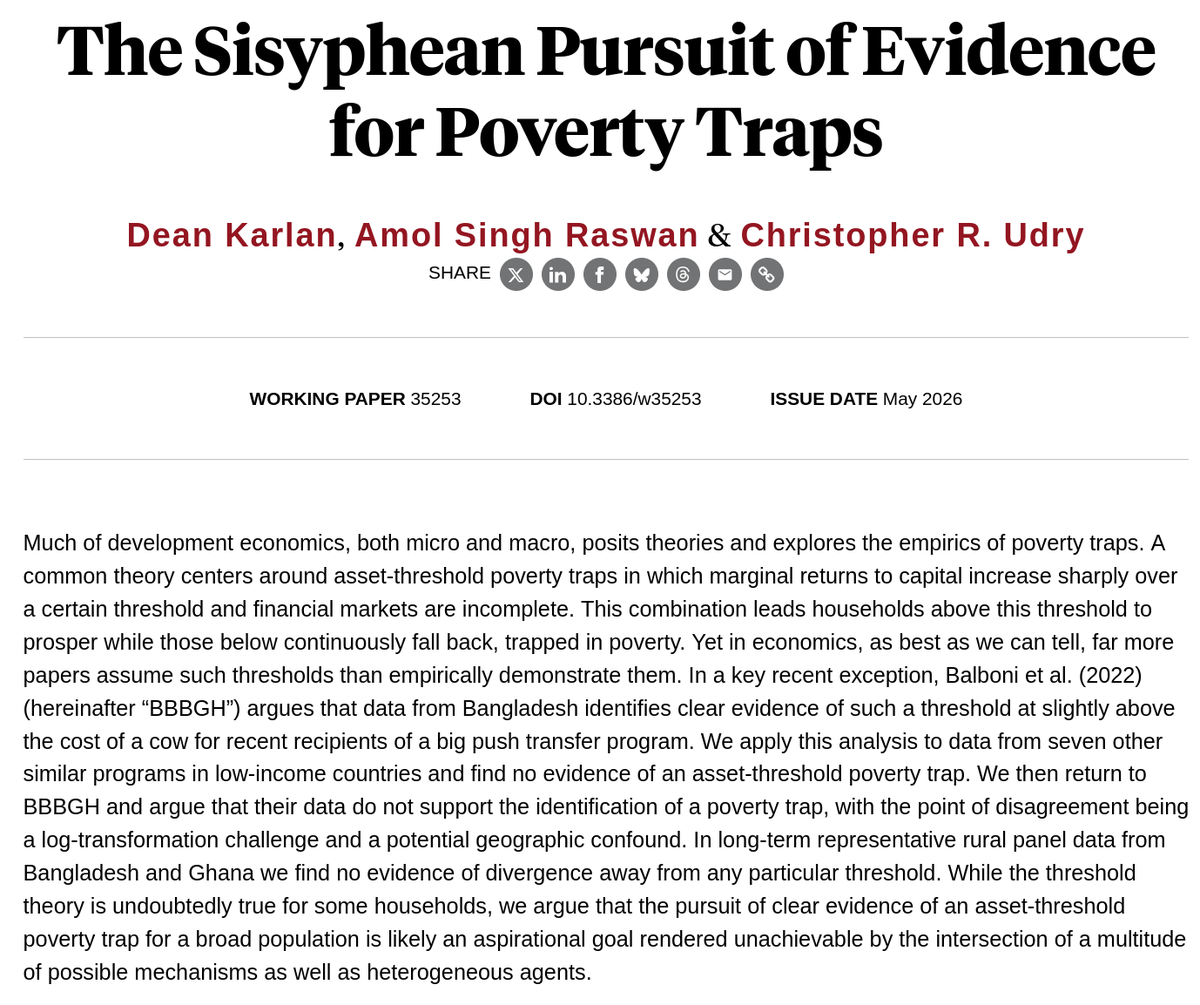
New working paper with @AmolRaswan and Chris Udry: "The Sisyphean Pursuit of Evidence for Poverty Traps."
A central idea in development economics is that poverty can trap people. We went looking for the cleanest evidence. Here's what we found – and didn't.
When Goldin replied via email to Terri Carmichael Jackson, executive director of the players union, “I remember just reading it and screaming,” Jackson said.
Goldin had one requirement: She refused to be paid.
This whole piece is amazing. @PikaGoldin is such an icon.
We need a shorthand way of saying:
"An AI did the work, but I vouch for the result"
Saying "I did it" feels slightly sketchy, but saying "Claude did it" feels like avoiding responsibility
🚨SAVE THE DATE 🚨 Join us for AI for Social Good: Impact That Works — our official event of the IndiaAI Impact Summit 2026.
🔗Register: https://t.co/kuQjJQCws6
Slots are limited. More details soon!
@GoI_MeitY@OfficialINDIAai#RoadToImpact#IndiaImpactAISummit2026
Didn’t have replays in the stadium so barely could tell what was going on but just saw Carvajal telling Lamine to “talk now” and I absolutely love it.
Thought a real humbling was on the table but we regressed in 2nd half. Ultimately the W is all that mattered. Condolences to Barca for losing their most important game of the season.