I killed 3 AI products before launching them. Part 2/3: the SMS agent
Quick intro for those who don’t know me.
I’m Arthur. I’ve been an entrepreneur for over 15 years, mostly in food. I opened 5 Dim Sum Cantine restaurants in Paris, featured in Le Fooding. I built and sold a mochi factory, Exquis Mochi, that went from €150K to €1M in revenue in two years. I set up a bao factory, Monsieur Bao. I co-founded Source, a matcha brand.
Real products. Real factories. Real customers.
And over the last year, I started building in AI. I built three products. I killed all three before launching them.
This is the story of the second one.
After WhatoDo, I kept thinking about one thing: distribution.
Today, getting someone to download an app is brutal. The App Store is full. People don’t want one more icon on their phone. For me, that’s become one of the biggest barriers to entry.
So I built an AI agent you could reach by SMS.
No app. No account. No onboarding. Just a phone number. You text it like you’d text a friend, and it does the work: invoices, follow-ups, reminders, admin.
I (and my wife/associate) found that phenomenal. Give someone a number, and you have a customer.
Then we gave it to our friends.
And something surprised us. They had dozens of things the agent could do for them. But faced with something that could “do anything,” they didn’t know what to ask. They were lost.
Even my older brother, who’s very technical, didn’t see the difference with Codex. (Not his most visionary moment: today, everyone is talking about AI agents.)
So why did I kill it?
Because I realized the market would need a lot of capital. And the giants were coming.
In March 2026, Poke launched in the US: an agent that works through iMessage, SMS and Telegram, no app needed.
Then in September, Meta launched Muse. A personal agent. With a free version.
When Meta gives away what you want to sell, you don’t win. And the channel I thought was my edge, messaging, belongs to them.
But one thing I still believe: agents sold as a service have a future.
Open-source agents like OpenClaw or Hermes are great, but you need your own API keys and you pay your own tokens. That’s fine for geeks. Normal people don’t want to deal with that. They want it to just work.
What it taught me:
→ No app is a great idea. But messaging channels are owned by giants.
→ Horizontal agents that “do everything” are a game for Meta, Apple and the AI labs.
→ “It can do anything” sells nothing. People need to see what it does for them.
→ Normal users will pay for agents that just work, without the tech headache.
Part 3 tomorrow: the social media agent I built with my wife, and why APIs killed it. 👇
J’ai céder à la tentation et tester de générer des vidéos avec Mandy de Gta6
La courte est moins ressemblante mais français parfois (omni1.2 de chez Google)
La deuxième minimax H3
@patamiel Pour 2x moins d’investissement ta le même loyer sur une grande ville comme Marseille .. Et en France la banque finance avec très peu d’apport ! Nos voisins espagnols sont plus à plaindre pour le coup !
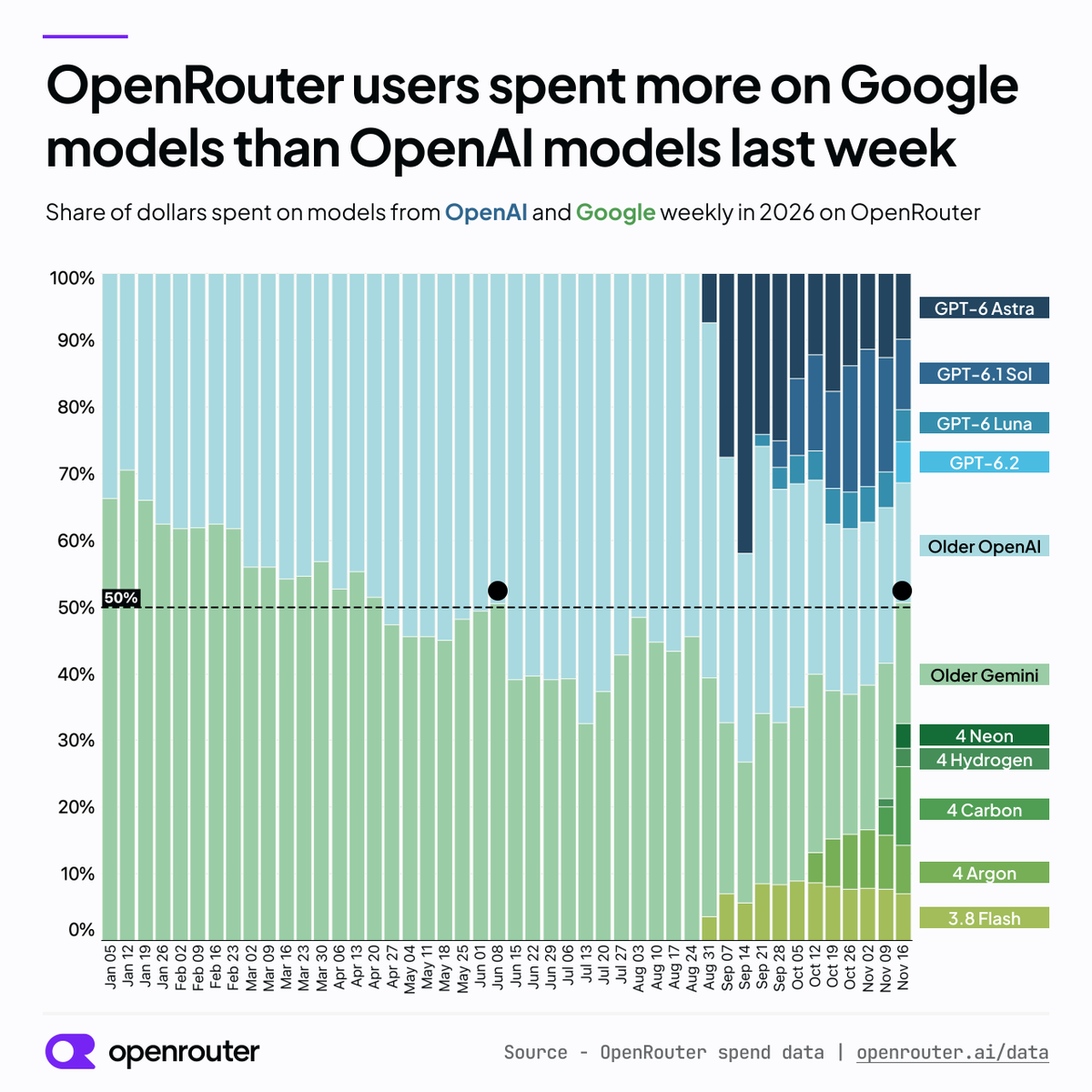
OpenRouter users spent more $ on models from Google than OpenAI last week.
Multiple well-received launches, including Gemini 4 Neon and Carbon, helped push Google over the 50% mark.
@realharismalik 👏 2 hours before see your post I ask gpt if Fitbit air have a micro to transform him into an agent 🤣
Btw, do we need subscription for your product or it works with our own harness ?